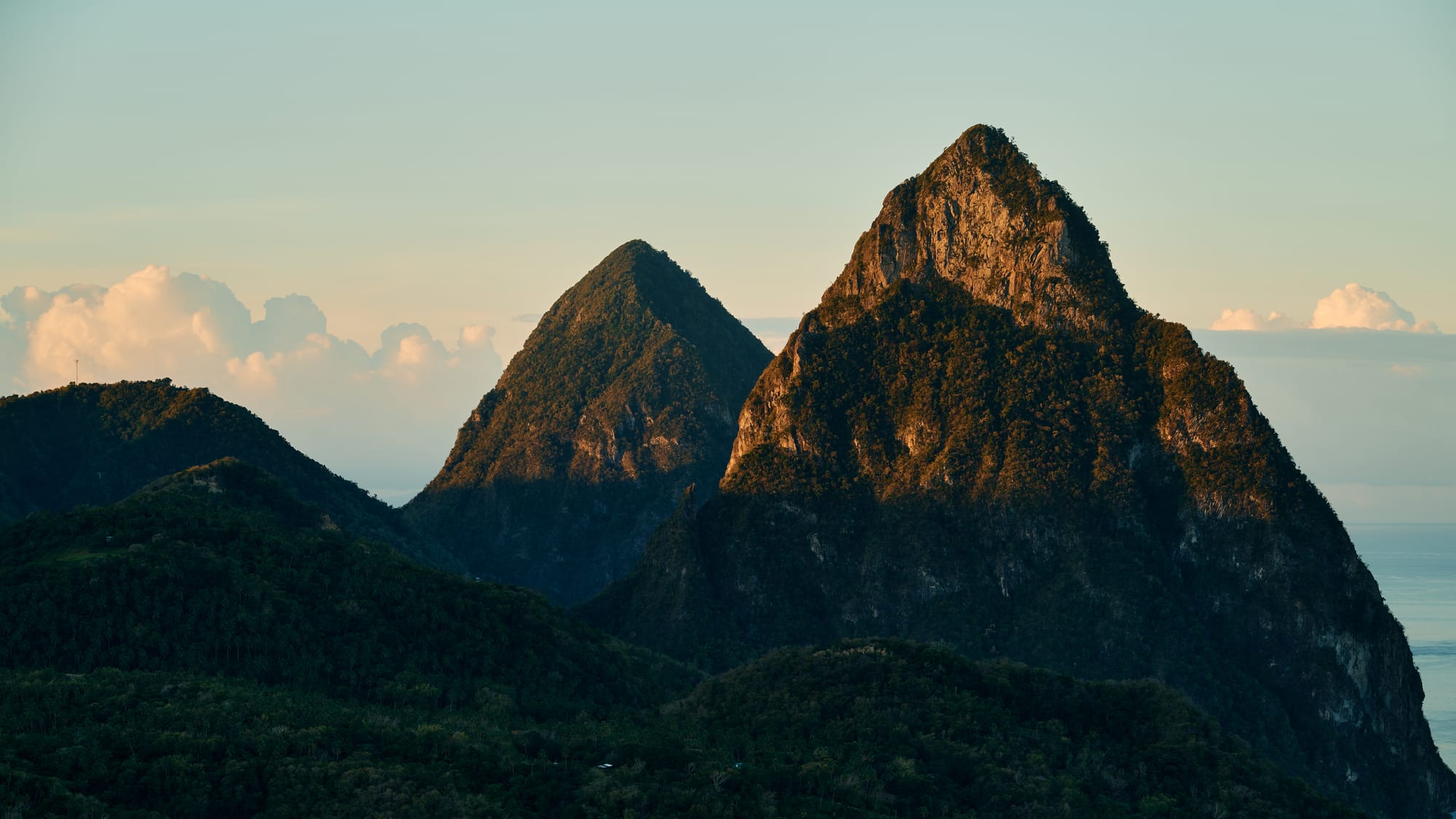
Two steep, forest-covered volcanic spires rising side by side straight out of the Caribbean Sea under a partly cloudy sky

Saint Lucia

The Pitons — Gros Piton and Petit Piton — rising from the sea near Soufrière, Saint Lucia's UNESCO-listed national emblem. (Jim Vajda / Wikimedia Commons · CC BY 2.0)

A volcanic, rainforested island in the eastern Caribbean, crowned by the twin Piton spires — fought over by France and Britain fourteen times, independent since 1979, and home, from a tiny population, to two Nobel laureates.

Explore Saint Lucia

History

The Kalinago inhabited the island, which France and Britain then fought over fourteen times — earning the nickname "the Helen of the West", after Helen of Troy — before Britain secured it in 1814 under the Treaty of Paris. A sugar and later banana plantation economy was worked by enslaved Africans until emancipation in 1834, and then by indentured labour.

Saint Lucia joined the short-lived West Indies Federation of 1958–62, became one of the West Indies Associated States with internal self-government in 1967, and gained independence on 22 February 1979. Politics has since alternated between the Saint Lucia Labour Party and the United Workers Party. From a population of under 200,000, the island has produced two Nobel laureates, both born in Castries — the economist Sir Arthur Lewis, who shared the economics prize in 1979, and the poet Derek Walcott, who won for literature in 1992 — a fact of great national pride.

Bananas were the mainstay of the economy until competition from South American growers cut the industry back, and tourism, along with some offshore finance and a citizenship-by-investment programme running since 2015, has taken over.

  • Saint Lucia: The Helen of the West Indies — A mountainous island that, by tradition, changed hands between Britain and France fourteen times — a late-settled Carib stronghold, a sugar and banana economy, and a small nation that has produced two Nobel laureates

Culture & Customs

Saint Lucian culture blends African, French, and British inheritances. It is strongly Roman Catholic, a French legacy, and Kwéyòl — the French-based creole — is the everyday language of most people, celebrated on the last Sunday of October as Jounen Kwéyòl, held every year since 1984, with food, dress, and music in villages across the island.

The flower societies of La Rose, whose festival falls on 30 August, and La Marguerite, on 17 October, with their friendly rivalry, are a distinctive tradition, alongside string-band music, calypso and soca, and a summer Carnival. Cricket is the most popular sport, with football widely played too, and the island prides itself on having produced more Nobel laureates for its size than any other sovereign country.

  • Saint Lucia: Roses, Marguerites and Madras — A Catholic, Kwéyòl-speaking island of rival flower societies with their own kings and queens, a Creole Day that crowns a whole month of heritage, and lanterns that light the way to its patron saint's feast

Daily Life

Most Saint Lucians live in and around Castries in the north and along the west coast, with the interior mountainous and forested. Tourism dominates the economy — cruise calls and stay-over resorts, with the north around Rodney Bay for nightlife and Soufrière and Marigot Bay for scenery and luxury — supplemented by small-scale agriculture, light manufacturing, and finance.

High public debt, hurricane vulnerability, and youth unemployment are the standing challenges, and there have been attempts to bring in geothermal and wind energy to cut reliance on imported fuel.

  • Saint Lucia: Two Languages, One Coast — A steep, volcanic island where nearly everyone speaks a French-based Creole at home and English at school, and where the mountainous interior pushes almost all of daily life onto a narrow ring of coastal towns

Food

Saint Lucian cooking is Creole. The national dish is green figs (green bananas) and saltfish, and bouyon, a thick red-bean one-pot of meat, ground provisions, and vegetables, is the Saturday standard. Callaloo soup, accra (saltfish fritters), green fig salad, breadfruit and saltfish, and bakes (fried bread) round out the table.

Cocoa is grown on the island, and cocoa tea — a spiced hot breakfast drink — along with juices of local fruit and lime squash, is common, with Piton, the pilsner brewed on the island since 1992, and rum for the evening.

Attractions & Natural Wonders

The Pitons, the twin volcanic plugs rising from the sea near Soufrière — Gros Piton at 798 metres and Petit Piton at 743 — are the national emblem and a World Heritage Site, with Gros Piton the easier of the two to climb on a guided tour. Soufrière also has the Sulphur Springs, a geothermal field of steam vents and boiling mud pits inside a long-collapsed crater, known as "the world's only drive-in volcano", along with botanical gardens and waterfalls and, offshore, diving and snorkelling.

Marigot Bay, a deep inlet hemmed in on three sides by steep forested hills, and the beach and coastal trails at Anse Chastanet are among the most photographed spots on the west coast. In the north, Rodney Bay and Reduit Beach — the island's most popular beach, with a strip of restaurants and clubs behind it — are the resort and nightlife hub, and Pigeon Island, a national landmark since 1992 and joined to the mainland by a causeway in 1972, keeps the 18th-century British forts, including Fort Rodney, from which the navy watched French Martinique. The Atlantic east coast is wilder, with the fishing villages of the Dennery district.

Planning basics

Budget

Saint Lucia runs from backpacker guesthouses to some of the Caribbean's priciest luxury resorts around Soufrière. Local eateries, minibuses, and guesthouses keep costs modest; the resort belt and organised tours are where money goes.

Daily Budget Midrange
USD 170–400 (mid-range hotel, restaurants, a hire car or boat transfers, tours)
Daily Budget Shoestring
USD 60–110 (guesthouse, local restaurants, minibuses)

Take a boat between Castries and Soufrière rather than the long, winding west-coast road, and agree taxi fares against the fixed-rate sheet first.

Visa Requirements

Citizens of the EU, the UK, the US, Canada, Australia, New Zealand, and most Commonwealth and CARICOM countries enter visa-free; others need a visa in advance or, for some nationalities, on arrival. Carry a passport valid for the stay and proof of onward travel, and check the length of stay you are granted, which is set at the border.

Typical Stay
Visa-free for most Western passports; the period granted is set on arrival

Safety

Saint Lucia is a popular destination and the resort areas are generally safe, but it has a relatively high violent-crime rate for its size, with periodic spikes in gang- and drug-related homicides, and there have been robberies and some assaults affecting tourists. Travel advisories urge caution — avoid isolated beaches and walking alone at night, including between resorts, and be wary in Castries after dark.

Natural
Hurricanes June–November; flash floods and landslides on steep terrain; strong currents on Atlantic-side beaches

Use licensed taxis, don't leave valuables on the beach, swim on the calm Caribbean side, and carry insurance with medical evacuation cover.

Climate

Tropical rainforest climate, warm year-round and tempered by the northeast trade winds. The dry season runs 1 December to 31 May, the peak time, and the wet season 1 June to 30 November, over the Atlantic hurricane season, which peaks August to October. Daytime temperatures average about 30°C and nights about 24°C. The interior rainforest is wet much of the year.

Temperature
About 30°C by day and 24°C at night, year-round
Hurricane Season
June–November, greatest risk August–October

Transportation

Hewanorra International near Vieux Fort in the south handles long-haul flights, with a longer transfer to the northern resorts; the smaller George F. L. Charles airport in Castries takes regional flights. On the island there are fixed-rate taxis, hire cars (drive on the left, with a local permit), minibuses, and boat transfers down the west coast.

The west-coast road to Soufrière is steep and serpentine — allow plenty of time, or take a boat.

Best Time to Visit

December to April is dry, breezy, and busy. May and November are quieter. Carnival is in the summer, the Jazz & Arts Festival is an annual fixture, and Creole Day (Jounen Kwéyòl) falls on the last Sunday of October.

Events
The Saint Lucia Jazz and Arts Festival; Carnival (summer); La Rose (30 August) and La Marguerite (17 October) flower festivals; Jounen Kwéyòl (last Sunday in October)

Currency

The currency is the Eastern Caribbean dollar (XCD), pegged to the US dollar at 2.70. US dollars are widely accepted; cards work at hotels and larger restaurants, and ATMs are in the towns.

Symbol
EC$
Currency Code
XCD — Eastern Caribbean dollar

Language

English is the official language. Saint Lucian French Creole (Kwéyòl), an Antillean French-based creole, is the home language of a large majority and is celebrated on Creole Day. French itself is little spoken, though Saint Lucia belongs to the Francophonie. Visitors manage entirely in English.

Home Language
Saint Lucian French Creole (Kwéyòl)
Official Language
English