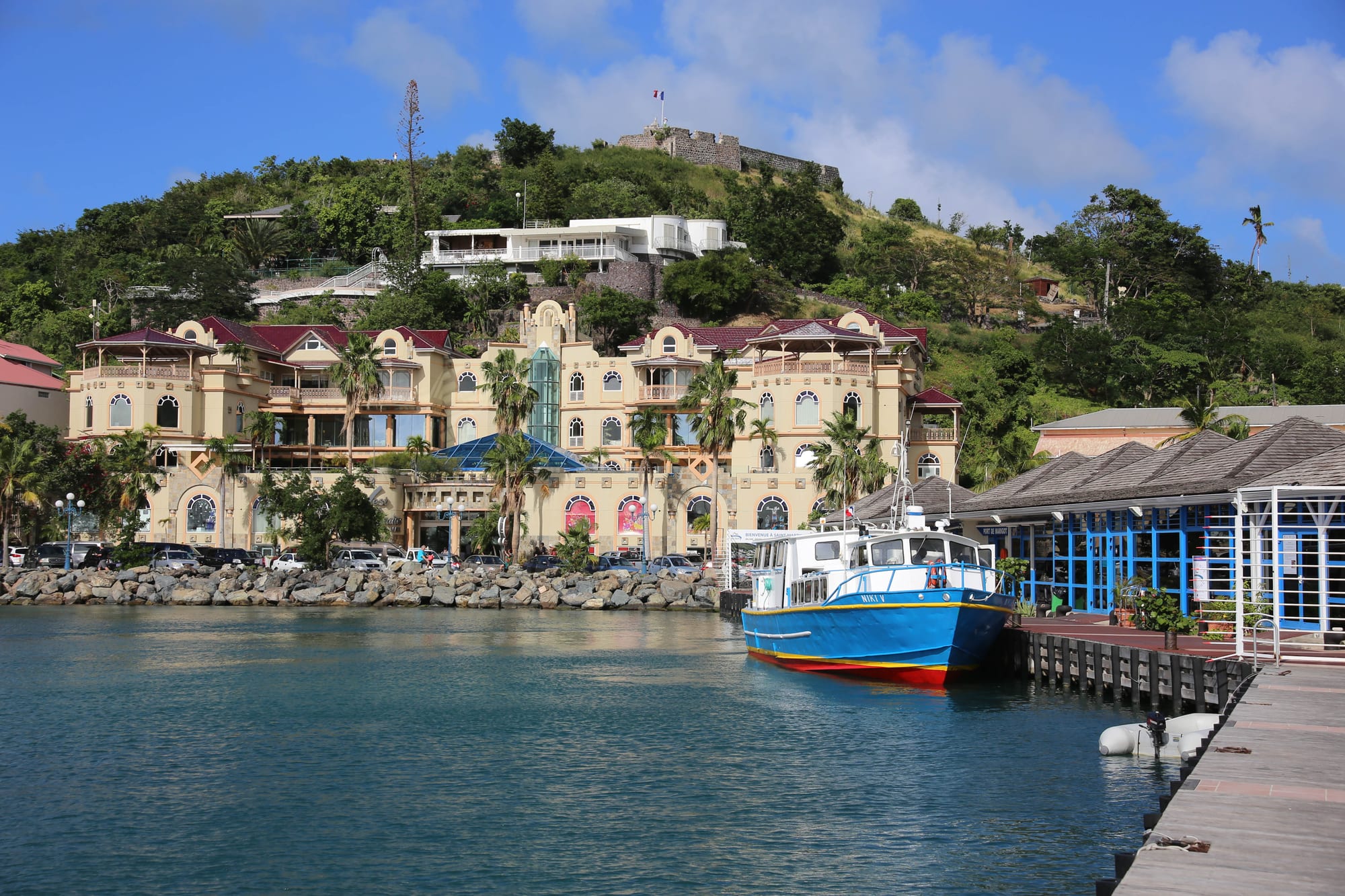
A blue and white boat moored by a jetty in front of arcaded waterfront buildings, with a stone fort on the green hill above

Saint-Martin

Marigot

The Marigot waterfront at Galisbay. (Paul Sableman / Wikimedia Commons · CC BY 2.0)

The capital of the French side of Saint Martin, on Marigot Bay below Fort Louis. A small port town named after the surrounding marshes, it grew around harbour warehouses, became a duty-free shopping town, and has a waterfront market, a marina and ferries to Saint Barthélemy. Its population has been falling for years.

Neighbourhoods

  • The waterfront and market
    • First-time visitors
    • Markets
    • Shopping

    The town centre along Marigot Bay, where a seafront promenade runs from the marina past the open-air market to the cemetery. Duty-free shops, cafés and restaurants fill the streets behind, and Fort Louis looks down from the hill.

    Open in Maps
  • Marina Fort Louis and Galisbay
    • Boats and ferries
    • Best for food

    Marina Fort Louis, below the fort hill, is used by yachts of all sizes, and the seafront promenade starts here. Galisbay is one of the quarters that make up the town.

    Open in Maps
  • Sandy Ground
    • Beaches
    • Quiet and residential

    A coastal community on the edge of Marigot, counted as one of the town's quarters, known for its beaches and natural setting as well as its hotels.

    Open in Maps

Things to do

Landmarks

  • Fort Louislandmark

    The French fort of 1789 on Marigot Hill, built under Louis XVI to protect the harbour warehouses; abandoned in 1851 and restored in the 1990s, it overlooks the bay and the town.

    Open in Maps
  • St. Martin of Tours' Churchlandmark

    The Catholic parish church on rue du Fort Louis, built in 1941 and enlarged in 1971, dedicated to the bishop the island is named after.

    Open in Maps
  • Musée de Saint-Martinmuseum

    The museum of Saint-Martin, in the town.

    Open in Maps

Markets and the waterfront

  • Marigot marketmarket

    The large open-air market on the waterfront, selling souvenirs and spices; the vendors' banter is part of the visit, especially on Wednesday and Saturday mornings.

    Open in Maps
  • Waterfront promenadetrail

    The seafront walk from Marina Fort Louis past the market to the cemetery, the easiest way to see the town and the bay.

    Open in Maps
  • Marina Fort Louisattraction

    The town's marina below the fort, used by yachts of all sizes.

    Open in Maps

Short trips from the town

  • Simpson Bay Lagoonpark

    One of the largest inland lagoons in the West Indies, divided down the middle by the French–Dutch border and joined to the sea by channels into Baie Nettlé and Simpson Bay, just west of town.

    Open in Maps
  • Pic Paradisviewpoint

    The island's highest point, inland from Marigot on the French side, with forest trails on its slopes.

    Open in Maps
  • Grand Caseneighborhood

    The former fishing village up the north coast, known for its restaurants, roadside grills and beach.

    Open in Maps

Seasonal events

  • Carnivalthe weeks before Lent

    The French side's Carnival, with costumed groups, music and street parades, usually between February and early March, while the Dutch side holds its own between mid-April and early May.

Eat and drink

Long-standing places and food districts in Marigot. Hours, ratings and directions come from your maps app, always current.

Food districts and markets

  • Marigot marketmarket

    The waterfront market, where spices are among the local products on sale alongside souvenirs.

    Open in Maps
  • Restaurants at Marina Fort Louisneighborhood

    Restaurants and cafés around the marina and the waterfront, part of the reason Marigot shares Grand Case's name for good food on the French side.

    Open in Maps

Experience Marigot

History

The name Marigot comes from the marshes that surrounded the site, and the area has been inhabited since the 17th century. Its harbour became the French side's port, with warehouses where coffee, salt, rum and cane sugar were stored for shipping. To protect them, the commander Jean-Sébastien de Durat built a fort, a prison and a bridge in 1789 on the orders of Louis XVI. The fort, with barracks for 54 troops, was abandoned by the military in 1851; the prison was used until 1968, when it became the fire station.

The town's churches tell part of its social history. A church built in 1840 counted 800 to 900 parishioners, more than 500 of them enslaved, and Methodism reached the island from Anguilla when John Hodge came to Marigot in 1817 but could not found a church there. The present Catholic church of St. Martin of Tours dates from 1941.

Modern services came late: electricity arrived in 1963 and a seawater desalination plant in 1965. Marigot later became a duty-free shopping town, using its free-port status to sell luxury goods and French fashion. Hurricane Irma struck the island on 6 September 2017 and damaged or destroyed 95 per cent of the structures on the French side. The town's population has been declining for decades — from 3,700 in 2007 to 3,196 in 2017 and 2,911 in 2022.

Culture & Customs

Marigot is a French town with a Caribbean population. French is the language of administration and schooling, but English is spoken in the street, and most residents across the French side are of black or mixed Creole ancestry, with a sizable Haitian community and smaller numbers of Europeans. That mix shows in the market, where the vendors' banter is part of the attraction, and in the town's festivals.

Carnival on the French side usually runs between February and early March, while the Dutch side holds its own between mid-April and early May. The island carries the name of Saint Martin of Tours, and the parish church in Marigot is dedicated to him. Religious life is mainly Christian, and the history of Methodism on the island — brought by a preacher from Anguilla in the early 19th century — is a reminder of how closely the island has always been tied to its English-speaking neighbours.

The French connection remains strong in the shops and cafés, and in the town's pride in its duty-free trade in fashion and luxury goods. Courtesy follows French habits — a greeting on entering a shop, a slower pace at the table.

Daily Life

Marigot had a population of 2,911 in 2022, and the figure has fallen at every count since 2007. The town is made up of several quarters, including Agrément, Hameau-du-Pont, Galisbay, Concordia, Sandy Ground, Saint-James and Bellevue. As the capital it holds the institutions of the collectivity, and much of the French side's population lives within a short drive.

The economy depends on tourism and shopping. The figures are hard: in 2022 a third of the town lived below the poverty line, and unemployment among people aged 15 to 64 stood at 23.6 per cent. Across the French side, the population fell after Hurricane Irma destroyed most of the island's infrastructure in 2017, and in 2025 only 12 per cent of students starting high school had a sufficient command of French — a problem linked to a high drop-out rate.

The day follows the port and the road. Minibuses run along the crowded main road to Philipsburg, the market is at its best on Wednesday and Saturday mornings, and ferries and yachts come and go from the bay. The 2013 causeway bridge across the lagoon has brought the airport much closer.

Food

Marigot's food is French and Creole. Restaurants around the marina and the waterfront serve French cooking and seafood, and the town shares with Grand Case a reputation for good meals on the French side of the island. Baguettes, pastries, French cheese, charcuterie and wine are part of everyday shopping.

Creole dishes run through the menus: accras, salt-cod fritters; colombo, a curry of chicken or goat; johnnycakes, fried dough breads; and locri, the island's one-pot rice dish cooked with meat or fish. Fresh fish and seafood are the local strength. The waterfront market sells spices and local products as well as souvenirs.

Local rums and guavaberry — a liqueur made from a small wild berry, shared with the Dutch side of the island — are the usual drinks. Eating more cheaply means the market, the supermarkets and the roadside lolos, open-air shacks serving grills and Antillean dishes, which are found elsewhere on the French side, especially at Grand Case.

Planning tools

Budget

Marigot is expensive, like the rest of the island, though the French side is generally better value than the Dutch resort strip. Waterfront restaurants and duty-free shopping are the big temptations; guesthouses and apartments, supermarkets and the lolos — roadside barbecue shacks — elsewhere on the French side cut costs.

Daily Budget Midrange
USD 200–420 (hotel, restaurants, car hire, a boat trip to Pinel or Tintamarre)
Daily Budget Shoestring
USD 80–140 (guesthouse or apartment, market and supermarket food, minibuses)

Visit the market on a Wednesday or Saturday morning, and use the minibuses rather than taxis for trips along the main road.

Best Time to Visit

December to April is the drier season and the time of the French-side Carnival. May and November are quieter shoulder months. June to November is wetter and hotter and is the hurricane season, with the greatest risk from August to October.

Suggested Number of Days

The town itself can be seen in a day. Most visitors use it as one stop on a week on the island, and the number of days depends on how many beaches, boat trips and day trips to neighbouring islands are added.

First Visit
1–2 days
With Surroundings
5–7 days

Transportation

Minibuses run frequently along the main road between Marigot and Philipsburg, and taxis are available. A hire car is the easiest way to reach the beaches; the roads are narrow, sometimes in poor condition and often crowded between Marigot and Philipsburg, and scooters overtake on both sides. There is no checkpoint between the French and Dutch sides.

Drive steadily and let scooters pass rather than braking or pulling over.

Airport & Station Connections

Most visitors fly into Princess Juliana International Airport on the Dutch side; since 2013 the Simpson Bay Causeway Bridge has linked the Marigot area with the northern end of its runway, cutting the drive. The small Grand Case–Espérance airport serves inter-island flights. Ferries to Saint Barthélemy leave from Marigot, and the port can take one small cruise ship at a time.

Walkability

The centre is easy to explore on foot, and the waterfront promenade links the marina, the market and the bay. Traffic is heavy, pavements are narrow or missing in places, and the midday sun is strong. Fort Louis stands on the hill above the town.

Safety

Saint-Martin has a higher crime rate than many Caribbean islands, with robberies and break-ins to cars and villas, concentrated away from the main beaches and worse after dark; petty theft on the sand is common. In Marigot the daytime centre is busy; traffic and the sun are the everyday hazards.

Leave nothing in a parked car, avoid unlit streets at night, use insect repellent and follow the forecast in hurricane season. Check current official travel advice before travelling.

Climate

Tropical, hot and humid, cooled by the trade wind. The drier season runs from December to April; June to November is wetter and hotter and is the Atlantic hurricane season.

Summer
hot, humid and wetter — across the island temperatures are around 28–31°C, with the hurricane risk at its peak from August to October
Winter
drier, sunny and breezy, still around 28°C by day across the island

Local Customs

French is the official language and is used in government and schools, but English is the everyday language of the island, and Spanish and Haitian Creole are also spoken. Greeting with 'bonjour' on entering a shop follows French habit. Society is mainly Christian, and churches should be visited quietly and decently dressed.

The legal age for buying alcohol is 18, as in France; ask before photographing market vendors.

Common Payment Methods

The currency is the euro, though US dollars are widely accepted, often at a poor rate. Cards are standard in shops and restaurants; carry some cash for the market and small shops.