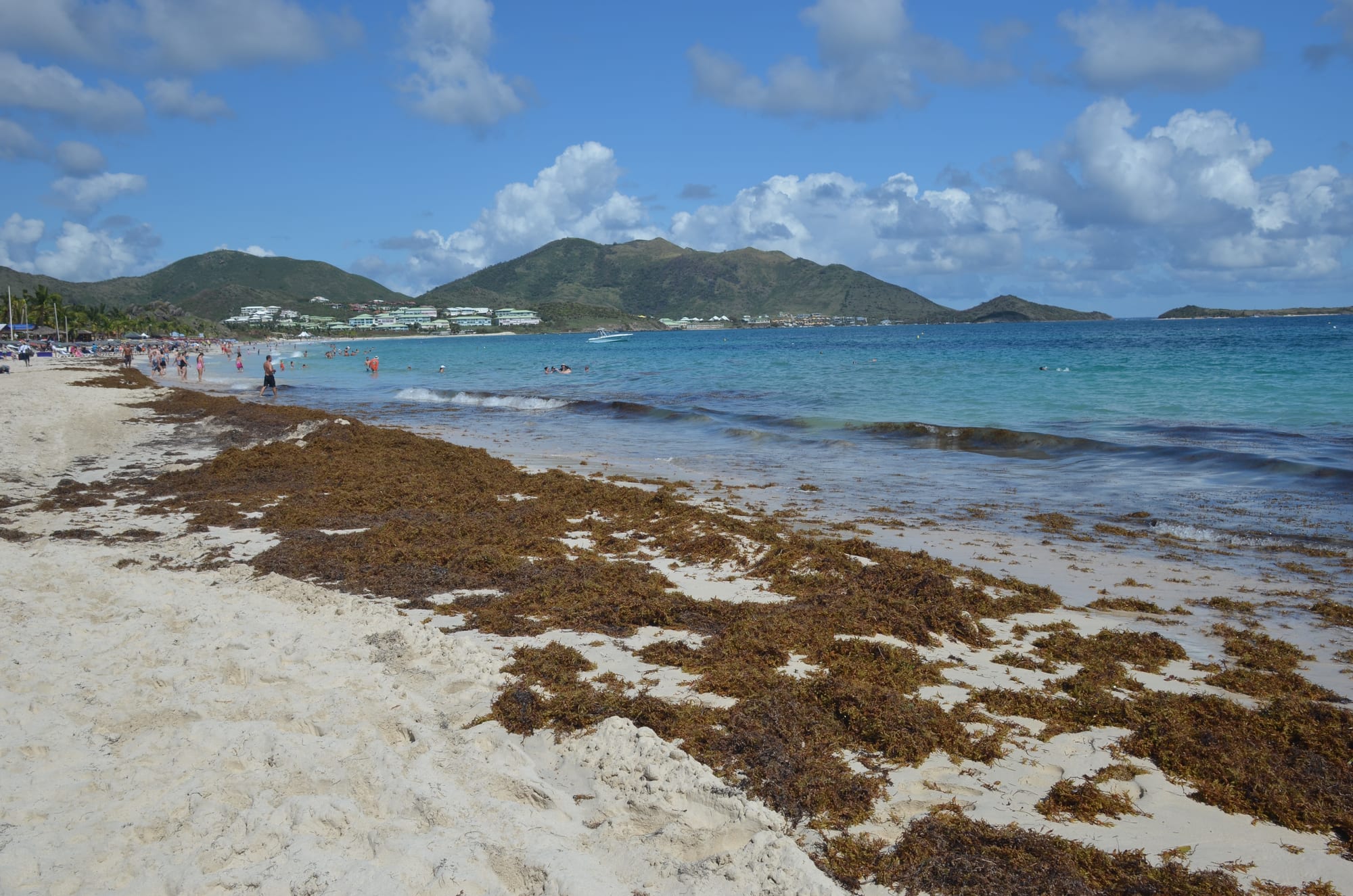
A long white-sand beach with seaweed at the waterline, bathers in turquoise water and green hills with buildings behind

Saint-Martin

Orient Bay

Orient Bay's long beach on the east coast of Saint-Martin. (alljengi / Wikimedia Commons · CC BY-SA 2.0)

A coastal community and long beach on the east coast of the French side of Saint Martin, on a sand bar between the sea and old salt ponds. Undeveloped until 1985, it grew into the island's most popular beach, lined with bars and restaurants, with the islets of a national nature reserve offshore. Hurricane Irma badly damaged it in 2017.

Neighbourhoods

  • The beach strip
    • Beaches
    • First-time visitors
    • Water sports

    The long sandy beach itself, with bar-restaurants and sunbed concessions along almost its whole length. Beach volleyball, sea kayaks, parasailing and catamaran trips start from the sand, and the islets of the nature reserve lie offshore.

    Open in Maps
  • Orient Bay Village
    • Best for food
    • Quiet and residential

    A mixed residential area built in the 2000s in a Bahamian style, with buildings in a wide range of Caribbean colours around a lively square full of restaurants.

    Open in Maps
  • The southern end
    • Beaches
    • Quiet

    The southern end of the beach, where a section is frequented by naturists.

    Open in Maps

Things to do

Beaches and the reserve islets

  • Orient Bay beachbeach

    The most popular beach on the island and the busiest on the French side, a long bar of sand between the sea and the Étang Chevrise pond.

    Open in Maps
  • Green Cayattraction

    Caye Verte, a small islet in the National Nature Reserve of Saint-Martin, which covers the north-east of the island and its waters.

    Open in Maps
  • Pinel Islandbeach

    A limestone islet in Cul-de-Sac Bay, part of the nature reserve, with four beaches, shallow coral shoals, walking trails and two restaurants; a pre-Columbian site was found on its south-western beach in 2000.

    Open in Maps
  • Île Tintamarreattraction

    Also called Flat Island, an uninhabited island about 3 kilometres off Saint Martin, once a dairy farm and from 1946 to 1950 the base of a small airline with its own airstrip.

    Open in Maps
  • Creole Rockattraction

    An uninhabited islet in the same reserve off Grand-Case, with a reef that draws snorkellers and divers.

    Open in Maps

Ponds and villages nearby

  • Salines d'Orientpark

    The salt pond behind the beach, worked semi-industrially for salt from 1848 and now part of the nature reserve's protected public land.

    Open in Maps
  • Cul-de-Sacneighborhood

    The former fishing village close to the bay, opposite Pinel and Tintamarre, from which boats leave for Pinel every half hour in the high season.

    Open in Maps
  • Pic Paradisviewpoint

    The island's highest point, at 424 metres, at the top of the ridge that rises from the hills behind the bay.

    Open in Maps

Eat and drink

Long-standing places and food districts in Orient Bay. Hours, ratings and directions come from your maps app, always current.

Food districts

  • Orient Bay beach bars and restaurantsneighborhood

    Bar-restaurants on concessions along almost the whole length of the beach, serving lunch and drinks within a few steps of the sea.

    Open in Maps
  • Orient Bay Village squareneighborhood

    The square at the heart of the 2000s residential village, lined with restaurants and lively.

    Open in Maps

Experience Orient Bay

History

The bay's name comes from its position on the east coast, though old maps call it the "baie d'Orléans". It was also known as the "Baie des Flamants", after the flamingos that once lived in the salt ponds behind the beach and were wiped out long ago. On 22 June 1676, during the Franco-Dutch War, a large Dutch fleet landed here and sacked the French part of the island. In 1848 the two big ponds were worked semi-industrially for salt: the Étang Chevrise by the notary Charles de Mery d'Arcy with the abolitionist François Perrinon, and the Salines d'Orient by Pierre Daniel Beauperthuy.

In 1985 the area was still completely undeveloped. After a French tax-break law for overseas territories in 1986, known as the Loi Pons, a wave of property development followed, with many exemptions from planning rules, and temporary permits allowed bar-restaurants and sunbed concessions along almost the whole beach. From the 1970s the far end of the beach had been home to a naturist establishment.

Hurricane Luis caused damage in 1995, quickly repaired. Hurricane Irma did considerable damage in 2017, and the repairs have been slow; since Irma the naturist club and the tennis courts have gone. The offshore islets became part of a national nature reserve in 1998.

Culture & Customs

Orient Bay is a beach community rather than a town, and its culture is the culture of the beach. It is the most popular beach on the island, and the day is spent in the water and on the sand: beach volleyball, sea kayaks, parasailing and catamaran trips all start here, and there is a riding centre. Boats run from nearby Cul-de-Sac to Pinel, which has four beaches, coral shoals and walking trails.

The French side's relaxed attitudes apply. Topless sunbathing is frequently seen on the island, and a section at the southern end of the beach is frequented by naturists.

Respect for the sea is part of local life. The islets offshore — Green Cay, Pinel, Tintamarre — and the salt pond behind the beach belong to the National Nature Reserve of Saint-Martin, created in 1998 and covering about 3,000 hectares, most of it sea. Seabirds still pass Pinel but no longer nest there because of the number of visitors.

Daily Life

Orient Bay is a small resort community with no population figure of its own. It has no schools and no places of worship — a chapel-shaped building in the area is purely decorative. Orient Bay Village, built in the 2000s, is the residential heart, a mixed area of colourful Bahamian-style buildings around a square with restaurants.

The economy is tourism: hotels, apartments, beach concessions, restaurants and water sports. The beach is the busiest on the French side, and the development that has grown up behind it since the late 1980s depends on visitors. Since Hurricane Irma in 2017 the area has been rebuilding slowly.

Geography shapes the place. The beach is a tombolo, a bar of sand between the Étang Chevrise pond and an older, fossil sand bar at its eastern end; the flat land behind extends to the Salines d'Orient pond and is backed by the 58-metre Morne Griselle, the foot of a ridge rising to Pic Paradis.

Food

Eating at Orient Bay means the beach bar-restaurants that line the sand and the restaurants around the square of Orient Bay Village. The cooking mixes French dishes, grilled fish and seafood, and Creole food from across the French side.

The Creole dishes of the island include accras, salt-cod fritters; colombo, a curry of chicken or goat; johnnycakes; and locri, the island's one-pot rice dish with meat or fish. French cheese, charcuterie, wine and bread are part of everyday shopping.

On Pinel Island two restaurants serve visitors who come over by boat from Cul-de-Sac. For cheaper meals, the lolos of Grand-Case — open-air shacks serving grills and traditional Antillean dishes — are a short drive away. Grand-Case, which calls itself the gastronomic capital of the French Antilles, is also the place for a more formal dinner. Local rums and guavaberry liqueur, shared with the Dutch side, are the usual drinks, along with French wine.

Planning tools

Budget

Orient Bay is one of the more expensive parts of an expensive island. The hotels here are dear, and sunbeds and beach-bar lunches add up quickly. Guesthouses and apartments elsewhere on the French side, supermarket food and the lolos at Grand-Case are the ways to spend less.

Daily Budget Midrange
USD 200–420 (hotel, restaurants, car hire, a boat trip to Pinel or Tintamarre)
Daily Budget Shoestring
USD 80–140 (guesthouse or apartment elsewhere on the French side, supermarket picnics, a shared car)

Bring a picnic and a towel rather than renting a sunbed every day, and take the boat to Pinel from Cul-de-Sac.

Best Time to Visit

December to April is the drier season and the busiest time on the beach. May and November are quieter shoulder months. June to November is wetter and hotter and is the hurricane season, with the greatest risk from August to October.

Suggested Number of Days

A beach stay can be as long as the budget allows; two or three days covers the bay and a boat trip to the islets. A week allows time for the rest of the island from a base here.

First Visit
2–3 days
With Surroundings
5–7 days

Transportation

Orient Bay lies on the RN7, the main road along the east of the French side, north-east of Marigot. A hire car is the easiest way to get around the island; the roads are narrow and often crowded, and scooters overtake on both sides. Boats to Pinel leave from nearby Cul-de-Sac.

Leave nothing in the car when parking for the beach.

Airport & Station Connections

Most visitors fly into Princess Juliana International Airport on the Dutch side and drive across the island. Grand Case–Espérance Airport on the French side handles regional flights to Guadeloupe and Saint Barthélemy. There is no checkpoint between the two sides of the island.

Walkability

The beach and Orient Bay Village are compact and easy on foot, and walking the length of the sand is the main way to explore. Beyond the bay, a car or taxi is needed.

Safety

Saint-Martin has a higher crime rate than many Caribbean islands, with robberies and break-ins to cars and villas, concentrated away from the main beaches and worse after dark; petty theft on the sand is common. Strong currents run on some Atlantic-facing beaches, and the sun is intense.

Keep valuables out of sight on the sand and in the car, swim where others are swimming, and watch the forecast in hurricane season. Check current official travel advice before travelling.

Climate

Tropical, hot and humid, cooled by the trade wind. The drier season runs from December to April; June to November is wetter and hotter and is the Atlantic hurricane season.

Summer
hot, humid and wetter — across the island temperatures are around 28–31°C, with the hurricane risk at its peak from August to October
Winter
drier, sunny and breezy, still around 28°C by day across the island

Local Customs

Topless sunbathing is frequently seen on the island, and a section at the southern end of the beach is frequented by naturists. English is the everyday language, French the official one.

The legal age for buying alcohol is 18, as in France; do not photograph naturists or other bathers without asking.

Common Payment Methods

The currency is the euro, though US dollars are widely accepted, often at a poor rate. Cards are standard at the beach bars and restaurants; carry some cash for small purchases.