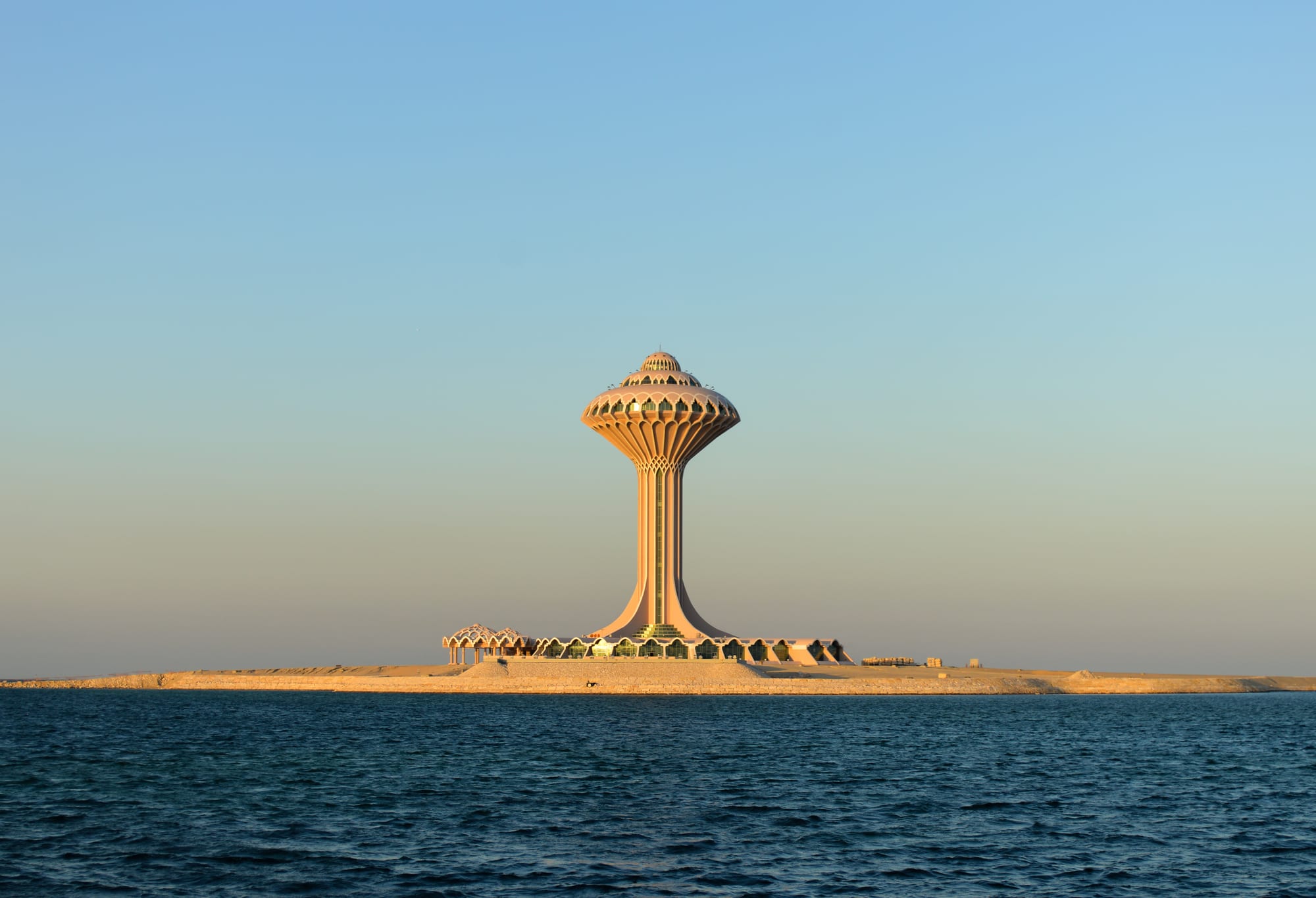
The mushroom-shaped Khobar water tower standing on a low spit of land above calm blue Gulf water at golden hour

The Eastern Province, Saudi Arabia

Khobar

The Khobar Water Tower on the seafront, the city's best-known landmark. (Francisco Anzola / Wikimedia Commons · CC BY 2.0)

A Gulf coast city in Saudi Arabia's Eastern Province that grew from a small fishing settlement into a commercial centre after oil was found at nearby Dhahran in 1938. Khobar forms one metropolitan area with Dammam and Dhahran, and is known for its long seafront corniche, its restaurants and malls, and the causeway that carries traffic across the sea to Bahrain.

Neighbourhoods

  • The Corniche and the waterfront
    • First-time visitors
    • Evening walks
    • Families

    A long strip of lawns, promenades, play areas and cafés along the Gulf, with the water tower at its landmark point and Bahrain's towers sometimes visible on a clear day. It is the city's gathering place after sunset, when families picnic on the grass.

    Open in Maps
  • Central Khobar
    • Best for food
    • Shopping
    • Close to public transport

    The grid of numbered streets between the Corniche and King Khalid Street, laid out early in the city's life. Gold shops, perfumeries, electronics dealers, bakeries and restaurants crowd the blocks, and most of the older hotels are here.

    Open in Maps
  • North Khobar
    • Quiet and residential
    • Shopping

    Newer districts stretching up the coast towards Dammam, with villa compounds, broad avenues, large malls and international hotels. It is calmer than the centre and close to the causeway road.

    Open in Maps
  • Al Thuqbah
    • Best for food
    • Local life

    An inland district west of the centre, densely built and busy, with markets, small shops and a concentration of South Asian, Filipino and Arab restaurants that draws people from across the metropolitan area.

    Open in Maps
  • Dhahran
    • Museums
    • Architecture

    The neighbouring city, built around Saudi Aramco's headquarters and the university, a short drive inland. Ithra, the Aramco cultural centre, and the site of the first successful oil well stand here among landscaped company districts.

    Open in Maps

Things to do

Landmarks and the waterfront

  • Khobar Water Towerlandmark

    A tapering concrete tower with a mushroom-shaped head on the seafront, long used as the emblem of the city.

    Open in Maps
  • Khobar Cornichepark

    The seafront park and promenade running for kilometres along the Gulf, with piers, gardens, cafés and open lawns.

    Open in Maps
  • King Fahd Causewaylandmark

    The 25-kilometre chain of bridges and embankments opened in 1986 that carries the road from Khobar across the sea to Bahrain.

    Open in Maps
  • Al Rashid Mallattraction

    One of the largest shopping centres in the Eastern Province, a social as much as a commercial landmark in a city where malls are meeting places.

    Open in Maps

Museums and culture

  • King Abdulaziz Center for World Culturemuseum

    Known as Ithra, a striking pebble-shaped building in Dhahran built by Saudi Aramco, holding galleries, a museum, a library, a cinema and a theatre.

    Open in Maps
  • Dammam No. 7landmark

    The well near Dhahran that struck oil in commercial quantity in March 1938 and set off the transformation of the province; it produced until 1982 and is now a historic landmark in the care of Aramco.

    Open in Maps
  • King Fahd University of Petroleum and Mineralslandmark

    The kingdom's best-known technical university, its modernist campus stepping up a hillside in Dhahran.

    Open in Maps

Beaches and parks

  • Half Moon Baybeach

    A curving sandy bay south of the city where dunes meet the Gulf, long the main weekend beach of the Eastern Province.

    Open in Maps

Short trips from the city

  • Dammamattraction

    The provincial capital immediately north, with its own corniche, a busy port, the regional museum and the fish market.

    Open in Maps
  • Tarout Castlelandmark

    The old fortress on Tarout Island off Qatif, standing on a mound some five thousand years old and built over the remains of an earlier temple. It is not open to visitors and is seen from the lanes around it.

    Open in Maps
  • Manamaattraction

    Bahrain's capital, reached across the King Fahd Causeway with a passport and the right entry permission, a long-standing weekend destination from Khobar.

    Open in Maps

Seasonal events

  • Ramadan and Eidvaries with the Islamic calendar

    Days are quiet and the evenings long, with the Corniche, cafés and malls filling after the fast is broken and family visiting through the Eid holidays.

  • Saudi National DaySeptember

    Green flags, decorated cars and fireworks along the Corniche mark the anniversary of the unification of the kingdom.

  • Founding DayFebruary

    A newer national holiday commemorating the first Saudi state, marked with heritage displays and traditional dress.

Eat and drink

Long-standing places and food districts in Khobar. Hours, ratings and directions come from your maps app, always current.

Khobar classics

  • Gulf seafoodrestaurant

    Fish restaurants near the Corniche grill or fry hamour, shrimp and other Gulf catch, usually served with spiced rice, salad and flat bread.

    Open in Maps
  • Machboos and Saudi grillsrestaurant

    Saudi kitchens across the city serve machboos, kabsa and mandi, rice dishes cooked with chicken or lamb, and mixed grills eaten with the hand from a shared platter.

    Open in Maps

Food districts

  • Al Thuqbah restaurant streetsneighborhood

    The densest eating quarter in the city, with Pakistani and Indian grill houses, Filipino canteens, Egyptian and Levantine bakeries and juice stalls along the main streets.

    Open in Maps
  • Prince Faisal bin Fahd Road cafésneighborhood

    The seafront road is lined with speciality coffee houses and dessert shops that fill late in the evening, a central part of the city's social life.

    Open in Maps
  • Dammam fish marketmarket

    The wholesale and retail fish market on the neighbouring city's waterfront, where the Gulf catch is landed and sold, and some stalls will have a fish cooked to order.

    Open in Maps

Experience Khobar

History

Khobar was founded in 1923, when members of the Dawasir tribe settled this stretch of shallow Gulf shore with the permission of Ibn Saud, its people connected as much to Bahrain as to the Arabian interior. Its rise came from oil. After American geologists struck oil at Dhahran in 1938, the shore at Khobar was used to load the first crude onto barges for Bahrain, and a pier, offices and workers' housing followed. The town grew as the civilian settlement beside the Aramco compound, laid out on the grid of numbered streets that still orders the centre.

Through the 1950s and 1960s Khobar became the shopping and service town of the oil province, with shops selling imported goods to Aramco staff and Saudis from across the region. The deep-water port and government offices went to Dammam, the company and the university to Dhahran, and Khobar kept the trade, the restaurants and the hotels — a division of roles that survives. The opening of the King Fahd Causeway to Bahrain in 1986 made it the crossing point to the island and a weekend thoroughfare.

The city has seen violence at intervals: an attack on the Khobar Towers housing complex in 1996 killed nineteen American air force personnel, and an attack on two oil-industry offices and a foreign workers' compound in 2004 killed twenty-two people. Since then Khobar has continued to grow northward along the coast in malls, towers and villa districts, and the three cities of Khobar, Dammam and Dhahran have merged into a single conurbation of more than two million people.

Culture & Customs

Khobar's culture is Gulf coastal rather than inland Arabian. Families that once fished, pearled and traded with Bahrain, Kuwait and Qatar share a dialect, music and cooking with them, and the causeway keeps that relationship alive: the crossing is a weekend habit for many. The city is also a meeting point of the province's Sunni majority and the Shia communities of Qatif and Al-Ahsa, who work and shop here.

Oil made it an international place. Aramco's presence brought Americans, Britons and other foreign staff from the 1940s, and the workforce today is heavily South Asian, Filipino, Egyptian and Levantine. That mix shows in the restaurants, the shopping streets and the languages heard in Al Thuqbah, and gives the city a reputation among Saudis as relaxed and outward-looking.

Social life happens in the evening and in three places: the Corniche, the malls and the cafés. Family sections and family days remain common in restaurants and parks, though the strict segregation of the past has eased, and since 2018 concerts, film screenings and sporting events have become part of the calendar. Ithra in Dhahran has made the area a centre for exhibitions, film and the arts. Manners are the kingdom's: unhurried greetings, the right hand for eating and giving, coffee and dates offered to guests, and restraint in public between men and women.

Daily Life

About 410,000 people live in Khobar itself and some 660,000 in its governorate, part of a Dammam–Khobar–Dhahran conurbation of well over two million. A large share of residents are foreign workers, and many households are tied to the oil industry, whether through Aramco itself, contractors, engineering firms or the shops and services that supply them.

The working week runs from Sunday to Thursday, and the roads fill twice a day as people commute between the three cities and out to Ras Tanura, Abqaiq and Jubail. Outside oil, the economy rests on retail, hospitality, healthcare, education and the cross-border trade with Bahrain. Housing is mostly villas and flats in gated or semi-gated districts, and almost every household depends on a car.

Life is lived indoors in summer, when air conditioning runs continuously and the malls serve as public space, and outdoors in the cool months, when the Corniche, the beaches at Half Moon Bay and the desert campsites fill at weekends. Water comes largely from desalination, and the strain of a growing population on power, water and traffic is a steady local concern, alongside the question of what a city built on oil will do as the kingdom diversifies.

Food

Khobar eats well and cheaply by the standards of the kingdom. The Gulf supplies the local speciality: hamour, a grouper, along with shrimp, kingfish and smaller reef fish, grilled over charcoal or fried and served on spiced rice. Machboos, the Gulf version of kabsa, is rice cooked with meat or fish, dried lime and baharat spices; muhammar, rice sweetened with date syrup, is often eaten alongside fish. Mandi, meat and rice cooked in a pit oven and strongly associated with Yemeni cooking, is as popular here as anywhere in Saudi Arabia.

Breakfast can be balaleet, sweet saffron vermicelli topped with a thin omelette, or foul, stewed broad beans, with hot flat bread from a wall oven. Sweets lean to the Gulf and the Levant: luqaimat, small fried dumplings in date syrup, kunafa and baklava, and dates from the Al-Ahsa oasis inland, served with cardamom coffee.

The foreign workforce has made the city a place to eat food from elsewhere: biryani and karahi in the Pakistani grill houses of Al Thuqbah, dosa and curry in the South Indian canteens, Filipino rice dishes, Egyptian koshari, Syrian and Lebanese shawarma and mezze. Coffee culture is strong and growing, with speciality roasters and dessert cafés along the seafront roads that stay busy until well after midnight. Alcohol is illegal throughout the kingdom, and the drinks lists run to fresh juice, mint lemonade, Arabic coffee and tea.

Planning tools

Budget

Khobar is one of the more expensive Saudi cities outside Riyadh and Jeddah, because business travel keeps hotel rates high on weekdays. Eating is cheap if the city's workers' restaurants are used, much dearer in seafront restaurants and hotels. A hire car or ride-hailing is a daily cost, as distances are long.

Daily Budget Midrange
USD 160–350 (four-star hotel, restaurants, a hire car, trips along the coast)
Daily Budget Shoestring
USD 55–95 (budget hotel, local restaurants, ride-hailing and intercity buses)

Hotel prices fall at weekends, when business travellers leave; the Corniche, the beaches and the parks cost nothing.

Best Time to Visit

November to March, when the sea breeze is pleasant and the Corniche, the beaches and the desert are comfortable. Summer on this coast combines great heat with heavy humidity and is best avoided. Since the war began in late February 2026, air travel, events and tourism across the Gulf have been disrupted, so dates should be confirmed before booking.

Suggested Number of Days

Khobar is a place to eat, walk the seafront and use as a base rather than a city of many sights, so one or two days covers it. Three or four suit anyone adding the neighbouring cities, the oasis inland and the coast.

First Visit
1–2 days
With Surroundings
3–4 days

Transportation

The metropolitan area is built for cars, and ride-hailing apps are the simplest way for visitors to move around; taxis can also be hired by the hour. A hire car helps for the beaches, Al-Ahsa and the causeway. Buses run between Khobar, Dammam and Dhahran and to other cities, and trains to Riyadh leave from Dammam.

Traffic on the causeway to Bahrain builds up badly at weekends and on holidays, so allow extra time at the border posts.

Airport & Station Connections

King Fahd International Airport, north-west of Dammam, is about 50 kilometres from Khobar, roughly 40 minutes by road, and handles domestic and international flights. Trains from Riyadh reach Dammam station in about four hours, and buses serve the same routes. Many visitors arrive by road from Bahrain across the King Fahd Causeway.

Walkability

The Corniche is made for walking and cycling, and the numbered streets of the centre can be covered on foot, with shops, restaurants and hotels close together. Everything else is spread across wide, fast roads with long blocks and little shade, and the heat and humidity make walking uncomfortable from about May to October.

Safety

Crime is low and the city is calm, with well-policed public spaces. The main practical risks are the summer heat and humidity, dust storms, and fast driving on the highways. Oil and industrial installations along this coast are heavily guarded and photographing them is prohibited. The region's oil facilities were hit by a drone and missile attack in 2019, and in the war that began in late February 2026 the Eastern Province was among the areas struck by Iranian missiles and drones, Aramco's Ras Tanura refining facility was hit in early March, and projectiles have since fallen near shipping off Ras Tanura; the conflict is continuing.

Avoid photographing oil, industrial, port or security sites, drive defensively, and keep out of the water at unsupervised beaches in rough conditions. Check current official travel advice before travelling.

Climate

A hot desert climate made heavier by the Gulf. Summers are long, extremely hot and humid, winters are mild and the pleasant season, and rain falls rarely, mostly between November and April. Dusty northerly winds blow in early summer.

Summer
43–48°C by day and very humid, with warm, close nights
Winter
mild and comfortable — 15–24°C by day, cooler at night, with occasional rain

Local Customs

Khobar is more cosmopolitan than most Saudi cities, with large expatriate communities, but the kingdom's norms apply. Modest dress is expected: loose clothing covering shoulders and knees, and for women a long skirt or trousers with a top that covers the arms; the abaya is no longer required of foreign visitors. Non-Muslims may not enter mosques. Shops and restaurants pause at prayer times, and the working week runs Sunday to Thursday.

Ask before photographing people, especially women and families; alcohol is illegal in Saudi Arabia and cannot be brought across the causeway; tipping is not obligatory but small amounts are appreciated.

Common Payment Methods

The currency is the Saudi riyal. Cards and mobile payment are accepted almost everywhere, including taxis and small shops, and ATMs are plentiful. A little cash is still handy in markets and for smaller eating houses.