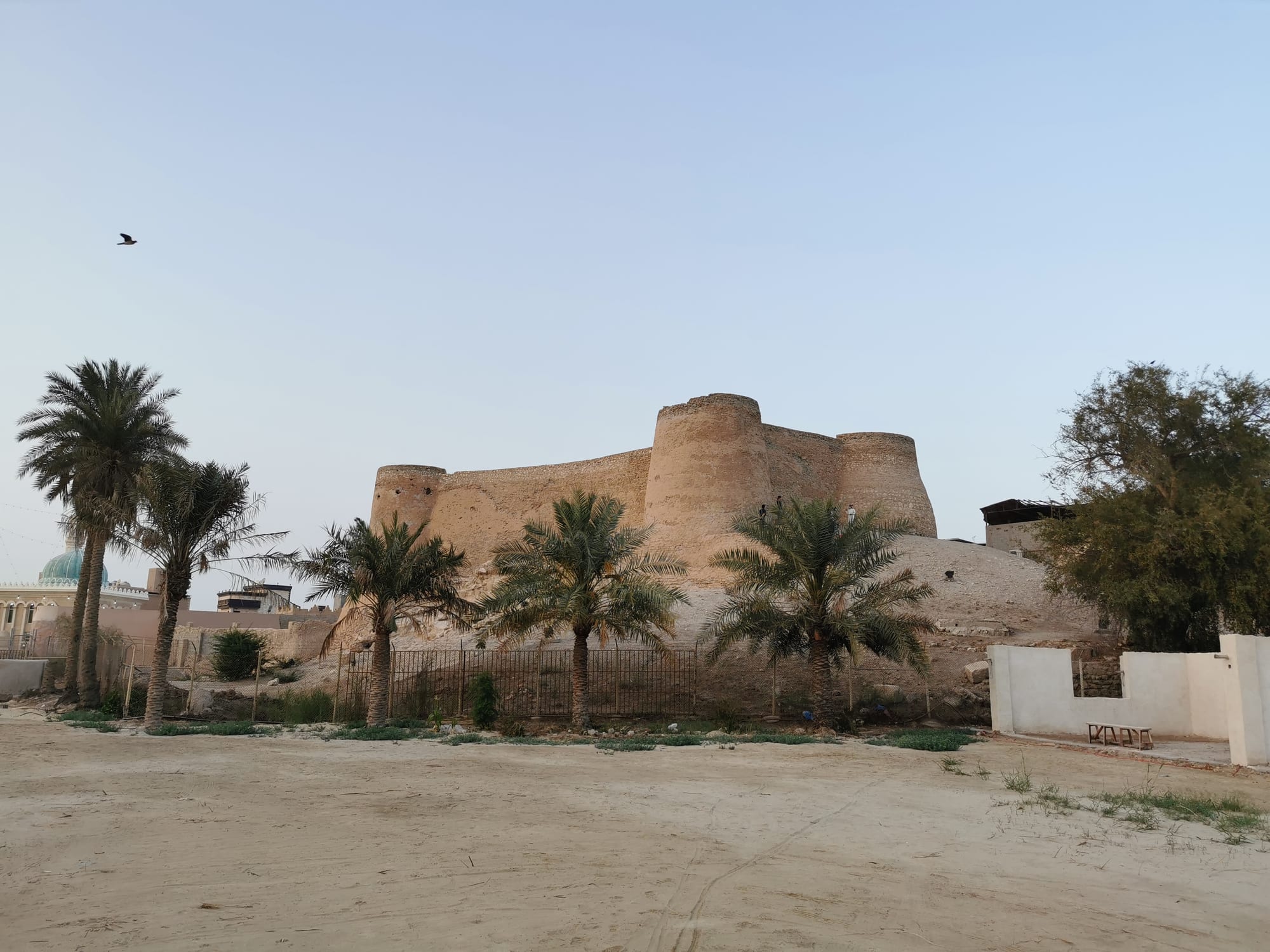
The weathered stone and mud walls of Tarout Castle on a low mound above date palms, with a green-domed mosque to the left

The Eastern Province, Saudi Arabia

Qatif

Tarout Castle on its ancient settlement mound, on the island off Qatif. (AhmadElq / Wikimedia Commons · CC BY-SA 4.0)

An old oasis and port on the Gulf coast of Saudi Arabia's Eastern Province, north of Dammam, settled for thousands of years and long known for its date palms, fishing fleet and markets. Qatif is the centre of the kingdom's largest Shia community, and its governorate takes in Tarout Island, with its ancient settlement mound and fortress, and a string of oasis towns.

Neighbourhoods

  • Central Qatif and the old quarters
    • First-time visitors
    • Markets
    • Historic district

    The core of the town around the site of the old fortress, where markets, mosques and husseiniyas sit among lanes of older houses and newer concrete blocks. The vegetable and fish markets and the date stalls are the busiest places in the morning.

    Open in Maps
  • The corniche and the seafront
    • Evening walks
    • Families

    A reclaimed waterfront of promenades, lawns and play areas looking across shallow water towards Tarout Island and the dhow moorings. It fills in the evening with families and walkers, and fishing boats come and go from the harbour nearby.

    Open in Maps
  • Tarout Island
    • History
    • Quiet and residential

    An inhabited island joined to the mainland by causeways, with the castle and its settlement mound at the centre, old stone houses and palm gardens around it, and the small port of Darin at its eastern end.

    Open in Maps
  • The oasis towns
    • Local life
    • Palm groves

    Awamiyah, Safwa, Saihat and a ring of villages spread through the palm groves and along the coast around the main town, each with its own markets and mosques and a slower, more agricultural rhythm.

    Open in Maps

Things to do

History and landmarks

  • Tarout Castlelandmark

    A fortress of stone and mud standing on a mound some five thousand years old, built over the remains of an earlier temple and used in turn by local rulers and the Portuguese. It is not open to visitors and is seen from the lanes around it.

    Open in Maps
  • Tarout Islandattraction

    The island off the town, occupied since the Dilmun period, with the castle, old quarters, palm gardens and the harbour at Darin.

    Open in Maps
  • The old town of Qatifneighborhood

    The centre around the site of the demolished Qatif fortress, where a few old houses, mosques and market lanes survive among modern rebuilding.

    Open in Maps

Markets and the waterfront

  • Qatif fish marketmarket

    The main landing and sale point for the local fleet, where Gulf fish, shrimp and crab are auctioned and sold in the early morning.

    Open in Maps
  • Qatif Cornichepark

    The seafront promenade and parkland facing Tarout Island, with lawns, walkways and views of the fishing boats.

    Open in Maps
  • Date and vegetable marketsmarket

    Stalls in the centre sell the oasis's dates, fresh produce from the palm gardens and the herbs and greens the area grows for the whole province.

    Open in Maps

Short trips from the town

  • Awamiyahattraction

    A neighbouring town within the oasis, whose old quarter was demolished during a security operation in 2017 and has since been redeveloped.

    Open in Maps
  • Safwaattraction

    An oasis town just north of Qatif, surrounded by palm groves and market gardens.

    Open in Maps
  • Saihatattraction

    A coastal town south of Qatif on the road towards Dammam, with its own markets and seafront.

    Open in Maps
  • Dammamattraction

    The provincial capital half an hour south, with a corniche, a large port, the regional museum and the main transport links.

    Open in Maps

Seasonal events

  • Ashurathe month of Muharram, varies with the Islamic calendar

    The most important observance of the year in Qatif's Shia community, marked with majlis gatherings, processions and public mourning in the town and surrounding villages.

  • Ramadan and Eidvaries with the Islamic calendar

    Quiet days and long evenings, with markets and cafés busy after the fast is broken and family visiting through the Eid holidays.

  • Date harvestlate summer into autumn

    The oasis picks its crop as the worst heat passes, and the date stalls of Qatif and the surrounding towns are at their fullest.

Eat and drink

Long-standing places and food districts in Qatif. Hours, ratings and directions come from your maps app, always current.

Qatif classics

  • Gulf fish and shrimprestaurant

    The local catch — hamour, safi, shrimp and crab — is grilled, fried or cooked into rice dishes in restaurants near the market and the seafront.

    Open in Maps
  • Machboos and muhammarrestaurant

    Spiced rice cooked with fish or meat, and the sweet date-syrup rice eaten alongside it, are the everyday dishes of the Qatif table as they are across the Gulf.

    Open in Maps

Markets and food streets

  • Qatif fish marketmarket

    Fish and shellfish landed by the local fleet, sold at stalls in the early morning, with stands nearby frying and grilling the catch.

    Open in Maps
  • Date stalls of the central marketmarket

    Dates from the oasis palms, sold fresh in season and pressed or stuffed the rest of the year, along with date syrup and sweets.

    Open in Maps
  • Cafés and sweet shops of the centreneighborhood

    Coffee houses and pastry shops around the main streets serve cardamom coffee, tea and Gulf sweets such as luqaimat and halwa.

    Open in Maps

Experience Qatif

History

Qatif is one of the oldest continuously inhabited places on the Arabian side of the Gulf. The mound beneath Tarout Castle on the island offshore holds layers of occupation going back some five thousand years, to the era of Dilmun, the trading culture centred on Bahrain, and finds from the island include one of the best-known early Arabian statues. The oasis, watered by springs and planted with palms, supported towns and harbours through the Hellenistic and pre-Islamic periods, when the coast was known as al-Khatt and so famous for spear-making that khatti became the standard poetic word for a spear.

The people of the oasis were among the earliest in Arabia to accept Islam. Afterwards Qatif was ruled in turn by the Qarmatians from al-Hasa, by local dynasties and by the Jabrids; the Portuguese and the Ottomans fought over the coast in the 16th century, and Tarout's fortress was rebuilt in that period. The Bani Khalid and then the Ottomans governed until Ibn Saud took the province in 1913. Pearling and fishing sustained the town until the pearl trade collapsed between the wars.

Oil changed everything after 1938. Qatif's palm gardens kept their place as a food source for the province while the men of the oasis found work with Aramco and in the new cities, and the town grew and modernised. The old fortress at the centre of Qatif was demolished by the government in the 1980s. The town saw protests and security operations in the 2010s, and the old quarter of Awamiyah nearby was cleared in 2017 and redeveloped.

Culture & Customs

Qatif's identity rests on two things: the oasis and its Shia faith. Most residents are Twelver Shia Muslims, part of the largest such community in Saudi Arabia, and religious life is visible in the many mosques and husseiniyas, the gathering halls where sermons, recitations and mourning assemblies are held. Muharram, and above all Ashura, is the high point of the year, marked with black banners, processions, public kitchens and communal meals.

Family and neighbourhood ties are strong, and the oasis has long produced scholars, poets and writers, with a lively tradition of religious and secular poetry recited at gatherings. Palm crafts survive as a household skill — baskets, mats and fans woven from fronds — and the fishing communities keep their own vocabulary and songs from the dhow and pearling years, when boats from Qatif and Darin worked the banks offshore.

Visitors are met with the hospitality usual in the kingdom: coffee with cardamom, dates and unhurried greeting. Manners are conservative — modest dress, restraint between men and women in public, and discretion with a camera, particularly around religious buildings and gatherings. The town's relationship with the state has been tense at times, and political and sectarian questions are not a subject for casual conversation.

Daily Life

The Qatif governorate holds roughly half a million people, spread between the main town, Tarout Island and a ring of towns and villages including Safwa, Saihat and Awamiyah. Almost all are Saudi citizens, which makes the area unlike the expatriate-heavy cities to the south.

Work is mostly elsewhere: a large share of residents commute to Dammam, Dhahran, Ras Tanura and Jubail, many of them to Aramco and its contractors, to hospitals and to government offices. Locally, the economy rests on farming, fishing, retail and construction. The palm gardens still produce dates and vegetables for the province, though rising salinity, falling groundwater and the spread of housing have taken land out of cultivation, and the fishing fleet works from harbours at Qatif and Darin.

Daily rhythm follows prayer times and the heat: business opens early, pauses in the afternoon and revives in the evening, when the corniche and the markets fill. Weekends bring family visits and picnics in the palm gardens or on the seafront. Local concerns are practical as well as political — water and the future of the groves, jobs for young people, and the redevelopment that has reshaped parts of the oasis.

Food

Qatif eats from the sea and the palm grove. The fish market sets the menu: hamour, safi, shrimp and crab, grilled over charcoal, fried, or cooked into machboos, the Gulf rice dish spiced with dried lime and baharat. Muhammar, rice cooked with date syrup and spices, is the classic accompaniment to fish, and sayadiyah-style fish with onions and rice appears in many kitchens. Dried and salted fish are used in stews through the year.

Dates are everywhere — eaten plain with coffee, boiled down into dibs, syrup, stuffed with nuts or sesame, and folded into pastries such as kleicha, the date-filled biscuit flavoured with cardamom that is made across Iraq and Arabia. The oasis also supplies herbs, tomatoes and greens to the wider province, and its vegetable markets are the liveliest in the morning.

Breakfast may be balaleet, sweet saffron vermicelli under a thin omelette, or eggs and beans with hot bread from a wall oven. Harees, wheat and meat pounded to a porridge, and thareed, bread soaked in stew, belong to Ramadan and to family occasions, and the public kitchens of Muharram cook rice and meat dishes in quantity for whole neighbourhoods. Sweets run to luqaimat, fried dough balls in syrup, and halwa thickened with starch and set with nuts. Arabic coffee, qahwa, pale and cardamom-scented, and sweet tea are drunk all day; alcohol is illegal in the kingdom.

Planning tools

Budget

Qatif is inexpensive. There are few hotels in the town itself and most visitors stay in Dammam or Khobar, where the choice and prices are wider. Food in the local restaurants is cheap, and the main cost is transport, since the oasis towns are spread out.

Daily Budget Midrange
USD 140–300 (hotel in Dammam or Khobar, restaurants, a hire car)
Daily Budget Shoestring
USD 45–80 (budget hotel nearby, local restaurants, ride-hailing)

Base in Dammam or Khobar and come for the day; the markets, the corniche and the castle cost nothing or very little.

Best Time to Visit

November to March, when the coast is mild and the markets, the corniche and Tarout are comfortable in daylight. The date harvest fills the markets from late summer into autumn. Summer combines extreme heat with humidity. Since the war began in late February 2026, air travel, events and tourism across the Gulf have been disrupted, so dates should be confirmed before booking.

Suggested Number of Days

The town and the island can be seen in a day, and most people come out from the cities to the south. Longer stays suit anyone taking in the surrounding oasis towns and the coast; mornings are the best part of the day here.

First Visit
half a day to a day
With Surroundings
2 days

Transportation

Almost all movement is by car. Ride-hailing apps work across the governorate and are the simplest option for visitors, and a hire car makes the oasis towns and the island easy. Causeways carry the road to Tarout, and a motorway runs south to Dammam and Khobar in about half an hour. Local public transport is limited.

Streets in the older quarters and on Tarout are narrow and parking is tight, so it is easier to park on the edge and walk in.

Airport & Station Connections

King Fahd International Airport near Dammam is about 40 kilometres away, roughly half an hour by road. Dammam's railway station, with trains from Riyadh, is a similar distance, and buses run along the coastal road. Most visitors drive from Dammam, Khobar or Jubail.

Walkability

The centre around the markets and the corniche is walkable, and Tarout's old quarter is best seen on foot. Between the towns of the oasis, distances are too long and the roads too fast for walking, and heat makes it impractical for much of the year. Pavements are patchy away from the seafront.

Safety

Crime is low and the towns are calm in daily life. Qatif saw protests, unrest and security operations in the 2010s, and the old quarter of Awamiyah was cleared in 2017; a visible security presence remains, and checkpoints are possible. Oil and industrial installations along this coast are heavily guarded and photographing them is prohibited. In the war that began in late February 2026 the Eastern Province was among the areas struck by Iranian missiles and drones, Aramco's Ras Tanura refining facility was hit in early March, and the conflict is continuing.

Avoid photographing security posts, oil or port facilities, be discreet with cameras in residential streets and at religious gatherings, and keep politics out of conversation. Check current official travel advice before travelling.

Climate

A hot desert climate on a humid coast. Summers are long, very hot and sticky, winters mild and the comfortable season, and rain is rare and falls mostly between November and April. Dusty northerly winds blow in early summer.

Summer
43–48°C by day and very humid, with little relief at night
Winter
mild — 15–24°C by day, cooler at night, with occasional rain

Local Customs

Qatif is a conservative town and the centre of Saudi Arabia's Twelver Shia community, so religious life is prominent: mosques, husseiniyas and the mourning rituals of Muharram shape the calendar. Dress modestly — loose clothing covering shoulders and knees, and for women a long skirt or trousers with a top that covers the arms, with a headscarf useful near religious buildings. Non-Muslims may not enter mosques in the kingdom.

Ask before photographing people or religious gatherings, avoid discussing sectarian or political questions, and note that alcohol is illegal throughout Saudi Arabia.

Common Payment Methods

The currency is the Saudi riyal. Cards and mobile payment are taken in shops, restaurants and petrol stations, but cash is still the norm at the fish market, date stalls and small kiosks. ATMs are available in the town centre and the larger oasis towns.