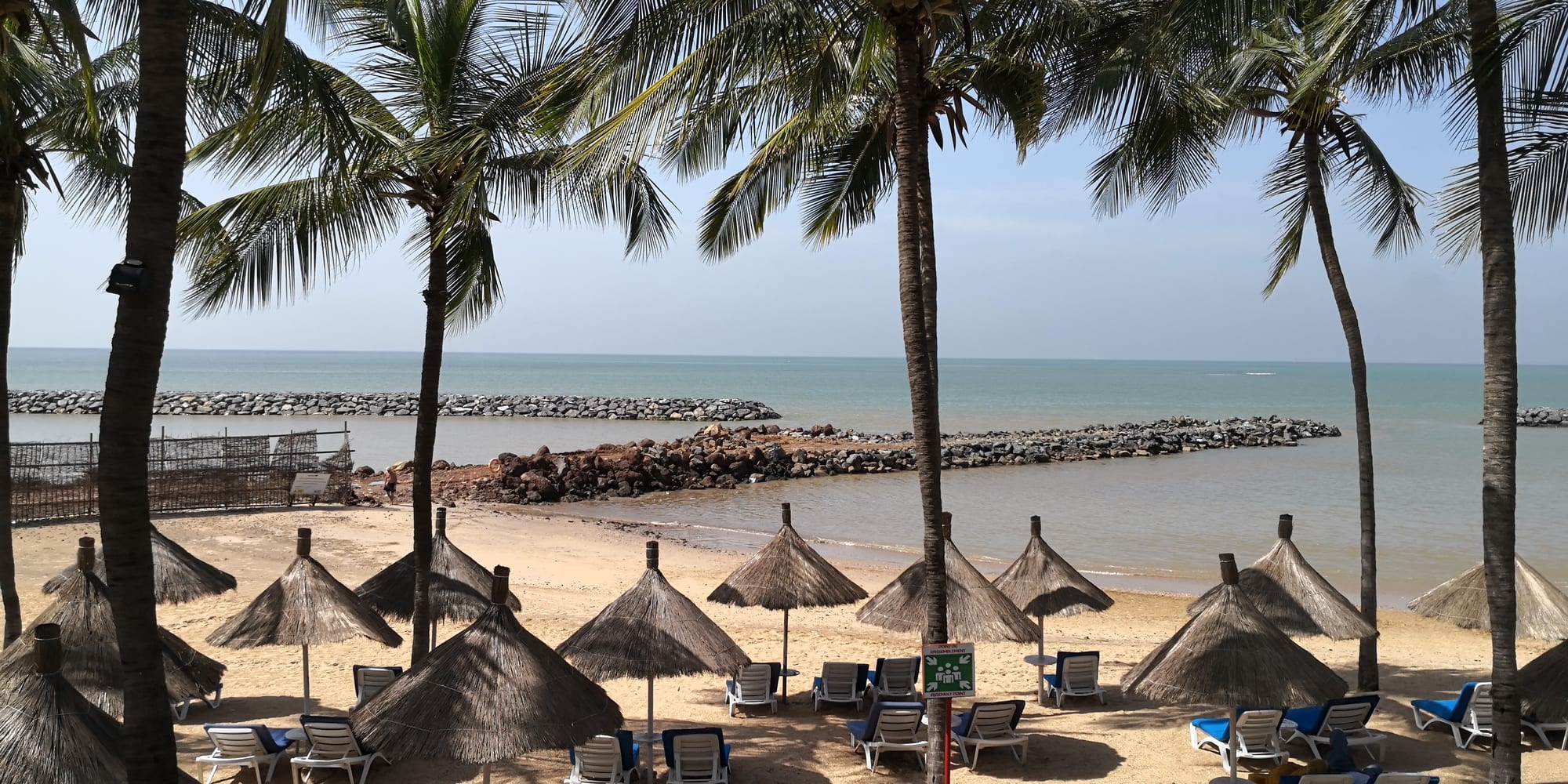
Thatched parasols and sun loungers on a sandy beach framed by palm trees, with stone breakwaters reaching into a calm green sea

Dakar & the Petite Côte, Senegal

Saly

The beach at Saly on the Petite Côte, with thatched parasols above the sand. (Davric / Wikimedia Commons · CC BY-SA 4.0)

Senegal's main beach resort, on the Petite Côte about 80 km south of Dakar. Created in 1984 on an empty stretch of shore beside the old Portuguese trading post of Portudal, it is a low-rise strip of hotels, residences and restaurants behind a long Atlantic beach, with the fishing town of Mbour next door and wildlife reserves and lagoons within easy reach.

Neighbourhoods

  • Saly Portudal
    • First-time visitors
    • Beaches
    • Restaurants

    The original resort zone, a grid of hotels, holiday residences and gardens set back from the beach, with restaurants, craft stalls and tour desks along the main street. It takes its name from Portudal, the Portuguese trading post that stood on this shore.

    Open in Maps
  • Saly Niakh Niakhal
    • Quiet and residential
    • Local life

    The older village side of Saly, inland from the hotels, where most of the people who work in the resort live. Small shops, a market and cheap eateries give it a different rhythm from the beachfront.

    Open in Maps
  • Mbour
    • Local life
    • Markets
    • Fishing beach

    The working town immediately south, one of Senegal's main fishing ports. Pirogues land their catch on the beach through the afternoon, the market spreads back from the shore, and the streets are busy in a way the resort is not.

    Open in Maps
  • Ngaparou and the Somone lagoon
    • Quiet and residential
    • Birdwatching
    • Beaches

    A village a short way north of the resort, beyond which the Somone river forms a shallow lagoon behind a sandbar. Pirogues cross the water among mangroves and wading birds, the lagoon has been classed as a protected marine area since 2020, and the beaches here are quieter than Saly's.

    Open in Maps

Things to do

The coast around Saly

  • Mbour fishing beachbeach

    The landing beach of one of Senegal's busiest fishing ports, a few kilometres south, where painted pirogues come ashore and the catch is sorted, weighed and sold on the sand.

    Open in Maps
  • Ngaparouneighborhood

    A fishing village just north of the resort with a broad beach, a small market and pirogues drawn up under the palms.

    Open in Maps
  • Nianingbeach

    A quieter stretch of coast south of Mbour, with a long beach, a few small hotels and Serer villages inland.

    Open in Maps

Short trips from the resort

  • Popenguineattraction

    A cliff-backed village up the coast, known above all as a place of Catholic pilgrimage and for the nature reserve created above it in 1986.

    Open in Maps
  • Joal-Fadiouthattraction

    A fishing town south along the coast, birthplace of Léopold Sédar Senghor, joined by a bridge to Fadiouth, an island of clam shells, with a cemetery shared by Christians and Muslims on a neighbouring shell island.

    Open in Maps
  • Bandia Reservepark

    A fenced private reserve of about 3,500 hectares inland towards Dakar, created in 1990, holding rhinoceros, giraffe, large antelope, zebra and warthog among baobab woodland.

    Open in Maps
  • Toubab Dialawattraction

    A small clifftop village north towards Dakar, home to the École des Sables, an international centre for African dance founded in 1998, with guesthouses built into the rock and a beach below the cliffs.

    Open in Maps

Seasonal events

  • Tabaskimoves with the Islamic calendar

    The feast of the sacrifice, the year's biggest family occasion, when sheep are bought in the days beforehand and the town smells of grilling mutton.

  • Koritémoves with the Islamic calendar

    The end of Ramadan, marked by morning prayers, new clothes and visits between households.

  • European winter seasonNovember to April

    The dry months are the resort's busiest, when charter visitors from France and neighbouring countries fill the hotels and the beach restaurants.

Eat and drink

Long-standing places and food districts in Saly. Hours, ratings and directions come from your maps app, always current.

Petite Côte classics

  • Grilled fish and seafoodrestaurant

    Thiof, sole, prawns and lobster landed at Mbour are grilled over charcoal in beach restaurants along the resort strip, usually with rice, chips or an onion sauce.

    Open in Maps
  • Ceebu jënrestaurant

    The national dish of fish, vegetables and broken rice in tomato sauce, eaten at midday from a shared bowl; the eateries in Mbour and Saly Niakh Niakhal serve the everyday version.

    Open in Maps
  • Yassa and maférestaurant

    Chicken or fish in lemon and onions, and groundnut stew with meat, are the staples of the small Senegalese kitchens away from the hotel restaurants.

    Open in Maps

Markets and street food

  • Mbour marketmarket

    The town market behind the fishing beach, selling fish fresh and dried, fruit, vegetables, cloth and household goods.

    Open in Maps
  • Dibiteries and street stallsrestaurant

    Charcoal grills sell mutton by weight with mustard and onion in the evenings, alongside stalls frying fataya pastries and accara bean fritters.

    Open in Maps

Experience Saly

History

The shore where Saly stands was a landing place long before it was a resort. The Portuguese traded here at a post they called Porto de Ale, which became Portudal, one of a string of stations on the Petite Côte dealing in hides, wax, ivory and captives with the Serer and Wolof states inland; Dutch merchants were working the same shore by the late sixteenth century. The surviving Portuguese connection is now mainly the name, carried by the modern resort zone of Saly Portudal.

The coast otherwise lived on fishing and farming until the second half of the twentieth century. Mbour, immediately to the south, grew into one of Senegal's largest fishing ports and a centre of the groundnut trade, while Saly remained a Serer and Wolof village on the dunes behind the beach.

Tourism arrived in the 1980s. The resort was created on 24 February 1984 on a previously unoccupied tract of land near the old trading post, as the Senegalese state and foreign operators developed the Petite Côte as a package destination for European winter visitors, building hotel villages and holiday residences along the sand and relying on the mild dry season and the short flight from France. Saly became the largest of these developments and the centre of Senegalese beach tourism, later adding privately owned villas and second homes. The industry has had difficult periods — the global downturn, the regional impact of the 2014 Ebola epidemic in other West African countries, and the closure of travel during the coronavirus pandemic — and the opening of the airport at Diass in 2017, far closer than Dakar, changed how visitors arrive.

Culture & Customs

Saly is a resort and behaves like one, but it sits in Serer and Wolof country and the surrounding villages keep their own life. Mbour and the inland settlements have strong Serer traditions alongside a Muslim majority and a visible Christian minority, and the mixture is clearest at the religious calendar's high points, when Tabaski and Christmas are both marked on the same coast.

The working culture of the area is the sea. Pirogue crews leave before dawn, women run the trade in fresh and dried fish, and the whole rhythm of Mbour follows the landings. Craft and music have grown up around tourism as well: drum and dance groups perform in the hotels, and sellers of wood carvings, silver and printed cloth work the beach and the roadside stalls, where bargaining is expected and conducted with good humour.

Visitors and residents meet in a fairly narrow strip, and relations between them are a subject of local discussion. Saly has a reputation for sex tourism that Senegalese commentators and authorities have criticised for years, and it sits awkwardly with the conservative norms of the villages just inland. Away from the beachfront the usual courtesies apply — long greetings, modest dress, an offer of tea — and they matter more here than the resort's informality suggests.

Daily Life

Saly's own resident population was counted at nearly 42,000 in 2023, in the village and the service quarters behind the hotels, and the number of people in the area at any moment rises and falls with the season. It functions as part of a much larger urban area: Mbour, a few kilometres south, had 284,189 residents at the 2023 census. Many who work in the resort live there or in Saly Niakh Niakhal and commute in by cart, motorbike taxi or shared car.

The local economy rests on two pillars. Fishing employs thousands directly and many more in processing, drying and transport, though catches have fallen and competition with industrial fleets offshore is a running grievance. Tourism provides hotel, restaurant, guiding and construction work, strongly seasonal and sensitive to events far away; a large population of European residents and second-home owners supports building trades and services year-round.

Days start early and slow at midday, when the main meal is shared from a communal bowl and the heat empties the streets, and pick up again in the late afternoon when the pirogues come in and the beach fills. The pressing local issues are coastal erosion, which has brought rock breakwaters to parts of the Saly shore, the pressure of building on the dunes, water supply and waste, and the seasonality of work.

Food

The Petite Côte eats what the pirogues bring in. Thiof, a white grouper that Senegalese cooks prize above other fish, is grilled whole over charcoal, as are sole, capitaine, prawns and, on restaurant menus along the beach, lobster. Simple kitchens serve the fish with rice, chips or an onion and mustard sauce; hotel restaurants add a French repertoire that has been part of Senegalese cooking for a century.

The everyday dishes are the national ones. Ceebu jën — thieboudienne — is the midday meal, fish stuffed with a herb paste and simmered with tomato and vegetables over broken rice cooked in the same sauce. Yassa, poultry or fish marinated in lemon, mustard and a large quantity of onions, and mafé, a groundnut stew, follow close behind, and Serer households in the villages inland cook millet couscous with meat or fish sauce.

Street food is cheap and everywhere: ndambé, a bean stew in a baguette, for breakfast; accara, black-eyed-pea fritters in a hot sauce; fataya pastries filled with fish; and dibi, mutton grilled over charcoal and sold by weight with mustard and raw onion. Drinks are bissap from hibiscus flowers, bouye from baobab fruit, ginger juice, and ataya, strong green tea poured in three sweetening rounds; Café Touba, roasted with grains of selim pepper, is sold from flasks in the street.

Planning tools

Budget

Saly is priced for package holidays and is one of the more expensive places in Senegal, though rates drop sharply outside the European winter season. Hotel and residence rooms are the main cost; eating in Mbour or the village side of Saly rather than on the beachfront cuts the daily total a long way.

Daily Budget Midrange
USD 95–230 (beachfront hotel or residence, restaurant meals, taxis, a day trip with a driver)
Daily Budget Shoestring
USD 30–60 (simple guesthouse or room in Mbour, local eateries, shared taxis)

Agree a taxi fare before setting off, and expect prices on the beach and in the craft stalls to be a starting point for bargaining.

Best Time to Visit

November to May is dry and the sea is calm, with December to April the most comfortable and also the busiest. The rains from July to October are hot, humid and much quieter, with lower prices and short heavy downpours rather than all-day rain.

Suggested Number of Days

Two or three days are enough for the beach and the neighbouring fishing town; four to six suit a slower stay that reaches the lagoon, the reserve and the villages down the coast. Many visitors treat Saly as a base for a week rather than a stop.

First Visit
2–3 days
With Surroundings
4–6 days

Transportation

The resort strip is covered on foot, by taxi or by the horse-drawn carts and motorbike taxis that work the local roads. Taxis and shared sept-place cars run to Mbour and up the coast, and car hire with a driver is the usual way to reach the reserves, the lagoon or Dakar for the day.

The Dakar–Mbour road carries heavy traffic and has a poor accident record, so travel it in daylight and avoid crowded minibuses.

Airport & Station Connections

Blaise Diagne International Airport at Diass is about 30 km north of Saly, usually well under an hour by road, which makes the resort one of the closest beach destinations to the country's main airport. Dakar is roughly 80 km away by motorway and coast road, and sept-place taxis and buses run from the capital to Mbour throughout the day.

Walkability

The resort itself is flat and easily walked, with the hotels, restaurants and craft stalls strung along a few streets behind the beach, and the sand gives a long walk at low tide. Mbour is a few kilometres away and reached by taxi rather than on foot; street lighting away from the main strip is patchy after dark.

Safety

Saly is calm and used to visitors, and the main problems are petty: bag snatching, theft from rooms and persistent beach sellers and self-appointed guides. Atlantic currents can be strong and there are no lifeguards on most stretches of sand. The resort has a long-standing reputation for sex tourism, which brings associated risks and scams.

Don't walk the Corniche or empty beaches after dark or carry valuables, be firm with touts, take malaria precautions, and check current advice for the far east near Mali and rural Casamance. Check current official travel advice before travelling.

Climate

A coastal Sahelian climate, a little warmer than Dakar and tempered by sea breezes. The dry season runs from November to May and the short rainy season from July to October.

Summer
warm and humid, generally around 26–32°C, with heavy showers and high humidity from July to October
Winter
dry and mild, generally around 18–28°C, with cool evenings and steady sea breezes

Local Customs

Beachwear belongs on the beach: away from the hotels, in Mbour and in the village, modest dress is expected and shoulders and knees are covered. Greetings are formal and unhurried, and bargaining is normal in markets and with craft sellers. Most residents are Muslim, and alcohol, while sold freely in the resort, is not drunk openly elsewhere.

Ask before photographing people, especially at the fishing beach, and give a clear, friendly refusal to beach sellers rather than engaging in a long negotiation.

Common Payment Methods

The currency is the West African CFA franc (XOF), pegged to the euro. Hotels and the larger restaurants take cards, but markets, taxis, carts and small eateries are cash only. ATMs are available in Saly and Mbour, and mobile money is widely used.