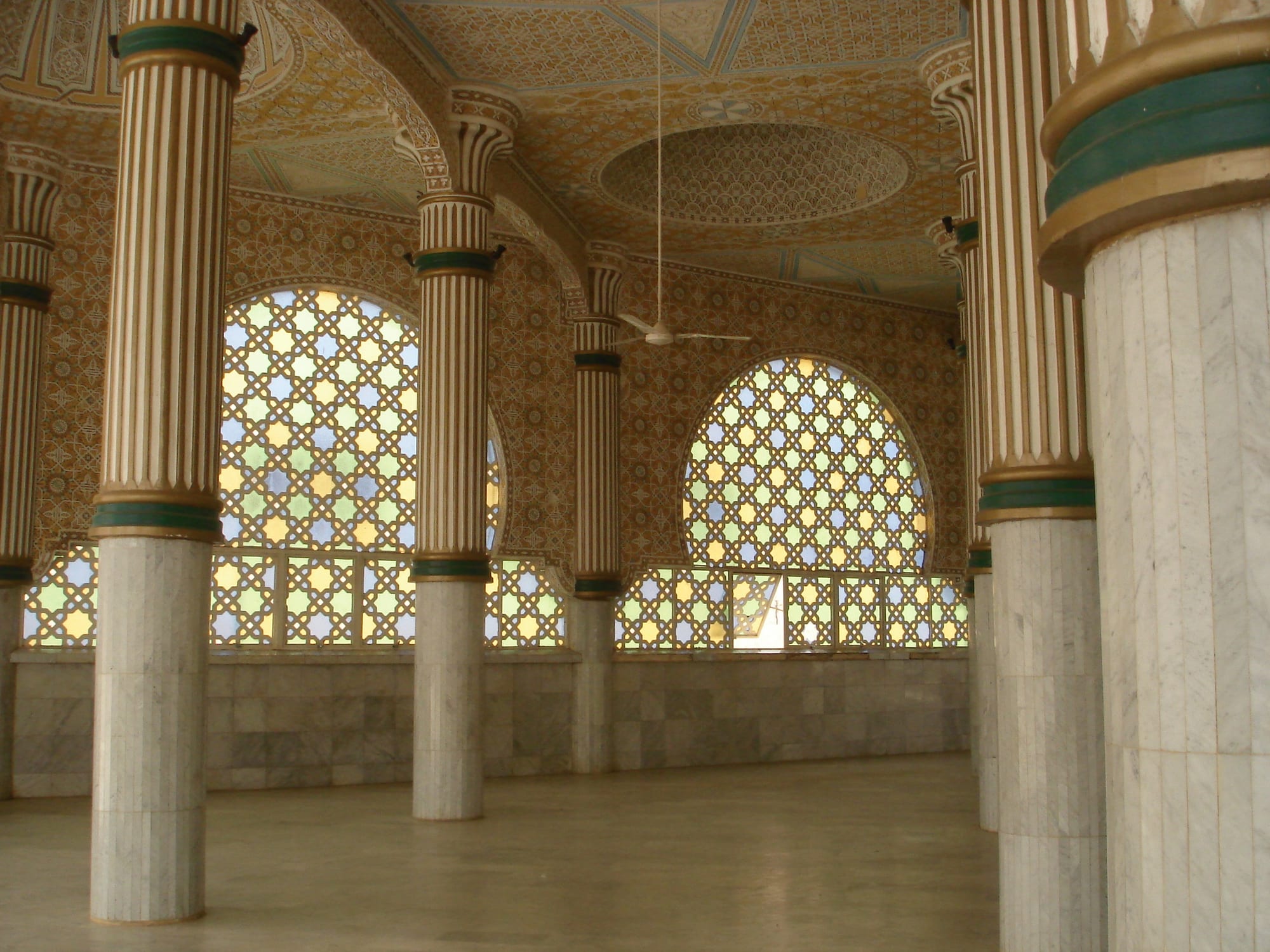
Marble columns with gilded capitals inside a mosque, with patterned ceilings and round stained-glass windows in soft daylight

Dakar & the Petite Côte, Senegal

Touba

Inside the Great Mosque of Touba, the centre of the Mouride brotherhood. (zivax / Wikimedia Commons · CC BY-SA 3.0)

The holy city of the Mouride Sufi brotherhood, on the dry plains of central Senegal. Founded by Cheikh Amadou Bamba in 1887 and grown from a settlement in the bush into the country's second-largest city, it is built around a great mosque over its founder's tomb, governed under its own religious rules, and filled each year by the Grand Magal pilgrimage.

Neighbourhoods

  • Touba Mosquée
    • First-time visitors
    • Religious sites
    • Historic district

    The central quarter around the Great Mosque, with the esplanade, the mausoleums, religious schools and the libraries. Streets converge on it from every direction, and the density of pilgrims, traders and students makes it the busiest part of the city all year.

    Open in Maps
  • Darou Khoudoss and Darou Minam
    • Local life
    • Quiet and residential

    Large residential quarters named after Mouride settlements and spreading out from the centre in a loose grid. Family compounds, small shops and neighbourhood mosques fill them, and many houses are built with money sent home by relatives abroad.

    Open in Maps
  • The market quarters
    • Markets
    • Street food

    Trading streets and market grounds north and west of the mosque, where the brotherhood's commercial networks meet — cloth, electronics, religious books and imported goods sold from stalls, lock-ups and lorries.

    Open in Maps
  • Mbacké
    • Local life
    • Markets
    • Transport connections

    The older administrative town some nine kilometres south, founded in 1796 and the source of the Mbacké family name. Less strictly regulated than Touba, it has the transport yards, cheaper lodgings and a busy market, and many visitors arrive through it.

    Open in Maps

Things to do

The mosque complex

  • Great Mosque of Toubalandmark

    The largest building in the city and long among the largest mosques in Africa, founded by Amadou Bamba in 1887 and inaugurated in 1963, with seven minarets, three large domes and the founder's tomb inside.

    Open in Maps
  • Lamp Fall minaretlandmark

    The mosque's central minaret, 96 metres tall and named Lamp Fall after Ibrahima Fall, founder of the Baye Fall; it is visible across the plain and serves as the symbol of the city.

    Open in Maps

Markets and city life

  • The Touba marketsmarket

    The trading grounds around the centre, supplied by Mouride commercial networks and among the largest markets in Senegal, selling cloth, produce, religious books and imported goods.

    Open in Maps
  • Touba Mosquée quarterneighborhood

    The dense quarter immediately around the mosque, with religious schools, libraries, mausoleums of the caliphs and the guesthouses that take in pilgrims.

    Open in Maps

Short trips from the city

  • Mbackéneighborhood

    The neighbouring town just south of Touba, older than the holy city and the base for much of its transport and trade.

    Open in Maps
  • Diourbelneighborhood

    The regional capital south-west of Touba, where the French held Amadou Bamba under surveillance and where a large mosque associated with him stands.

    Open in Maps

Seasonal events

  • Grand Magal of Touba18 Safar, moving with the Islamic calendar

    The Mouride pilgrimage commemorating Amadou Bamba's 1895 exile to Gabon, held on the 18th of Safar and drawing millions of people from across Senegal and the diaspora; the organisers put attendance in 2025 at more than six million.

  • Tabaskimoves with the Islamic calendar

    The feast of the sacrifice, marked by mass prayers and family gatherings, with sheep traded in the weeks beforehand.

  • Koritémoves with the Islamic calendar

    The end of Ramadan, a month when the city's religious life intensifies and the mosque fills for night prayers.

Eat and drink

Long-standing places and food districts in Touba. Hours, ratings and directions come from your maps app, always current.

Touba kitchens

  • Ceebu jënrestaurant

    Fish, vegetables and broken rice in tomato sauce, cooked in quantity here and served from shared bowls; during the Magal, households cook for strangers as a religious duty.

    Open in Maps
  • Yassa and maférestaurant

    Chicken or mutton in lemon and onions, and groundnut stew, are the staples of the simple eateries around the markets and in neighbouring Mbacké.

    Open in Maps
  • Grilled muttonrestaurant

    Sheep are central to the local economy and to religious feasts, and charcoal grills sell mutton by weight with mustard and raw onion.

    Open in Maps

Markets and drinks

  • The market streetsmarket

    The trading grounds around the centre sell produce, cloth, religious books and imported goods, and are among the largest markets in the country.

    Open in Maps
  • Café Toubacafe

    Coffee roasted with grains of selim pepper, associated with Amadou Bamba and the brotherhood and named after the city, sold strong and sweet from flasks in the street.

    Open in Maps

Experience Touba

History

Touba began as a place chosen for prayer. In 1887 Cheikh Amadou Bamba Mbacké, a scholar from a religious family in nearby Mbacké, founded a settlement in the bush under a tree he identified with felicity — touba in Arabic — and made it the centre of the Sufi order he had begun to gather around him. The French colonial authorities distrusted the movement's growth and exiled him to Gabon in 1895 and later to Mauritania, then kept him under surveillance at Diourbel until his death in 1927. The exile, endured without armed resistance, became the central story of Mouride devotion and is what the Grand Magal commemorates.

Bamba was buried at Touba, and his successors built the city around the tomb. Construction of the Great Mosque began under his son Mamadou Moustapha Mbacké; foundations were finished in 1932, work stopped during the Second World War and resumed afterwards, and the building was inaugurated in 1963. Successive caliphs enlarged and decorated it, adding minarets, domes and marble brought from abroad.

Around the mosque an entirely new city grew, built and financed largely by the brotherhood and its traders and by Mourides working in Dakar, France, Italy and the United States. Touba obtained a distinctive legal status, administered by the caliphate rather than by ordinary municipal government, with its own rules on conduct. From a few thousand residents at independence it has grown into the second largest city in Senegal, spreading over the flat groundnut country in every direction.

Culture & Customs

Everything in Touba refers back to the brotherhood. The Mouride order teaches work as a form of worship, discipleship to a spiritual guide, and the memory of Amadou Bamba, whose portrait — the one known photograph, a robed figure with a covered face — appears on walls, buses and shopfronts across Senegal. The Baye Fall, the community founded by Ibrahima Fall, are the most visible members, wearing patchwork robes and dreadlocks and devoting themselves to labour and to collecting for the brotherhood.

The city's calendar is religious rather than civic. The Grand Magal is the great event, when millions of people arrive and households across Touba cook for whoever comes, hospitality being understood as a religious act; smaller magals and the birthdays of caliphs punctuate the rest of the year. Religious chant, the recitation of Bamba's poems known as khassaides, is the characteristic music, and it is sung in mosques, in homes and at family ceremonies rather than in clubs.

Behaviour is regulated more tightly than elsewhere in Senegal. Alcohol and tobacco are forbidden in the city, entertainment considered frivolous is discouraged, and dress is conservative for residents and visitors alike. Within those limits Touba is welcoming, and the ordinary Senegalese courtesies — long greetings, tea in three rounds, food shared from a common bowl — are as strong here as anywhere.

Daily Life

Touba's population was about 1.1 million at the 2023 census, which makes it the second largest city in Senegal after Dakar, and it swells enormously for the Magal. Growth has been extraordinarily fast, driven by migration from the surrounding countryside and by Mourides choosing to build in the holy city; whole quarters have been laid out on former farmland, often ahead of the water, drainage and electricity networks that follow.

The economy is trade. Mouride commercial networks reach from Touba's markets to Dakar's Sandaga, to Italy, France and New York, and the remittances they generate finance the large houses, the mosque's continuous enlargement and much local building work. Groundnut farming and livestock support the surrounding area, religious schools employ teachers and scholars, and transport keeps a constant stream of goods moving on the Dakar road.

Daily life follows prayer times and the heat: activity early and late, a long pause in the middle of the day, and evenings in the courtyard or at the mosque. The city has no bars or nightlife in the usual sense. Its pressing problems are water supply, flooding after heavy rain in quarters built on low ground, waste collection for a population that periodically multiplies, and the strain of the Magal on roads, health services and sanitation.

Food

Cooking in Touba is Senegalese home cooking done on a large scale. Ceebu jën — fish with vegetables over broken rice in tomato sauce — is the midday meal here as everywhere, though this is inland country and dried or salted fish often stands in for fresh. Mutton and chicken are more prominent than on the coast: yassa, cooked with lemon, mustard and quantities of onion, and mafé, the groundnut stew that suits a region built on the groundnut crop, are the dishes served most often.

Millet remains a staple in the surrounding countryside and appears as lakh, a porridge eaten with sweetened curdled milk, and thiakry, steamed millet couscous with curds, which is also the food most readily offered to a visitor. During the Magal, families cook enormous pots of rice and meat and distribute them free to pilgrims, and street kitchens work day and night.

The city's name is attached to the country's characteristic coffee. Café Touba is roasted with djar, the grains of selim pepper, ground with the beans and brewed strong and sweet; it is associated with Amadou Bamba and sold from flasks on street corners across Senegal. Otherwise the drinks are bissap from hibiscus flowers, bouye from baobab fruit, ginger juice and ataya tea poured in three rounds — and nothing stronger, since alcohol is not permitted in the city.

Planning tools

Budget

Touba is cheap by Senegalese standards, with simple lodgings and inexpensive food, though rooms are scarce and prices rise steeply around the Magal, when most pilgrims stay with relatives or in mosque accommodation. Many visitors come for the day from Dakar or stay in Mbacké.

Daily Budget Midrange
USD 60–120 (better hotel room, restaurant meals, a car and driver for the day)
Daily Budget Shoestring
USD 20–40 (simple auberge in Touba or Mbacké, local eateries, shared taxis)

Alcohol and tobacco are not sold or permitted in the city, and rooms need arranging well ahead of the Magal.

Best Time to Visit

November to February is the most comfortable, with warm days and cool nights; March to June is very hot, often near 40°C, and the short rains fall between July and October. The Magal transforms the city for several days, which is either the reason to come or the time to avoid.

Suggested Number of Days

A day is enough for most visits, and many people come from Dakar and return the same evening. Two days allow a slower look at the city and its neighbouring towns. The Magal is the exception, when the visit is the pilgrimage itself.

First Visit
1 day
With Surroundings
2 days

Transportation

Shared sept-place taxis, minibuses and buses connect Touba with Dakar, Thiès, Diourbel and Kaolack, using the garages in Touba and Mbacké. Inside the city, taxis, motorbike taxis and horse carts cover the long distances between quarters, and the wide streets around the mosque fill with traffic on religious occasions.

Travel to and from Touba is far heavier around the Magal, when roads from Dakar are congested for days and accidents increase.

Airport & Station Connections

Touba lies roughly 190 km east of Dakar, about three to four hours by road, with a toll motorway covering much of the route via Thiès and Diourbel. Sept-place taxis and buses run throughout the day from the capital's garages, and the nearest international airport is Blaise Diagne at Diass, near Dakar.

Walkability

The mosque esplanade and the surrounding quarter are walked easily, and pilgrims cover the central area on foot. The city as a whole is very spread out, flat, hot and short of shade, and there is little pavement, so most journeys between quarters are made by taxi, motorbike or cart.

Safety

Touba is calm and closely watched by the brotherhood's own organisation, and crime against visitors is rare. The main risks are heat, crowds and traffic, all sharply increased during the Magal, when millions of people and vehicles converge on the city. Giving offence through dress or behaviour is a more likely problem here than theft.

Don't walk the Corniche or empty beaches after dark or carry valuables, be firm with touts, take malaria precautions, and check current advice for the far east near Mali and rural Casamance. Check current official travel advice before travelling.

Climate

A hot, dry Sahelian climate well inland from the moderating Atlantic. The dry season runs from November to June, with fierce heat before the rains, and a short rainy season falls between July and October.

Summer
very hot, often near or above 40°C before the rains, then humid with heavy showers from July to October
Winter
dry, with warm days around 30–34°C, cool nights and harmattan dust

Local Customs

Touba has a special status and its own rules: alcohol and tobacco are forbidden in the city, along with other pursuits judged frivolous, and conservative dress is expected of everyone. Women cover their hair and arms, men wear long trousers or a boubou, and shoes come off at the mosque. Photography inside the mosque complex may be restricted, and the caliph's authority rather than the state's sets the tone of public life.

Dress modestly, ask before photographing people or the mosque interior, do not bring alcohol or cigarettes into the city, and follow a guide's instructions at the mausoleums.

Common Payment Methods

The currency is the West African CFA franc (XOF). Touba is largely a cash economy: markets, taxis and eateries take notes only, mobile money is widely used, and card acceptance is limited. ATMs are available in the city and in Mbacké but can run out of cash before major religious dates.