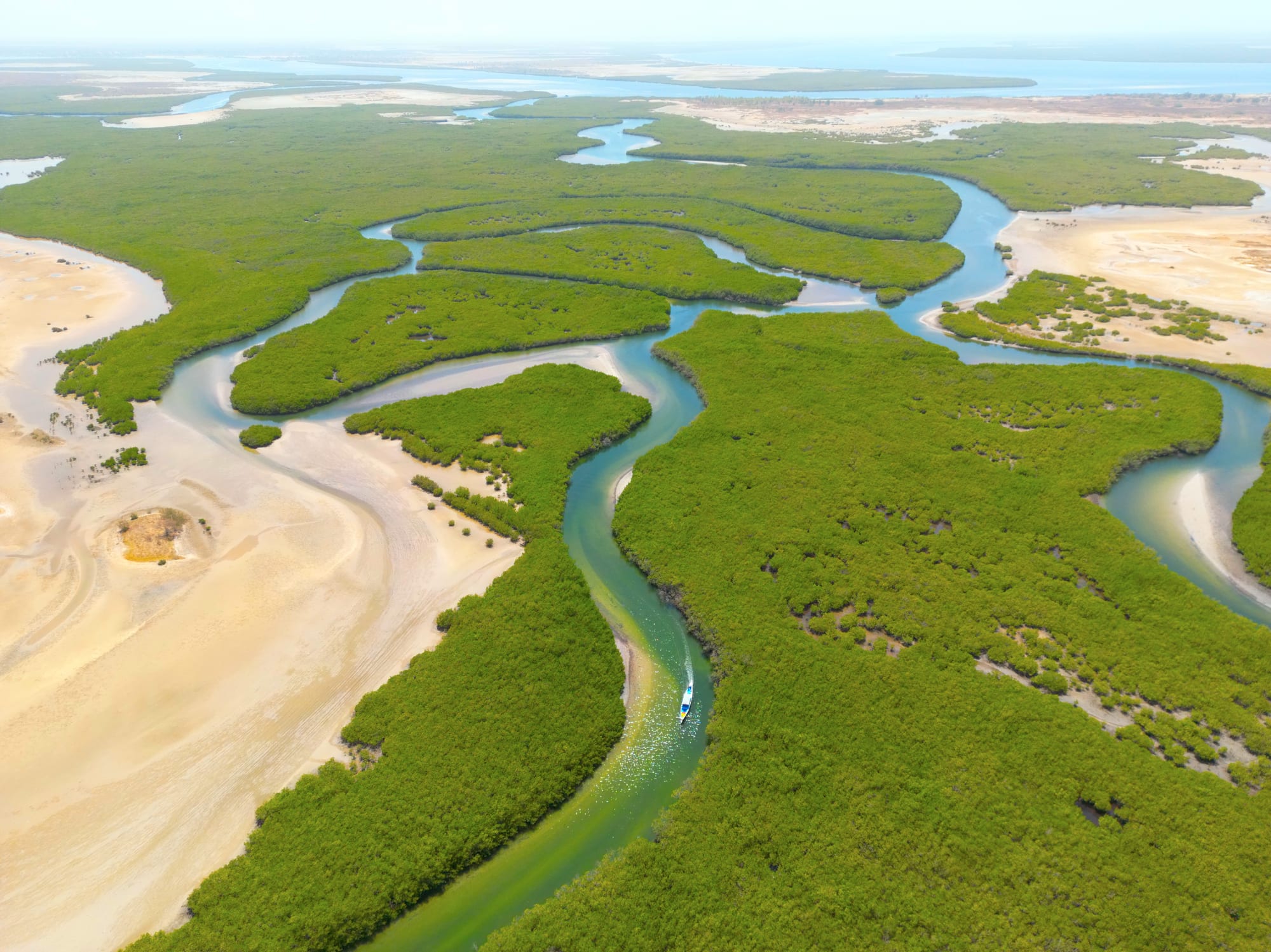
Aerial view of a turquoise tidal channel winding between bright green mangrove forest and pale sandbanks, with a small boat leaving a wake and open water on the horizon

Senegal

A boat follows a winding channel through the mangroves of the Sine-Saloum delta, a UNESCO World Heritage Site on the Atlantic coast south of Dakar. (Issiaga0 / Wikimedia Commons · CC BY-SA 4.0)

The westernmost country of mainland Africa, on the Atlantic, wrapped around The Gambia — a stable democracy, a stronghold of Sufi Islam, and the cultural hub of French-speaking West Africa, now reshaped by a young reformist government and new offshore oil and gas.

Explore Senegal

History

Before the Europeans, the Senegal region held the Wolof Jolof Empire and its successor kingdoms, the Fula theocracy of Fouta Toro, and the Mandinka-linked states of the east. From the seventeenth century, French trading posts at Saint-Louis and on Gorée Island off Dakar became centres of the Atlantic slave trade — Gorée's "House of Slaves" is now a world memorial to it — and Saint-Louis went on to serve as the capital of French West Africa. In four coastal "communes", including Dakar and Saint-Louis, residents held French citizenship and, from 1914, elected an African deputy to Paris, and Senegalese tirailleurs fought and died for France in both world wars.

Independence came in 1960 under Léopold Sédar Senghor — poet, philosopher of Négritude, and member of the Académie française — who governed for twenty years and then handed power over voluntarily. Senegal became one of the very few African countries never to suffer a military coup, with peaceful changes of government in 2000, 2012, and 2024.

A sharp political crisis ran from 2021, as prosecutions of the popular opposition figure Ousmane Sonko brought deadly protests, and President Macky Sall's abrupt 2024 postponement of the election triggered a constitutional showdown. It was resolved when Sonko's little-known deputy, Bassirou Diomaye Faye, was released from prison and won the presidency in the first round at 44, the youngest president in Senegal's history, and appointed Sonko prime minister. The new government moved to renegotiate resource contracts, reassess ties with France — whose troops left in 2025 — and audit public finances, just as newly discovered offshore oil and gas came on stream. The audits exposed far bigger public debts than had been declared, and in May 2026, amid the debt crisis and stalled talks with the International Monetary Fund, Faye fell out with Sonko, dismissed him and made the economist Ahmadou Al Aminou Lo prime minister.

  • Senegal: The Westernmost Edge — The African mainland's Atlantic tip — medieval Sahel kingdoms, the oldest French foothold in Africa, the island of Gorée, a poet-president, and one of the few states on the continent never to have had a successful military coup

Culture & Customs

Senegalese culture is defined by teranga, a byword for hospitality that the country makes central to its self-image, and by Sufi Islam: the great brotherhoods — the Mouride, centred on the holy city of Touba, and the Tijaniyya at Tivaouane and Kaolack — shape social life, politics, and the economy, and their annual pilgrimages, the Grand Magal above all, draw millions.

Music is a national art: the mbalax of Youssou N'Dour, built on the sabar drum, and the griot tradition of praise-singing and history-keeping, with the kora played across the south. Dakar is a fashion and art capital, home to the Dak'Art biennale, and Senegalese cinema, from Ousmane Sembène onward, has an outsized reputation. Laamb, traditional wrestling with a mystical build-up of amulets and drumming, fills stadiums.

The boubou robe, elaborate for celebrations, and matching family outfits for weddings and naming ceremonies are worn with pride, and the extended family and religious community remain the bedrock of daily life.

  • Senegal: Teranga and the Brotherhoods — A near-universal Muslim faith lived through Sufi brotherhoods, greetings that trade family names like gifts, and a code of hospitality, teranga, that the country treats as the heart of its identity

Daily Life

Senegal is young and urbanising fast, with around a quarter of the population in Greater Dakar, a crowded peninsula city of markets, mosques, and traffic, ringed by suburbs that flood in the rains. About two in five Senegalese still live rurally, farming groundnuts, millet, and rice, or fishing from wooden pirogues along a coast where foreign industrial fleets and overfishing are a live grievance.

The economy leans on that agriculture and fishing, on phosphates and gold, on remittances from a large diaspora in France, Italy, Spain, and the US, and, from 2024–25, on new offshore oil and gas. Youth unemployment is the central social problem, feeding both the protest movements that shook the country and the dangerous migration route to Europe via the Canary Islands.

Senegal's stability, its free press and courts, and its record of peaceful transitions stand out in a region of coups, but the government is grappling with debts far larger than the official figures had shown — reassessed in 2025 at around 119 per cent of GDP — and with high expectations.

  • Senegal: The Compound and the Communal Bowl — Extended families sharing a walled ker compound, a time-sense summed up in the phrase ndank ndank, "slowly, slowly", and a meal still commonly eaten by several hands from one shared platter rather than separate plates

Food

Senegalese cooking is among the most celebrated in West Africa. The national dish is thieboudienne — fish simmered with tomato and served over broken rice cooked in the same sauce, with vegetables — the dish from which jollof rice is thought to derive, and itself on UNESCO's list of intangible cultural heritage. Yassa, chicken or fish marinated in lemon, mustard, and a mountain of onions, and mafé, a groundnut stew, are the other pillars.

Street food runs from fataya and nem to grilled dibi mutton eaten with bread and onions, and the coast has superb grilled fish. Sweetened couscous with curdled milk and rice pudding are common desserts.

Hibiscus bissap, baobab bouye, and ginger juices, and strong sweet ataya tea poured in three rounds, are the everyday drinks, and Café Touba, spiced with grains of selim pepper, is a Mouride institution.

Attractions & Natural Wonders

Dakar has the pastel colonial houses and quiet lanes of Gorée Island, a short ferry from the port and a World Heritage Site; the vast African Renaissance Monument; the IFAN museum and the Museum of Black Civilisations; the Corniche and the Soumbédioune craft market; and Lac Rose, the salt lake about 35 km north-east of the city that lost its famous pink colour to flooding in 2022 and has since partly regained it.

North, Saint-Louis — the former colonial capital on an island in the Senegal River, with wrought-iron balconies, a famous jazz festival, and the Guet Ndar fishing quarter — is a World Heritage town, and the nearby Djoudj bird sanctuary is one of the world's great sites for migratory pelicans and flamingos.

South of Dakar, the Petite Côte resorts and the Sine-Saloum Delta — a maze of mangrove channels, islands, and pirogue villages — lead toward Casamance, greener and culturally distinct, with the beach of Cap Skirring, Jola villages and sacred forests, and Carabane island. Inland, the far southeast around Kédougou has waterfalls and the Bassari and Bedik hill cultures, and the holy cities of Touba, with its great mosque and the tomb of Ahmadou Bamba, and Tivaouane welcome respectful, appropriately dressed visitors.

  • Senegal: Five Attractions and Natural Wonders — An island that stands as one of the most direct memorials anywhere to the transatlantic slave trade, a towering bronze monument taller than the Statue of Liberty, and a lake usually coloured pink by its own salt-loving algae

Planning basics

Budget

Senegal is moderately priced for West Africa. Guesthouses and auberges, street and market food, and shared "sept-place" taxis are cheap; Dakar hotels, the Petite Côte resorts, and internal flights or Casamance travel cost more.

Daily Budget Midrange
XOF 45,000–110,000 / USD 75–190 (mid-range hotel, restaurants, a car with driver, guided trips)
Daily Budget Shoestring
XOF 18,000–32,000 / USD 30–55 (auberge, local eateries, sept-place taxis)

Agree taxi fares before setting off — meters are not used in practice — or use ride-hailing apps in Dakar.

Visa Requirements

Citizens of the UK, most other Western countries, and many African and other countries can enter visa-free for up to 90 days. Passports must be valid for at least six months from the date of arrival. A yellow-fever certificate is required if you arrive from a country with a risk of the disease; check the current rules before you travel.

Typical Stay
90 days visa-free for most Western passports

Safety

Senegal is one of the safer and more stable countries in West Africa, and Dakar and the tourist areas are generally fine with normal precautions. Petty theft — pickpocketing, moped bag-snatching, phone theft — occurs in Dakar's markets and along the Corniche, and persistent "guides" latch on to tourists at Gorée and in Saint-Louis. Protests can still flare in Dakar and Ziguinchor. A new peace agreement with the main Casamance rebel movement was signed in 2025 and the separatist conflict is now largely dormant, though it has not been formally concluded and some rural border zones retain landmine risk. Homosexuality is illegal in Senegal, and a law passed in 2026 increased the penalties.

Health
Malaria is a year-round risk countrywide; strong Atlantic currents cause drownings at Dakar-area beaches

Don't walk the Corniche or empty beaches after dark or carry valuables, be firm with touts, take malaria precautions, and check current advice for the far east near Mali and rural Casamance.

Climate

Sahelian in the north and interior — hot and dry, with a short rainy season from July to September — grading to a wetter, greener south in Casamance. The Atlantic coast, especially Dakar, is milder and breezier, cooled by the Canary Current, with a pleasant dry season and a warmer, humid rainy season. The interior is very hot before the rains.

Dakar
Dry season December–May, 17–27°C; humid rains July–October
Interior
40°C+ in April–June

Transportation

Blaise Diagne International Airport, about 45 km from Dakar, is the main gateway, linked to the city by a toll motorway and, since September 2026, by the TER express train, which runs from central Dakar via Diamniadio to the airport. Intercity travel is by shared "sept-place" station wagons and minibuses on a decent road network; Casamance is reached overland through The Gambia, by a long inland route, or by the Dakar–Ziguinchor ferry.

Choose reputable transport over crowded minibuses on the accident-prone Dakar–Mbour road, and avoid night travel between towns.

Best Time to Visit

November to February, the cool dry season, is the most comfortable time countrywide and the peak for migratory birds at Djoudj. March to May gets hot inland; the July–October rains bring flooding to Dakar and heavy rain to Casamance.

Events
Saint-Louis International Jazz Festival (held since 1993); the Grand Magal de Touba (Mouride pilgrimage); Tabaski (Eid al-Adha); Dak'Art biennale of contemporary African art (even years); the Summer Youth Olympics in Dakar, Diamniadio and Saly, 31 October–13 November 2026

Currency

Senegal uses the West African CFA franc (XOF), shared with seven other countries and pegged to the euro. Cards work at Dakar hotels and supermarkets; carry cash elsewhere. ATMs are common in cities, scarce in rural areas, and mobile money is widely used.

Symbol
CFA
Currency Code
XOF — West African CFA franc

Language

French is the official language, used in government, administration, and education. Wolof is the de facto national lingua franca, spoken or understood by around 80 per cent of the population regardless of ethnicity. Pulaar, Serer, Mandinka, Soninke, and Jola are recognised national languages, each dominant in its home region. English is spoken by some younger people and in tourism.

Lingua Franca
Wolof
Official Language
French