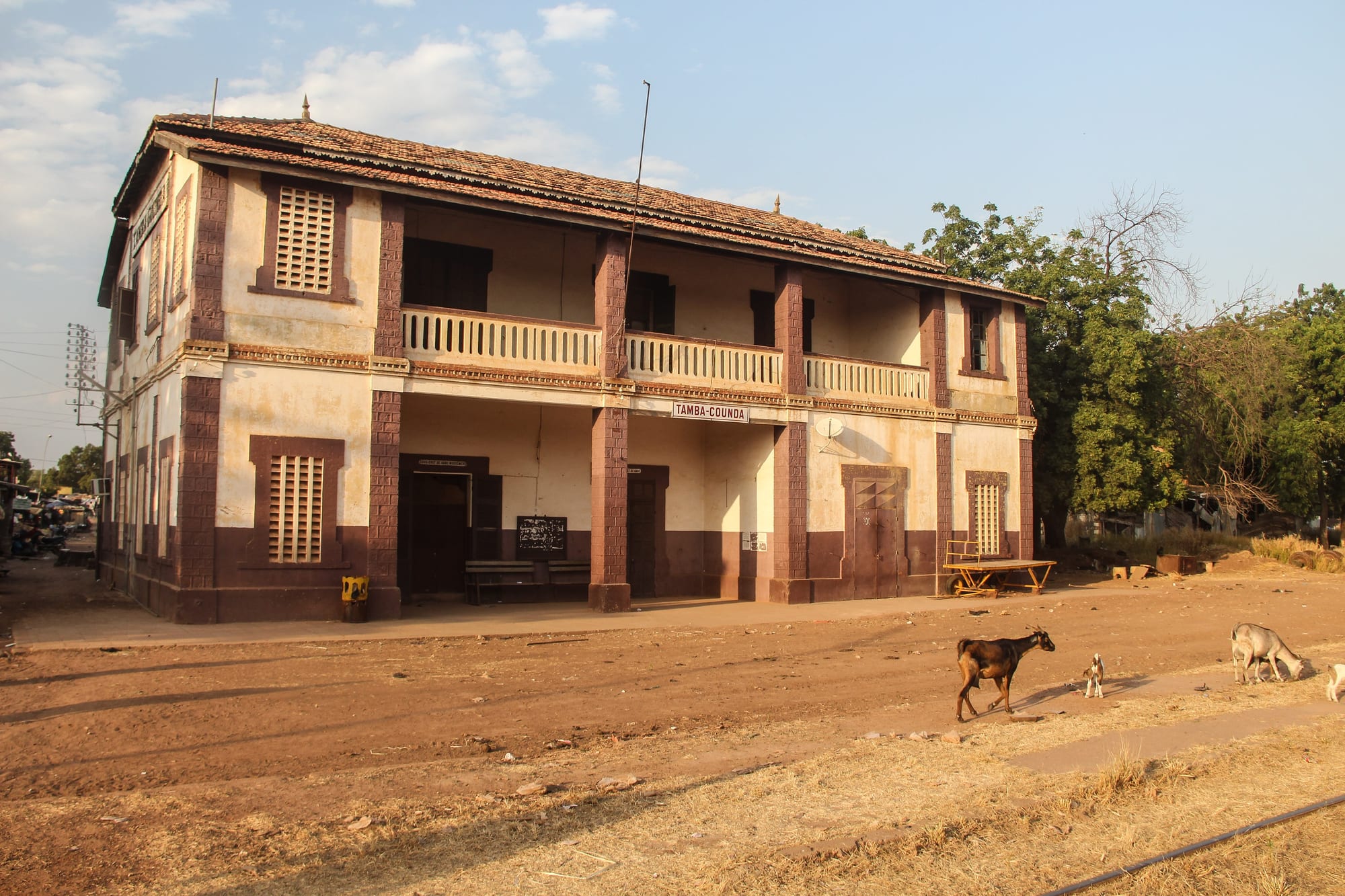
A two-storey colonial railway station with a balcony and tiled roof, signed Tamba-Counda, beside a dusty yard with goats

The Casamance & the East, Senegal

Tambacounda

The railway station at Tambacounda, built when the line from Dakar towards Mali reached the town. (Peter van der Sluijs / Wikimedia Commons · CC BY-SA 4.0)

The largest town in eastern Senegal and the capital of its biggest region, set in hot savanna where the roads and the railway from Dakar towards Mali meet. It grew as a railway town, lives on trade, transport and livestock, and is the usual staging point for the Niokolo-Koba National Park and the road south to Kédougou.

Neighbourhoods

  • The centre and the market
    • First-time visitors
    • Markets
    • Local life

    The commercial heart of the town, where the market, shops, banks and offices cluster within a few streets. It is busiest early in the morning and again once the afternoon heat breaks.

    Open in Maps
  • Around the station
    • Historic district
    • Quiet and residential

    The quarter laid out around the railway, with the old station building, railway housing and workshops, and mango trees along the tracks. It is the oldest recognisable part of the town.

    Open in Maps
  • The transport axis
    • Transport
    • Budget stays

    The strip along the main road where bus and sept-place taxi yards, fuel stations, workshops and cheap eating houses serve traffic heading to Dakar, Kédougou, Mali and the Gambian border.

    Open in Maps
  • The outer quarters
    • Local life
    • Quiet and residential

    Low compounds of concrete and mud brick spreading into the bush around the centre, where most of the town's population lives, each quarter with its mosque, shops and small workshops.

    Open in Maps

Things to do

Markets

  • Tambacounda marketmarket

    The central market, where cloth, grain, cola nuts, dried fish and goods moving between Dakar, Mali and the Gambia change hands.

    Open in Maps

Landmarks and transport

  • The railway stationlandmark

    The colonial-era station on the line from Dakar towards Bamako, which reached the town in 1913 and made it the junction of eastern Senegal.

    Open in Maps
  • Tambacounda Airporttransit hub

    The small airport on the edge of town, a short way from the centre and far quieter than the road and rail traffic that built the place.

    Open in Maps

Short trips from the town

  • Niokolo-Koba National Parkpark

    The large savanna and gallery-forest park along the Gambia river south of the town, a UNESCO World Heritage Site with hippos, antelopes, primates and a small lion population.

    Open in Maps
  • Koussanarattraction

    A small town on the road and railway west of Tambacounda, once the seat of a pre-colonial state ruled by the Sane family, a branch of the Kaabu dynasty.

    Open in Maps

Eat and drink

Long-standing places and food districts in Tambacounda. Hours, ratings and directions come from your maps app, always current.

Markets and food streets

  • Tambacounda marketmarket

    Grain, groundnuts, dried and smoked fish, mangoes and vegetables, with women cooking rice and sauce for traders at the edges of the stalls.

    Open in Maps
  • The eating houses along the main roadneighborhood

    Simple kitchens and grills strung along the transport strip, feeding drivers and passengers on rice, sauce, grilled meat and tea at all hours.

    Open in Maps

Eastern Senegal classics

  • Dibi and grilled muttonrestaurant

    Mutton or goat roasted over wood in a dibiterie and served with raw onion, mustard and bread, the standard evening meal of the inland towns.

    Open in Maps
  • Mafé, yassa and millet couscousrestaurant

    Groundnut stew, lemon-and-onion yassa and rice or millet couscous, with local beef and river fish more common here than sea fish.

    Open in Maps

Experience Tambacounda

History

Tambacounda is a modern town with an old setting. The country around it belonged to Mandinka states linked to the Kaabu and Wuli polities and to Fula herding communities, on routes that carried gold, kola, salt and captives between the Niger and the Atlantic. The settlement itself was founded in the eighteenth century by Mandinka settlers of the Jatta family, driven from the Falémé valley by the expanding state of Bundu, and stayed small until French rule, which reached the neighbouring kingdom of Wuli as a protectorate in 1888, made it a post on the way inland.

The railway made the town. When the line from Dakar towards Bamako reached the town in 1913, Tambacounda became its major junction and depot in eastern Senegal, with workshops, sheds, railway housing and a station that still stands. Trade, groundnuts and cattle followed the tracks, and migrants came from across Senegal and from Mali and Guinea to work.

Independence left the town as the administrative centre of a vast, thinly populated region, and its fortunes have tracked its transport links ever since. The decline of the Dakar–Bamako railway, whose passenger services have been suspended since 2009, was offset by the improvement of the national highway, which carries lorries between the port of Dakar, Mali and the eastern borders. The creation of the Kédougou region in 2008 took the far south-east out of its administration, and the gold boom there pulled trade and traffic down the road, but Tambacounda remains the market, hospital and transport hub for a huge area, and the point where most journeys to Niokolo-Koba begin.

Culture & Customs

Tambacounda is a crossroads town, and its culture reflects that. Fula, Mandinka, Soninke, Wolof, Bambara and Jakhanke families live in the same quarters, Pulaar and Mandinka are as common as Wolof in the streets, and Malian and Guinean traders are part of everyday commerce. Islam is the strong common thread, with Tijani and Mouride affiliations, Koranic schools, and mosques that fill the streets on Fridays.

The griot tradition is alive here: hereditary musicians and praise-singers of the Mandinka and Fula worlds attend naming ceremonies, weddings and funerals, playing kora and balafon, and the town's position between musical regions makes it a meeting point for styles. Traditional wrestling, football and long evenings of tea and conversation are the usual entertainment.

Manners are those of inland Senegal, and they matter more than on the coast. Greetings run through a sequence of questions about family, health and work before any business begins, elders and religious teachers are greeted first, and hospitality is taken seriously — guests are fed, and refusing tea is close to rudeness. Dress is conservative, particularly for women, and the day's rhythm bends around prayer times and the heat.

Daily Life

The 2023 census counted about 149,000 people in Tambacounda, making it the largest town in eastern Senegal and the centre of a region that covers a great deal of the country's land area but holds a small share of its population.

The economy runs on movement and on livestock. Lorries, buses and shared taxis stop here for fuel, repairs and food; the market redistributes goods across the east and into Mali; and cattle, sheep and goats from the surrounding savanna are traded in large numbers. Cotton, groundnuts, maize, millet and market gardening occupy the countryside, and the regional hospital, schools and government offices provide the salaried jobs.

Days begin before dawn and stop in the worst of the afternoon heat, resuming in the late afternoon when the market and the streets fill again. Water, power cuts and the cost of transport are constant concerns, as are malaria in the rains and the strain on a hospital serving a very large area. Young people leave for Dakar, for the gold fields around Kédougou, or abroad, and the money they send back is a visible part of the local economy. South of the town, lodges along the Gambia river draw the small number of visitors who come for the park and its birdlife.

Food

Inland Senegal eats grain, meat and groundnuts, with fish arriving dried, smoked or frozen from the coast. Rice with a sauce is the standard meal, but millet couscous, thiéré, and maize porridges are still common, and fonio appears from the hills to the south.

The dishes to expect are mafé, a groundnut stew with beef or mutton; yassa, with lemon and a great quantity of onions; soupou kandja, thick with okra and palm oil; and rice cooked with dried fish and vegetables. Beef, goat and mutton are better and cheaper here than on the coast, and the evening dibiterie — mutton roasted over wood, chopped, dusted with pepper and served with raw onion and bread — is the town's best-known food. Fish from the Gambia river, grilled or stewed, appears when the catch comes up from the south.

Mangoes are abundant in season, as are groundnuts roasted and sold by the cup, cola nuts passed as gifts, baobab fruit for juice and porridge, and milk, fresh or soured, from the herds. Sweet ataya tea poured in three rounds, hibiscus bissap, ginger juice and Café Touba are the everyday drinks.

Planning tools

Budget

Tambacounda is cheap for food, rooms and transport, and most visitors spend only a night here between longer journeys. The costs that matter are the ones incurred outside it: a four-wheel-drive vehicle, a driver and a guide for Niokolo-Koba, or a lodge on the Gambia river south of the town.

Daily Budget Midrange
USD 80–210 (better hotel or river lodge, restaurant meals, a vehicle and driver or a guided park visit)
Daily Budget Shoestring
USD 25–50 (basic hotel, market and street food, shared taxis)

Draw cash here — this is the last town with reliable banks before Kédougou and the eastern border crossings.

Best Time to Visit

November to February, when the heat is bearable and the park roads are open, is the practical season; game viewing improves later in the dry season as water sources shrink. March to June is punishing, often around 40°C, and the rains from July to October make bush tracks difficult.

Suggested Number of Days

A day is enough for the town itself. Three or four make sense for anyone using it as a base for the park and the river country to the south, where journeys are slow and an overnight stay outside the town is usual.

First Visit
1 day
With Surroundings
3–4 days

Transportation

The town is crossed by taxi, motorbike or on foot. It is above all a road junction: sept-place taxis, minibuses and long-distance buses run west to Kaolack and Dakar, south to Kédougou and the Guinean border, east towards Mali and north-west towards the Gambian frontier. Vehicles for the park are hired here.

Leave early for long journeys, travel between towns in daylight, and settle the fare before boarding a shared taxi.

Airport & Station Connections

Most arrivals are by road from Dakar, some 400 km to the west, a journey of most of a day by bus or sept-place taxi through Kaolack. Kédougou is about 230 km south. The railway from Dakar towards Bamako runs through the town, but passenger services on it have been suspended since 2009, and the small airport carries little traffic.

Walkability

The centre is flat, compact and walkable, with the market, banks and transport yards close together, though pavements are patchy and the heat limits walking to the early morning and the evening. The outer quarters are spread out, and most people use motorbike taxis to reach them.

Safety

Senegal is one of the safer and more stable countries in West Africa, and Dakar and the tourist areas are generally fine with normal precautions. Tambacounda is a calm working town where the main hazards are road accidents on the busy national highway, extreme heat and dehydration, and malaria, which is present year-round and worst in the rains. Petty theft occurs around the market and the transport yards. The region reaches east towards the Malian border, a more sensitive area.

Stick to main roads and established routes, do not walk into bush areas near the borders, and take malaria precautions. Check current official travel advice before travelling.

Climate

Hot Sahelian-Sudanian climate, and among the hottest towns in Senegal. One rainy season from June to October brings storms and green bush; the rest of the year is dry, with harmattan dust and building heat.

Summer
hot and wet, roughly 24–35°C, with heavy storms and high humidity
Winter
dry, with warm to hot days around 33–38°C and cool nights; April to June is hotter, often near 40°C

Local Customs

The town is strongly Muslim and mixed in origin — Fula, Mandinka, Wolof, Soninke and Bambara — with Pulaar, Mandinka and Wolof all heard alongside French. Greetings are long and are not skipped, elders are addressed first, and meals are often shared from a common bowl with the right hand.

Dress modestly, ask before photographing people, the market or official buildings, and accept tea when it is offered, as refusing is unfriendly.

Common Payment Methods

The currency is the West African CFA franc (XOF). Tambacounda has banks and cash machines, which are the most dependable in eastern Senegal but can run out of notes, and mobile money is widely used. Everything outside the few hotels is paid in cash.