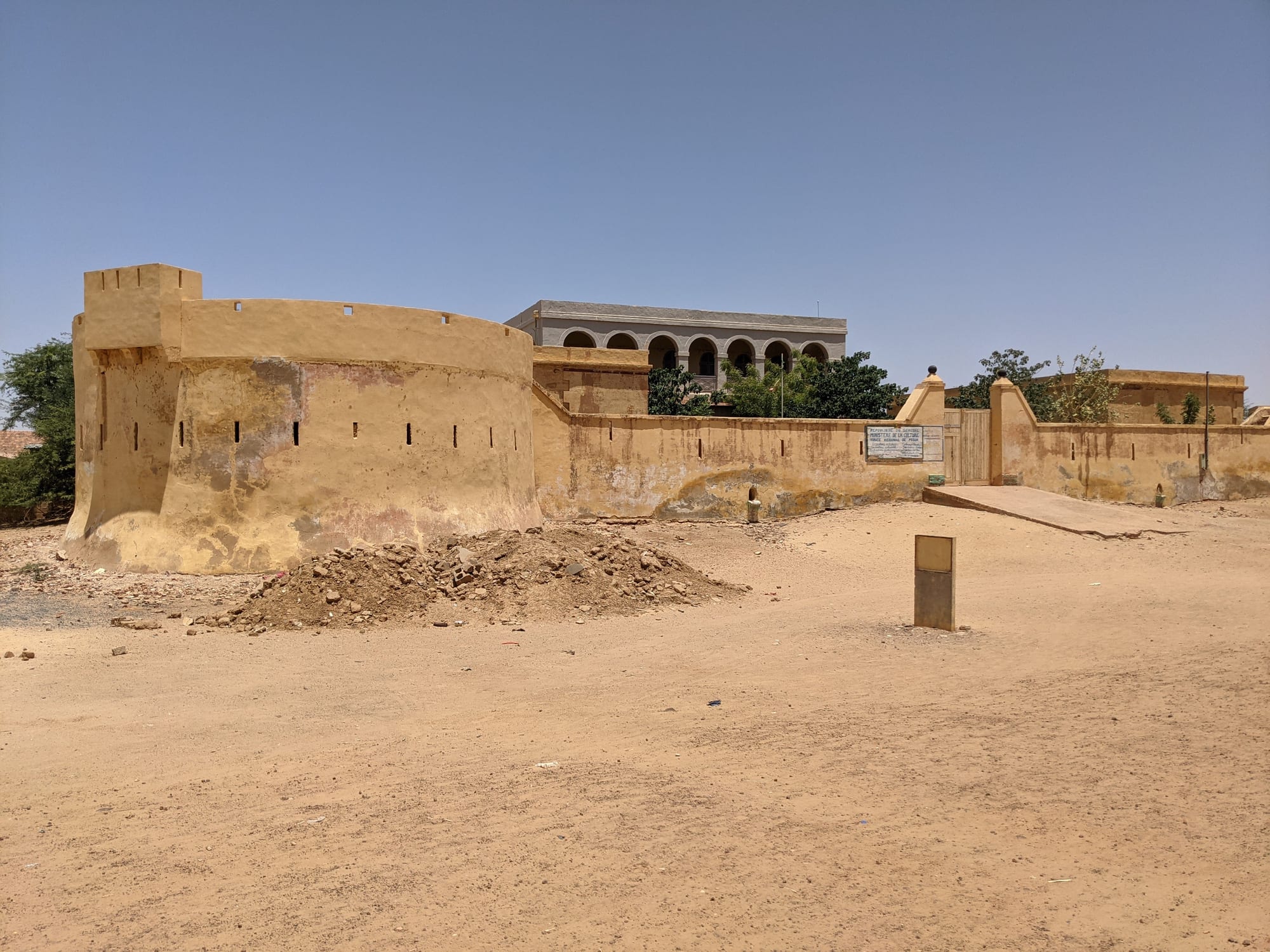
A restored sand-coloured fort with a rounded bastion and loopholes, standing on bare dry ground under a clear blue sky

Saint-Louis & the North, Senegal

Podor

The restored nineteenth-century fort at Podor, on the bank of the Senegal River. (Catjacket / Wikimedia Commons · CC0)

A small river town in the far north of Senegal, on an island between two arms of the Senegal River facing Mauritania. It was a trading post for gum arabic and a French fort from the middle of the nineteenth century, and its quay of merchants' houses, its restored fort and the Fula country of the Fouta Toro around it are what visitors come for.

Neighbourhoods

  • The quay and the old town
    • First-time visitors
    • Historic district
    • River views

    The riverfront strip where the fort, the restored trading houses with their arcades and balconies, and the landing stage for boats all stand within a few hundred metres. It is the part of Podor that recalls the river trade, and the place where cruise passengers come ashore.

    Open in Maps
  • The town behind the river
    • Local life
    • Markets
    • Quiet and residential

    Compounds of low houses, a market, schools and the administrative offices spread back from the quay across the island. Life here is unhurried and follows the heat, with activity early in the morning and again in the evening.

    Open in Maps
  • The Île à Morphil
    • Local life
    • Villages
    • Birdwatching

    The long strip of land between the Senegal River and its Doué branch, reached by road and ferry from the town. Fula and Toucouleur villages, irrigated fields, cattle and old mud-brick mosques line the tracks along it.

    Open in Maps

Things to do

The river town

  • Fort of Podorlandmark

    The well-preserved French colonial fort, built in 1854 as a centre for the river's gold trade and restored in recent decades as the town's main monument.

    Open in Maps
  • The quay and trading houseslandmark

    The line of nineteenth-century merchants' houses along the riverfront, with arcades, shutters and first-floor balconies, restored as part of the town's riverside walk.

    Open in Maps
  • Senegal Riverattraction

    The great river of the western Sahel, forming the border with Mauritania here and the reason the town exists; pirogues cross it and cruise boats work up from Saint-Louis.

    Open in Maps

Along the valley

  • Halwarattraction

    A village a short way upstream, known as the birthplace of El Hadj Omar Tall, the nineteenth-century Toucouleur scholar and conqueror.

    Open in Maps
  • Doué Riverattraction

    The branch that runs parallel to the Senegal on its southern side, leaving the main channel upstream towards Kaédi and rejoining it near Podor, enclosing the long island of Morphil.

    Open in Maps

Short trips from the town

  • Ndioumneighborhood

    A market town upriver on the N2, the main valley road, linked to the Île à Morphil by the Ndioum bridge over the Doué.

    Open in Maps

Seasonal events

  • Tabaskimoves with the Islamic calendar

    The feast of the sacrifice, the largest occasion of the year in the valley, when families gather and sheep are slaughtered and grilled.

  • Koritémoves with the Islamic calendar

    The end of Ramadan, marked with morning prayers in the open, new clothes and visits between compounds.

  • River cruise seasonNovember to April

    The cool dry months, when boats run up the Senegal River from Saint-Louis to Podor and the valley is at its most comfortable.

  • Harvest along the riverafter the rains, roughly October to February

    The season when the irrigated rice, onions and tomatoes of the valley are brought in and the markets of the river towns are fullest.

Eat and drink

Long-standing places and food districts in Podor. Hours, ratings and directions come from your maps app, always current.

Valley cooking

  • River fish and ricerestaurant

    Captain and other river fish cooked with rice from the irrigated fields, the valley's version of the coastal ceebu jën.

    Open in Maps
  • Fula milk and milletrestaurant

    Kossam, the herders' soured milk, drunk on its own or poured over millet couscous, is the dish most associated with the Fouta Toro.

    Open in Maps
  • Grilled muttonrestaurant

    Sheep are the wealth of the valley, and mutton grilled over charcoal with mustard and onion is the festival and evening food.

    Open in Maps

The market

  • Podor marketmarket

    The town market, selling river fish fresh and dried, onions and tomatoes from the nearby fields, milk, cloth and goods brought across from Mauritania.

    Open in Maps
  • Tea and juicescafe

    Ataya, strong green tea poured in three sweetening rounds, is drunk everywhere, alongside bissap hibiscus and bouye baobab juices sold cold in the market.

    Open in Maps

Experience Podor

History

Podor sits at a strategic point on the Senegal River, at the head of the reach that seagoing boats could work up from the sea and at the western edge of the Fouta Toro, the Fula- and Pulaar-speaking country of the middle valley. Trade in gum arabic, gathered from acacia forests on the Mauritanian bank, drew European merchants upstream from Saint-Louis from the seventeenth century, and the site was fortified and abandoned more than once.

The Fouta Toro itself was a power in its own right. In 1776 Muslim clerics overthrew the ruling Denianke dynasty and founded a state governed by elected almamys, and the region produced El Hadj Omar Tall, born at Halwar near Podor about 1794, whose jihad built an empire far to the east. The French returned to the river in force in the 1850s under Governor Louis Faidherbe, who built the fort at Podor in 1854 as part of a chain of posts used to control the valley and its trade.

Under French rule the town became a busy river port. Merchants built two-storey houses with arcades and balconies along the quay, and steamers carried gum, hides, millet and later groundnuts downstream while the water was high. Road transport and the decline of river shipping ended that trade, and Podor shrank back into a small administrative town. Since the 1990s the fort and several quayside houses have been restored, and cruise boats from Saint-Louis have brought a modest tourism to the riverfront.

Culture & Customs

Podor belongs to the Fouta Toro and its Haalpulaar'en, the Pulaar-speaking people also known as Toucouleur, whose identity rests on early and deep Islamisation, Quranic scholarship, and an elaborate social order of families and occupational groups. Religious learning is a source of status, and the valley has produced scholars, reformers and the founders of states.

The town's best-known son today is the singer Baaba Maal, born in Podor, whose work draws on Pulaar praise-singing and the region's music and who has kept the name of the town in circulation far beyond Senegal. Griot families continue to hold and perform genealogies at weddings and naming ceremonies, and drumming, flute and stringed instruments accompany them.

Emigration shapes everything. Families from the valley have gone to Dakar, to France and to central Africa for generations, and the money they send back builds large concrete houses in villages that otherwise look poor, pays for weddings and supports those left behind. The result is a place that is at once conservative and outward-looking. Visitors are met with formal courtesy: greetings first, questions about family and health, tea poured in three rounds, and food shared from a common bowl.

Daily Life

Podor is small — about 12,500 residents at the 2023 census, with a larger population in the surrounding department — and it functions as a market and administrative centre for the villages of the river and the Île à Morphil. It is the northernmost town in Senegal, and the Mauritanian bank is within sight across the water.

The economy is the river. Irrigated schemes along the valley grow rice, onions, tomatoes and other vegetables with water pumped from the Senegal, a system transformed by the dams built after independence; herders keep cattle, sheep and goats on the flood plain and move them with the seasons; fishing supplies the market. Public employment, small trade and remittances from abroad fill out the rest, and tourism is a minor addition centred on the quay.

The rhythm follows the heat. Work is done early, the middle of the day is spent in shade with the main meal shared from a bowl, and the town comes out again in the evening for tea and conversation. The problems are those of the whole valley: extreme heat, uncertain rainfall, the cost of pumping and fertiliser, limited health services and schooling, and the steady departure of young people for Dakar or abroad.

Food

Cooking here belongs to the river and the herd rather than the ocean. Freshwater fish — captain and others taken from the Senegal and the Doué — is cooked with rice grown in the irrigated fields nearby, a valley version of the ceebu jën eaten on the coast, and dried or smoked fish seasons sauces when fresh is scarce.

Millet is the older staple and remains central: steamed as couscous and eaten with a sauce of meat, fish or groundnut, or cooked into lakh, a porridge served with sweetened curds. The Fula contribution is dairy. Kossam, soured milk, is drunk on its own, sweetened, or poured over millet couscous to make the dish most closely identified with the Fouta Toro, and butter and curds appear on the same table. Mutton and goat are the meats of feasts and of the charcoal grills, sold by weight with mustard and raw onion.

Vegetables from the valley's schemes — onions above all, along with tomatoes, sweet potatoes and okra — go into everyday sauces, and mangoes and other fruit are traded in season. Tea is the fixed ritual: strong green ataya brewed in a small pot and poured from a height in three rounds, each sweeter than the last, drunk through the long afternoons. Bissap from hibiscus flowers, bouye from baobab fruit and ginger juice are the cold drinks, and coffee is served as Café Touba, roasted with grains of selim pepper.

Planning tools

Budget

Podor is inexpensive, with a handful of small hotels and guesthouses, some in restored river houses, and cheap eateries around the market. The costs that add up are transport — a hired vehicle or a place in a sept-place from Saint-Louis — and a berth on a river cruise, which is in another bracket entirely.

Daily Budget Midrange
USD 70–170 (guesthouse in a restored river house, restaurant meals, a car and driver, a boat trip)
Daily Budget Shoestring
USD 20–40 (simple auberge, local eateries, sept-place taxis)

Bring enough cash for the whole stay, as banking facilities in the valley are limited compared with Saint-Louis.

Best Time to Visit

November to February, when days are warm rather than fierce and the nights are cool, is much the best time, and it is also the river cruise season. April to June is extremely hot, regularly above 40°C, and the short rains fall between July and September.

Suggested Number of Days

A day covers the fort, the quay and the market. Two or three allow the villages of the Île à Morphil, a boat on the river and the wider Fouta Toro, which is the real reason to come this far upstream.

First Visit
1 day
With Surroundings
2–3 days

Transportation

Sept-place taxis and minibuses run along the valley road between Saint-Louis, Richard-Toll, Podor and Ndioum, thinning out as the day goes on and upstream. Within the town, distances are short and covered on foot, by horse cart or by motorbike taxi, and pirogues cross the river and the Doué branch.

Set off early for road journeys in the valley: departures dry up in the afternoon and night travel is best avoided.

Airport & Station Connections

Podor is about 220 km from Saint-Louis by the paved road that follows the river through Richard-Toll, roughly three to four hours by car or sept-place taxi, and a full day's drive from Dakar. A river cruise boat working between Saint-Louis and Podor is the other way in, taking several days each way and usually booked as a package.

Walkability

The town is small, flat and easily walked, and the quay, the fort and the market are all within a few minutes of one another. The heat is the limiting factor rather than the distances: shade is scarce, and walking is sensible only in the early morning and the evening for much of the year.

Safety

Podor is quiet and crime against visitors is rare. The serious risks are environmental: extreme heat in the hot season, strong currents and bilharzia in the river, and malaria through and after the rains. This is a border area, so identity documents should be carried, and the river is not a casual place to cross into Mauritania.

Don't walk the Corniche or empty beaches after dark or carry valuables, be firm with touts, take malaria precautions, and check current advice for the far east near Mali and rural Casamance. Check current official travel advice before travelling.

Climate

Hot and dry Sahelian, far from the moderating ocean and among the hottest parts of Senegal. The dry season runs from October to June and a short rainy season falls between July and September.

Summer
very hot, often above 40°C in May and June, then humid with occasional heavy showers from July to September
Winter
warm days around 30–34°C, markedly cool nights and harmattan dust

Local Customs

This is Haalpulaar country, where Pulaar rather than Wolof is the everyday language and Islamic scholarship and family lineage carry weight. Dress is conservative for men and women, greetings are long and expected before any business, and hospitality — tea, and food from a shared bowl — is offered readily and should be accepted graciously.

Ask before photographing people, dress to cover shoulders and knees, and greet elders first when entering a compound or a shop.

Common Payment Methods

The currency is the West African CFA franc (XOF). Podor runs on cash: the market, transport and small eateries take notes only, mobile money is widely used, and bank branches and ATMs are few, so money is best drawn in Saint-Louis or Richard-Toll before arriving.