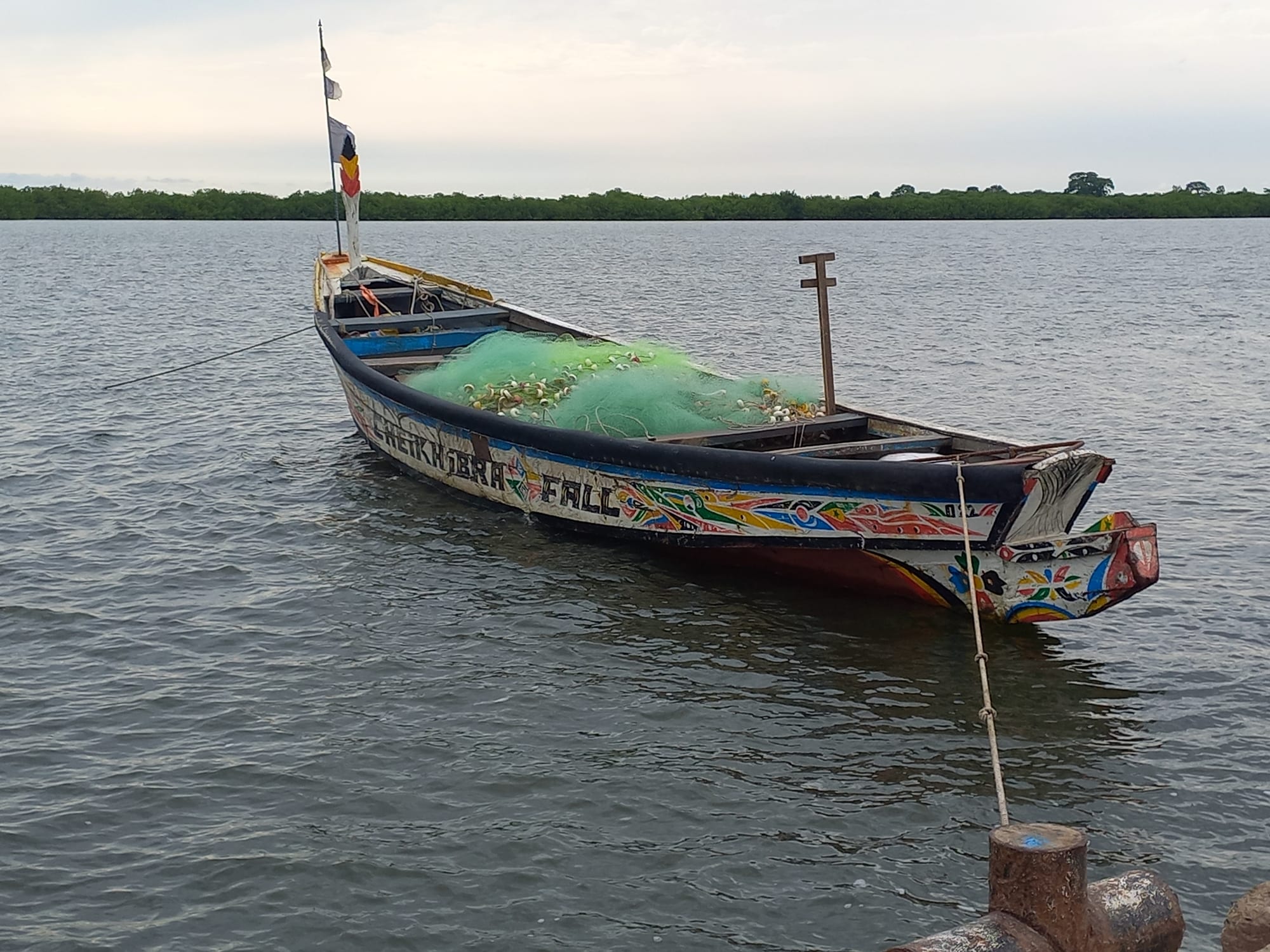
A painted wooden fishing pirogue loaded with green nets, moored on calm water with a mangrove shore beyond

Senegal

The Sine-Saloum Delta & the Centre

A fishing pirogue at Missirah, on the Bandiala channel in the Saloum delta. (Mouhamadoulmansour / Wikimedia Commons · CC BY-SA 4.0)

Central Senegal between Dakar's hinterland and The Gambia, from the mangrove islands of the Saloum delta inland through Fatick and the trading city of Kaolack to the groundnut fields of Kaffrine — the land of the old Serer kingdoms of Sine and Saloum and the heart of the peanut basin.

Explore The Sine-Saloum Delta & the Centre

History

The delta has been lived in for many centuries. Its people piled up huge middens of shells from harvested shellfish, some used as burial mounds, which are the reason for the UNESCO listing. From the 14th and 15th centuries, the Serer kingdoms of Sine and Saloum ruled the region. Sine had its capital at Diakhao and was ruled by a king called the maad a sinig; Saloum, with its capital at Kahone near Kaolack, grew rich on salt and trade.

In the 19th century the Muslim reformer Maba Diakhou Ba led a jihad across Saloum and neighbouring lands, but in 1867 he was killed at the battle of Fandane-Thiouthioune by the forces of Sine. The French, advancing from the coast, took control of the region in the late 19th century, and the peanut basin was born as the colonial economy pushed groundnut farming across the interior. Kaolack became the main collecting centre and river port for the crop.

In the 20th century Kaolack also became a religious capital when Ibrahim Niass founded Medina Baye, from which his branch of the Tijaniyya spread across West Africa. Kaffrine was separated from Kaolack region in 2008. Fatick's best-known modern figure is Macky Sall, born there in 1961, who became president in 2012.

Culture & Customs

This is Serer country, particularly in Fatick and the delta, and Serer identity is strong and distinctive. Many Serer are Muslim, but the region has a notable Catholic minority, and traditional Serer religion survives alongside both. Each year the Xoy, a gathering of saltigués — seers — is held in Fatick to foretell the coming rains and harvest. Wrestling, a Serer tradition, is taken very seriously, and village bouts after the harvest draw crowds.

Kaolack is Wolof-speaking and strongly shaped by the Tijaniyya: Medina Baye draws followers from Nigeria, Ghana, Mauritania and beyond, and its annual gatherings fill the city. The island villages of the delta have their own identity, with Niominka fishermen and women who gather oysters and shellfish in the mangroves.

Manners follow the national norms of greetings, shared bowls and ataya tea. Religious tolerance is widely admired; mixed Muslim and Christian families are common among the Serer.

Daily Life

Kaolack is the largest city, a busy commercial hub with a huge central market, groundnut oil mills and salt works along the Saloum river. Fatick and Kaffrine are smaller administrative towns, and Foundiougne, Sokone and Koungheul serve their districts. Much of the population is rural.

Farming dominates: groundnuts, millet and sorghum in the peanut basin, with cattle and horses in most villages, and horse-drawn carts on every road. In the delta, men fish from pirogues and women harvest oysters, cockles and salt. Tourism provides jobs in the lodges around Toubacouta, Palmarin and Ndangane.

The rhythm follows the farming year: planting when the rains come in July, weeding through the wet season and harvesting peanuts in the autumn. Current issues include soil exhaustion in the peanut basin, low crop prices, salinisation of farmland near the delta, loss of mangroves, and young people leaving for Dakar or abroad.

Food

Peanuts dominate the central diet. Mafé, a stew of meat in a thick groundnut sauce, is everyday food, and roasted peanuts are sold by the paper cone at every bus stop. Millet is the grain of the countryside, eaten as thiéré (steamed couscous) with a sauce, or as the sweet porridge lakh with curdled milk.

The delta adds seafood. Mangrove oysters are grilled over the embers; cockles, crabs and fish from the channels are dried or smoked for sale. Grilled fish with rice is standard in the island villages, and ceebu jën is made with the local catch.

Among Serer Christians, ngalakh — a sweet mixture of millet, peanut paste and baobab fruit — is prepared at Easter and shared with Muslim neighbours. Bissap and bouye juices are sold everywhere, and ataya tea closes most meals.

Attractions & Natural Wonders

The Saloum delta is the region's great sight: a maze of mangrove channels, sandbanks and low islands where the Saloum river meets the Atlantic. It is protected as a national park and biosphere reserve, and the delta is a UNESCO World Heritage Site for its shell middens and burial mounds. Pirogue trips run from Ndangane, Djifer, Foundiougne and Toubacouta to island villages such as Mar Lodj, Dionewar and Niodior, where visitors can see fishing, oyster gathering and birdlife — pelicans, herons, terns and flamingos. Palmarin, on the northern edge, has marshes, beaches and palms, and the Pointe de Sangomar is a sand spit at the mouth.

In the south of the delta, the Bandiala channels around Missirah and the Fathala forest reserve, part of the national park, add woodland to the mangroves.

Inland, Kaolack is worth a stop for its large central market and the Grand Mosque of Medina Baye. Beyond, the peanut basin around Kaffrine is flat country of baobabs, millet fields and village markets, where the harvest season of groundnut piles and horse carts is the scene most visitors remember.

Cities in The Sine-Saloum Delta & the Centre

Planning basics

Budget

The centre is one of the cheaper parts of Senegal for daily costs, with inexpensive food and transport around Kaolack, Fatick and Kaffrine. The delta is different: most visitors stay in eco-lodges or campements at Ndangane, Palmarin, Toubacouta or on the islands, often half-board, and pay extra for pirogue trips, which are the main expense.

Daily Budget Midrange
USD 80–190 (delta lodge with meals, private pirogue excursions, a car and driver)
Daily Budget Shoestring
USD 25–50 (simple campement, local food, sept-place taxis, a shared pirogue)

Agree the length, route and price of a pirogue trip before boarding, and whether fuel is included.

Safety

The region is calm and generally safe. The main risks are on the roads, which carry heavy freight traffic through Kaolack, and on the water, where pirogues can be overloaded and life jackets are not always provided. Mosquitoes are thick in the mangroves, particularly in the rainy season.

Ask for life jackets on pirogues, avoid boat trips in poor weather, and take malaria precautions. Check current official travel advice before travelling.

Climate

The delta is moderated by the sea and is milder than the interior, while Kaolack and Kaffrine are hot savanna country, with fierce heat before the rains. The rainy season, roughly July to October, is heavier than in the north, turning the peanut basin green. The dry season brings dusty harmattan winds inland.

Summer
hot and humid, around 27–35°C, with heavy downpours; Kaolack is often hotter before the rains
Winter
dry, around 18–32°C, cooler nights, harmattan haze inland

Transportation

Kaolack is a crossroads on the main roads to Mali, The Gambia and the Casamance, a few hours from Dakar by sept-place taxi. Fatick lies on the Dakar–Kaolack road. The delta is reached by road to Ndangane, Djifer, Foundiougne or Toubacouta, and then by pirogue; some island villages have no vehicle access at all.

Arrange the pirogue transfer with the lodge in advance, and travel between towns in daylight.

Best Time to Visit

November to April is the best season for the delta, with dry weather, calm channels and many migrant birds. March to June is very hot inland. The rains from July to October are hot and humid, and bring mosquitoes to the mangroves, but also green landscapes and the groundnut harvest that follows in the autumn.