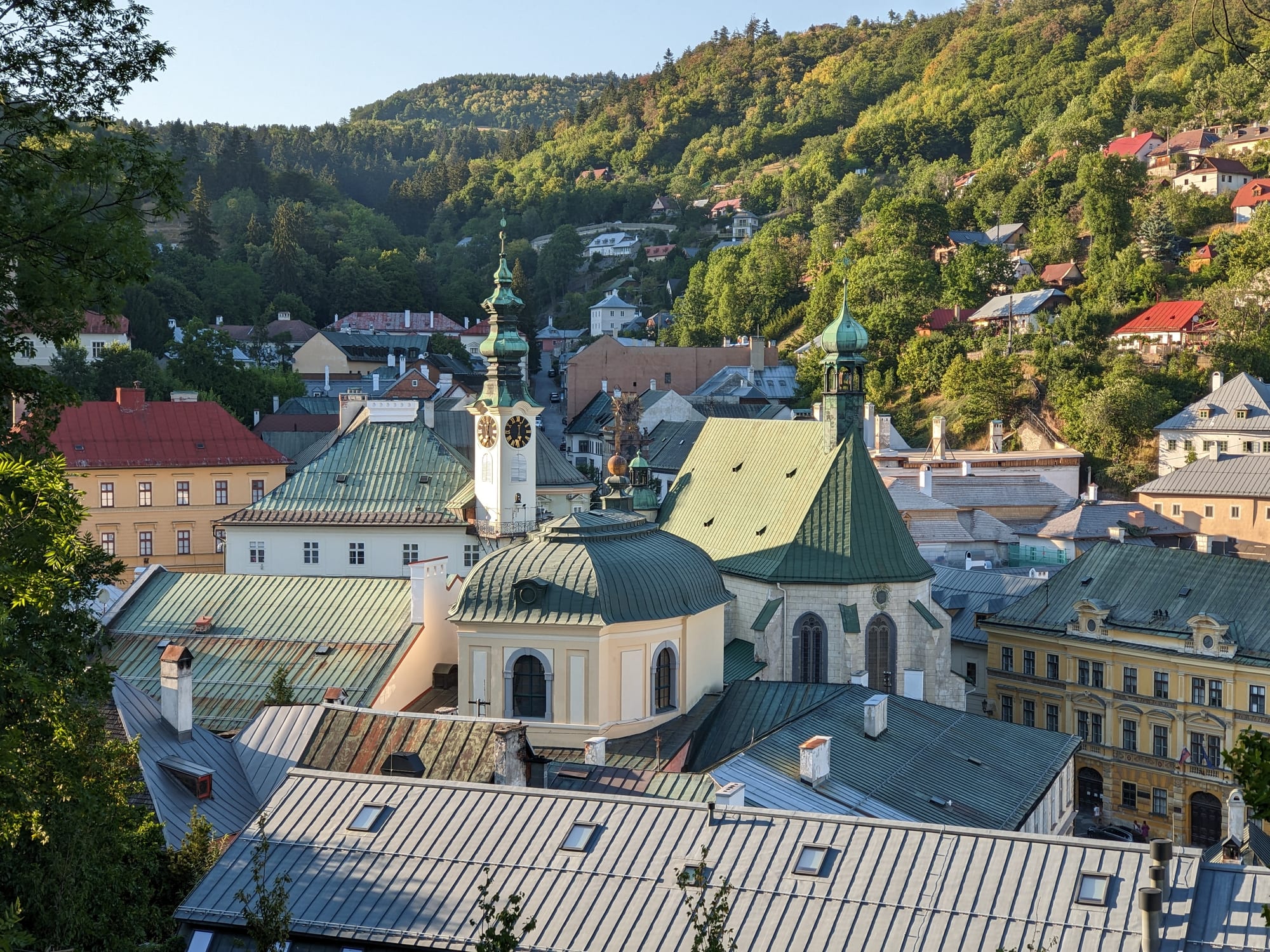
Green copper roofs, a white clock tower and the Gothic church of St Catherine in a steep wooded valley lined with houses

Central Slovakia, Slovakia

Banská Štiavnica

The roofs of Banská Štiavnica's old centre, with the town hall clock tower, the Lutheran church and St Catherine's Church. (Patrik Kunec / Wikimedia Commons · CC BY-SA 4.0)

A small town in central Slovakia set in the caldera of a collapsed volcano, the Štiavnica Mountains. For centuries the Kingdom of Hungary's leading producer of silver and gold and the seat of a pioneering mining academy, it keeps a steep old centre of churches, burghers' houses and two castles, ringed by artificial mining lakes, and is a UNESCO World Heritage Site.

Neighbourhoods

  • The historic centre
    • First-time visitors
    • Historic district
    • Best for food

    The old town climbing the sides of a narrow valley, from Holy Trinity Square with its plague column and burghers' houses up to the Old Castle and across to the New Castle. Its streets are steep and compact, lined with churches, the old mining offices, museums, cafés and guesthouses.

    Open in Maps
  • Calvary hill
    • Walks
    • Viewpoints

    Ostrý vrch, the hill on the edge of town crowned by a late-baroque Calvary of three churches and 22 chapels, built in 1744–51 on the initiative of the Jesuits.

    Open in Maps
  • The tajchy lakes
    • Swimming
    • Walks
    • Families

    The artificial mining reservoirs in the wooded hills around the town, now used for recreation. Počúvadlo, much visited by locals in summer, has boat hire, fast food and camping.

    Open in Maps

Things to do

The old town

  • Holy Trinity Squarelandmark

    The sloping main square, laid out in the early 16th century and lined with houses of rich burghers and mining entrepreneurs, with a large Holy Trinity column put up in thanks for the end of the plague of 1710–11.

    Open in Maps
  • St Catherine's Churchlandmark

    A late Gothic church of 1488–91 on the main square, known as the Slovak Church because mass was preached in Slovak there from 1658.

    Open in Maps
  • Old Castlemuseum

    A 13th-century Romanesque basilica turned into a fortress against Turkish raids in the 1540s, with a round chapel and charnel house, and museum displays of sacred art, local tobacco pipes and blacksmithing.

    Open in Maps
  • New Castlemuseum

    A whitewashed Renaissance fortress of 1564–71 with four corner bastions on a hill at the entrance to the town, built against the threat of Ottoman invasion.

    Open in Maps
  • Piarg Gatelandmark

    The only one of the town's six fortified gates still standing, built in 1554 and given baroque decoration in the 18th century.

    Open in Maps

Mining heritage

  • Open-air Mining Museummuseum

    A museum about a kilometre outside the town where visitors in helmets and lamps walk about 1.5 km of underground galleries dating from the 17th century, with mining buildings and machines on the surface.

    Open in Maps
  • Kammerhofmuseum

    One of the largest building complexes in the town, the former seat of the Mining Chamber that ran the mines, smelters and mints of central Slovakia, now a mining exhibition.

    Open in Maps
  • Glanzenberg aditattraction

    A medieval mine running directly beneath the town centre, visited on guided tours.

    Open in Maps

Hills, lakes and short trips

  • Banská Štiavnica Calvarylandmark

    A late-baroque Calvary of 1744–51, unique in its extent and content, with churches and chapels on a hill above the town.

    Open in Maps
  • Tajchypark

    Artificial reservoirs built mostly in the 18th century to power the silver mines, once a system of 60 lakes joined by more than 100 km of channels and tunnels; 24 survive as places to swim and walk.

    Open in Maps
  • Svätý Anton Manormuseum

    In the neighbouring village, a baroque manor house rebuilt in the mid-18th century into a four-wing noble residence, last privately owned by Ferdinand I of Bulgaria and now a museum of art, history and hunting.

    Open in Maps

Seasonal events

  • Salamander DaysSeptember

    The town festival, centred on the Salamander procession after dark, which began as a ceremonial parade of mining academy students and now portrays the life and legends of the mining town; it is listed as intangible cultural heritage of Slovakia.

  • St Hubert's DaysSeptember

    Hunting festivities at the manor in Svätý Anton, with a St Hubert's mass and a deer-calling competition.

Eat and drink

Long-standing places and food districts in Banská Štiavnica. Hours, ratings and directions come from your maps app, always current.

Banská Štiavnica classics

  • Bryndzové haluškyrestaurant

    Small potato dumplings with bryndza sheep's cheese, the national dish, served in the restaurants of the old town.

    Open in Maps
  • Holy Trinity Squareneighborhood

    The main square and the streets around it hold most of the town's restaurants, pizzerias and cafés.

    Open in Maps

By the lakes

  • Počúvadlo lakeneighborhood

    One of the tajchy, much visited by locals in summer, with fast-food stands beside the water.

    Open in Maps

Experience Banská Štiavnica

History

The Celts, probably the Cotini tribe, founded the first mining settlement here in the 3rd century BC. By 1156 the area was already called terra banensium, "the land of miners". German miners arrived from the 13th century. The town gained the status of a royal town in 1238, among the first in the Kingdom of Hungary, and through the High and Late Middle Ages it was the kingdom's main producer of silver and gold.

The Ottoman wars brought fortifications and two castles in the 16th century, and the town became a centre of the Reformation as a member of the Protestant League of Seven Mining Towns. It was also a centre of mining innovation: in 1627 gunpowder was used in one of its mines for one of the first times in the world, and in the 18th century the scientists Samuel Mikovíny, Jozef Karol Hell and Maximilian Hell built the tajchy, reservoirs and channels that drained and powered the mines. Mikovíny founded a mining school in 1735, which became the Academy of Mining in 1763 with Maria Theresa's support, and later added forestry. In 1782 Banská Štiavnica was the third-largest town in the Kingdom of Hungary.

Mining declined from the second half of the 19th century, and in 1919, after the creation of Czechoslovakia, the academy moved to Sopron in Hungary. Soviet troops took the town on 7 March 1945. On 11 December 1993 UNESCO listed the town and the technical monuments around it as a World Heritage Site, and tourism and recreation are now its main business.

Culture & Customs

Mining shaped the town's culture as well as its streets. The Klopačka, a tower of 1681, once sounded the start of the miners' shifts and announced festivals, meetings, funerals and fires, and the Salamander procession, first a ceremonial parade of the academy's students, has been revived every September since 1949 as the centrepiece of the Salamander Days. It portrays the life of the mining town and the legend of how its gold and silver were found, and is listed as part of Slovakia's intangible cultural heritage.

The academy's student traditions, known as the School traditions of Selmec after the town's Hungarian name, live on at its successor schools in Slovakia and Hungary. Religion has left its mark too: St Catherine's became the Slovak Church in 1658, the Church of the Assumption served German speakers, and the Lutheran church of 1794–96, which has no tower, follows the rules Emperor Joseph II set for Protestant churches. Today Roman Catholics are the largest group, alongside a Lutheran minority and many people of no religion.

The summer calendar fills the old town and the castles with festivals and concerts, and in September the manor at Svätý Anton hosts St Hubert's Days, with hunting traditions and a mass.

Daily Life

About 9,200 people live in Banská Štiavnica. In 1782 the town and its suburbs had tens of thousands of inhabitants; the decline of mining from the late 19th century left a small town in a large historic shell, and today the old centre holds museums, guesthouses, cafés and shops alongside homes.

Tourism and recreation are now the town's main business. Visitors come for the old town, the mining museums and the lakes. Everyday shopping happens at supermarkets on Drevená street, and much local life moves out to the lakes in summer, when Počúvadlo and the other tajchy fill with swimmers and campers.

The landscape around the town is part of the Štiavnica Mountains Protected Landscape Area, with forests, meadows, orchards and old mining works — waste heaps, shafts and reservoirs — scattered across the hills. Sitno, at 1,009 metres the highest point of the range, was a Bronze Age hill fort.

Food

Banská Štiavnica eats as central Slovakia does, from sheep's-cheese country. Bryndzové halušky, small potato dumplings with bryndza sheep's cheese, are on the menus of the town's restaurants, along with bryndzové pirohy, dumplings filled with the cheese, and demikát, a soup based on bryndza. Kapustnica, sauerkraut soup often cooked with mushrooms, meat and sausage and sometimes served in a bread bowl, is another staple.

Most restaurants and cafés are on and around Holy Trinity Square, with Slovak cooking alongside pizzerias. Chicken paprikash is typically served with halušky, and Hungarian-style goulash with slices of a large steamed bread dumpling, while lokše, pancakes of potato dough baked directly on the stove, are another Slovak staple. In summer the lakes have their own simple food scene, with snack bars and fast food by the water at Počúvadlo. For something sweet, zlaté halušky, golden dumplings of curd cheese and semolina topped with sweet breadcrumbs, are a traditional Slovak dessert.

Planning tools

Budget

Banská Štiavnica is cheaper than western Slovakia but is a popular weekend destination, and guesthouses fill up at weekends. Weekdays and the months outside summer are quieter and better value. Most visitors arrive by car, and parking near the New Castle is cheaper than in the centre.

Daily Budget Midrange
USD 100–180 (guesthouse in the old town, restaurant dinners, mine and castle tickets, a hire car)
Daily Budget Shoestring
USD 45–75 (pension or private room, set lunches, buses)

Walking the old town, the Calvary and the paths around the lakes costs nothing.

Best Time to Visit

June to September, when the lakes are warm enough for swimming, the castles host concerts and festivals, and the Salamander procession takes place. September and October bring autumn colour in the hills. The town is quietest outside summer weekends.

Suggested Number of Days

One or two days are enough for a first visit; three suit those who also want time in the surrounding mountains and lakes. The town is far from other main sights, so an overnight stay is usual.

First Visit
1–2 days
With Surroundings
3 days

Transportation

The old town is compact and best seen on foot. A car or taxi is the practical way to reach the lakes, the neighbouring villages and the mining museum outside town. Taxi numbers are available from the tourist office.

Park near the New Castle and walk into the centre, five to ten minutes away.

Airport & Station Connections

There is no direct main-line rail service: trains run from Bratislava towards Zvolen with a change at Hronská Dúbrava, and the town's station is about 3 km downhill from the centre, a 30–40 minute walk. Two or three buses a day run from Bratislava, and Zvolen, about 35 km away, has direct buses. Drivers leave the R1 expressway for some 20 km of winding, narrow roads.

Walkability

The historic centre is small and easy to cover on foot, but it is built on the steep sides of a valley, so every walk involves climbing. Streets are cobbled, and paths lead from the edge of town up to the Calvary and out to the nearest lakes.

Safety

Slovakia is a very safe country with low violent crime. Banská Štiavnica is a small, quiet town. The practical hazards are steep, slippery cobbles in wet or icy weather, winding mountain roads for drivers, and old mining features in the surrounding hills.

Wear shoes with a good grip, stay on marked paths in the hills, and drive slowly on the approach roads in winter. Check current official travel advice before travelling.

Climate

The town's climate has a mountain character but is mild, without extreme swings in temperature.

Summer
warm — June and July are the wettest months in nearby Zvolen, whose average over the whole year is about 8.5°C
Winter
cold — across Slovakia daily winter temperatures average between -5 and 10°C, and nights may be freezing

Local Customs

The town's identity is bound up with mining: the old academy's student traditions survive in the Salamander procession and in universities in Slovakia and Hungary that descend from it. The Catholic and Lutheran churches are both working churches, a reminder of the town's role in the Reformation.

Dress modestly in churches, book mine tours in advance, and respect private property in the hillside streets and villages.

Common Payment Methods

The currency is the euro. Cards are accepted in most restaurants, museums and guesthouses, and there are ATMs in the centre. Carry some cash for parking, snack bars at the lakes and small shops.