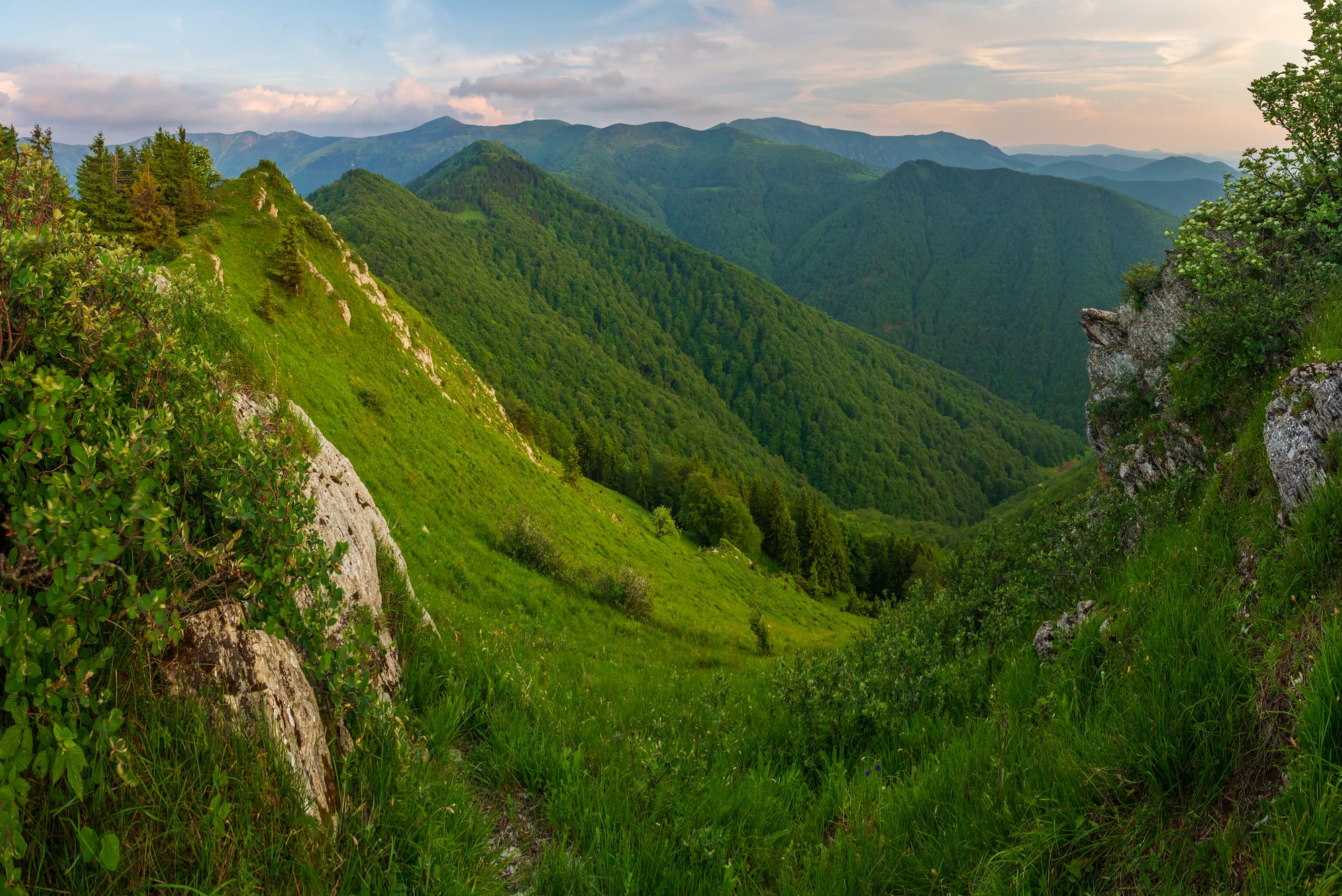
Grassy, rock-edged ridge dropping into forested valleys, with rows of green mountain ridges under a pink evening sky

Slovakia

Central Slovakia

The ridges of the Malá Fatra seen from Baraniarky in Žilina District. (Ximonic (Simo Räsänen) / Wikimedia Commons · CC BY-SA 4.0)

The mountainous heart of Slovakia, from the Orava and Kysuce valleys on the Polish border through Žilina, Liptov and the Low Tatras to the old mining towns of the Štiavnica hills and the Hungarian-speaking south — the country of sheep-cheese farms, timbered villages and the 1944 uprising.

Explore Central Slovakia

History

The mountains of central Slovakia were thinly settled until the Middle Ages, when their ores made them some of the richest land in the Kingdom of Hungary. From the 13th century German-speaking miners founded or expanded the royal mining towns: Banská Štiavnica on silver, Kremnica on gold — its mint, working since 1328, still strikes coins — and Banská Bystrica on copper, which the Thurzo and Fugger families exported across Europe from the 1490s. From 1763, with Maria Theresa's support, the mining school at Banská Štiavnica became a mining academy, one of the first technical colleges of its kind.

In the north, Orava, Kysuce and Liptov were lands of castles, sheep farming and poor mountain villages, settled in part by Wallachian shepherds. Juraj Jánošík, born in Terchová in 1688, robbed travellers in the region and was executed in Liptovský Mikuláš in 1713, becoming Slovakia's folk hero. The 19th-century national revival centred on Martin, where the Memorandum of the Slovak Nation was adopted in 1861, the cultural society Matica slovenská was founded in 1863 and Slovak leaders declared support for a common state with the Czechs in October 1918.

On 29 August 1944 the Slovak National Uprising broke out, with its headquarters in Banská Bystrica, and held much of central Slovakia for two months before German forces crushed it; villages such as Kalište were later burned in reprisal. After the war, heavy industry came to Žilina, Martin and the Hron valley, and much of it closed after 1989 before new investment arrived.

Culture & Customs

Central Slovakia is often seen as the country's folk heartland. Its dialects are the base of standard Slovak, codified by Ľudovít Štúr in the 1840s, and Martin remains the home of Matica slovenská and the Slovak National Cemetery, where many writers and patriots are buried. Podpoľanie, around Detva, is the home of the fujara, the long shepherd's flute, and of richly embroidered costume, while Čičmany, in the hills south of Žilina, is known for log houses painted with white geometric patterns.

The region's festivals are among the country's biggest: the Východná folklore festival in Liptov each July, the Folk Festival under Poľana in Detva, and Jánošík's days in Terchová. Shepherding traditions survive in the salaš, the upland sheep farm where cheese is made, and in the carved wooden crosses, bells and shepherds' tools sold at fairs.

Most people are Catholic, but Lutheranism is strong in towns such as Banská Bystrica and around Liptov, and the wooden articular church at Hronsek recalls the time when Protestants were allowed only timber churches outside the town walls. In the south, around Lučenec and Rimavská Sobota, there is a sizeable Hungarian minority. Hockey loyalties run high, with Banská Bystrica, Zvolen, Žilina and Liptovský Mikuláš all fielding clubs.

Daily Life

Žilina, with about 80,000 people, and Banská Bystrica, with about 75,000, are the main cities; Martin, Zvolen, Ružomberok, Liptovský Mikuláš, Dolný Kubín and Lučenec are the other centres. The north is mountainous and densely settled along its river valleys, the south more rural and poorer.

The Kia plant at Teplička nad Váhom, near Žilina, opened in 2007 and brought suppliers and jobs across the north. Martin has engineering firms, Ružomberok a large paper mill, and Banská Bystrica and Zvolen universities, public offices and services, while tourism supports Liptov, the Malá Fatra and Banská Štiavnica. The southern districts along the Hungarian border have high unemployment, and many young people leave for Bratislava, Czechia or abroad.

Days start early, lunch is the main meal, and weekends belong to the chata, the forest and the garden. Mushroom picking in late summer and autumn is close to a regional obsession. Air quality in winter inversions, bears wandering near villages and the long-delayed completion of the D1 motorway through the mountains are recurring local issues.

Food

This is the land of sheep's cheese. The salaš farms of Liptov, Orava and Podpoľanie make bryndza, a soft, crumbly salted sheep's cheese, and serve it in bryndzové halušky and in pirohy, filled dumplings. Oštiepok is a smoked sheep's cheese pressed into carved wooden moulds, parenica is a steamed cheese rolled into a spiral and smoked, and korbáčiky, thin braided strings of cheese, are an Orava speciality. Žinčica, the sour whey left over from cheesemaking, is drunk by the mug.

Everyday cooking is hearty mountain food: demikát, a shepherds' soup of bryndza and bread, kapustnica sauerkraut soup, potato pancakes, and strapačky, halušky tossed with sauerkraut and bacon instead of cheese. Venison and wild boar appear on menus in the hunting country of the Low Tatras and Poľana, and forest mushrooms turn up in soups and sauces in autumn.

For drink, borovička, a juniper spirit, and slivovica plum brandy are served at every celebration, and the herbal liqueur Demänovka shares its name with Liptov's Demänová valley. Martin has a long-established brewery, and the southern slopes of the Hron and Ipeľ valleys grow some wine.

Attractions & Natural Wonders

In the south, Banská Štiavnica rises in terraces around its main square, with the Old Castle, the New Castle, a hilltop Calvary, mining museums and the tajchy, old artificial mining reservoirs around the town. Kremnica has its mint and a hilltop castle, and Banská Bystrica combines a square of burghers' houses and a castle quarter with the museum of the Slovak National Uprising. Further south lie the Poľana mountains and the Muráň plateau, and the ruined castle of Fiľakovo stands above its town.

The north is mountain country. The Malá Fatra, above Žilina, has the rocky summit of Veľký Rozsutec, the Vrátna valley and the gorges of Jánošíkove diery, crossed by ladders and footbridges, with Terchová and its Jánošík statue at the park's edge. Žilina has an arcaded square, Budatín Castle stands at the town's northern edge, and Martin's Museum of the Slovak Village gathers timber houses from across the north. Orava Castle climbs a cliff above the river at Oravský Podzámok, and the valley continues past the wooden church of Tvrdošín to the Orava reservoir.

The Liptov valley runs east beneath the Low Tatras, whose Chopok ridge is served by lifts from the Jasná ski area; the Demänová valley below has two show caves, the Cave of Liberty and an ice cave. Liptovská Mara is a large reservoir with the Tatralandia aquapark nearby, and above Ružomberok the log-house village of Vlkolínec is still inhabited.

Cities in Central Slovakia

Planning basics

Budget

Central Slovakia is cheaper than the west. Žilina and Banská Bystrica have modestly priced hotels, and pensions and private rooms in the villages are good value; costs rise in Liptov's resorts around Jasná and at the aquaparks in the ski and summer seasons, and Banská Štiavnica's guesthouses fill and raise prices at weekends.

Daily Budget Midrange
USD 100–200 (hotel or resort stay, restaurant dinners, lift passes or cave tickets, a hire car)
Daily Budget Shoestring
USD 45–75 (pension or private room, salaš and denné menu meals, buses and trains)

Stay in Liptovský Mikuláš rather than at Jasná, and eat at a roadside salaš for filling, inexpensive meals.

Safety

Central Slovakia is safe, with little crime aimed at visitors. The real hazards are mountain ones: fast weather changes and wet, slippery ladders in the Jánošíkove diery gorges, avalanche risk on the higher ridges in winter, bears in the forests of the Low Tatras and Malá Fatra, and winter driving on mountain passes.

Stay on marked trails, make noise in bear country and carry winter equipment in the car from November to March. Check current official travel advice before travelling.

Climate

Colder and wetter than the west. The mountain basins of Orava, Kysuce and Liptov have long, snowy winters and frequent temperature inversions, while the southern valleys of the Hron and the Ipeľ are warmer and drier. Snow lasts on the higher Low Tatras and Malá Fatra ridges into spring.

Summer
warm in the valleys, 20–28°C, cooler on the ridges, with afternoon thunderstorms
Winter
cold, often -10 to 0°C in the basins, with reliable snow in the mountains

Transportation

Žilina is the region's rail hub: the main line from Bratislava runs through it and on east through Liptov. Banská Bystrica is reached by rail via Zvolen, and buses serve Orava, Terchová and the mountain villages. Banská Štiavnica is awkward by public transport, and a car makes the region far easier.

Use Žilina or Liptovský Mikuláš as a base for the north, and Banská Bystrica or Zvolen for the south.

Best Time to Visit

June to September for walking in the Malá Fatra and Low Tatras, the castles and the folk festivals, including Východná in early July and Jánošík's days in Terchová. September and October bring clear days and autumn colour. December to March is ski season at Jasná and in the Vrátna valley, and Banská Štiavnica is quietest outside summer weekends.