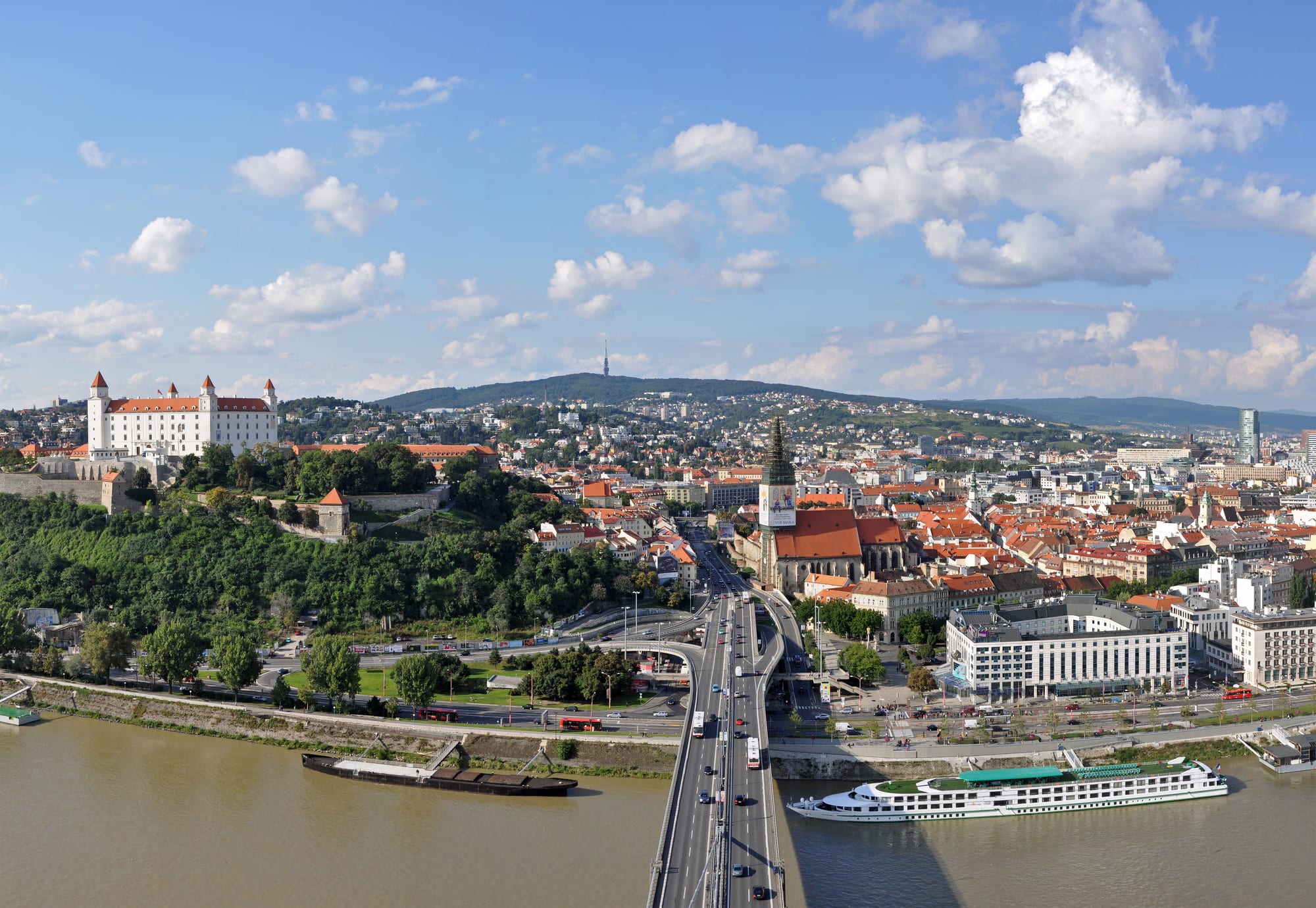
Bratislava Castle and the old town above the Danube, with a bridge, a river cruise ship and wooded hills behind

Slovakia

Bratislava & Western Slovakia

Bratislava from the SNP Bridge, with the castle on its hill and St Martin's Cathedral beside the Danube. (Marc Ryckaert (MJJR) / Wikimedia Commons · CC BY 3.0)

The lowland west of Slovakia, from the capital on the Danube across the Small Carpathian vineyards and the farmland of the Danubian plain to the Váh valley — the country's richest and most populous corner, home to its old coronation city, its first university town, the Great Moravian seat of Nitra and the spa of Piešťany.

Explore Bratislava & Western Slovakia

History

Celts of the Boii tribe had a fortified settlement on Bratislava's castle hill in the 1st century BC and struck silver coins there, and the Romans later guarded the Danube frontier at Gerulata, in today's Rusovce. At Trenčín a Roman legion carved an inscription into the castle rock in AD 179, recording a winter camp during the Marcomannic Wars. In the 9th century Nitra was the seat of Prince Pribina, who had a church consecrated there around 827, before his principality was absorbed into Great Moravia; Devín, above the Danube, was one of its strongholds.

Under the Kingdom of Hungary the region grew rich on Danube trade and wine. Pressburg, as Bratislava was then known, gained a short-lived university, the Academia Istropolitana, in 1465, and after the Ottomans took Buda in the 16th century it became Hungary's capital and coronation city: kings and queens, Maria Theresa among them, were crowned in St Martin's Cathedral until 1830, and the Hungarian diet met there until 1848. Trnava, seat of the archbishops of Esztergom in exile, gained a university in 1635, and Anton Bernolák based the first standard Slovak on the western dialects there in the 1780s. Ottoman armies raided the south and took the fortress of Nové Zámky in 1663.

In 1919 the city was renamed Bratislava and became the Slovak capital within Czechoslovakia, while the 1920 Treaty of Trianon left a large Hungarian population along the Danube. Communism brought vast housing estates such as Petržalka, and in 1993 Bratislava became the capital of independent Slovakia.

Culture & Customs

The west is the most urban and most outward-looking part of Slovakia, shaped by its closeness to Vienna and Budapest. Along the Danube and around Komárno and Dunajská Streda, Hungarian is the everyday language of many towns, with Hungarian schools, churches and a football club, DAC Dunajská Streda, that carries a strong minority identity. Záhorie, in the north-west, has its own dialect close to Moravian Czech.

The region is predominantly Catholic, and Trnava, with its dense ring of churches, is still called the "Slovak Rome". Wine culture runs deep in the Small Carpathians, where cellar open days and the September vintage festivals of Pezinok and Modra bind the villages together. Modra is known for its blue-and-white glazed majolica, a craft inherited from the Anabaptist Haban settlers of the 16th century, and Ľudovít Štúr, the father of standard Slovak, spent his last years there.

Bratislava re-enacts the Hungarian coronations at its coronation festivities, hosts the Bratislava Jazz Days and has a busy theatre and café life, while Trenčín's Pohoda is the country's largest summer music festival. In Slovenský Grob, near Pezinok, the autumn goose feast has become a regional ritual.

Daily Life

Bratislava, with about 475,000 people, dominates the region and the country's economy; the Bratislava Region has one of the highest incomes per head in Central Europe. Nitra, with about 75,000 people, Trnava, with about 63,000, and Trenčín, with about 54,000, are the other main centres, alongside Prievidza and Nové Zámky.

Cars drive the economy. Volkswagen builds vehicles in Bratislava's Devínska Nová Ves, Stellantis has a plant outside Trnava and Jaguar Land Rover opened a factory near Nitra in 2018, and supplier firms fill industrial parks along the motorways. The capital also runs on government, IT and shared-service centres, while the Danubian Lowland in the south is Slovakia's granary, growing wheat, maize, sunflowers and vegetables.

Life in Bratislava moves at a Central European city pace: trams and traffic jams into the centre, lunch menus in office districts, and weekends at the family chata or in the vineyards. Thousands commute to Vienna, and many Slovaks have bought homes in Austrian and Hungarian border villages. Housing costs in the capital, traffic, and the gap between the prosperous west and the rest of the country are the everyday political issues.

Food

The west eats from vineyards, fields and the Danube. Goose and duck are the pride of Slovenský Grob, where the husacie hody, the goose feast, serves roast goose with red cabbage and lokše, thin potato pancakes brushed with goose fat. Bratislavské rožky, crescent pastries filled with walnut or poppy seed, are the capital's traditional sweet, and Skalica in Záhorie is known for its trdelník, a hollow cake baked on a rotating spit.

In the Hungarian south the cooking leans towards paprika: halászlé, a spicy fish soup made with river carp, and lecsó, stewed peppers and tomatoes, are everyday dishes. Everywhere, the lunchtime denné menu brings soup and a main course, often vyprážaný syr, fried cheese with tartare sauce, or pork schnitzel with potato salad.

The Small Carpathians are one of Slovakia's best-known wine areas, making dry whites from Veltlínske zelené (Grüner Veltliner), Rizling vlašský (Welschriesling) and Riesling, and reds from Frankovka modrá (Blaufränkisch). In September the wine towns sell burčiak, partly fermented grape must that is sweet, cloudy and stronger than it tastes. Nitra and the southern hills produce more wine, and fruit brandies are made across the region.

Attractions & Natural Wonders

Bratislava's old town is small enough to walk in a morning: St Martin's Cathedral, where the Hungarian coronations took place, Michael's Gate, the Primate's Palace, the Old Town Hall and the art-nouveau Blue Church of St Elizabeth. The castle, rebuilt in the 20th century, looks down on the Danube and the SNP Bridge with its saucer-shaped observation deck. West of the city, Devín Castle's ruins stand at the meeting of the Morava and the Danube, and downstream at Čunovo the Danubiana modern art museum stands on the Danube dike near the Austrian and Hungarian borders.

North-east of the capital the Small Carpathians wine route runs through Svätý Jur, Pezinok and Modra, with cellars, wine shops and the Renaissance castle of Červený Kameň above the vineyards. Trnava has a walled centre, a town tower, and the cathedral of St John the Baptist in its old university quarter. Nitra's castle hill carries the cathedral of St Emmeram, with Zobor hill behind the town, and on the Danube the old fortress of Komárno faces its Hungarian twin town across the river.

Up the Váh valley, Piešťany's spa island, reached by the Colonnade Bridge, has thermal baths, mud treatments and the statue of a man breaking his crutch that is the town's emblem. Further north, Trenčín Castle rises above the old town, and in the Nitra valley Bojnice Castle, remodelled in romantic style between 1888 and 1910, is one of the most visited in Slovakia; the ruins of Čachtice, linked with Countess Elizabeth Báthory, lie on a hill near Nové Mesto nad Váhom.

Cities in Bratislava & Western Slovakia

Planning basics

Budget

This is the most expensive part of Slovakia, and Bratislava's old town is where prices come closest to Vienna's, especially for hotels and restaurants. Trnava, Nitra and Trenčín are noticeably cheaper, the wine villages offer good-value pensions and cellar tastings, and the spa hotels of Piešťany range from modest to expensive depending on the treatment package.

Daily Budget Midrange
USD 130–230 (central Bratislava hotel or spa hotel, restaurant dinners, wine tastings, castle tickets)
Daily Budget Shoestring
USD 55–85 (hostel or pension, denné menu lunches, regional trains and buses)

Stay in Trnava or a Small Carpathian wine town and day-trip into Bratislava to cut accommodation costs.

Safety

Western Slovakia is safe. The main issues are pickpockets in Bratislava's old town, at the main station and on busy trams, rowdy stag parties in the centre at weekends, and summer heat in the lowlands. Designated drivers matter on the wine route.

Watch bags in Bratislava's old town and use licensed or app taxis at night. Check current official travel advice before travelling.

Climate

The warmest and driest part of the country: the Danubian Lowland has long warm summers and relatively mild winters, while the Small Carpathians and the hills around the Váh valley are a little cooler and wetter. Bratislava is often windy, and snow in the lowlands rarely lasts long.

Summer
warm to hot, typically 25–32°C in the lowlands, with thunderstorms
Winter
cold but milder than the mountains, around -3 to 4°C, with grey spells and occasional snow

Transportation

Bratislava is about an hour from Vienna and its airport by train or bus and has its own smaller airport. The main line up the Váh valley links Bratislava with Trnava, Piešťany and Trenčín in roughly one to one and a half hours, and trains and buses reach Nitra and the wine towns. A car helps for the castles and the southern Danube towns.

Regional trains reach Pezinok in well under an hour from Bratislava; drivers need a motorway vignette.

Best Time to Visit

May to June and September to October are the best months: mild weather, the vineyards green or at harvest, and the Small Carpathian wine towns busy with vintage festivals and burčiak in September. July and August are hot in the lowlands, and July brings the Pohoda music festival at Trenčín. December has Christmas markets in Bratislava and Trnava.