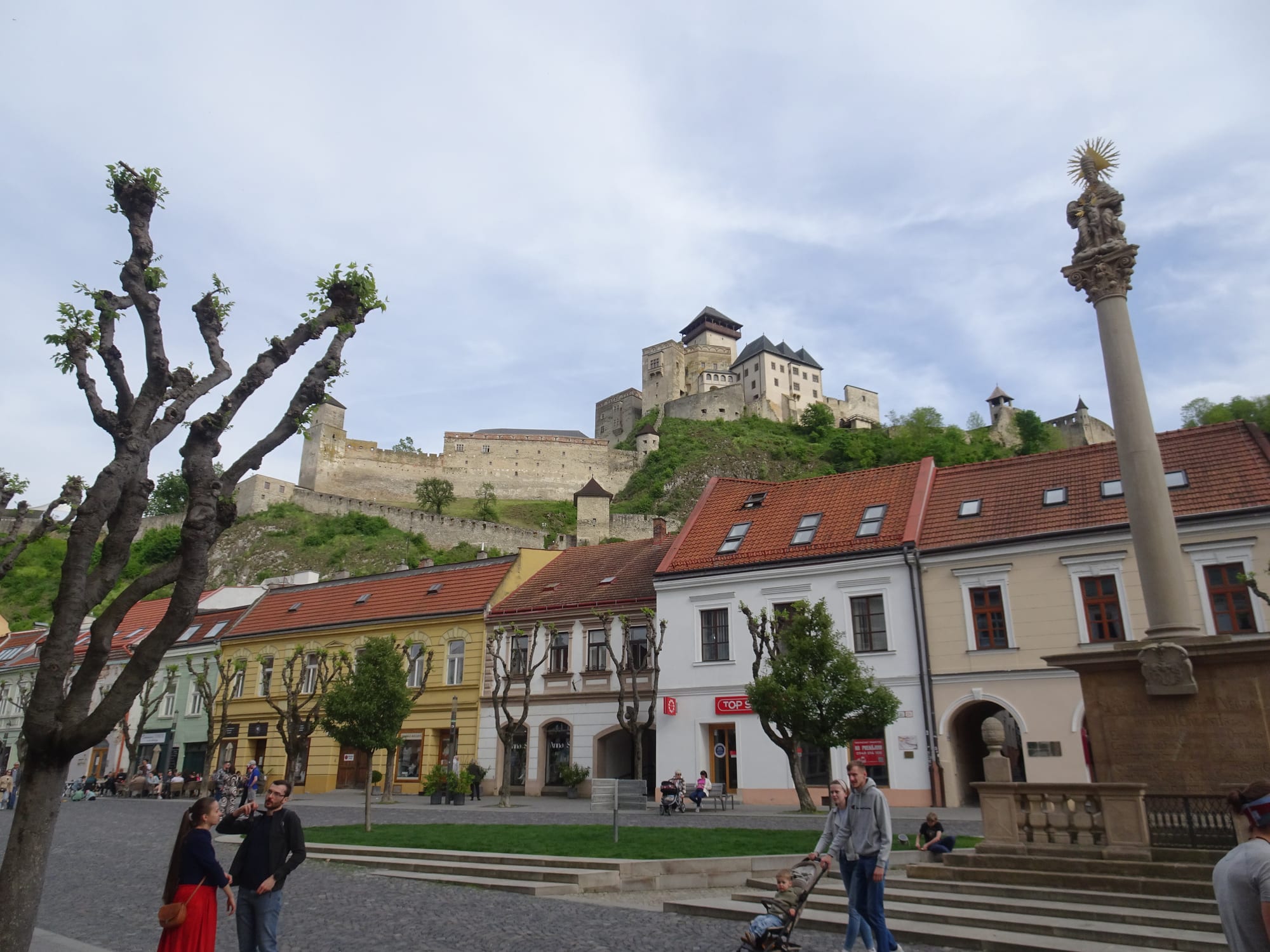
Trenčín Castle's walls and tall keep on a green hill above a row of pastel houses and a stone column on the main square

Bratislava & Western Slovakia, Slovakia

Trenčín

Trenčín Castle rising above the houses of Mierové námestie, the main square of the old town. (Palickap / Wikimedia Commons · CC BY 4.0)

A city in the middle Váh valley of western Slovakia, near the Czech border, below one of the country's largest castles. Roman soldiers carved an inscription into its castle rock in AD 179; a medieval magnate controlled most of today's Slovakia from it. Now a regional capital with a restored old town, it is a European Capital of Culture for 2026.

Neighbourhoods

  • Old town (Staré mesto)
    • First-time visitors
    • Historic district
    • Best for food

    The small, largely pedestrianised centre below the castle rock, restored since 1990. Mierové námestie, the long main square, has the Piarist church, a plague column and the town gate tower, and steep streets and covered stairs climb from it to the parish church and the castle.

    Open in Maps
  • Ostrov and the Váh embankment
    • Sport
    • Walks
    • Families

    Ostrov, the island by the Váh next to the centre, is the town's main place for recreation, with sports halls, courts and canoe hire. The levee along the river carries a path used by walkers, cyclists and rollerbladers.

    Open in Maps
  • Sihoť
    • Quiet and residential
    • Sport

    Housing estates north of the centre, home to the Sihoť football stadium of AS Trenčín.

    Open in Maps

Things to do

The castle and the old town

  • Trenčín Castlelandmark

    The third-largest castle in Slovakia, divided into upper and lower sections, with the Matthew Tower keep dominating the skyline of castle and town, and a well about 80 metres deep cut into the rock in the 16th century.

    Open in Maps
  • Roman inscriptionlandmark

    Lines carved into the castle rock in AD 179, during the Marcomannic Wars, recording the Roman soldiers at Laugaricio — for a long time the northernmost known evidence of Roman troops in Central Europe.

    Open in Maps
  • Mierové námestielandmark

    The main square, lined with the Piarist church and burghers' houses, with a plague column topped by a statue of the Holy Trinity and the surviving town gate at one end.

    Open in Maps
  • Piarist Church of St Francis Xavierlandmark

    The baroque church and monastery of the Piarists, formerly of the Jesuits, on the main square.

    Open in Maps
  • Town gate towerlandmark

    The Lower Gate, a tower gate from the first half of the 15th century and the only one of the town's two gates to survive, with two Latin inscriptions and the town's coat of arms above its Gothic arch.

    Open in Maps
  • Parish church and covered stairslandmark

    The old parish church on the castle hillside above the old town, reached from below by historic covered stairs and winding lanes, with a view over the rooftops.

    Open in Maps
  • Trenčín Synagoguelandmark

    A synagogue built in 1913 on the site of an earlier wooden one, damaged by the Hlinka Guard in 1941 and now a cultural centre with exhibitions and concerts.

    Open in Maps

Museums and galleries

  • Galéria M. A. Bazovskéhomuseum

    The town's art gallery, founded in 1969 and named after the painter Miloš Alexander Bazovský, housed since 2001 in the Maršovský Palace on Palackého street.

    Open in Maps

Parks, the river and sport

  • Brezinapark

    The forest park that wraps around the south-east of the town, a short walk from the centre, with quiet trails for walking and cycling.

    Open in Maps
  • Ostrovpark

    The island beside the old town, used for sport and recreation, where canoes can be hired on the Váh in summer.

    Open in Maps
  • HK Dukla Trenčínattraction

    The city's ice hockey club, nicknamed the Soldiers, champions of Czechoslovakia in 1992 and of Slovakia in 1994, 1997 and 2004.

    Open in Maps

Short trips from the town

  • Trenčianske Tepliceattraction

    A small spa town in the Teplička valley a few kilometres away, a spa since the 14th century and by the 16th century counted the most important in the Kingdom of Hungary.

    Open in Maps
  • Beckov Castlelandmark

    Castle ruins above the former town of Beckov in the Váh valley, restored in stages since the late 20th century.

    Open in Maps

Seasonal events

  • PohodaJuly

    Slovakia's biggest music festival, held since 1997 and at Trenčín Airport since 2004, with rock, pop, electronic, classical and folk music on many stages alongside theatre, film and discussions.

  • Splanekorsummer

    The 'sailing of unusual ships', a yearly summer event of unusual craft sailing on the Váh by the Ostrov island.

Eat and drink

Long-standing places and food districts in Trenčín. Hours, ratings and directions come from your maps app, always current.

Trenčín classics

  • Cigánska pečienkarestaurant

    Pork roast in a bread roll, sold at fast-food counters in the town centre.

    Open in Maps
  • Bryndzové haluškyrestaurant

    The national dish of potato dumplings with bryndza sheep's cheese, served in the town's traditional restaurants.

    Open in Maps

Squares and bars

  • Mierové námestie and the old townneighborhood

    The main square and the streets around it hold most of the town's restaurants, cafés and pubs, busiest on Friday and Saturday evenings.

    Open in Maps

Experience Trenčín

History

The Greek geographer Ptolemy marked a place called Leukaristos here around AD 150, and in AD 179, during the Marcomannic Wars, Roman soldiers carved an inscription into the rock beneath today's castle, naming the place Laugaricio. The oldest part of the castle, a stone rotunda, may date from Great Moravian times. In 1017 Stephen I of Hungary took the region, and by the end of the 11th century the castle was the seat of Trencsén county; it was one of the few stone castles to hold out against the Mongol invasion of 1241.

Between 1302 and 1321 the castle was the seat of Matthew Csák, a magnate who controlled most of present-day Slovakia in defiance of the king; the castle's great keep carries his name. In 1335 the kings of Bohemia, Hungary and Poland concluded the Treaty of Trentschin here. The town became a free royal town in 1412, but centuries of war followed: imperial troops took it in 1528, a battle was fought nearby in 1708, and plague killed 1,600 people two years later. In 1790 a fire burned the town and the castle, which has been a ruin ever since.

The railways to Žilina and Bratislava brought textile, food and machine industries in the 19th century. After the Slovak National Uprising of 1944 the town was occupied by German forces and became a Gestapo headquarters, and it was taken by Romanian and Soviet troops in April 1945. Since 1990 the old centre has been restored, and since 1996 Trenčín has been the seat of its own region.

Culture & Customs

The castle is the town's emblem and its main draw, and the Roman inscription below it is a point of local pride. Trenčín shares the title of European Capital of Culture for 2026 with Oulu in Finland, and its cultural reputation rests above all on Pohoda, the largest music festival in Slovakia, first held in 1997 and staged since 2004 at the town's airport. Its programme mixes rock, pop, electronic, classical and folk music with theatre, film, literature and discussions, and the festival has a capacity of 30,000 visitors. For many years the Art Film Fest was also held in Trenčín and the nearby spa of Trenčianske Teplice before it moved to Košice in 2016.

Sport is central to local identity. HK Dukla Trenčín, founded in 1962 as an army club and nicknamed the Soldiers, won the Czechoslovak title in 1992 and the Slovak title three times, and the town is the hometown of the NHL players Marián Gáborík, Zdeno Chára and Marián Hossa. AS Trenčín plays football in the top division. In summer the Váh by Ostrov is the setting for Splanekor, the 'sailing of unusual ships'.

Roman Catholics are the largest religious group and Lutherans the next, while more than a third of residents declare no religion. The synagogue of 1913, damaged by the Hlinka Guard in 1941, recalls the town's former Jewish community; the building is now a cultural centre.

Daily Life

About 54,000 people live in Trenčín, which makes it one of the ten largest towns in Slovakia. It is the seat of the Trenčín Region and the main town of the middle Považie, the Váh valley. The old centre is small; the city's other districts include Juh to the south, Sihoť to the north, and Zámostie and Zlatovce to the west.

The town grew in the 19th century, after the railways arrived, on textiles, food processing and engineering. Alexander Dubček University, with about 7,000 students, and a private management college bring a student population. The main railway line and the D1 motorway put Bratislava and Žilina within easy reach.

Life follows a small-town rhythm. On Friday and Saturday evenings people come into the centre for the bars and cafés around the main square, and in summer the island, the riverside levee and the Brezina forest fill with walkers, cyclists and families. Hockey nights in winter and the Pohoda weekend in July are the high points of the town's year.

Food

Trenčín eats as western Slovakia does. The national dish, bryndzové halušky, small potato dumplings with bryndza sheep's cheese, appears on most traditional menus, along with bryndzové pirohy, dumplings filled with the same cheese, and kapustnica, a sauerkraut soup often cooked with mushrooms, meat and sausage. Chicken paprikash is typically served with halušky, and goulash with slices of a large steamed bread dumpling.

The town's street food is cigánska pečienka, roast pork served in a bread roll, sold at fast-food counters in the centre. Lokše, pancakes of potato dough baked directly on the stove, and demikát, a soup made with bryndza, are other Slovak staples found in the region. Most of the town's restaurants, cafés and pubs are in and around Mierové námestie, alongside pizzerias and kebab shops.

Drink follows Slovak habits: local beer from national brands, wine from the vineyards of western Slovakia, fruit brandies such as slivovica, and Kofola, the cola-like soft drink. Among the sweets are zlaté halušky, golden dumplings of curd cheese and semolina topped with sweet breadcrumbs.

Planning tools

Budget

Trenčín is noticeably cheaper than Bratislava for rooms and meals. Lunch, traditionally the main meal of the day, is the easiest time to eat a hot meal cheaply.

Daily Budget Midrange
USD 100–180 (town-centre hotel, restaurant dinners, castle tickets, a day trip by bus or train)
Daily Budget Shoestring
USD 45–75 (hostel or pension, set lunches, buses and trains)

Walking the old town, the riverside path and the Brezina forest costs nothing.

Best Time to Visit

May to September, when the castle and the riverside are at their best; July brings the Pohoda festival. Autumn is quiet, and winters are long and cold, with ice hockey the main event.

Suggested Number of Days

A day covers the old town and the castle. Two or three days allow time for the spa town and castles nearby and for the hills around the Váh valley; a festival visit needs a long weekend of its own.

First Visit
1 day
With Surroundings
2–3 days

Transportation

City buses reach the outer boroughs, though less often to the smaller ones; stops are by request, and some night lines run before weekends and holidays. The main bus station is across the road from the railway station. Cycling along the Váh is popular.

Tickets can be bought on the bus or with a contactless bank card at the readers on board.

Airport & Station Connections

Trenčín is about 95 km north-east of Bratislava on the main railway line to Žilina and Košice; frequent trains take about one hour twenty minutes from the capital, and the D1 motorway runs past the town. The nearest international airport is in Bratislava. Roads also lead west into the Czech Republic towards Brno.

Walkability

The centre is very small, mostly pedestrianised, and can be crossed on foot in a few minutes. The climb to the castle and the parish church is steep, by stairs and winding lanes.

Safety

Slovakia is a very safe country with low violent crime. Trenčín is a quiet town with little crime and a visible police presence in the centre; the main risks are pickpockets on buses, trains and in crowds, especially at festival time.

Keep wallets secure in crowds and on public transport. Check current official travel advice before travelling.

Climate

Set between mountain ranges, the town is often windy. Winters are fairly long, and summers are not as warm as the Slovak average.

Summer
warm — in nearby Piešťany about 62 days a year pass 25°C and about 14 pass 30°C, mainly in July and August
Winter
cold — in nearby Piešťany the temperature falls to 0°C or below on about 103 days a year, mostly from December to March

Local Customs

Trenčín is proud of its castle, its hockey and its festival, and in the past it called itself a town of fashion, with many small shops in the centre. Roman Catholics are the largest religious group, with a Lutheran minority, and the Piarist and parish churches are working churches.

Dress modestly in churches and keep quiet during services; buses stop only on request, and passengers must stand visibly at the stop.

Common Payment Methods

The currency is the euro. Cards and contactless payment are widely accepted, including on city buses, and ATMs are found in the centre. Carry some cash for small bakeries, stalls and village shops.