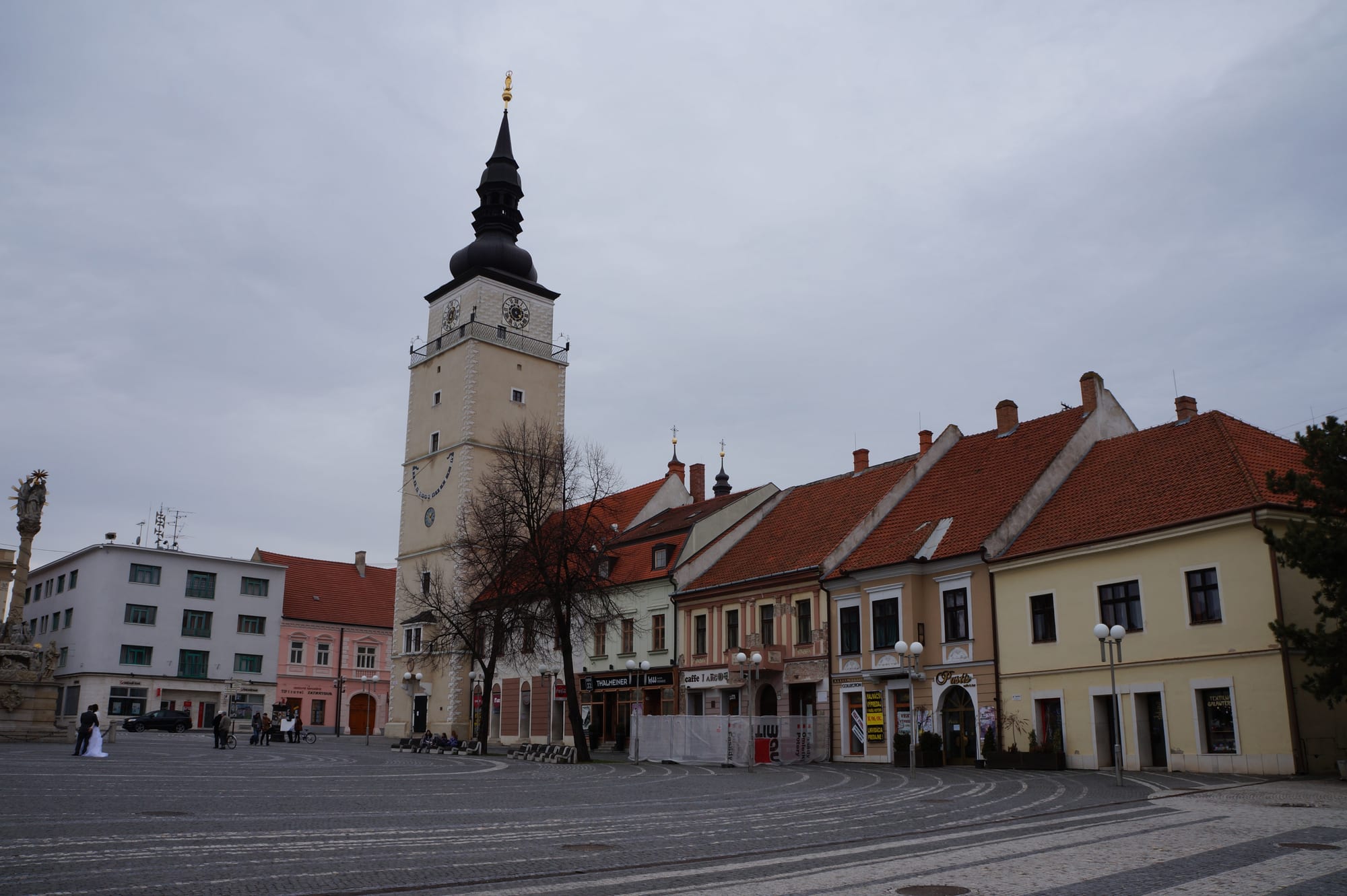
A wide cobbled square with a tall cream clock tower topped by a dark onion spire beside a row of red-roofed pastel houses

Bratislava & Western Slovakia, Slovakia

Trnava

The City Tower and burghers' houses on Trojičné námestie, the main square of Trnava's old town. (Kiwiev / Wikimedia Commons · CC0)

A city on the Danubian Lowland about 45 km north-east of Bratislava, the first town in present-day Slovakia to receive a royal charter. For almost three centuries the seat of Hungary's archbishops, and from 1635 to 1777 of its only university, it gained the nickname 'Little Rome' for the churches inside its walls; today it is also a car-making city.

Neighbourhoods

  • Old town (Staré mesto)
    • First-time visitors
    • Historic district
    • Best for food

    The historic centre inside the long medieval walls, most of which still stand. Hlavná and Štefánikova streets and Trojičné námestie, with the City Tower and the theatre, are the traditional shopping streets, and the cathedral, the basilica and the old university buildings are a few minutes' walk apart.

    Open in Maps
  • Around the station and City Arena
    • Close to public transport
    • Shopping

    The area between the old town and the railway, with the bus and railway stations side by side, a shopping centre about a kilometre from the centre, and the rebuilt football stadium with the City Arena mall beside it.

    Open in Maps
  • Modranka
    • Quiet and residential

    A former village annexed by the city in the 1970s, now the only rural one of its six urban districts.

    Open in Maps

Things to do

Churches and landmarks

  • City Towerviewpoint

    The Renaissance town tower of 1574 on the main square, which can be climbed for a view over the rooftops and churches of the old town.

    Open in Maps
  • St John the Baptist Cathedrallandmark

    The first purely baroque building in present-day Slovakia, built by Italian masters from 1629 as the university church and consecrated in 1637, with a colossal main altar finished in 1640.

    Open in Maps
  • Basilica of St Nicholaslandmark

    A large Gothic brick church of 1380–1421 at the highest point of the old town, the archbishops' cathedral from 1543 to 1820, with a great stained-glass window of St Cecilia on its front.

    Open in Maps
  • Trojičné námestielandmark

    The main square of the old town, named after its Holy Trinity column, with the City Tower, the town hall and the theatre.

    Open in Maps
  • Status Quo Ante Synagoguemuseum

    A twin-towered synagogue of 1897, used as a warehouse after the war and now the contemporary art centre of the Ján Koniarek Gallery, with a Holocaust memorial at its entrance.

    Open in Maps

Museums and culture

  • West Slovak Museummuseum

    One of the largest museums in Slovakia, in a 13th-century Poor Clare convent, with collections on regional history, folk life, bells and brickmaking.

    Open in Maps
  • Ján Palárik Theatreattraction

    The town's professional Slovak-language theatre company, the only professional theatre in the Trnava Region, playing in the theatre where the first performance was given at Christmas 1831.

    Open in Maps

Sport

  • Anton Malatinský Stadiumattraction

    The home of FC Spartak Trnava, rebuilt in 2013–2015 with 18,200 seats as the second-largest football stadium in Slovakia; the national team also plays here.

    Open in Maps

Short trips from the town

  • Smolenice Castlelandmark

    A castle on the eastern slope of the Little Carpathians, rebuilt in the 20th century on the model of Kreuzenstein castle near Vienna, now a conference centre of the Slovak Academy of Sciences open to visitors in July and August.

    Open in Maps
  • Piešťanyattraction

    Slovakia's best-known spa town, whose spa island between two branches of the Váh uses hot springs and sulphurous mud from the river.

    Open in Maps

Eat and drink

Long-standing places and food districts in Trnava. Hours, ratings and directions come from your maps app, always current.

Trnava classics

  • Sessler beerrestaurant

    Trnava is one of the few Slovak towns with its own beer: the Sessler brewery, just north of town, has its own restaurant and makes light, dark and special beers.

    Open in Maps
  • Patriotrestaurant

    A restaurant on Jeruzalemská street, regarded as a Trnava staple.

    Open in Maps

Wine and food streets

  • Mrva & Stanko wineryrestaurant

    A winery north-east of town, founded in 1997, that makes wine from local grape varieties grown in the Little Carpathians.

    Open in Maps
  • Hlavná and the old townneighborhood

    The old town's main street and the square around the City Tower hold most of the town's restaurants, cafés and pubs.

    Open in Maps

Experience Trnava

History

A market settlement grew up here in the Middle Ages at the crossing of two trade routes, from Bohemia to Hungary and from the Mediterranean to Poland. First recorded in 1211, Trnava became in 1238 the first town in present-day Slovakia to receive a royal charter. Walloon and German settlers shaped the early town, and long walls were built around it from the turn of the 14th century. The Hussites captured it in 1432 and held it until 1435.

After the Ottomans took most of Hungary in 1541, the archbishops of Esztergom moved to Trnava, and it became the centre of the Counter-Reformation in the kingdom. The Jesuits arrived in 1561, a printing house followed in 1577, and in 1635 Archbishop Péter Pázmány founded Trnava University, then the only university in the Kingdom of Hungary; it moved to Buda in 1777. So many churches went up that people called the town "Little Rome". In 1787 the priest Anton Bernolák based the first standard Slovak on the local dialect. After blood libels, 14 Jews were burnt in 1494 and the community was expelled in 1539.

The archbishops returned to Esztergom in 1820, but railways revived the town: the horse-drawn line from Bratislava reached it in 1846, and steam trains in 1873 brought a sugar factory, a malt-house and engineering works. By 1918 Trnava was one of the most industrialised towns in Czechoslovakia. Most of its Jews were deported in 1942. In 1977 Trnava became the seat of a Slovak archbishopric, and in 1996 the capital of its own region.

Culture & Customs

Trnava's character comes from its churches. The cathedral of St John the Baptist, the Gothic basilica of St Nicholas, which served as the archbishops' cathedral, and several monastery churches within the walls earned it the nickname of Little Rome, and the archdiocese's archives keep the Camaldolese Bible, the first known complete translation of the Bible into Slovak. Much of Slovak literary history runs through the town, from the old university, where half the students were Slovaks, to Bernolák's grammar and the St Adalbert Association, founded here in 1870 to publish Catholic books in Slovak at a time of Magyarisation.

Cultural life today centres on the Ján Palárik Theatre, the Ján Koniarek Gallery, which uses the former Status Quo Ante synagogue as its contemporary art space, and Malý Berlín, an independent cultural centre with concerts, theatre, film and discussions. The 19th-century Orthodox synagogue became a café in 2016, a use that has drawn criticism. The town has two universities, the University of Trnava and the University of Ss. Cyril and Methodius, each with about 7,000 students.

Sport is a large part of local life. FC Spartak Trnava is one of the best-known clubs in Slovak football, playing in a stadium also used by the national team, and the town has an ice hockey club, rugby, American football and baseball teams, and a women's international tennis tournament, the Empire Slovak Open, held since 2009.

Daily Life

About 63,000 people live in Trnava, which is the seat of the Trnava Region. The city is divided into six urban districts, from the walled old town to the housing estates and suburbs around it and the former village of Modranka. Two universities, with about 14,000 students between them, add a student population.

The town has been known for engineering since the early 20th century. The communist-era Trnava car works collapsed after 1989, but car-making returned with the Stellantis plant, which opened in the 2000s and is one of the largest engineering companies in Slovakia. Suppliers, a ZF plant, railway workshops and a glass-fibre factory add to the industrial base.

The rhythm of life is that of a busy regional centre: commuter trains and rush-hour traffic, shopping in the malls on the edge of town and around the stadium, and cycling on one of the best networks of cycle paths in Slovakia. The town's green spaces include Ružový park, Bernolákov sad, the Štrky recreation zone and the Trnava ponds.

Food

Trnava eats as western Slovakia does. Bryndzové halušky, small potato dumplings with bryndza sheep's cheese, are the national dish, and kapustnica, sauerkraut soup often cooked with mushrooms, meat and sausage, is a staple. A festive menu traditional in nearby Slovenský Grob is the goose or duck feast: roast goose with goose liver, lokše, potato pancakes baked straight on the stove, stewed red cabbage, and strudel with sour cherry and poppy seed.

The town's own pride is its beer. Trnava is one of the few Slovak towns with its own brand, Sessler, brewed just north of the centre in light, dark and special versions and served at the brewery's restaurant and in a pub on the main street. The vineyards of the Little Carpathians are close, and local wineries make wine from the grape varieties grown on their slopes.

Most of the restaurants are in the old town along Hlavná and around the main square, and the City Arena mall beside the stadium has a food court.

Planning tools

Budget

Trnava is noticeably cheaper than Bratislava for rooms and meals. Lunch, traditionally the main meal of the day, is the easiest time to eat a hot meal cheaply.

Daily Budget Midrange
USD 100–180 (small hotel in the old town, restaurant dinners, museum and tower tickets, a wine tasting)
Daily Budget Shoestring
USD 45–75 (pension, set lunches, buses and trains)

The old town, its walls and its churches can be seen on foot at little cost.

Best Time to Visit

Late spring to early autumn is the most pleasant time, with warm summers on the lowland and the vineyards of the nearby Little Carpathians green or at harvest. Winters are cold and grey, but the churches and museums are open year-round.

Suggested Number of Days

The walled centre is compact and a single day covers a first visit. Two or three days allow time for the surrounding wine country and spa towns as well.

First Visit
1 day
With Surroundings
2–3 days

Transportation

Most points of interest can be reached on foot from the centre. City buses run on several lines, and traffic jams are common at rush hour. Trnava is one of the most bicycle-friendly towns in Slovakia, with more than 20 km of cycle paths and a municipal bike-sharing scheme.

Use a car or taxi for the outskirts, and the regional trains for day trips along the main line.

Airport & Station Connections

Trains on the main Bratislava–Žilina line take about 30 minutes from the capital, and buses run at least hourly in about 50 minutes; the bus and railway stations stand side by side near the centre. Bratislava Airport, about 40 km away, is the nearest commercial airport, with Vienna's airport the other choice. The D1 motorway links the town with Bratislava, Trenčín and Žilina.

Walkability

The old town is flat and compact, and the walk from the stations to the main square is short. Walking the line of the city walls is the easiest way to see their extent. Beyond the centre, cycle paths are more useful than pavements for reaching the outer districts.

Safety

Slovakia is a very safe country with low violent crime. Trnava is a quiet regional town; ordinary care with bags at the stations and in busy places is enough.

Watch bags on crowded trains and buses at commuter times. Check current official travel advice before travelling.

Climate

A continental climate with four distinct seasons, warm summers and cold winters, on the flat Danubian Lowland. The annual mean temperature is between 9 and 10°C.

Summer
warm — July is the warmest month, averaging about 20°C
Winter
cold — January is the coldest month; in nearby Piešťany the temperature falls to 0°C or below on about 103 days a year

Local Customs

Trnava's identity is bound up with the Catholic Church: it is the seat of an archbishopric, has many working churches and is still called the 'Slovak Rome'. Roman Catholics are the largest religious group. The local beer and the Little Carpathian wines are a point of pride.

Dress modestly and keep quiet in churches, especially during services.

Common Payment Methods

The currency is the euro. Cards and contactless payment are widely accepted, and ATMs are common in the centre. Carry a little cash for small bakeries, market stalls and village wineries.