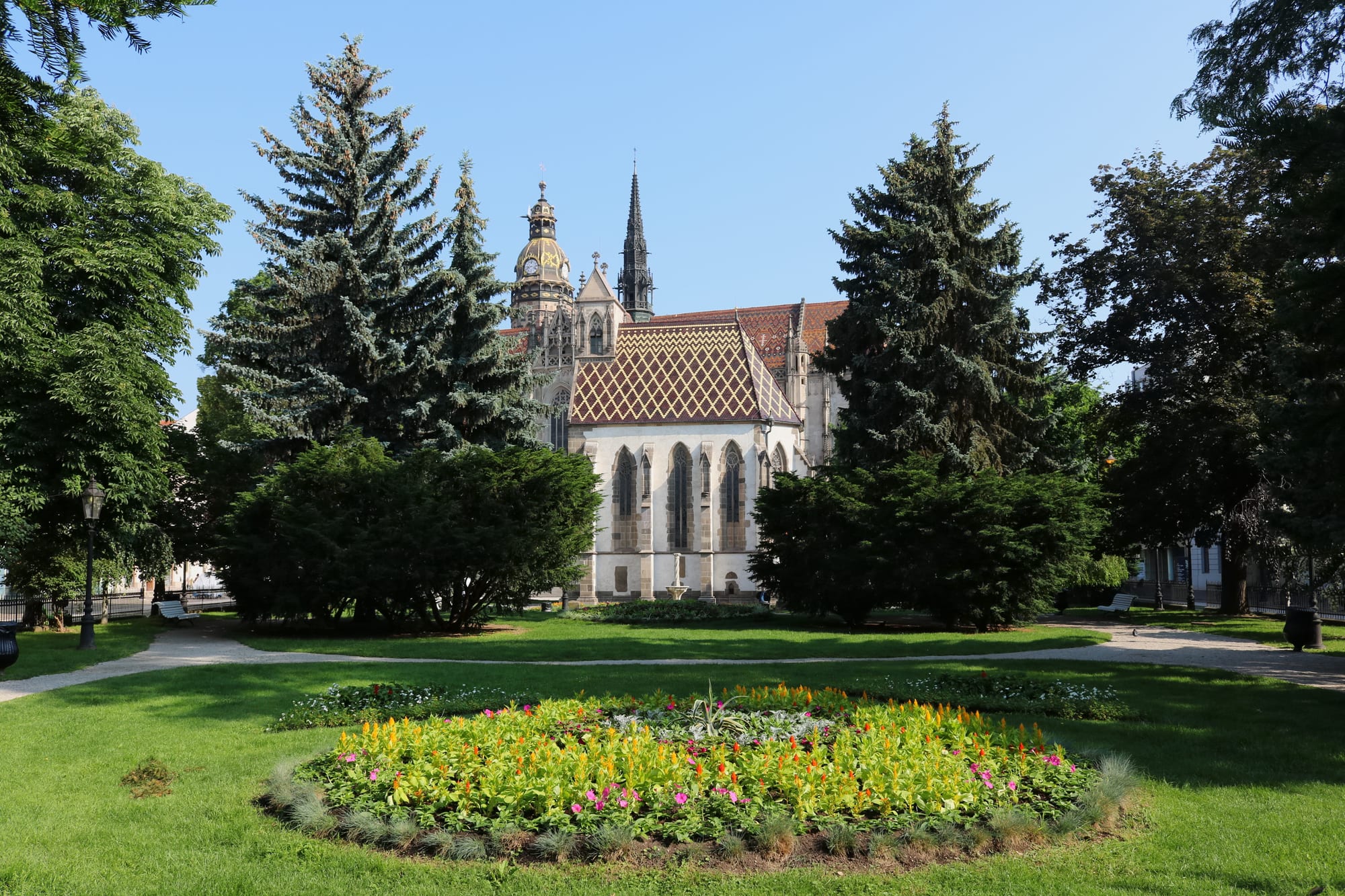
A small Gothic chapel with a patterned tiled roof among tall fir trees, with the cathedral's spire and tower behind and a flowerbed in front

The High Tatras & Eastern Slovakia, Slovakia

Košice

St Michael's Chapel and the Cathedral of St Elisabeth seen from the park on Hlavná, Košice. (Ingo Mehling / Wikimedia Commons · CC BY-SA 4.0)

Slovakia's second city, on the Hornád river near the Hungarian and Ukrainian borders. A medieval royal free town on the trade route from Hungary to Poland, it was long the chief city of Upper Hungary and later grew around a vast steelworks. Today its long, lens-shaped main street and the Gothic Cathedral of St Elisabeth anchor the largest historic centre in Slovakia.

Neighbourhoods

  • Old Town (Staré Mesto)
    • First-time visitors
    • Historic district
    • Nightlife

    The historic core along the pedestrian Hlavná, a long lens-shaped street of palaces, churches and burghers' houses around the cathedral. Most sights, cafés, beer bars and restaurants are here, and the railway station is about ten minutes' walk away through the city park.

    Open in Maps
  • Sídlisko KVP
    • Quiet and residential
    • Local life

    One of the big housing estates, built between 1980 and 1989 and named after the 1945 Košice Government Programme. Its blocks of flats house more than 20,000 people, and public transport links it with the centre.

    Open in Maps
  • Kavečany and the Čermeľ valley
    • Families
    • Walks and nature

    The wooded northern edge of the city, where locals go at weekends. Kavečany has the Košice Zoo, and the Čermeľ valley has the narrow-gauge Children's Railway and the start of hiking trails into the hills.

    Open in Maps

Things to do

Famous landmarks

  • Cathedral of St Elisabethlandmark

    Slovakia's largest church, begun in the late 14th century as the biggest cathedral in the Kingdom of Hungary, and the easternmost western-style Gothic cathedral in central Europe; Francis II Rákóczi was reburied here in 1906.

    Open in Maps
  • St Michael's Chapellandmark

    A 14th-century Gothic cemetery chapel beside the cathedral, which once served the town's Slovaks while the cathedral served its Germans and Hungarians.

    Open in Maps
  • St Urban's Towerlandmark

    A Renaissance bell tower of the 16th century on Hlavná, named after its great bell dedicated to St Urban, patron saint of vine-dressers.

    Open in Maps
  • National Theatre Košice and the singing fountainlandmark

    The neo-Baroque theatre of 1879–99 by Adolf Lang, home to drama, opera and ballet, with a ceiling painted with scenes from Shakespeare; the musical fountain in front of it plays in the evenings.

    Open in Maps
  • Plague Columnlandmark

    The Baroque Immaculata column, erected in 1723 on Hlavná, raised on the site of the old gallows to commemorate the plague of 1710–11.

    Open in Maps
  • Executioner's Bastion and Rodoštolandmark

    The main surviving part of the city walls, beside a replica of the house in Ottoman Rodosto where Francis II Rákóczi lived in exile.

    Open in Maps
  • Dominican Churchlandmark

    The Church of the Assumption of the Virgin Mary on Dominikánske námestie, the oldest preserved building in Košice.

    Open in Maps

Museums and culture

  • East Slovak Museummuseum

    One of the oldest museums in Slovakia, founded as the Museum of Upper Hungary, in a neo-Renaissance building on Peace Marathon Square.

    Open in Maps
  • Slovak Technical Museummuseum

    The country's main technology museum, in the Captain's Palace at the north end of Hlavná, with collections on industry and science and a planetarium.

    Open in Maps
  • East Slovak Gallerymuseum

    Founded in 1951 as the first regional gallery documenting the art of eastern Slovakia.

    Open in Maps
  • Kunsthalle Košicemuseum

    A disused 1960s swimming pool turned into Slovakia's first Kunsthalle for the 2013 European Capital of Culture.

    Open in Maps
  • Tabačka Kulturfabrikattraction

    A 19th-century tobacco factory turned into a centre of independent culture, with concerts, a gallery and artists' studios.

    Open in Maps
  • New Orthodox Synagoguelandmark

    A synagogue completed in 1927, still used for worship in the Ashkenazi rite.

    Open in Maps

Parks, sport and the hills

  • Košice Zoopark

    The largest zoo in Slovakia, opened in 1985 in Kavečany, with forest land preserved as a Carpathian habitat beyond the visitor area.

    Open in Maps
  • Košice Children's Heritage Railwayattraction

    A narrow-gauge railway in the Čermeľ valley on the city's northern edge, a weekend outing and the start of walks into the hills.

    Open in Maps
  • Steel Arenaattraction

    The home of HC Košice, one of Slovakia's most successful ice hockey clubs, and a venue of the 2011 and 2019 world championships.

    Open in Maps

Markets

  • Dominikánske námestie marketmarket

    The main morning market in the centre, where regional growers sell seasonal vegetables, eggs, honey, flowers and mountain berries.

    Open in Maps

Short trips from the city

  • Herľany geyserattraction

    Slovakia's only full-scale geyser, a rare cold-water geyser that erupts every 34 to 36 hours to a height of 10–15 metres.

    Open in Maps
  • Slovak Karst National Parkpark

    A karst landscape of gorges and caves in south-eastern Slovakia, a biosphere reserve whose caves are part of a UNESCO World Heritage Site.

    Open in Maps
  • Prešovattraction

    Slovakia's third-largest city, about 36 km north, with its own historic centre.

    Open in Maps
  • Spiš Castlelandmark

    The extensive white ruins of a medieval fortress on a limestone hill above Spišské Podhradie, part of a UNESCO World Heritage Site.

    Open in Maps

Seasonal events

  • Košice Music SpringApril–May

    A spring festival of concerts organised by the State Philharmonic Košice.

  • City DaysMay

    A week of events marking 7 May 1369, when the city received its coat of arms, with crafts and medieval fights on Hlavná.

  • IFF Art FilmJune

    Slovakia's longest continuously running international film festival, founded in 1993 and held in Košice since 2016.

  • Košice Peace Marathonfirst Sunday in October

    The oldest marathon in Europe, first run in 1924, on a mostly flat course through the city centre.

  • Christmas marketDecember

    Stalls along Hlavná selling gifts, hot mead and mulled wine, with a stage for concerts and dance.

Eat and drink

Long-standing places and food districts in Košice. Hours, ratings and directions come from your maps app, always current.

Košice classics

  • Restaurants on and around Hlavnáneighborhood

    The main street and its side streets hold most of the city's restaurants, from Slovak kitchens serving halušky and kapustnica to pizza places and Asian bistros.

    Open in Maps
  • Dominikánske námestie marketmarket

    Farmers' and growers' stalls by the Dominican church, the main produce market in the centre.

    Open in Maps

Cafés and bars

  • Ice-cream and pastry shopscafe

    Ice-cream parlours along Hlavná, several of which work as pastry shops through the winter.

    Open in Maps
  • Beer bars and beer gardenscafe

    A compact and lively bar scene in the old town, with brewpubs, beer bars with long tap lists and Slovak-style beer gardens open on summer evenings.

    Open in Maps

Experience Košice

History

Košice was first recorded in 1230 as Villa Cassa. After the Mongol invasion of 1241, King Béla IV invited German colonists, and two settlements merged in the 13th century around the long, lens-shaped street that is today's Hlavná. The town received its first known privileges in 1290, and its position on the trade route from central Hungary to Poland made it rich, and in 1347 it was ranked second among the kingdom's free royal towns, with the same rights as Buda. In 1369 Louis I granted it the first coat of arms given to a town in Europe. Building began on the Cathedral of St Elisabeth, and by the late 15th century the town had about 10,000 inhabitants.

From the 16th to the early 18th century Košice was the seat of the Habsburg Captaincy of Upper Hungary and a base for the Protestant nobles' uprisings against the Habsburgs. When the wars ended in 1711, trade routes moved away, and the city declined into a provincial town known for its garrison; the railway arrived in 1860, and the first factories had opened in the 1840s.

In the 20th century it changed hands repeatedly: it became part of Czechoslovakia after the First World War, was ceded to Hungary in 1938, and in 1944 its Jewish population of about 12,000 was deported, most of them to Auschwitz. In April 1945 the Košice Government Programme was proclaimed here. The East Slovak Ironworks drove the population from about 60,700 in 1950 to 235,000 in 1991. After 1993 Košice became Slovakia's second city and the seat of its Constitutional Court, and after 2022 it became a hub for refugees from Ukraine.

Culture & Customs

Košice has long been a meeting point of Slovak, Hungarian, German and Jewish cultures, and it calls itself a city of peace. It has the largest number of protected historic monuments in Slovakia, a Hungarian theatre and a professional Roma theatre alongside the State Theatre's drama, opera and ballet companies, and the State Philharmonic, founded in 1968. Sándor Márai, the Hungarian writer born in the city in 1900, has a memorial in the centre.

The title of European Capital of Culture in 2013 aimed to move the city from heavy industry towards creative work. Old barracks became the Kasárne Kulturpark, a 1960s swimming pool became the Kunsthalle, and a former tobacco factory, Tabačka, became a home for independent culture. The festival calendar runs from Košice Music Spring and City Days in May to IFF Art Film in June, the Cassovia folk festival in late June, jazz festivals in autumn and the Christmas market.

Sport is a source of pride. The Košice Peace Marathon, first run in 1924, is the oldest marathon in Europe and the third-oldest in the world, and it is held on the first Sunday of October. HC Košice is the most successful ice hockey club in Slovakia, the city co-hosted the world championships in 2011 and 2019, and it was European City of Sport in 2016.

Daily Life

About 222,000 people lived in Košice at the end of 2025. Most of them live in the communist-era housing estates that quadrupled the city's population, such as KVP, built in the 1980s, while the old town has turned largely to shops, offices, bars and students. The city has three universities, the largest of them the Technical University, with about 16,000 students.

The steelworks, renamed Nippon Steel Slovakia in October 2026 and with about 13,500 employees, is the largest employer in the city and the largest private employer in the country. Information technology is the second pillar: Deutsche Telekom IT Solutions has been based in the city since 2006 and employs thousands, and an IT cluster has grown around it. Volvo Cars began building a car plant in 2023, and in 2025 it put back the start of production to 2027.

The city is also the administrative centre of eastern Slovakia and a gateway to Hungary and Ukraine. Poverty is concentrated in places such as Luník IX, an estate where one of the largest Roma communities in Slovakia lives with very poor services. Weekends take many residents into the wooded hills to the north and west, which public transport reaches.

Food

Košice eats the hearty food of eastern Slovakia. Bryndzové halušky, potato dumplings with bryndza sheep's cheese, and bryndzové pirohy, dumplings filled with it, appear on most Slovak menus, as do kapustnica, a sauerkraut soup that often also contains mushrooms, meat and sausage, and segedínsky guláš, a pork stew with sauerkraut and cream or sour cream, served with slices of steamed dumpling. Lokše, pancakes of potato dough baked directly on the stove, are a common side.

Restaurants cluster on Hlavná and the streets beside it, with Slovak kitchens alongside pizzerias, Asian bistros and an Israeli falafel place. Many restaurants offer a cheap set lunch on weekdays and open only for dinner on Sundays. The market on Dominikánske námestie sells vegetables, honey, eggs and berries from the hills, and ice-cream parlours along the main street turn into pastry shops in winter.

Drink runs from beer gardens to brewpubs and beer bars. The Slovak part of the Tokaj wine region, the smallest of the country's six wine-growing regions, lies south-east of the city, and Šariš beer comes from the brewery at Veľký Šariš near Prešov. At the Christmas market, vendors sell hot mead and warm wine.

Planning tools

Budget

Košice is good value: cheaper than Bratislava, with low prices for public transport, beer and lunchtime menus. Hotels in the centre cost more than those further out, and the main extra expenses are day trips by car to Spiš and the Slovak Karst.

Daily Budget Midrange
USD 100–180 (central hotel, restaurant dinners, museum and theatre tickets, day trips)
Daily Budget Shoestring
USD 45–75 (hostel or pension, lunch menus and market food, trams and buses)

Buy public transport tickets through the city's app or website, and look at the State Theatre's opera and ballet programme.

Best Time to Visit

Late April to June and September to October are the most pleasant — spring brings the music festivals and City Days, and autumn the Peace Marathon and warm, settled weather with autumn colour. July and August can be hot; winters are cold, with a Christmas market on Hlavná in December.

Suggested Number of Days

The compact historic centre needs a day or two. Allow four or five to add day trips into eastern Slovakia, which the city's rail and road links make easy; a car shortens the trips to the castles and the karst.

First Visit
1–2 days
With Surroundings
4–5 days

Transportation

The city transport company runs trams and buses, from about 5 a.m. to 11 p.m., with a few night buses; its horse-drawn tram of 1891, electrified in 1914, makes it the oldest transit system in present-day Slovakia. The centre is compact and mostly pedestrian, and trams serve the housing estates and the station. The D1 motorway runs north to Prešov.

Validate paper tickets in the machine on board the first time they are used.

Airport & Station Connections

Košice International Airport, about 6 km south of the cathedral, has direct flights to cities including Prague, Vienna, Warsaw, Zürich and London. The railway station is about ten minutes' walk from the centre, with frequent trains to Bratislava — about 400 km to the west, a little under five hours by InterCity — and direct trains to Prague, Budapest and Vienna.

Walkability

Excellent in the centre: Hlavná is closed to traffic, and nearly all the sights lie on it or within a few streets. The city park links the old town with the station. Beyond the centre, housing estates spread across the hills and are best reached by tram.

Safety

Slovakia is a very safe country with low violent crime. Košice is generally safe; take care late at night in parks and around the railway station, and on quieter streets after dark.

Keep to well-lit streets late at night and call 112 in an emergency. Check current official travel advice before travelling.

Climate

Humid continental, with four distinct seasons: long, warm summers with cool nights and long, cold, snowy winters. Rain is spread through the year, with more in summer.

Summer
warm — July averages about 19°C, and hot days can reach about 30°C
Winter
cold and snowy — January averages about −3°C

Local Customs

Roman Catholics are the largest religious group, with Greek Catholic, Lutheran, Calvinist and small Jewish communities, and church interiors call for covered shoulders and quiet. A Hungarian-speaking minority lives in the city, which calls itself a city of peace and tolerance. Many restaurants open only for dinner on Sundays.

Greet shop staff with dobrý deň, and ask before photographing people, especially in the poorer outlying districts.

Common Payment Methods

Slovakia uses the euro. Cards are widely accepted in the centre, and ATMs are easy to find; carry some cash for market stalls and small kiosks.