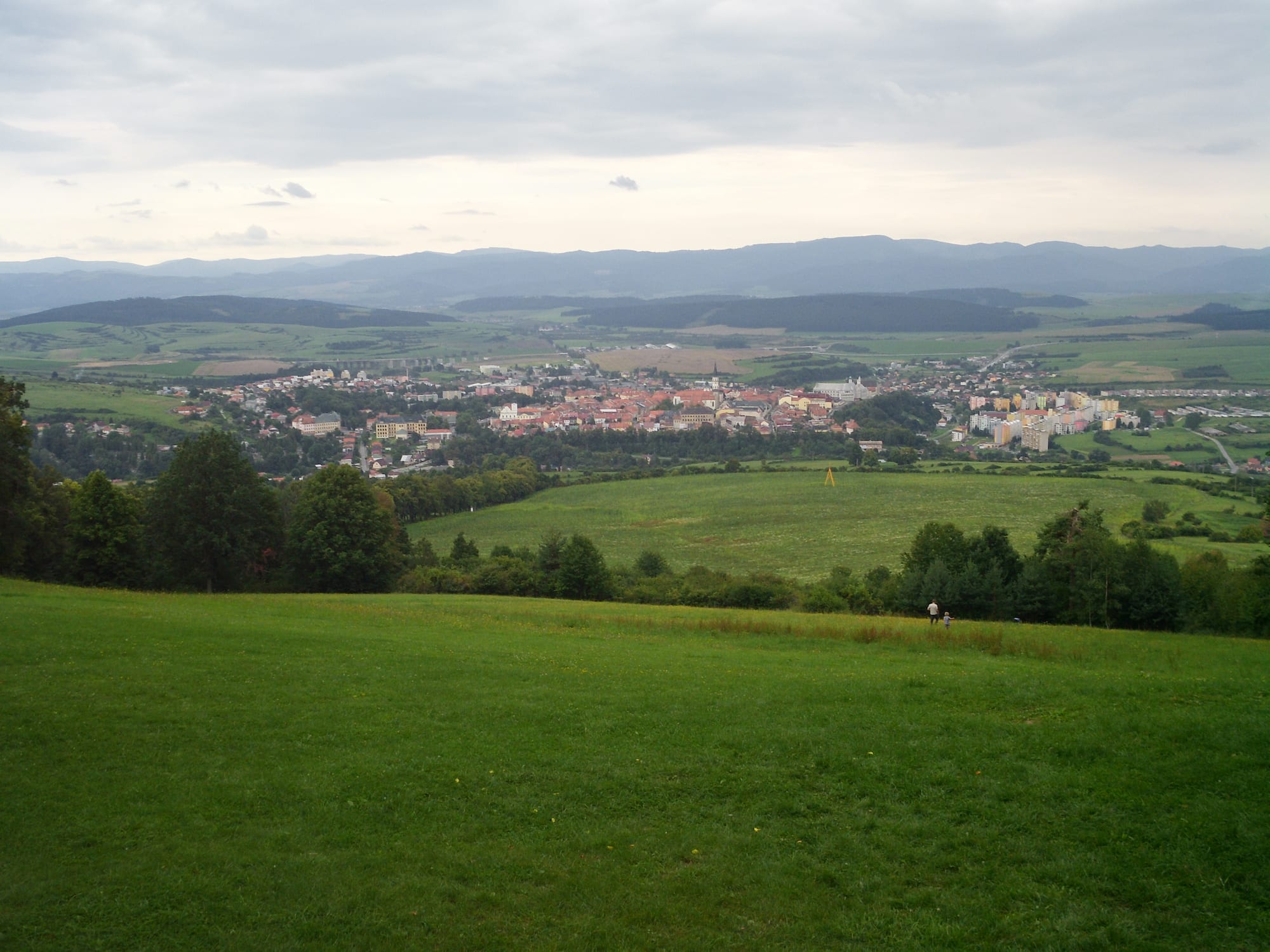
A green hillside meadow looking down over the red roofs and church towers of a small town and its housing blocks, with wooded ridges beyond

The High Tatras & Eastern Slovakia, Slovakia

Levoča

Levoča seen from Mariánska hora, the pilgrimage hill north of the town. (Jan Pešula / Wikimedia Commons · CC0)

A small walled town of Spiš at the foot of the Levoča Hills, once the rich capital of the region's German towns on the trade route between Poland and Hungary. Its long square holds a Renaissance town hall and the Basilica of St James, home of Master Paul's carved altar, the tallest wooden altar in the world, and the town is part of a UNESCO World Heritage Site.

Neighbourhoods

  • The old town inside the walls
    • First-time visitors
    • Historic district
    • Quiet evenings

    The historic centre, still enclosed by most of its medieval walls and entered through the 15th-century Košice Gate. Everything is close together around the long rectangular square of Master Paul, with its town hall, churches, museums and burghers' houses, and the town goes quiet early in the evening.

    Open in Maps
  • Outside the walls
    • Close to public transport
    • Local life

    The newer town spreads beyond the fortifications, with apartment blocks, shops and the bus station a short walk below the walls, and the road up to the pilgrimage church on Mariánska hora to the north.

    Open in Maps
  • Levočská Dolina and Závada
    • Quiet and residential
    • Walks and nature

    Small settlements in the Levoča Hills about 4 km from the town, a quiet base for walking, with views towards the High Tatras and skiing at Závada in winter.

    Open in Maps

Things to do

On Master Paul's Square

  • Basilica of St Jameslandmark

    The Gothic parish church whose main altar, carved in the workshop of Master Paul of Levoča in the early 16th century, is the tallest wooden altar in the world at 18.62 metres.

    Open in Maps
  • Old Town Hallmuseum

    A town hall rebuilt in Renaissance style in 1615, with arcades on two floors and a belfry added in 1656–61, now holding exhibits of the Spiš Museum.

    Open in Maps
  • Cage of Shamelandmark

    A wrought-iron cage in front of the town hall, once used to punish minor offenders in public.

    Open in Maps
  • Evangelical Churchlandmark

    The large domed Lutheran church at the southern end of the square, consecrated in 1832, which replaced wooden articular churches outside the walls.

    Open in Maps
  • Large Provincial Houselandmark

    A Classicist county hall of 1806–26, built when Levoča was the seat of Spiš county and designed to fit the square's Renaissance character.

    Open in Maps

Walls, churches and the hill

  • Town walls and the Košice Gatelandmark

    The almost complete ring of fortifications, entered through the 15th-century Košice Gate, with the Baroque Church of the Holy Spirit just inside.

    Open in Maps
  • Old Minorite Monasterylandmark

    A 14th-century monastery and church behind the square, with the only fully preserved 14th-century cloister in Slovakia.

    Open in Maps
  • Basilica on Mariánska horalandmark

    The pilgrimage church on a hill about 2 km north of the town, built in its present form in 1906–22, where about 650,000 people gathered for Pope John Paul II in 1995.

    Open in Maps

Short trips into Spiš

  • Spiš Castlelandmark

    The extensive ruins of a medieval fortress on a limestone hill, part of the same UNESCO World Heritage Site as Levoča.

    Open in Maps
  • Spišská Kapitulalandmark

    A walled medieval church town of one street and St Martin's Cathedral, facing Spiš Castle across the valley.

    Open in Maps
  • Dreveníktrail

    The largest travertine massif in Slovakia, a national nature reserve beside Spiš Castle.

    Open in Maps
  • Slovak Paradise National Parktrail

    A national park of narrow gorges climbed by ladders, chains and footbridges beside waterfalls, with its headquarters in Spišská Nová Ves.

    Open in Maps

Seasonal events

  • Mariánska hora pilgrimageearly July

    The annual pilgrimage to the hilltop basilica on or around 2 July, the Feast of the Visitation, which draws very large numbers of pilgrims.

  • Days of Master PaulJuly–August

    The town's summer festival, with performances and a crafts fair.

  • Mysterious Levočalate August

    A late-summer event in the old town.

  • Christmas marketDecember

    Seasonal Christmas stalls in the town.

Eat and drink

Long-standing places and food districts in Levoča. Hours, ratings and directions come from your maps app, always current.

Levoča classics

  • Restaurants on Master Paul's Squareneighborhood

    Restaurants around the square, including an old-style restaurant facing the Basilica of St James, serve Slovak meat and fish dishes and a choice of wines.

    Open in Maps
  • Cafés in the old towncafe

    A few cafés and bars on and near the square serve coffee, cakes and beer by day; evenings in the town are quiet.

    Open in Maps

Experience Levoča

History

Levoča was first recorded in 1249, after the Mongol invasion, when Spiš was settled by Germans. The town became the capital of the Association of Spiš Germans, which had a form of self-rule within the Kingdom of Hungary, and it was made a royal town in 1317. Rights granted in 1321 drew merchants, craftsmen and mine owners, and by the 15th century, at a crossing of trade routes between Poland and Hungary, Levoča was a rich centre exporting iron, copper, furs, leather, grain and wine.

It was also a centre of learning and art. The English humanist Leonard Cox taught at its school around 1520, a Wittenberg bookseller set up a printing works that lasted 150 years, and the woodcarver Master Paul settled here, finishing the great altar of St James in the early 16th century. Fires in 1550 and 1599 destroyed much of the Gothic town, which was rebuilt in Renaissance style, and Levoča became a centre of the Protestant Reformation before declining during the 17th-century uprisings against the Habsburgs. A feud in 1700 that ended in the murder of the mayor, whose embalmed arm was kept in the town hall, inspired Kálmán Mikszáth's novel The Black City.

From the 16th century until 1922 Levoča was the administrative centre of Spiš county, but in 1871 the main railway was built 8 km to the south, through Spišská Nová Ves, and the town lost its importance. During the Second World War 981 local Jews were deported. In 1995 Pope John Paul II celebrated Mass for about 650,000 people on Mariánska hora, and in 2009 UNESCO added the town to the World Heritage Site it shares with Spiš Castle.

Culture & Customs

Levoča's identity rests on its past as a free royal town and on its art. The UNESCO listing cites the historic centre, the fortifications and the works of Master Paul, whose altar dominates the Basilica of St James. A plaque on the square records that Comenius's famous picture book, Orbis Pictus, was printed in the town. The square itself is a long medieval rectangle with a ratio of about three to one, and its arcaded town hall, Lutheran church and county hall show the town's wealth and its Protestant and administrative past.

Religion is central to local life. The pilgrimage to the Basilica of the Visitation on Mariánska hora, a site of pilgrimage since the Middle Ages, is held on or around 2 July and still draws very large numbers of pilgrims. As a former royal town Levoča belongs to the Pentapolitana association with Košice, Bardejov, Prešov and Sabinov.

The festival year includes a spring music festival, the Days of Master Paul in summer, with performances and a crafts fair, Mysterious Levoča in late August, an autumn music festival and Christmas markets. Local crafts are sold at the fairs, and an ensemble of brass instruments, Brass Collegium, has played historical and contemporary music in the town since 1988.

Daily Life

About 13,800 people lived in Levoča at the end of 2025, making it the district town of a rural area of Spiš. The Germans, Hungarians and Jews who once shaped the town have largely gone as a result of the upheavals of the 20th century; most residents are now Slovak, with a sizeable Roma minority. Many people live in apartment blocks outside the walls, while the old town mixes homes, offices, schools and tourist businesses.

Levoča is a quiet place. The regional state archives and the district administration sit on the square, and the town serves the surrounding villages for schools, offices and shopping. Tourism brings coaches to the basilica and the castle trips by day, but the town empties early in the evening, and outside festival weeks life follows a small-town rhythm.

The pilgrimage season transforms that rhythm, filling the roads and the hill with visitors. The surrounding villages of the Levoča Hills, such as Levočská Dolina and Závada, offer walking in summer and skiing in winter.

Food

Levoča eats the food of Spiš and of Slovakia as a whole. Bryndzové halušky, potato dumplings with bryndza sheep's cheese, and strapačky, the same dumplings with sauerkraut, are on most menus, along with bryndzové pirohy, dumplings filled with bryndza. Džatky, small balls of mashed potato and flour often served with bacon, are described as a typical Spiš dish.

Soups begin most meals: kapustnica, made of sauerkraut, often with mushrooms, meat and sausage, and cesnačka, garlic soup, which is often served in a bread bowl. Lokše, pancakes of potato dough baked directly on the stove, and zemiakové placky, potato pancakes fried in oil, are everyday sides and snacks. Venison goulash, often served in a bread cup, reflects the hunting country of the hills.

The restaurants around the square serve Slovak meat and fish dishes and a choice of wines, and the cafés offer cakes and beer. Home baking in the region includes buchty, buns filled with jam, plum, curd or poppy seed, and Christmas markets are held in December.

Planning tools

Budget

Levoča is one of the cheaper places to stay in Spiš, with guesthouses and small hotels in and around the old town. Costs rise mainly with a hire car, which makes Spiš Castle and the Slovak Paradise easy, and with castle and museum tickets.

Daily Budget Midrange
USD 100–180 (old-town hotel, restaurant dinners, castle and museum tickets, a hire car)
Daily Budget Shoestring
USD 45–75 (pension or private room, lunch menus, regional buses)

Combine Levoča with Spiš Castle and Spišská Kapitula, which lie close together east of the town.

Best Time to Visit

June to September, when the festivals fill the square, the castles are open and the hills are good for walking. Late spring and early autumn are quieter. Winters are cold and snowy; the pilgrimage brings huge crowds to the hill above the town each summer.

Suggested Number of Days

The walled centre can be seen in a day. Two to four days allow time for the castles and church towns of Spiš and the Slovak Paradise; travelling by bus rather than car adds time.

First Visit
1 day
With Surroundings
2–4 days

Transportation

Regular buses link Levoča with Poprad, Košice and Prešov; Spišská Nová Ves is the nearest town on the main railway. The town's own railway station, on a branch line, has very few trains. A car is the easiest way to reach the Spiš sights, and the E50 road passes close to the town.

Use the bus rather than the train to reach Levoča, and check return times for village connections.

Airport & Station Connections

Levoča lies about 25 km east of Poprad, 50 km west of Prešov and 90 km north-west of Košice. The nearest airports are Poprad–Tatry, about 25 minutes away by road, and Košice. The main railway bypasses the town through Spišská Nová Ves, about 10 minutes away by road; most visitors arrive by bus or car.

Walkability

The historic centre inside the walls is small and easily covered on foot. The bus station is a short walk below the walls, and Mariánska hora is about 2 km north of the town on foot or by road.

Safety

Slovakia is a very safe country with low violent crime. Levoča is a quiet, small town; normal care with valuables is enough, and the main hazards are on mountain trails and winter roads.

Expect very heavy traffic and crowds on pilgrimage weekends. Check current official travel advice before travelling.

Climate

The town sits at over 600 metres in the Levoča basin, at the southern edge of the Levoča Hills; winters are cold and summers mild, with snow common in the surrounding hills.

Summer
mild — summer days in northern Slovakia are usually around 25°C, less in the hills
Winter
cold, with snow common in the hills — across Slovakia winter days average between −5 and 10°C

Local Customs

Levoča is a deeply Catholic town and a pilgrimage centre; dress modestly and keep quiet in the basilicas, especially during services. The town once had a large German Lutheran community, and today it is mostly Slovak with a sizeable Roma minority. Greet shop staff with dobrý deň.

Visit the Basilica of St James outside service times, and do not photograph worshippers during Mass.

Common Payment Methods

Slovakia uses the euro. Cards are taken in most hotels and restaurants, and there are ATMs in the centre; carry some cash for small shops, market stalls and the craft fairs.