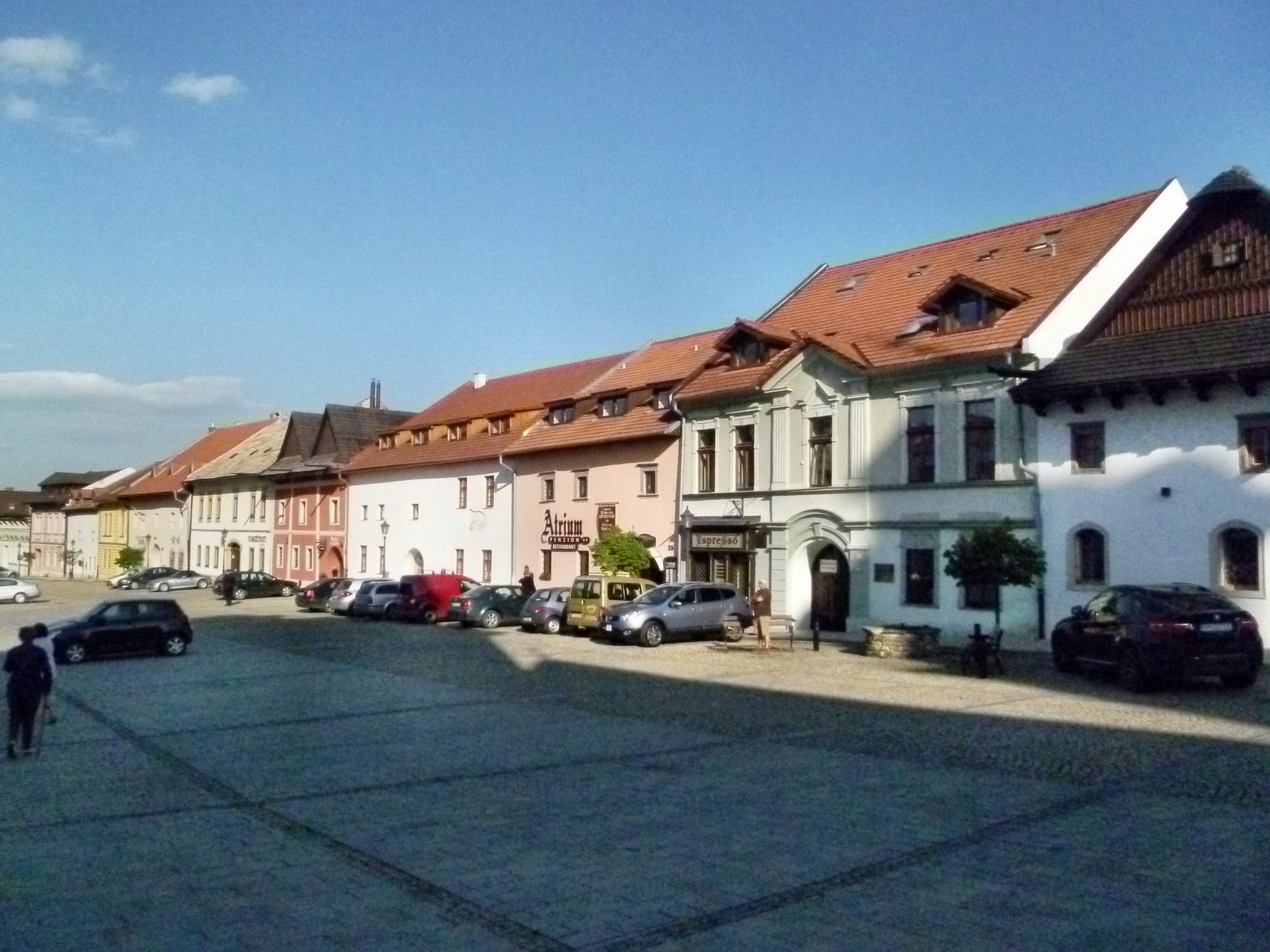
A broad cobbled square lined with pastel burghers' houses under red-tiled roofs, with parked cars, in late afternoon sun

The High Tatras & Eastern Slovakia, Slovakia

Poprad

The main square of Spišská Sobota, the historic quarter of Poprad. (JoJan / Wikimedia Commons · CC BY 3.0)

The largest town of Spiš, on the Poprad river in the basin below the High Tatras. Founded by medieval German settlers and pawned to Poland for three and a half centuries, it grew with the railway into the gateway to the mountains, joining older neighbours such as Spišská Sobota. Today it is an industrial and service town with an airport and a mountain railway.

Neighbourhoods

  • Staré Mesto (Old Town)
    • First-time visitors
    • Close to public transport
    • Shopping

    The centre around the long Námestie svätého Egídia, rimmed with 18th- and 19th-century houses, with the Gothic Church of St Giles, a Renaissance bell tower, cafés and sweetshops. The railway station, the start of the Tatra Electric Railway, is close to the centre.

    Open in Maps
  • Spišská Sobota
    • Historic district
    • Quiet evenings
    • Guesthouses

    A once-independent market town, joined to Poprad after the Second World War and protected as a town monument reserve. Its square of burghers' houses surrounds the Church of St George, and many of the town's best guesthouses are here.

    Open in Maps
  • Veľká
    • Quiet and residential
    • Local life

    A former village, part of the city since 1945, with the Church of St John the Evangelist and a new professional theatre that opened its first season in 2025.

    Open in Maps
  • Matejovce and Stráže pod Tatrami
    • Quiet and residential
    • Village churches

    Two old Spiš villages absorbed into the city in 1974 and 1960. Matejovce keeps a Renaissance bell tower of the 17th century and the Church of St Stephen; Stráže has the Gothic Church of St John the Baptist and its old town hall.

    Open in Maps

Things to do

Landmarks of the town

  • Námestie svätého Egídialandmark

    The town's long central square and pedestrian heart, lined with houses mainly of the 18th and 19th centuries and used for festivals.

    Open in Maps
  • Church of St Giles and its bell towerlandmark

    An early Gothic church of the late 13th century on the main square, with rich wall paintings, beside a 16th-century Renaissance bell tower.

    Open in Maps
  • Church of St George, Spišská Sobotalandmark

    The parish church of Spišská Sobota, with five late Gothic winged side altars and a main altar from the workshop of Master Paul of Levoča.

    Open in Maps
  • Spišská Sobota squareneighborhood

    The preserved centre of the medieval market town, with burghers' houses, a Renaissance bell tower and the Church of St George.

    Open in Maps

Museums and leisure

  • Podtatranské Museummuseum

    The museum of the town and the region below the Tatras, whose prize is a cast of the Neanderthal skull found at nearby Gánovce.

    Open in Maps
  • Tatra Gallerymuseum

    An art gallery in a former steam power station by the railway station, showing artists from Spiš and eastern Slovakia.

    Open in Maps
  • AquaCity Popradattraction

    A large water park and pool complex rebuilt from the town's swimming pool from 2003, filled with thermal water from a nearby geothermal borehole.

    Open in Maps
  • Poprad Ice Stadiumattraction

    The 4,500-seat home of HK Poprad, opened in 1973, which has hosted Winter Universiades and world championship ice hockey.

    Open in Maps
  • Gánovce travertinesattraction

    A village 3 km south-east of the town, known for its old hot springs and the travertine site where a Neanderthal skull cast was found.

    Open in Maps

Short trips into the High Tatras

  • Tatra Electric Railwaytransit hub

    The metre-gauge electric railway that has climbed from Poprad station to the Tatra resorts since 1908, with lines to Štrbské Pleso and Tatranská Lomnica.

    Open in Maps
  • Starý Smokovec and Hrebienoktrail

    The Tatra resort of Starý Smokovec and the funicular to Hrebienok above it, a starting point for walks to the waterfalls of the Studená dolina.

    Open in Maps
  • Štrbské Plesoattraction

    A glacial lake and resort at the western end of the railway, modernised in the 1970s with ski jumps that have hosted World Cup and junior world championship competitions.

    Open in Maps
  • Popradské plesotrail

    A mountain lake below the peaks, reached on foot from the railway, with a Symbolic Cemetery nearby in memory of those who died in the Tatras.

    Open in Maps
  • Lomnický štítviewpoint

    At 2,634 metres the second-highest peak of the High Tatras, reached by cable car from Tatranská Lomnica.

    Open in Maps

Short trips into Spiš

  • Kežmarokattraction

    A neighbouring Spiš town with a castle and a wooden Lutheran articular church.

    Open in Maps
  • Levočaattraction

    The walled Spiš capital, whose Church of St James holds Master Paul's tall carved Gothic altar.

    Open in Maps
  • Slovak Paradise National Parktrail

    A national park of narrow gorges climbed by ladders, chains and footbridges beside waterfalls.

    Open in Maps
  • Spiš Castlelandmark

    The extensive ruins of a medieval fortress on a limestone hill, part of a UNESCO World Heritage Site.

    Open in Maps

Seasonal events

  • International Festival of Mountain FilmsOctober

    A festival of mountain and adventure films held every year since 1993; Sir Edmund Hillary was among its guests in 1994.

  • Christmas marketDecember, before Christmas

    A Christmas fair held before Christmas, with the arrival of St Nicholas among the town's other seasonal events.

Eat and drink

Long-standing places and food districts in Poprad. Hours, ratings and directions come from your maps app, always current.

Poprad classics

  • Slovak restaurants in the centreneighborhood

    Restaurants around the main square and its side streets serve Slovak dishes such as bryndzové halušky and kapustnica, with lunchtime set menus on weekdays.

    Open in Maps
  • Spišská Sobotaneighborhood

    Restaurants around the old market square of the historic quarter, a quieter setting for dinner.

    Open in Maps

Cafés and sweetshops

  • Sweetshops on the main squarecafe

    Several cafés and sweetshops on Námestie svätého Egídia serve cakes, ice cream and coffee.

    Open in Maps

Experience Poprad

History

Poprad was first recorded on 16 March 1256, in a deed of King Béla IV. After the Mongol invasion the area was resettled by German colonists, and the town became Deutschendorf, the "Germans' village". From 1412 to 1770 it was one of the Spiš towns pawned by the Kingdom of Hungary to Poland, which left a strong Polish influence. For centuries Poprad was only one of several neighbouring settlements — Matejovce, Spišská Sobota, Veľká and Stráže pod Tatrami — and the most important of them was Spišská Sobota, a market town with city privileges from 1271 and the right to hold fairs from 1567. A paper mill founded in 1692 was the town's oldest manufactory.

The Košice–Bohumín Railway, which reached Poprad in 1871, turned the balance. A line to Kežmarok followed in 1892 and the Tatra Electric Railway in 1908, and Poprad became the gateway to the High Tatras. During the Second World War most of the transports of Slovak Jews left from Poprad's station, beginning on 25 March 1942 with about 1,000 girls and young women sent to Auschwitz; by the end of that year more than 58,000 Jews had been deported from Slovakia through the town.

Soviet troops took Poprad on 28 January 1945, and its German population was expelled. The neighbouring settlements were merged into the city between 1945 and 1974, new factories were built, and the population grew from about 12,000 in 1949 to about 55,000 in 1991. Winter sport made the town the starting point for the Tatras, and in 1999 Poprad bid for the 2006 Winter Olympics, losing to Turin.

Culture & Customs

Poprad belongs to Spiš, and its old quarters show it: Gothic churches with Renaissance bell towers standing beside them, as in other formerly German towns of upper Spiš, and the Church of St George in Spišská Sobota with altars from the workshop of Master Paul of Levoča. The Podtatranské Museum covers the town's history and the region's prehistory, and the Tatra Gallery, in a former power station, shows the art of Spiš and eastern Slovakia.

The town's best-known event is the International Festival of Mountain Films, held every October since 1993 and shared with Kežmarok and Spišská Nová Ves. The main square hosts festivals, the town marks the arrival of St Nicholas and holds a Christmas market, and in 2025 a new professional theatre opened in Veľká.

Sport is central to local identity. HK Poprad plays top-flight ice hockey at the town's ice stadium, which has staged Winter Universiades and world championship matches, and the annual Tatra Cup, first held in 1929, is the second-oldest club tournament in Europe after the Spengler Cup. Women's basketball has a long tradition here, and the town is a base for skiers, climbers and cyclists heading into the mountains.

Daily Life

About 48,000 people lived in Poprad at the end of 2025, making it the largest town in Spiš and the tenth-largest in Slovakia. Most live in the post-war housing estates around the centre and in the absorbed villages of Veľká, Matejovce, Stráže and Spišská Sobota. Since the expulsion of the Germans the town has been overwhelmingly Slovak, with a sizeable Roma minority and smaller Czech and Rusyn communities.

Industry and tourism both matter. The largest firms include Tatravagónka, which builds railway wagons, a Whirlpool appliance plant, a water heater maker and an air ambulance operator, while hotels, shops, AquaCity and the airport live off the visitors heading for the Tatras. The town serves as the market and service centre for the whole basin.

Daily rhythms follow the seasons. Winter brings skiers through the station and frequent snow; summer brings walkers, cyclists on the path to Svit and crowds at the water park. Locals spend weekends in the hills, and the view of the Tatra peaks from the town's streets is a constant reminder of where the region's money and weather come from.

Food

Poprad eats the food of Spiš and of Slovakia as a whole. Bryndzové halušky, potato dumplings with bryndza sheep's cheese, are on almost every menu, alongside bryndzové pirohy, dumplings filled with the same cheese, and strapačky, which swap the cheese for sauerkraut. Džatky, small balls of mashed potato and flour often served with bacon, are described as a typical Spiš dish.

Potato dough appears in many forms: lokše, potato pancakes baked directly on the stove, and zemiakové placky, potato pancakes fried in oil. Soups start most meals — kapustnica, made of sauerkraut, often with mushrooms, meat and sausage, and cesnačka, garlic soup, which is often served in a bread bowl. Goulash cooked in a pot and venison goulash suit the mountain climate.

Sweet things are easy to find: cafés and sweetshops on the main square serve cakes and coffee, and home baking includes buchty, buns filled with jam, plum, curd or poppy seed. Kofola, the Czechoslovak cola, is drunk everywhere, and hot drinks warm skiers coming down from the mountains.

Planning tools

Budget

Poprad is cheaper than the Tatra resorts above it, which is why many visitors sleep here and ride up by train. Guesthouses in Spišská Sobota and Veľká and a few hotels cover most budgets; the main extra costs are cable cars, AquaCity and a car for the Spiš sights.

Daily Budget Midrange
USD 100–190 (town hotel, restaurant dinners, cable cars and park or castle tickets)
Daily Budget Shoestring
USD 45–75 (hostel or pension, lunch menus, Tatra Electric Railway and buses)

Sleep in Poprad rather than the resorts in high season and use the electric railway to reach the mountains.

Best Time to Visit

July to September for high-mountain walking; June and September are quieter. December to March is ski season in the Tatras. The town is busiest in summer and around New Year, and the mountain film festival fills October.

Suggested Number of Days

The town itself needs a day or two. Most people use it as a base for the High Tatras and Spiš, which takes four to six days; walkers, skiers and bad weather can stretch that, and a car shortens the trips into Spiš.

First Visit
1–2 days
With Surroundings
4–6 days

Transportation

City buses cover the town and its boroughs, and taxis are inexpensive. The Tatra Electric Railway runs from the main station into the mountains, and buses serve Kežmarok, Levoča and the Spiš villages. A cycle path of more than 6 km links Poprad with the neighbouring town of Svit. A car makes Spiš Castle and the Slovak Paradise much easier.

Check mountain conditions and any trail closures before setting out.

Airport & Station Connections

Poprad lies on the main railway between western and eastern Slovakia, about 330 km by road from Bratislava and 110 km from Košice, with direct trains to Bratislava, Žilina, Košice and Prague, including night trains from Prague. Poprad–Tatry Airport, just outside the town at 718 metres, has some scheduled flights and charters, mainly in winter; Košice has the nearest larger airport. Buses also run from Kraków and Zakopane in Poland.

Walkability

Compact and flat: the centre is easy on foot, and walking from it to any other district takes no more than about twenty minutes. Spišská Sobota is a pleasant walk across the town, and the railway station is close to the centre.

Safety

Slovakia is a very safe country with low violent crime. Poprad is a calm town, and the real risks are in the mountains above it: storms, snow lingering on high paths into spring, exposed chained sections and bears in the forests.

Start serious Tatra hikes early, turn back in storms and respect trail closures. Check current official travel advice before travelling.

Climate

A humid continental climate with four distinct seasons, with warm summers and cold winters in the town. The mountains above it are far colder.

Summer
warm — summer days in northern Slovakia are usually around 25°C; on the summit of Lomnický štít even August averages only about 6°C
Winter
cold in the town; on the summit of Lomnický štít February averages about −11°C

Local Customs

Most people are Roman Catholic, with Lutheran and Greek Catholic communities, and church interiors call for covered shoulders and quiet. Tips are a little smaller than in western Europe — about five per cent is usual in restaurants. Greet shop staff with dobrý deň. Ice hockey is followed closely.

Leave mountain huts and trails as found and carry rubbish down.

Common Payment Methods

Slovakia uses the euro. Cards are commonly used in Poprad's restaurants and shops, but it is worth asking first; carry some cash for small shops, mountain huts and bakeries.