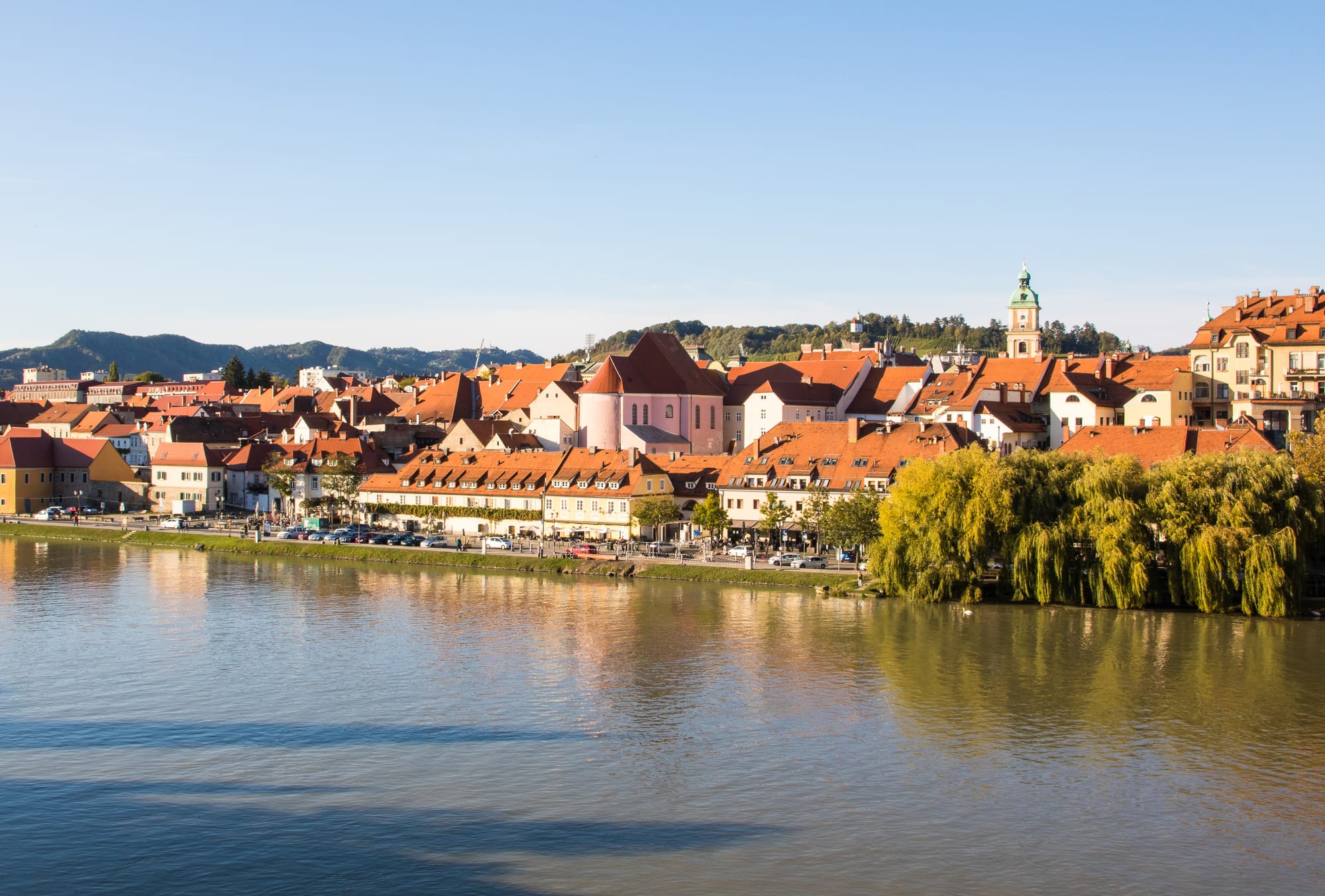
Old houses with orange-red roofs along a calm river, willows on the bank, a green-domed church tower and wooded hills behind

Eastern Slovenia, Slovenia

Maribor

The Lent quarter of Maribor on the bank of the Drava. (Jernej Furman from Maribor, Slovenia / Wikimedia Commons · CC BY 2.0)

Slovenia's second city, on the Drava below the Pohorje mountains and the vine-covered hills of Lower Styria. A medieval border fortress that grew rich on the wine trade, a German-speaking town secured for the Slovenes in 1918 and a Yugoslav industrial centre hit hard after 1991, it is now a university and wine city, European Capital of Culture in 2012.

Neighbourhoods

  • Lent
    • First-time visitors
    • Riverside
    • Nights out

    The oldest part of the town, on the north bank of the Drava, with the Old Vine and its house, the Water Tower and Judgement Tower, and the former Jewish quarter around the synagogue. Its small streets hold restaurants and bars, and it gives its name to the summer Lent Festival.

    Open in Maps
  • The old town centre
    • Historic district
    • Architecture
    • Close to public transport

    The squares behind the river: Glavni trg with the Renaissance Town Hall and the Plague Column, Slomškov trg with the cathedral and the theatre, and Grajski trg in front of Maribor Castle. Cafés and small shops fill the streets between them, and the bus and railway stations lie at the eastern edge.

    Open in Maps
  • Koroška Vrata
    • Sport
    • Parks
    • Quiet and residential

    The district north and west of the centre, home to Ljudski vrt, the football stadium of NK Maribor. The City Park and its promenade to the Three Ponds lead up towards Pyramid Hill and its vineyards.

    Open in Maps
  • Magdalena
    • Alternative culture
    • Local life

    A district on the south bank of the Drava, across the bridges from the old town. The Pekarna Cultural Centre, the city's alternative scene, occupies a former military bakery here.

    Open in Maps
  • The Pohorje foothills
    • Outdoor sports
    • Skiing
    • Families

    The southern edge of the city at the foot of Pohorje, with the lower station of the ski area, hotels, apartments and campsites, wellness centres with thermal water and an adventure park. City bus number 6 runs out from the centre.

    Open in Maps

Things to do

The old town

  • Old Vinelandmark

    A Žametovka vine more than 400 years old growing on the front of the Old Vine House in Lent, recorded by Guinness World Records in 2004 as the oldest grapevine in the world; the house holds exhibitions and wine tastings.

    Open in Maps
  • Maribor Synagoguemuseum

    A synagogue completed in the late 14th century in the former Jewish quarter, used as a church after the Jews were expelled and since 2001 a centre of Jewish cultural heritage; it is one of the oldest preserved synagogues in Europe.

    Open in Maps
  • Water Towerlandmark

    A pentagonal late-Renaissance tower of 1555 built of massive stone blocks directly on the Drava, guarding the south-east corner of the town walls.

    Open in Maps
  • Judgement Towerlandmark

    A fortified tower at the old south-west corner of the walls, completely rebuilt in 1540.

    Open in Maps
  • Maribor Cathedrallandmark

    The cathedral of St John the Baptist on Slomškov trg, with a Gothic vault and choir and later Baroque chapels, seat of the Archdiocese of Maribor and resting place of Bishop Anton Martin Slomšek; its bell tower can be climbed for views over the city.

    Open in Maps
  • Main Square and the Plague Columnlandmark

    Maribor's largest square, with the Renaissance Town Hall of 1515 and the Baroque Plague Column raised in thanks for the end of the plague, replaced in its present form in 1743.

    Open in Maps
  • Maribor Castlemuseum

    The castle begun in 1478 on the north-east side of the old town, now a Baroque mansion holding the regional museum, with collections of musical instruments, clocks, uniforms, furniture, weapons and archaeology.

    Open in Maps
  • Vinag Wine Cellarattraction

    A wine cellar under the city centre about 2 km long and covering 20,000 square metres, with room for 5.5 million litres of wine.

    Open in Maps

Parks and the river

  • City Park and the Three Pondspark

    The city's main park, with an aquarium and terrarium and a broad promenade leading to the Three Ponds, planted with more than a hundred kinds of trees.

    Open in Maps
  • Pyramid Hillviewpoint

    A vineyard-covered hill on the northern edge of the city with the ruins of the first Maribor castle and a 19th-century chapel, and an easy walk up from the City Park to a view over the city and the Drava.

    Open in Maps
  • Maribor Islandpark

    A natural island in the Drava, protected since 1951, with the city's oldest public bath, and a winter refuge for waterfowl.

    Open in Maps
  • Betnava Mansionlandmark

    A manor first mentioned in 1319 and rebuilt in late-Baroque style in 1784, facing a 19th-century English park on the southern edge of the city.

    Open in Maps

Music, sport and nights out

  • Slovene National Theatre Mariborattraction

    The city's theatre for drama, opera and ballet on Slomškov trg, whose productions draw the country's largest theatre audiences.

    Open in Maps
  • Ljudski vrtattraction

    The 11,709-seat stadium of NK Maribor, Slovenia's most successful football club, a short walk north of the centre.

    Open in Maps
  • Pekarna Cultural Centreattraction

    The home of Maribor's alternative scene, in a former military bakery in Magdalena, with several concert venues.

    Open in Maps

Short trips from the city

  • Maribor Pohorje Ski Resortpark

    The largest ski resort in Slovenia, just south of the city, with 42 km of slopes, cross-country tracks and night skiing; for decades it hosted the women's World Cup races of the Golden Fox.

    Open in Maps
  • Pohorjepark

    A mostly wooded range of medium-high mountains south of the Drava, with hiking and cycling trails, mountain huts and, in summer, an adventure park with a ropes course, summer sledding and a bike park.

    Open in Maps
  • Ptujattraction

    A town of Roman origins on the Drava, with a hilltop castle, Roman remains, old wine cellars and the Kurentovanje carnival.

    Open in Maps

Seasonal events

  • Lent Festivallate June, for about two weeks

    A major summer arts festival on stages along the river, with theatre, opera, ballet, classical, modern and jazz music, mime and children's events, organised by the Narodni dom cultural centre.

  • Old Vine Festivallate September

    The traditional festival around the harvest of the Old Vine's grapes in Lent.

Eat and drink

Long-standing places and food districts in Maribor. Hours, ratings and directions come from your maps app, always current.

Wine

  • Old Vine Houseneighborhood

    The house of the Old Vine in Lent, with a tourist information centre, an exhibition room and wine tastings of the region's wines.

    Open in Maps
  • Vinag Wine Cellarneighborhood

    The city-centre cellar of the Vinag wine company, about 2 km long, under the streets.

    Open in Maps

Food districts and cafés

  • Lent riverfrontneighborhood

    The small streets and riverbank of the oldest quarter, lined with restaurants and bars.

    Open in Maps
  • Glavni trg and the old towncafe

    The cafés of the main square and the surrounding streets, where people sit out in the sunshine near the Old Bridge.

    Open in Maps

Experience Maribor

History

The area has been settled since the fifth millennium BC, and under Rome it lay in Noricum, on a road linking Celeia and Poetovio. After Slavic settlement it became a frontier of the Frankish Empire against Hungary, and a castle on Pyramid Hill, first recorded in 1164 as Castrum Marchburch — "march fortress" — guarded it. A market grew below the castle, which received town rights in 1254 and prospered under the Habsburgs from 1278 on trade, viticulture and crafts, with a trading monopoly over the region and control of the wine trade with Carinthia. A Jewish quarter with a synagogue flourished until the expulsion ordered in 1496. The town withstood sieges by Matthias Corvinus and, in 1532, by an Ottoman army under Suleiman the Magnificent.

The Southern Railway arrived in 1846 and brought fast growth. In 1859 Bishop Anton Martin Slomšek moved the seat of his diocese here and encouraged the use of Slovene, though in 1900 more than four-fifths of townspeople spoke German at home. In November 1918 Major Rudolf Maister seized the city for the new South Slav state, and it was confirmed as Yugoslav in 1919. Annexed by Nazi Germany in 1941 and visited by Hitler, it saw mass expulsions of Slovenes, and Allied bombing devastated nearly half the city, making it the most war-damaged major town in Yugoslavia.

After 1945 the remaining German speakers were expelled, and Maribor was rebuilt as an industrial centre. The first clash of Slovenia's 1991 independence war took place in and near the city. The loss of the Yugoslav market drove unemployment to nearly 25 per cent, and protests in 2012–13 spread across Slovenia, the same years in which Maribor was European Capital of Culture and European Youth Capital.

Culture & Customs

Wine is at the heart of the city's identity. The Old Vine in Lent, a Žametovka vine more than 400 years old, is honoured with its own house and an annual festival around its harvest, and the vast Vinag cellar runs beneath the centre. The surrounding hills are covered with vineyards, and the city's warm summers are credited with its long wine tradition.

The Slovene National Theatre stages drama, opera and ballet for the country's largest theatre audiences, the University of Maribor has grown since its founding in 1975, and the Lent Festival each June brings two weeks of theatre, opera, dance, jazz and street performance; its jazz strand has hosted Ray Charles and B.B. King. The alternative scene gathers at the Pekarna Cultural Centre in a former army bakery. Nikola Tesla had his first job here in 1878–79, and the first electric light in Slovene lands was switched on in Grajski trg in 1883.

Sport is followed closely. NK Maribor has won the national football title a record 16 times and played in the Champions League group stage three times. The Pohorje slopes hosted the women's Golden Fox World Cup races from 1964 until 2019, after which a lack of snow moved them away. Rudolf Maister is remembered as a national hero, and the legend of the shoemaker who flooded the Ottoman camp in 1532 is still told.

Daily Life

About 98,000 people lived in the city in 2026, and about 114,000 in the City Municipality of Maribor in 2025, making it Slovenia's second city and the economic, administrative, educational and cultural centre of the east. The Drava divides the centre and the northern districts from the larger southern part of the city, and the municipality is split into eleven districts linked by four road bridges, a rail bridge and a footbridge.

Under Yugoslavia Maribor was one of the country's main industrial centres, home to firms such as the Maribor Automobile Factory, and the collapse of heavy industry after 1991 left deep scars. Today the university has made it a student city.

Daily life moves between the old town's cafés, the riverbank and the hills. Pohorje, on the city's doorstep, is used for hiking, cycling and skiing, and the vineyards on Pyramid Hill and Calvary Hill sit almost inside the city. Plans for a high-rise riverside district, the Drava Gate, have been postponed for lack of money.

Food

Maribor is known for both Slovene and international cooking, and its specialities include mushroom soup with buckwheat mush, tripe, sour soup, sausages with sauerkraut, cheese dumplings, apple strudel and gibanica. The best-known gibanica, prekmurska gibanica from neighbouring Prekmurje, is a layered pastry filled with poppy seeds, walnuts, apples, raisins and quark, now regarded as a national speciality of Slovenia. The city also has many popular restaurants serving Serbian food.

Pumpkin seed oil, bučno olje, is a speciality of the Austrian and Slovenian parts of Styria, sold in ordinary supermarkets, and is a typical thing to take home. The region's white wines are especially well regarded, and wine from the hills around the city is sold by its producers and in supermarkets alike.

The places to eat and drink are mostly in the old town. Lent's riverside streets have restaurants and bars, the cafés of Glavni trg and the neighbouring squares fill when the sun is out, and the Old Vine House offers tastings of the region's wines. The Žametovka grape of the Old Vine, once common in Styria, is today best known in Dolenjska, in the south-east, as part of the reddish wine cviček.

Planning tools

Budget

Maribor is cheaper than Ljubljana, Bled or the coast. Rooms in town and lunch menus are modestly priced, and wine tastings, the ski area and the thermal centres are the main extras. Parking in most of the centre is paid on weekdays.

Daily Budget Midrange
USD 110–220 (town hotel, restaurant dinners, wine tastings, museum and spa entry)
Daily Budget Shoestring
USD 55–90 (hostel or simple guesthouse, lunch menus and bakeries, city buses)

Street parking in the paid blue zone becomes free after 17:00 and at weekends; outlying shopping centres have free car parks.

Best Time to Visit

May to October is the main season, with the Lent Festival filling the riverfront in late June and the grape harvest and wine celebrations in autumn. Winter brings skiing on Pohorje when there is snow, though a lack of snow has troubled the ski area in recent winters.

Suggested Number of Days

Two days suit a first visit to the compact centre. Allow four or five to take in the mountains, the wine country and the smaller towns nearby as well; a car makes the countryside much easier, while the city itself needs none.

First Visit
2 days
With Surroundings
4–5 days

Transportation

The old town is walkable, and the city bus network covers the outer districts, with services from early morning to late evening. For the wine hills and the remoter parts of Pohorje, buses are irregular, and a hire car is the better choice. Motorways link the city with Ljubljana, Ptuj, Murska Sobota and the Austrian border.

Bus number 6 runs from the centre to the foot of Pohorje.

Airport & Station Connections

Maribor is about 123 km from Ljubljana and a few minutes from the Austrian border. The main railway station, east of the centre, has trains from Ljubljana and Graz — about an hour away — and through services from Vienna in about three and a half hours; the bus station is next to it. Graz Airport in Austria is the closest busy airport, about an hour and a half by train. The city's own airport, about 5 km south at Hoče–Slivnica, has had scheduled services only on and off.

Walkability

The historic centre, Lent and the riverbank are compact and pleasant on foot, and the City Park and Pyramid Hill are an easy walk from the main square. Several road bridges and a footbridge link the two banks of the Drava. Pohorje and the outer districts need a bus or a car.

Safety

Slovenia is one of the safest countries in Europe, with low crime. Maribor is a calm city; ordinary care with bags at the stations and in nightlife areas is enough, and changeable mountain weather on Pohorje calls for care.

Arrange a driver or transfer for wine tastings in the hills. Check current official travel advice before travelling.

Climate

A humid continental climate bordering on oceanic, with warm summers and winters around freezing. About 900 mm of rain falls a year, and Maribor is among the sunniest Slovene cities; its warm summers are one of the main reasons for its wine tradition.

Summer
warm — July, the warmest month, averages above 20°C, and an August record of 40.6°C was measured in 2013
Winter
cold — average temperatures hover around 0°C, with snow on Pohorje in good years

Local Customs

Maribor is the largest city of Lower Styria, a wine city with a strong football following. A greeting on entering a shop or inn is normal.

Opera at the Slovene National Theatre is performed in the original language, drama in Slovene.

Common Payment Methods

Slovenia uses the euro. Cards are accepted almost everywhere; keep a little cash for markets, small cafés and parking machines.