A white castle with orange roofs on a green hill above old houses along a wide blue-green river under a clear sky

Eastern Slovenia, Slovenia

Ptuj

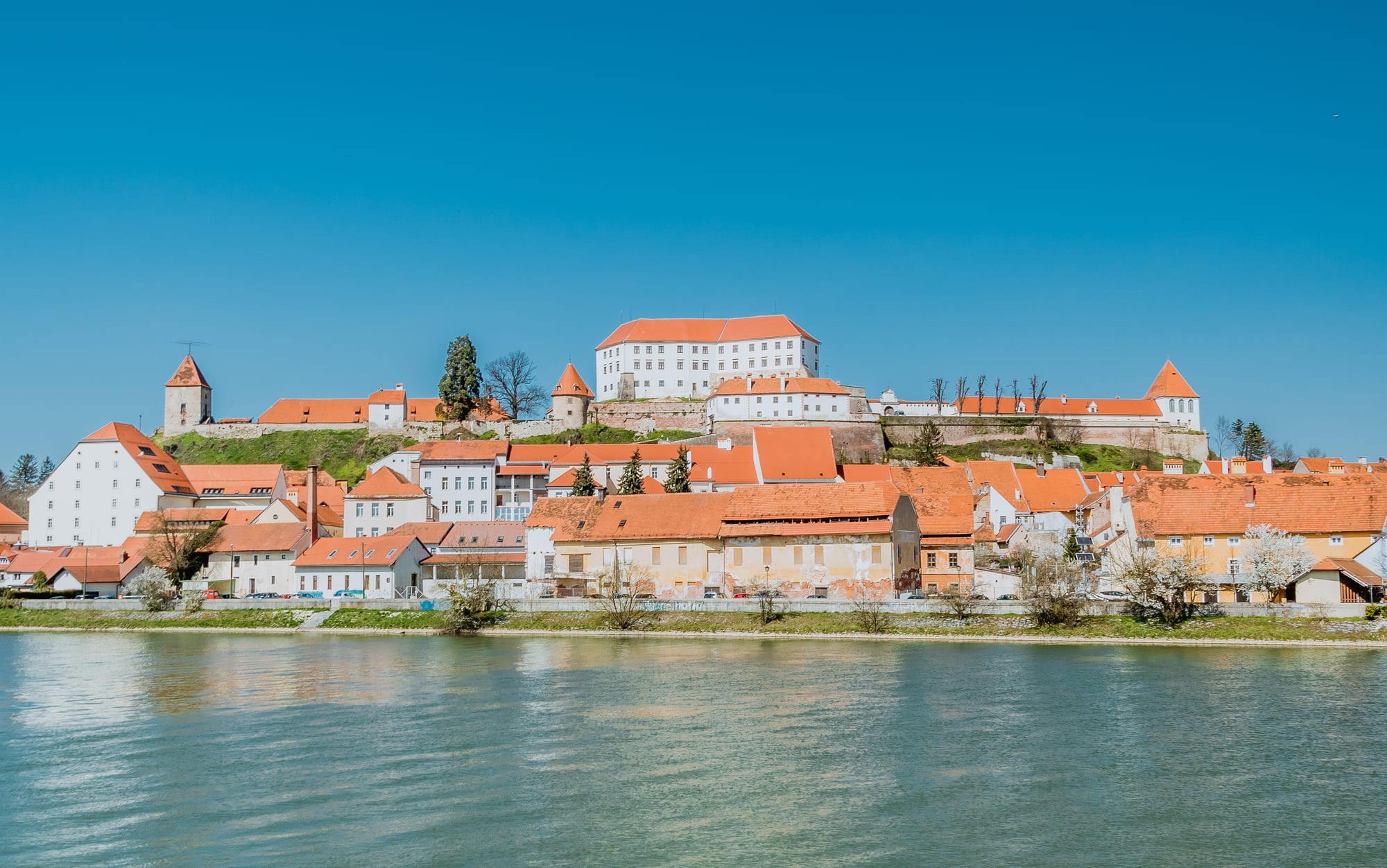
Ptuj Castle above the old town and the Drava. (focusonmore.com / Wikimedia Commons · CC BY 2.0)

A town on the Drava in Slovenian Styria, the oldest recorded town in the country. Roman Poetovio grew from a legionary fort at a river crossing; later ruled by the archbishops of Salzburg, it kept its medieval old town below a hilltop castle. Today it is known for wine cellars, Roman monuments and Kurentovanje, Slovenia's best-known carnival.

Neighbourhoods

  • The old town
    • First-time visitors
    • Historic district
    • Museums

    The medieval town that grew up around the castle hill on the left bank of the Drava. Slovenski trg, with the Town Tower, the Orpheus Monument and St George's Church, and Mestni trg, with the Town Hall, are its centres, and the Dominican monastery, the old cinema and the castle are all a short walk away.

    Open in Maps
  • Breg
    • Roman history
    • Quiet and residential

    The suburb on the right bank of the Drava, across the bridge from the old town, which stands on the western part of Roman Poetovio. Its Mithras shrine, built in the mid-3rd century, is the largest of the temples of Mithras found in the Roman town.

    Open in Maps
  • Lake Ptuj and the riverside
    • Outdoor sports
    • Nature

    South-east of the town the Drava widens into Lake Ptuj, a reservoir created in 1978 for a hydroelectric plant and used for rowing, sailing and fishing, with meadows and fields beside it.

    Open in Maps

Things to do

The old town

  • Ptuj Castlemuseum

    The castle on the hill above the town and the river, now part of the regional museum, with collections of musical instruments, arms, period furniture and the area's traditional carnival masks.

    Open in Maps
  • Orpheus Monumentlandmark

    A Roman tombstone almost 5 m high, carved from white Pohorje marble in the 2nd century for a mayor of Poetovio and used as a pillory in the Middle Ages; its reliefs show the myth of Orpheus.

    Open in Maps
  • St George's Churchlandmark

    The parish church behind the Orpheus Monument, built in the 12th century and redesigned in the Gothic style in the 15th.

    Open in Maps
  • Town Towerlandmark

    The free-standing tower on Slovenski trg, into whose walls Roman tombstones, altars and reliefs were set in 1830 to form the town's first open-air museum.

    Open in Maps
  • Dominican Monasterymuseum

    A monastery founded in the 13th century, with a vaulted cloister and a rich stucco façade, now one of the regional museum's sites.

    Open in Maps
  • Ptuj City Cinemaattraction

    A cinema that opened on 3 March 1897 and claims to be the oldest still operating in the world, renovated most recently in 2025.

    Open in Maps

The river and around

  • Lake Ptujpark

    Slovenia's largest reservoir, on the Drava south-east of the town, used for rowing, sailing and fishing.

    Open in Maps
  • Mithras Shrineattraction

    A temple of Mithras from the mid-3rd century in Breg, with altars dedicated by soldiers of the Roman legions and a copy of a relief from the shrine at Osterburken in Germany.

    Open in Maps

Short trips from the town

  • Ptujska Goralandmark

    A hilltop village whose church, the Basilica of the Virgin of Mercy, begun at the end of the 14th century, is one of the best-known pilgrimage churches in Slovenia.

    Open in Maps
  • Borl Castlelandmark

    A medieval castle above the Drava, probably dating from the 12th century, with later additions and surviving wall paintings.

    Open in Maps
  • Halozepark

    A hilly wine district stretching south of the Drava to the Croatian border, where vines have been grown since Celtic times.

    Open in Maps

Seasonal events

  • KurentovanjeFebruary or March, eleven days around Shrovetide

    Slovenia's best-known carnival, first held in 1960, when groups of kurents in sheepskins, masks and cowbells go through the town to chase away winter; their door-to-door rounds are on UNESCO's intangible heritage list.

  • St George's Fair23 April

    Jurjev sejem, the first of the town's three traditional fairs, with about 150 makers and sellers from across Slovenia.

  • St Oswald's Fair5 August

    Ožbaltov sejem, a fair filling the old town with wooden crafts, honey products, dried fruit, clothes and antiques.

  • St Catherine's Fair25 November

    Katarinin sejem, the last of the three yearly fairs on the town's streets and squares, with a large number of sellers, including second-hand goods.

Eat and drink

Long-standing places and food districts in Ptuj. Hours, ratings and directions come from your maps app, always current.

Ptuj classics

  • Ptuj onionmarket

    Ptujski lük, a heart-shaped onion with reddish layers and a purple edge, one of Slovenia's protected food products.

    Open in Maps
  • Styrian pumpkin seed oilmarket

    Štajersko-prekmursko bučno olje, the dark oil pressed from roasted pumpkin seeds, a protected product of Styria and Prekmurje used on salads.

    Open in Maps

Wine

  • Ptuj wine cellarsneighborhood

    Most of the wine grown in the Haloze hills is made, stored and bottled in Ptuj, a town known for its wine cellars.

    Open in Maps

Experience Ptuj

History

Ptuj is the oldest recorded town in Slovenia. People lived here in the late Stone Age and Celts in the late Iron Age, at a crossing of the Drava on the Amber Road between the Baltic and the Adriatic. Rome controlled it by the first century BC, and Poetovio became the base of the Legio XIII Gemina. In AD 69 the Danubian legions chose Vespasian as emperor here — the first written mention of the town — and in 103 Trajan granted it city status as Colonia Ulpia Traiana Poetovio. It grew into a military, trade and customs centre, and its bishop Victorinus was martyred in about 304. The Huns plundered it in 450, and Avars and Slavs occupied it in 570.

From the late ninth century the town came under the Archbishopric of Salzburg, which rebuilt the castle on the hill in the 12th century; city statutes of 1376 brought prosperity, and the Dominicans founded a monastery in 1230. After Habsburg rule was restored in 1490, Pettau, as it was known in German, was incorporated into the Duchy of Styria in 1555. It suffered Ottoman wars and great fires, and in the 19th century it declined when the Southern Railway was built through Maribor instead. In 1910 most of the old town spoke German, while the villages around spoke Slovene.

After the First World War Rudolf Maister secured Lower Styria for the new South Slav state, and the town became Ptuj. Nazi Germany occupied it in 1941 and deported its Slovene population, settling German speakers from South Tyrol and Gottschee in their homes; these and the local Germans were expelled to Austria in 1945, and since then the town has been almost entirely Slovene.

Culture & Customs

Kurentovanje is the town's great event. Begun in 1960 by Drago Hasl and his colleagues, it has grown from a one-day ethnographic event into an eleven-day festival at Shrovetide that draws around 100,000 people. Its central figure, the kurent or korant, wears a sheepskin, a mask with a long red tongue, cowbells and coloured ribbons, and groups of kurents go from house to house making noise with bells and wooden clubs to scare away evil spirits and winter. Kurents from Ptuj wear feathers, those from Haloze and Lancova Vas horns. In 2017 their door-to-door rounds were added to UNESCO's intangible heritage list, and Ptuj has belonged to the Federation of European Carnival Cities since 1991.

The town's Roman past is visible in the street. The Orpheus Monument, a Roman tombstone almost 5 m tall, still stands in its original place on Slovenski trg, and in 1830 a local priest set Roman stones into the Town Tower to make the town's first open-air museum. The regional museum spreads across the castle, the Dominican monastery and other sites.

Ptuj has kept its medieval fairs, though they now last three days a year rather than weeks: St George's in April, St Oswald's in August and St Catherine's in November. The town also claims the world's oldest working cinema, opened in 1897.

Daily Life

About 18,000 people lived in the town in 2023, and close to 24,000 in the whole City Municipality of Ptuj. It is the eighth-largest town in Slovenia and the economic, administrative, educational, health and cultural centre of the Lower Drava region, with the regional museum, a hospital, a town theatre and galleries.

The old town is compact, with the suburb of Breg on the right bank of the Drava and newer quarters spreading around it. Beyond the town, farmers keep dairy cattle and grow crops on the plain, while orchards and vineyards cover the sunny slopes of the Ptuj hills, and the large Dubrava forest lies at the foot of the hills.

Life follows the calendar of the vine and the carnival. Wine from the Haloze hills is made, stored and bottled in Ptuj, and the days before Lent belong to Kurentovanje, when masked groups from Ptuj and the surrounding villages fill the streets.

Food

Ptuj gives its name to one of Slovenia's protected foods, the Ptuj onion, ptujski lük, a heart-shaped onion with reddish layers and a deep purple edge. Another protected product of the region is Styrian and Prekmurje pumpkin seed oil, štajersko-prekmursko bučno olje, pressed from roasted, hull-less seeds of the local Styrian oil pumpkin. Dark in colour, it is mixed with cider vinegar in the typical Styrian salad dressing.

The best-known pastry of the north-east, prekmurska gibanica, comes from Prekmurje across the Mura but has become a national speciality: layers of pastry filled with poppy seeds, walnuts, apples, raisins and quark.

Wine is the town's other trade. Haloze, one of the seven districts of the Podravje wine region, has grown vines since the Celts in the fourth century BC, and most of its wine is made, stored and bottled in Ptuj. White wines dominate, and the town's cellars and the hills around are the natural places to taste them.

Planning tools

Budget

Ptuj is one of the cheaper bases in Slovenia. Rooms in town and lunch menus are modestly priced; museum tickets can be combined across the regional museum's sites, and wine tastings and the thermal springs are the main extras.

Daily Budget Midrange
USD 110–220 (town or spa hotel, restaurant dinners, wine tastings, museum and spa entry)
Daily Budget Shoestring
USD 55–90 (hostel or simple guesthouse, lunch menus and bakeries, buses and trains)

A combined ticket covers several sites of the regional museum, including the castle and the Dominican monastery.

Best Time to Visit

Kurentovanje, in the days before Lent, is the town's busiest and most colourful time. Spring and autumn suit the old town and the wine hills, with the harvest in autumn, and the three traditional fairs fall in April, August and November.

Suggested Number of Days

One or two days cover the compact old town. Allow three or four to add the surrounding hills, castles and wine country, for which a car is a great help.

First Visit
1–2 days
With Surroundings
3–4 days

Transportation

The old town is small and best seen on foot. The A4 motorway links Ptuj with Maribor and the A1 to Ljubljana, and there are frequent buses and trains to Maribor and connections to Ljubljana. The wine hills and castles around are easiest to reach by car.

Hire a car or arrange a driver for the wine roads of Haloze and the hills.

Airport & Station Connections

Most visitors arrive by road or rail through Maribor, which has frequent bus and train connections; there are also buses and trains from Ljubljana, and an international train between Budapest and Maribor stops at Ptuj. There is no airport in the town; international flights use Ljubljana or Graz in Austria.

Walkability

The old town is compact, and the castle, the squares, the museums and the river are all within a short walk of each other. Breg is across the bridge on the other bank, and Lake Ptuj lies on the south-eastern edge.

Safety

Slovenia is one of the safest countries in Europe, with low crime. Ptuj is a quiet town; the main hazards are narrow, winding roads in the wine hills after tastings.

Arrange a driver or transfer for wine-road tastings. Check current official travel advice before travelling.

Climate

Ptuj lies in the Pannonian lowland and has a sub-Pannonian climate, with an average yearly temperature of about 10°C, warm summers and cold winters.

Summer
in nearby Maribor, July, the warmest month, averages above 20°C
Winter
in nearby Maribor, average winter temperatures hover around 0°C

Local Customs

Carnival is taken seriously: the kurent's costume, mask and door-to-door rounds are traditions on UNESCO's intangible heritage list. A greeting on entering a shop or inn is normal, and English is widely spoken, especially by younger people.

The noise of the kurents' bells and clubs during Kurentovanje is part of the custom: it is meant to scare away evil spirits and winter.

Common Payment Methods

Slovenia uses the euro. Cards are accepted almost everywhere; keep some small cash for the fairs, markets and parking.