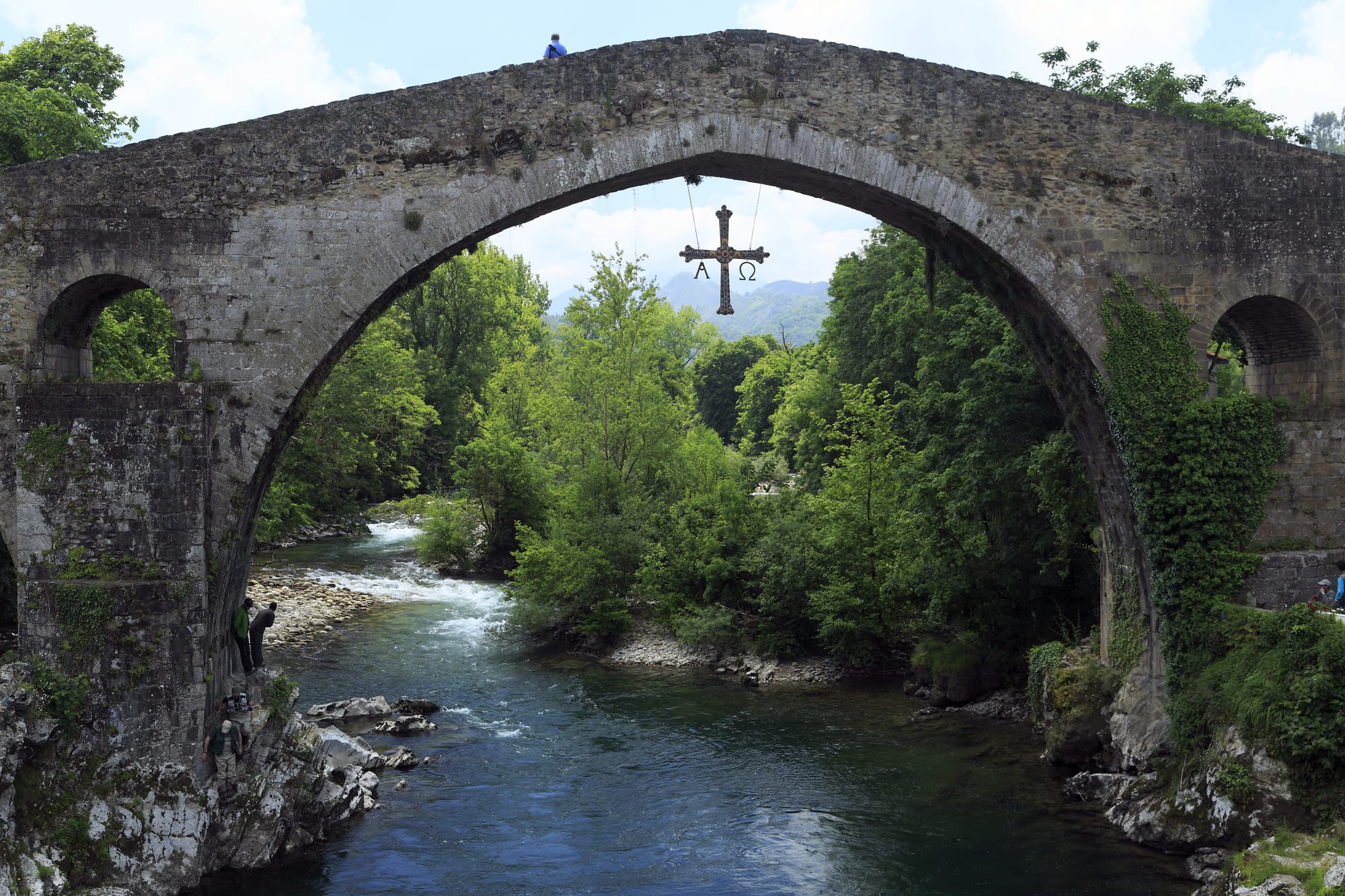
A tall pointed stone arch over a clear green river, with a cross hanging beneath it and wooded hills beyond

Asturias & Cantabria, Spain

Cangas de Onís

The medieval bridge known as the Puente Romano over the Sella at Cangas de Onís. (Falk2 / Wikimedia Commons · CC BY-SA 4.0)

A small town in eastern Asturias where the Güeña joins the Sella, beneath the Picos de Europa. After the battle of Covadonga it became the first capital of the Kingdom of Asturias, and its high-arched medieval bridge and 8th-century chapel recall that past. Today it lives largely from visitors heading for the Covadonga sanctuary and lakes.

Neighbourhoods

  • Town centre
    • First-time visitors
    • Best for food
    • Close to public transport

    The compact streets between the two rivers, around the eclectic former courthouse that now serves as the town hall. Cider houses, cheese shops and outdoor-sports agencies line the main streets, and villas built by returning emigrants stand among them.

    Open in Maps
  • The Sella riverside
    • Historic district
    • Walks

    The banks of the Sella around the medieval bridge, the town's best-known sight. The small Santa Cruz chapel stands on its prehistoric mound in the valley between the two rivers.

    Open in Maps
  • Covadonga
    • Pilgrimage
    • Mountain scenery

    A parish of the municipality in the mountains to the south-east, built around the sanctuary of the Holy Cave and the pink limestone basilica. It is the gateway to the road climbing to the Covadonga lakes.

    Open in Maps
  • Soto de Cangas and Corao
    • Quiet and rural
    • Local life

    Villages of the parish of Abamia, among meadows below the first ridges of the Picos de Europa. The church of Santa Eulalia de Abamia, near Corao, was the first burial place of Pelayo and his wife.

    Open in Maps

Things to do

Landmarks in the town

  • Roman Bridgelandmark

    Known as the Puente Romano but built in the reign of Alfonso XI, with one steeply raised central arch and two smaller unequal arches over the Sella.

    Open in Maps
  • Santa Cruz chapellandmark

    A small chapel founded in 737 by King Favila and Queen Froiliuba on a prehistoric dolmen, probably the first church built in Iberia after the Islamic conquest; it was rebuilt after the Civil War and the dolmen can be seen beneath it.

    Open in Maps
  • Monastery of San Pedro de Villanuevalandmark

    A former Benedictine monastery in the village of Villanueva, keeping parts of its Romanesque walls and three stepped apses from its medieval church.

    Open in Maps

Covadonga

  • Holy Cave of Covadongalandmark

    The cave shrine of the Virgin of Covadonga, in a rock face in the Picos de Europa, where Pelayo and Alfonso I are buried.

    Open in Maps
  • Basilica of Covadongalandmark

    A neo-Romanesque church built of pink limestone between 1877 and 1901 to a design by Roberto Frassinelli, standing on a large terrace.

    Open in Maps
  • Royal Collegiate Church of San Fernandolandmark

    The oldest building of the Covadonga sanctuary, next to the Holy Cave.

    Open in Maps

Short trips into the Picos de Europa

  • Lakes of Covadongapark

    Enol and Ercina, two glacial lakes at over 1,000 metres, the original heart of the national park created in 1918; the climbing road to them is a frequent climb of the Vuelta a España.

    Open in Maps
  • Picos de Europa National Parkpark

    The limestone massif shared by Asturias, Cantabria and Castile and León, part of which lies within the municipality.

    Open in Maps
  • Cares Trailtrail

    One of the most popular walks in the Picos, following the gorge of the Cares river from Poncebos in Asturias towards Caín and Posada de Valdeón in León.

    Open in Maps
  • Ribadesellaattraction

    The coastal town at the mouth of the Sella, finishing point of the canoe race from Arriondas and home to the prehistoric Tito Bustillo cave.

    Open in Maps

Seasonal events

  • Fiestas of San AntonioJune

    The town's patron saint's festival, when the saint's image is carried in procession from his chapel to the parish church, ending with La Jira and a fireworks display.

  • Fiesta del Pastor25 July

    The shepherds' festival on the Vega de Enol near the lakes, where herders choose the wardens of the mountain pastures, with folk dancing and sports.

  • International Sella River Descentearly August

    A canoe and kayak race of about 20 kilometres down the Sella from Arriondas to Ribadesella, held since 1930, with a train running alongside for spectators.

  • Day of Our Lady of Covadonga8 September

    The feast of La Santina, patron of Asturias, draws large numbers of pilgrims to the sanctuary for mass and a procession.

  • Picos cheese contest and honey fairOctober, around the 12th

    The Certamen del Queso de los Picos and the Feria de la Miel, held in the town during the Pilar holiday.

Eat and drink

Long-standing places and food districts in Cangas de Onís. Hours, ratings and directions come from your maps app, always current.

Cangas de Onís classics

  • Cider housesneighborhood

    Sidrerías serving Asturian natural cider, poured from a bottle held high above the server's head into a glass held below, alongside fabada and local cheeses.

    Open in Maps
  • Cheese shopsmarket

    Shops in the town centre selling the cheeses of the Picos de Europa, including the blue Cabrales and Gamonéu.

    Open in Maps

Experience Cangas de Onís

History

According to the Asturian tradition, after the battle of Covadonga in 722, the first major Christian victory in Iberia after the Islamic conquest, Pelayo chose Cangas de Onís as the seat of his new kingdom, using an existing Roman settlement where the Sella and the Güeña meet. It remained the capital of the Kingdom of Asturias until 774. In 737 Pelayo's son Favila and his queen, Froiliuba, founded the chapel of Santa Cruz on a prehistoric dolmen at the edge of the town, probably the first church built after the conquest.

The medieval town grew slowly. A parish called Cangas de Onís is recorded in the 14th century, the high-arched bridge over the Sella was built in the reign of Alfonso XI, and the municipality sent representatives to the Junta General of the Principality in 1504. From the 16th century Covadonga developed as a place of pilgrimage, and after a fire destroyed its church in 1777 the rebuilding of the sanctuary brought trade to the valley.

New roads in the mid-19th century, and the Buferrera mines in the mountains, worked by an English company, brought rapid growth, and in 1908 Cangas de Onís was granted the title of city. The national park of the Montaña de Covadonga was created around the lakes in 1918. The Civil War was a hard blow: the town was bombed several times, the chapel of Santa Cruz was destroyed, and charges were laid on the bridges of the Sella, and guerrilla bands remained in the mountains after the war. In 1978 the town hall hosted the founding of the Regional Council of Asturias, the body that prepared the region's autonomy.

Culture & Customs

Cangas de Onís is bound up with the founding story of Asturias, and its motto, Minima Urbium Maxima Sedium — the smallest of cities, the greatest of seats — recalls its royal past. In Asturian the town is Cangues d'Onís. The sanctuary of Covadonga, with the Holy Cave and the image of the Virgin known as La Santina, patron of Asturias, lies within the municipality, and its feast on 8 September brings pilgrims from across the region; tradition holds that young women who drink from every spout of the fountain there will marry within the year.

The calendar follows the farming and pastoral year. The town's patron, San Antonio, is honoured in June with a procession and, on the following Sunday, La Jira, closed by fireworks. On 25 July the Fiesta del Pastor on the Vega de Enol, near the lakes, is the day when the mountain shepherds choose the wardens who will govern the high pastures, with folk dancing and sport. In October the town holds its contest of Picos de Europa cheeses and a honey fair.

The landscape shapes local identity as much as history. The road to the lakes of Covadonga is a celebrated climb of the Vuelta a España, and the nearby Sella is the scene of the August canoe race from Arriondas to the sea. Several villas in the town, such as Villa Monasterio, are in the style of the indianos, emigrants who came home from the Americas with fortunes.

Daily Life

About 6,300 people live in the municipality (INE, 2025), most of them in the town itself, with smaller numbers in Mestas de Con, Soto de Cangas, Corao, Llano de Con, Labra and Triongo. The municipality peaked at about 11,300 in the mid-20th century and has declined since through emigration; the town has grown in recent years while the villages empty, and only about a fifth of residents are aged between 20 and 40.

Tourism is by far the main source of income. The Covadonga sanctuary and the lakes are among the most visited places in Asturias, and the town's streets are lined with restaurants, cider houses, guesthouses and agencies offering canoeing and walking in the mountains. Farming and cattle-rearing continue in the surrounding valleys.

The year has two rhythms. In summer and on holiday weekends the town is busy with visitors and traffic heading for Covadonga, and buses replace private cars on the lakes road at peak times. Out of season it returns to being a quiet market town for the eastern valleys, with an ageing population and long, damp winters.

Food

The town eats as eastern Asturias eats. Fabada asturiana is the best-known dish: large white beans, fabes de la Granja, soaked overnight and cooked with lacón, or pork shoulder, bacon, morcilla blood sausage and chorizo, with paprika and garlic. Pote asturianu is a stew of cabbage, potatoes, beans and pork products, and fabes con almejas pairs the beans with clams. Salmon are caught in the Sella, and in Asturias the first fish of the season is called the campanu.

The Picos de Europa are cheese country. Cabrales, a blue cheese with a strong flavour, can be made only from the milk of herds raised in a small zone of these mountains; Gamonéu takes its name from the village where it was first made, and Quesu de los Beyos and Afuega'l pitu are other Asturian cheeses. Cornmeal goes into boroña, a hard round loaf, and tortos, flatbreads, while frixuelos, thin pancakes, and rice pudding are common desserts.

The drink is sidra, a very dry natural cider made largely from acidic apples. In the sidrería an escanciador raises the bottle high above the head and pours a small amount, a culín, into a glass held below, to be drunk at once before the cider loses its sparkle; whatever is left is tipped onto the floor or into a trough at the foot of the bar.

Planning tools

Budget

Cangas de Onís is good value for Spain, with generous cider-house meals and plenty of rural guesthouses in the valleys around it. August is the exception: the town and the road to Covadonga fill with Spanish holidaymakers and prices rise.

Daily Budget Midrange
USD 120–230 (rural hotel or town guesthouse, restaurant dinners, a hire car)
Daily Budget Shoestring
USD 55–90 (hostel, pension or campsite, cider-house meals and buses)

Share a bottle of cider and a few raciones in a sidrería for a cheap, filling meal.

Best Time to Visit

June to September, when the high ground of the Picos de Europa is clear of snow. July and August are the warmest and busiest months, when the road up to the Covadonga lakes is restricted to shuttle buses at peak times; late spring and September are quieter and still green. The Covadonga pilgrimage in September and the cheese fair in October bring their own crowds.

Suggested Number of Days

The town itself is small, and one or two nights covers it and the sanctuary nearby. Most people use it as a base for the mountains, and walkers who want more of the Picos de Europa stay several days longer, depending on the weather.

First Visit
1–2 days
With Surroundings
3–5 days

Transportation

The town is small enough to cross on foot. Bus services in the mountains are limited, and in peak season only shuttle buses run up to the Covadonga lakes. A car makes the valleys, the coast and the trailheads far easier to reach.

Check whether the Covadonga lakes road is closed to private cars on the chosen date before driving up.

Airport & Station Connections

Cangas de Onís lies about 71 km east of Oviedo by road, on the national road between Oviedo and Santander, with another road crossing the Picos de Europa south to León. The nearest airport is Asturias Airport, in Castrillón, 15 km from Avilés.

Walkability

The centre is compact and mostly level along the rivers, and the bridge, the Santa Cruz chapel and the main streets are within an easy walk of each other. Covadonga, the lakes and the mountain trails are out of town and need a bus, a taxi or a car.

Safety

Spain is a safe country with low violent crime. In Cangas de Onís the main risks are in the mountains around the town, where fog can descend quickly, paths are exposed and the weather changes fast, and on the narrow mountain roads, which are shared with livestock.

Carry waterproofs and a map in the Picos de Europa even in summer, and turn back in fog. Check current official travel advice before travelling.

Climate

An oceanic climate, green because rain falls in every season. Winters are much milder than in the Spanish interior and summers far less hot. The Picos de Europa above the town are much colder and wetter, often in cloud, with snow on the high ground from autumn to late spring.

Summer
mild and changeable; in Oviedo the warmest month, August, averages a high of about 24°C
Winter
mild and wet; in Oviedo the coldest month, January, averages about 8°C, while the mountains get snow

Local Customs

Covadonga is a place of pilgrimage of great cultural importance to Asturias, and visitors to the Holy Cave and the basilica are among pilgrims at prayer. In the sidrería, cider is poured a little at a time and drunk at once. Tipping is neither mandatory nor considered customary in Spain.

Dress modestly and keep quiet in the Holy Cave and the basilica, especially during mass.

Common Payment Methods

The currency is the euro. Cards and contactless are accepted almost everywhere, including small bars; a little cash is useful in rural villages and mountain huts.