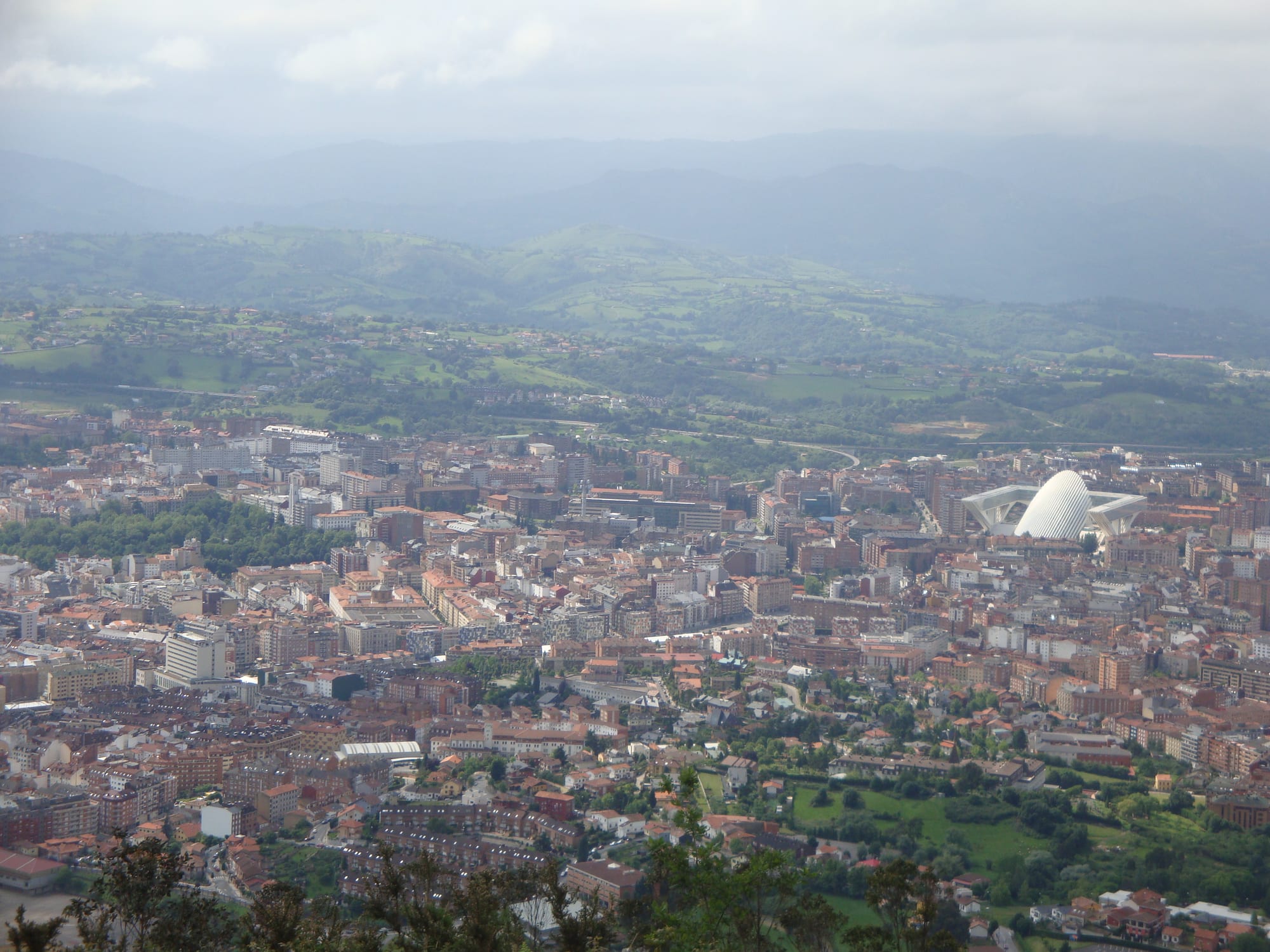
A wide view over the rooftops of Oviedo with a white domed congress building, green hills and mountains beyond

Asturias & Cantabria, Spain

Oviedo

Oviedo seen from Monte Naranco, with the green hills of central Asturias behind. (Frobles / Wikimedia Commons · CC BY-SA 4.0)

The capital of Asturias, set on hilly ground between Monte Naranco and the Sierra del Aramo, less than 30 km inland from the Bay of Biscay. Founded in 761 and made a royal seat by the kings of Asturias, it keeps 9th-century churches, a Gothic cathedral and a compact pedestrian old town; today it is a university and government city known for its cider houses.

Neighbourhoods

  • Casco Antiguo
    • Historic district
    • First-time visitors

    The old town of cobbled streets and squares spreading south from the cathedral, closed to through traffic. Palaces of the 17th and 18th centuries stand in its streets, and the town hall, the fine arts and archaeology museums and the Plaza del Fontán are a few minutes apart.

    Open in Maps
  • Gascona and El Fontán
    • Best for food
    • Nightlife

    The cider quarter. Calle Gascona, running north from the cathedral, is lined with sidrerías, and the arcaded Plaza del Fontán and its covered market sit at the edge of the old town, with bars on the streets around them.

    Open in Maps
  • Uría and the Campo de San Francisco
    • Shopping
    • Close to public transport
    • Parks

    The 19th-century expansion between the old town and the railway station. Calle Uría, the main shopping street, runs past the Campo de San Francisco, the large park in the centre, and the Campoamor Theatre stands nearby.

    Open in Maps
  • Monte Naranco
    • Viewpoints
    • Pre-Romanesque churches

    The mountain that shelters the city from the north. On its lower slopes, about 3 km from the centre, stand the 9th-century royal buildings of Santa María del Naranco and San Miguel de Lillo; higher up, a statue of the Sacred Heart overlooks the city.

    Open in Maps

Things to do

Pre-Romanesque Oviedo

  • Santa María del Narancolandmark

    A royal palace hall completed for King Ramiro I in 842 and consecrated as a church in 848, a UNESCO World Heritage Site and a forerunner of Romanesque building.

    Open in Maps
  • San Miguel de Lillolandmark

    A church built with the Naranco palace a short walk up the slope; most of it collapsed in the 12th or 13th century, but carved door jambs and pierced stone windows survive in the remaining western end.

    Open in Maps
  • San Julián de los Pradoslandmark

    Santullano, a church ordered by Alfonso II and built around 830, one of the greatest works of Asturian art, with painted wall decoration.

    Open in Maps
  • La Foncaladalandmark

    A 9th-century drinking fountain built by Alfonso III outside the old walls, the only surviving public civil structure of the early Middle Ages.

    Open in Maps

Cathedral and old town

  • Oviedo Cathedrallandmark

    The Gothic cathedral of San Salvador, begun in 1388 on the site of the 8th-century church, with a single tall tower, finished in 1551.

    Open in Maps
  • Cámara Santamuseum

    The 9th-century palace chapel of Alfonso II inside the cathedral, a UNESCO site that still guards the Victory Cross, the Cross of the Angels, the Arca Santa and the Sudarium of Oviedo.

    Open in Maps
  • Plaza del Fontánmarket

    An arcaded square at the edge of the old town, a marketplace for centuries, demolished and rebuilt in 1996–97.

    Open in Maps

Museums

  • Museum of Fine Arts of Asturiasmuseum

    The regional art museum, spread over three old-town buildings including the 18th-century Palacio de Velarde.

    Open in Maps
  • Archaeological Museum of Asturiasmuseum

    The region's prehistory, hillfort culture, Roman period and Asturian kingdom, in the 16th-century former Benedictine monastery of San Vicente.

    Open in Maps

Parks, music and sport

  • Campo de San Franciscopark

    The city's central park, known simply as El Campo, beside Calle Uría, with the Paseo del Bombé among its walks.

    Open in Maps
  • Campoamor Theatreattraction

    The opera house opened in 1892, home of the Oviedo opera season and the stage for the Princess of Asturias Awards ceremony.

    Open in Maps
  • Estadio Carlos Tartiereattraction

    The home of Real Oviedo, with 30,500 seats the largest stadium in Asturias.

    Open in Maps
  • Monte Narancoviewpoint

    The mountain north of the city, with views over Oviedo and a statue of the Sacred Heart at the top; its road is a finish for cycle races including the Vuelta a España.

    Open in Maps

Short trips from the city

  • Gijónattraction

    Asturias's largest city, a port on the Bay of Biscay about 24 km north-east, with beaches and a busy cultural life.

    Open in Maps
  • Avilésattraction

    A town on its estuary about 23 km to the north-west, whose historic buildings include the medieval Palacio de Valdecarzana.

    Open in Maps

Seasonal events

  • Martes de Campoa Tuesday in mid-May

    A local holiday, also called La Balesquida or Martes del Bollu, when people picnic in the parks.

  • Hoguera de San XuanJune

    La Foguera de San Xuan, the Saint John's bonfire lit at midsummer.

  • Fiestas de San MateoSeptember

    The city's main festival, about ten days of plays, concerts in the cathedral square, street food and the Día de América en Asturias parade.

  • Princess of Asturias AwardsOctober

    The ceremony at the Campoamor Theatre that honours international achievement in eight categories, from the arts to international cooperation.

Eat and drink

Long-standing places and food districts in Oviedo. Hours, ratings and directions come from your maps app, always current.

Oviedo classics

  • Calle Gascona sidreríasneighborhood

    The street of cider houses north of the cathedral, where cider is poured from a height and Asturian dishes are served in shared plates.

    Open in Maps
  • Old town tavernsneighborhood

    Restaurants and taverns around the cathedral, Plaza Porlier and Plaza del Riego serve fabada, cachopo and other Asturian dishes.

    Open in Maps

Food districts and markets

  • Mercado El Fontánmarket

    The covered market opened in 1885 beside the Plaza del Fontán, with stalls of meat, fish, cheese and produce.

    Open in Maps

Cafés and bars

  • Calle Rosal and Calle Monneighborhood

    Two of the city's bar streets, Rosal south-west of El Fontán and Mon south of the cathedral.

    Open in Maps

Experience Oviedo

History

Oviedo was founded on an empty hillside: tradition says two monks, Máximo and Fromestano, settled here in 761 and built a small church to Saint Vincent. King Fruela I added a palace and a church, and Alfonso II the Chaste, who reigned from 791 to 842, moved the court of the Kingdom of Asturias here from Pravia and built the church of the Saviour, the forerunner of the cathedral, and San Julián de los Prados. The creation of the pilgrims' route to the newly found tomb of Saint James at Santiago in his reign was a major event in the city's history. Ramiro I built a palace on Monte Naranco, and Alfonso III commissioned the jewelled Victory Cross in 908. Emir Hisham I sacked the city in 794.

After Alfonso III's death the court moved to León and Oviedo became a pilgrimage and church city. In the 12th century Bishop Pelayo forged royal charters to promote the church of Oviedo. The medieval city, with its walls and Gothic cathedral begun in 1388, kept its outline, and the university, founded by Fernando de Valdés Salas, opened in 1608. Nobles built palaces in the 18th century, and in the 19th industry and the new Calle Uría pushed the city outwards.

In October 1934 armed miners captured Oviedo during the Asturian revolt; Francisco Franco sent in troops, and the street fighting left thousands dead and the Cámara Santa blown up. In 1936 the garrison sided with the Nationalist coup and held out through a three-month siege until relieved in 1937. Rebuilt and expanded since, Oviedo has grown as the seat of the Asturian government and university.

Culture & Customs

Oviedo has a literary double: it is the model for Vetusta, the provincial cathedral town of Leopoldo Alas's novel La Regenta. Oviedo featured prominently in Woody Allen's film Vicky Cristina Barcelona, and a life-size statue of him, put up in 2005 after he praised the city on receiving the Prince of Asturias Award, stands on a central street. The Campoamor Theatre, opened in 1892 and burned during the 1934 revolution, hosts the opera season and the Princess of Asturias Awards, which bring international figures from the arts, science and public life to the city each year. The Orquesta Sinfónica del Principado de Asturias is based at the Prince Felipe Auditorium.

The cathedral is still a goal for pilgrims. The Sudarium of Oviedo, a cloth revered as Christ's burial cloth since the 9th century, is shown to the public three times a year: on Good Friday, on 14 September and on 21 September. The city's festive calendar runs from the Antroxu carnival through the Martes de Campo picnic holiday in May and the San Xuan bonfires to the San Mateo festival in September, with its Día de América en Asturias recalling the region's emigrants. El Desarme commemorates a local victory over a Carlist army in the 1830s.

Asturian is used alongside Spanish, and the city's official name is Oviedo / Uviéu. Fernando Alonso, the two-time Formula One world champion, is from Oviedo, and Real Oviedo, the football club, plays at the Carlos Tartiere.

Daily Life

About 224,000 people lived in the municipality in 2025, making it the second city of Asturias after Gijón. In 2024 about 15 per cent of residents were born abroad, Colombians, Venezuelans, Ecuadorians, Cubans and Romanians the largest groups. Oviedo sits about 24 km from Gijón and 23 km from Avilés, and the three form the core of central Asturias.

The economy depends on services. As the regional capital, Oviedo has a large public administration, and the University of Oviedo, with its international campus, draws students and scholars. Offices fill the city centre, while manufacturing lies in the neighbouring municipalities of Siero and Llanera to the north. Calle Uría is the main shopping street, with large shopping centres on the city's edge.

The old town has been pedestrianised and traffic restricted on Uría, so much of daily life happens on foot, between the park, the market and the sidrerías. The city is a hilly one, ringed by green slopes, with Monte Naranco to the north and rural parishes within its own boundaries.

Food

Asturian food is hearty mountain and farm cooking. Fabada asturiana, the region's most famous dish, is a rich stew of large white beans, fabes de la Granja, with pork shoulder, morcilla, chorizo and saffron, usually eaten at lunch in winter and served with cider or red wine. Cachopo is two veal fillets with ham and cheese, breaded and fried. Other local dishes include carne gobernada, chunks of meat in an onion, garlic and white wine sauce, chorizo cooked in cider, callos, or tripe, and fabes with clams.

Asturian cheeses are famous across Spain, especially Cabrales, known for its pungent smell and strong flavour. The sweet things are frixuelos, thin pancakes, arroz con leche, a rice pudding, and Oviedo's own carbayones, an almond pastry. Paxarines are figures of breadcrumb and egg coloured with saffron.

Cider, sidra, is the drink of Asturias: a very dry natural cider made mainly from acidic apples. In the sidrerías of Calle Gascona and across the city an escanciador raises the bottle high above the head to aerate it and pours a culín, a small measure to be drunk at once. Mercado El Fontán, the covered market opened in 1885, sells cheeses, meat and produce.

Planning tools

Budget

Oviedo is good value for Spain. Cider-house meals are generous and cheap, the menú del día is everywhere, and the old town and the Naranco churches cost little to see. Rooms rise during the San Mateo festival and when the Princess of Asturias Awards are held.

Daily Budget Midrange
USD 120–230 (city hotel, restaurant dinners, the cathedral and Naranco tickets, local trains to the coast)
Daily Budget Shoestring
USD 50–90 (hostel or pension, cider-house meals and menú del día, city buses)

Share a bottle of cider and a few plates in a sidrería on Calle Gascona for a cheap, filling meal.

Best Time to Visit

June to September brings the warmest, driest weather, with San Mateo in September. May has the Martes de Campo picnic holiday, and October the Princess of Asturias Awards. Winter is mild for northern Spain but grey and damp, and the cathedral and museums are quiet.

Suggested Number of Days

Two days cover the old town and the churches on the edge of the city. Four or five allow time for the coast and mountains of Asturias, best with a car. Pre-Romanesque church visits run on limited hours, which can add time.

First Visit
2 days
With Surroundings
4–5 days

Transportation

The old town is pedestrian and most visitors walk. City buses (TUA) cover the rest of the municipality, including the Naranco slopes, and Cercanías trains link Oviedo with Gijón, Avilés and the mining valleys. Taxis wait at the bus station and other central points; there is no bike-share scheme.

Take a bus or taxi up to Santa María del Naranco and walk back down to the centre.

Airport & Station Connections

Asturias Airport is on the coast near Avilés, about 47 km from Oviedo, with mainly domestic flights and a few international ones; an Alsa bus runs to the city about every hour. Trains from Madrid take about three and a half hours via León, using the high-speed line through the Pajares tunnels, and arrive at the station at the top of Calle Uría. Long-distance buses use the bus station nearby.

Walkability

The centre is compact and very walkable: the old town is pedestrianised and traffic is restricted on Calle Uría, so the station, the park, the cathedral and the cider streets are all within a short walk. The city centre is hilly, and Santa María del Naranco, about 3 km away, is an uphill walk.

Safety

Spain is a safe country with low violent crime. Oviedo has little crime affecting visitors; ordinary care in busy bar streets late at night is enough. Weather is the main practical factor, with frequent rain and fog on Monte Naranco.

Carry an umbrella, take care on wet cobbles in the old town, and keep belongings close in crowded sidrerías. Check current official travel advice before travelling.

Climate

An oceanic climate, very similar to nearby Gijón but slightly more varied in temperature because the city is higher and further inland. Monte Naranco and the Sierra del Aramo shelter it from strong winds. Winters are much milder than in inland Spain, summers far less hot, and rain falls in every season, a little less in summer.

Summer
mild — August averages about 18.7°C across day and night, with average highs near 24°C
Winter
cool and damp — January averages about 8°C across day and night

Local Customs

Spanish and Asturian are both used, and the city's official name is bilingual: Oviedo / Uviéu. Cider has its own etiquette: an escanciador pours a small amount, a culín, from a bottle held high above the head, and it is drunk at once before it loses its sparkle. Meals run late, with lunch after two and dinner after nine.

Drink a culín of cider straight away, before it loses its sparkle; cover shoulders in the cathedral and its chapels.

Common Payment Methods

Spain uses the euro. Cards and contactless are accepted almost everywhere, including small bars; carry a little cash for markets and rural tabernas. Cash machines are easy to find in the centre.