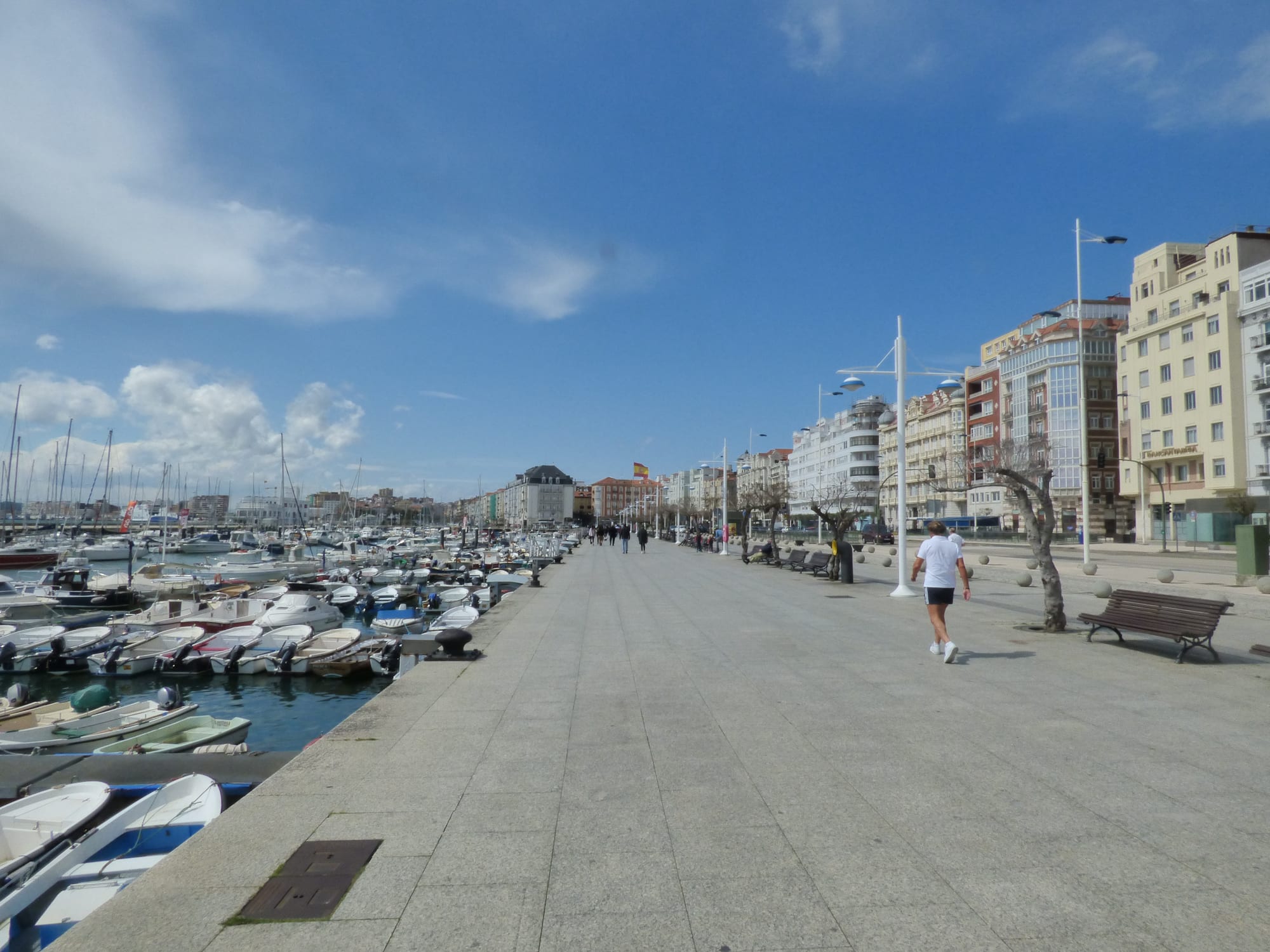
A wide seafront promenade beside a marina full of small boats, with tall pale apartment buildings on the right

Asturias & Cantabria, Spain

Santander

The marina at Puertochico and the Paseo de Castelar on the Bay of Santander. (Pmato / Wikimedia Commons · CC BY-SA 4.0)

The capital of Cantabria, on the north shore of the Bay of Santander facing the Cantabrian Sea. A port for Castile and the Americas for centuries, it became a fashionable bathing resort in the 19th century and a royal summer seat; after the great fire of 1941 it was largely rebuilt. Today it combines a working port, long beaches at El Sardinero and the Centro Botín arts centre.

Neighbourhoods

  • Centro
    • First-time visitors
    • Close to public transport
    • Best for food

    The city centre around the cathedral, the town hall and the Plaza Porticada, rebuilt on broad modern lines after the fire of 1941. The bus, railway and ferry terminals are close by, the covered Mercado de la Esperanza stands just north of the town hall, and the Paseo de Pereda runs east along the bay.

    Open in Maps
  • Puertochico
    • Waterfront
    • Nightlife

    The old harbour, now the marina, and the streets around it at the eastern end of the Paseo de Pereda, where the seafront boulevard becomes Calle Castelar. Promenades, boat trips round the bay and the Centro Botín on its pier are all nearby.

    Open in Maps
  • El Sardinero
    • Beaches
    • Families
    • Historic resort

    The 19th-century bathing resort a few kilometres east of the centre, developed from the 1840s and partly protected as a historic ensemble. Its beaches, the Piquío gardens and the Racing de Santander stadium are here.

    Open in Maps
  • La Magdalena
    • Parks
    • Beaches
    • Walks

    The wooded peninsula at the mouth of the bay, about 3 km from the centre, with the royal summer palace, two beaches, a small zoo, a lighthouse and replica ships.

    Open in Maps

Things to do

Famous landmarks

  • Palacio de la Magdalenalandmark

    The palace built between 1909 and 1911 by public subscription and given to the royal family as a summer residence, on the site of an old fort at the tip of the Magdalena peninsula.

    Open in Maps
  • Santander Cathedrallandmark

    A mainly Gothic cathedral on two levels, on the hill where the Roman settlement stood, with the lower Church of the Christ dating from the 12th century; the fire of 1941 gutted it.

    Open in Maps
  • Plaza Porticadalandmark

    A neoclassical arcaded square completed in 1950 as the new centre of the city after the fire, for decades the stage of the summer music festival.

    Open in Maps
  • Cabo Mayor lighthouseviewpoint

    The lighthouse that presides over the entrance to the Bay of Santander, with an art gallery at its base devoted to lighthouses.

    Open in Maps

Museums and culture

  • Centro Botínmuseum

    An arts centre of the Fundación Botín designed by Renzo Piano, two buildings standing on columns over the water of the bay, with contemporary art exhibitions.

    Open in Maps
  • Museum of Prehistory and Archaeology of Cantabriamuseum

    The region's archaeology from the Palaeolithic to the Roman and medieval periods, in the city centre.

    Open in Maps
  • Museo Marítimo del Cantábricomuseum

    Maritime heritage, natural history and an aquarium on the bay shore.

    Open in Maps
  • Palacio de Festivalesattraction

    The large modern concert hall facing the bay, used for classical music, opera and ballet.

    Open in Maps

Beaches and parks

  • Magdalena Peninsulapark

    A 28-hectare peninsula of gardens and woodland around the palace, popular with locals and visitors, with a small zoo, three galleons of the mariner Vital Alsar, two beaches and a lighthouse.

    Open in Maps
  • El Sardinero beachbeach

    The city's principal beach, split into first and second beaches by the little Piquío gardens promontory; it is tidal and can be too rough for bathing in north-westerly weather.

    Open in Maps
  • Playa de la Magdalenabeach

    The beach closest to the centre, inside the sheltered estuary below the Magdalena peninsula.

    Open in Maps
  • Pereda Gardenspark

    A park east of the cathedral on the bay front, with monuments to the writers José María de Pereda and Concha Espina.

    Open in Maps

Sport and nights out

  • Campos de Sport de El Sardineroattraction

    The stadium of Racing de Santander near El Sardinero beach, opened in 1988, with about 22,300 seats.

    Open in Maps

Short trips from the city

  • Cabárceno Natural Parkpark

    A zoo and nature reserve about 13 km south of the city in a former open-pit iron mine, devoted to the conservation of endangered species.

    Open in Maps
  • Santillana del Marattraction

    A historic town of old stone buildings around a Romanesque collegiate church, near the cave of Altamira, a UNESCO World Heritage Site.

    Open in Maps

Seasonal events

  • Hoguera de San Juanmidsummer, around 23–24 June

    A great bonfire and romería on the second beach of El Sardinero to welcome the summer, with other bonfires in the neighbourhoods.

  • Baños de Olamid-July

    A festival recalling the 19th-century fashion for sea bathing that made Santander a resort.

  • Fiestas de Santiagolate July, around 25 July

    The summer festival around the feast of Saint James, declared of regional tourist interest.

  • Festival Internacional de SantanderAugust

    One of Spain's oldest music festivals, with opera, ballet, theatre and concerts at the Palacio de Festivales and in churches and other venues.

Eat and drink

Long-standing places and food districts in Santander. Hours, ratings and directions come from your maps app, always current.

Santander classics

  • Rabas in the centreneighborhood

    Rabas, fried calamari, are one of the city's typical dishes, served in bars across the centre.

    Open in Maps
  • Seafood restaurantsrestaurant

    Clams, razor clams, sea bream, red mullet, anchovies, sea bass and sardines from the Cantabrian Sea are the basis of the local kitchen.

    Open in Maps

Food districts and markets

  • Mercado de la Esperanzamarket

    A large traditional covered market just north of the town hall with a wide choice of fresh local fish, meat and produce.

    Open in Maps
  • Mercado del Estemarket

    A former market building in the centre, now a food court.

    Open in Maps

Experience Santander

History

Santander owes its existence to its harbour, sheltered on the north side of the bay. Its Roman name was Portus Victoriae Iuliobrigensium, and in the 9th century Alfonso II founded the Abbey of the Holy Bodies here; the town is first mentioned in a document of 1068. Alfonso VIII of Castile granted a charter in 1187. Through the Middle Ages it was two walled towns on either side of a creek, building ships for the crown from Cantabrian timber, and it became an important port for Castile and later for trade with the Americas. It officially became a city in 1755.

From the 1840s the fashion for sea bathing turned El Sardinero into a resort for the wealthy, and under Alfonso XIII Santander became the court's favourite summer retreat; the city gave the king the Magdalena Palace. Disaster struck on 3 November 1893, when the steamship Cabo Machichaco, carrying dynamite, caught fire at a pier in the city centre and exploded, killing about 590 people and destroying dozens of buildings. In the Civil War the city stayed Republican until Nationalist forces captured it on 26 August 1937, after which many prisoners were executed.

On the night of 15 to 16 February 1941 a fire broke out and, driven by a strong southerly wind, burned for two days, destroying most of the medieval centre, gutting the cathedral and leaving thousands of families homeless. The city was rebuilt with broad boulevards, and the Plaza Porticada was completed in 1950 as a new centre.

Culture & Customs

Santander's cultural life has long revolved around summer. The Menéndez Pelayo International University is a major international summer university, and the Festival Internacional de Santander, which grew out of entertainment for its foreign students in 1948, is one of Spain's oldest music festivals, staging opera, ballet and concerts every August. The Paloma O'Shea International Piano Competition and an international organ festival are also held here. The Centro Botín, designed by Renzo Piano for the foundation of the banking family, stands on columns over the bay as a museum and study centre, completed in 2017.

The city is closely linked with Banco Santander, founded here in 1857; its legal headquarters remain in the city, although the bank is run from outside Madrid. Writers associated with Santander include the novelist José María de Pereda and Concha Espina, both honoured in the Pereda Gardens, and the scholar Marcelino Menéndez y Pelayo, whose library and house-museum are in the city.

Festivals follow the seasons: the Virgen del Mar on Whit Monday, the San Juan bonfire on El Sardinero, the Baños de Ola recalling the old bathing season, Santiago in July and the patron saints' feast at the end of August. Football means Racing de Santander, who returned to the top division in 2026, and the airport is named after the golfer Seve Ballesteros.

Daily Life

About 175,000 people lived in the municipality in 2025, making Santander the largest city in Cantabria. The economy is built on services rather than heavy industry: the regional government, the Marqués de Valdecilla University Hospital, the University of Cantabria and Banco Santander are major employers, and culture, leisure and tourism are an important part of the economy, with most visitors coming from elsewhere in Spain.

The port remains busy, with cargo traffic and ferries to Britain and Ireland, and the city has been used as a pilot smart city, with some 12,000 sensors embedded in its streets. Daily life runs between the rebuilt centre and the long bay front that links Puertochico with the Magdalena and El Sardinero.

The rhythm is seasonal. In summer the city fills with holidaymakers, the beaches are crowded and the music festival brings international performers; in winter Santander is a quiet, rainy administrative city where life moves indoors to bars and cafés.

Food

Santander's cooking is Cantabrian and based mainly on seafood. Popular shellfish include almejas, clams, and muergos, razor clams; the fish include sea bream, red mullet, anchovies, sea bass and sardines; and squid and cuttlefish are everyday food. Typical dishes of the city include rabas, fried calamari, and seafood dishes run from sea bass and sardines to morguera.

The great inland dish is cocido montañés, a Cantabrian stew dating from the 17th century. It is made with dried large white beans and collard greens, with a compangu of pork from the pig slaughter: bacon, pork ribs, morcilla and chorizo. It is a heavy dish, eaten above all at lunch in winter. Santander is also known for double donuts, a local pastry.

The Mercado de la Esperanza, a large covered market just north of the town hall, is the place to see the day's catch alongside local meat and produce, and the old Mercado del Este has become a food court. In summer the cafés and ice-cream parlours of El Sardinero are full.

Planning tools

Budget

Santander is good value for northern Spain outside the summer peak. August is the exception, when Spanish holidaymakers fill the city and prices climb. Tapas and the menú del día are cheap; seafood priced by weight is the main way to spend more.

Daily Budget Midrange
USD 130–240 (city hotel, restaurant dinners, the Centro Botín and a boat trip, buses or a hire car for day trips)
Daily Budget Shoestring
USD 55–95 (hostel or pension, rabas and menú del día, city buses)

Walk the bay front from the centre to the Magdalena and El Sardinero; the beaches, gardens and promenades cost nothing.

Best Time to Visit

June to September for the beaches, the San Juan bonfire, the summer festivals and the international music festival in August. July and August are the busiest months. Santander is one of the rainiest parts of Spain, with rain spread through the year but heaviest in spring and autumn; outside summer the city is quiet and mild.

Suggested Number of Days

Two days cover the centre, the bay and the beaches. Four or five allow time for the towns and countryside of Cantabria as well, more easily with a car. Bad weather on the coast is the main reason to allow an extra day.

First Visit
2 days
With Surroundings
4–5 days

Transportation

The places of interest are in a compact strip along the bay and are best explored on foot; from the town hall to the Magdalena or El Sardinero is about 4 km. TUS runs about two dozen city bus lines, and a hop-on hop-off sightseeing bus circles the main sights. The bus, mainline and Cercanías railway stations stand side by side in the centre.

Ride a city bus out to El Sardinero and walk back along the bay past the Magdalena peninsula.

Airport & Station Connections

Seve Ballesteros–Santander Airport, built on land reclaimed from the bay just south of the city, has flights from Madrid, Barcelona and other cities; a bus to the bus station takes about ten minutes. Trains from Madrid take four to five hours, and Alsa buses run from Madrid, Bilbao and Asturias. Brittany Ferries sail to the central ferry terminal from Portsmouth and Plymouth.

Walkability

Good. The centre, the market, the cathedral, Puertochico and the Centro Botín are close together, and a continuous seafront route leads out along the bay to the Magdalena peninsula and El Sardinero. Rain is frequent, so a raincoat is useful in any season.

Safety

Spain is a safe country with low violent crime. Santander is a calm city with little crime that affects visitors; ordinary care with bags on busy beaches and in bars at night is enough. The main hazards are natural: the open beaches face the Atlantic, can be too rough for bathing in north-westerly weather, and are tidal.

Swim where lifeguards are posted, check the tide before walking round rocky points, and keep belongings in sight on the beach. Check current official travel advice before travelling.

Climate

A mild oceanic climate with no extremes: the difference between the warmest and coldest months is only about 8°C. Humidity is high all year and rain falls in every season. In autumn and winter a strong, warm southerly wind can bring sudden heat and very dry air. Sunshine is low by Spanish standards.

Summer
mild — average highs around 24.5°C in August; warm spells are possible but rare
Winter
mild and wet — average lows around 5.8°C in February

Local Customs

Meals run late, with lunch after two and dinner after nine. Going out for rabas and a drink before a meal is a local habit, and in summer evening life moves to the bay front and El Sardinero. Churches, including the cathedral, are working places of worship.

Avoid visiting the cathedral during Mass, cover shoulders in churches, and keep beachwear for the beach.

Common Payment Methods

Spain uses the euro. Cards and contactless are accepted almost everywhere, including small bars; carry a little cash for markets and small tabernas. Cash machines are easy to find in the centre.