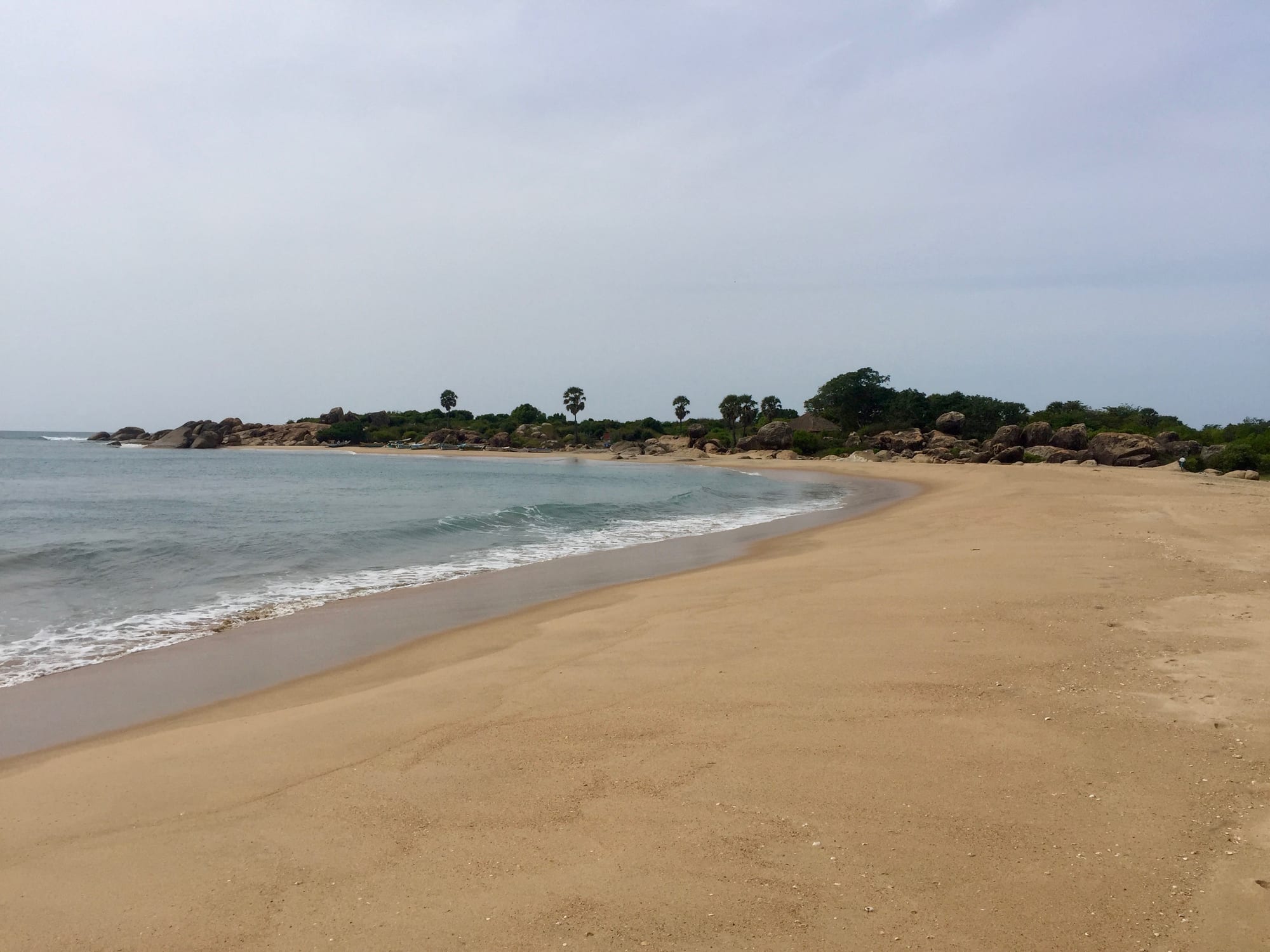
An empty curving beach of pale sand with small waves breaking, ending at a low rocky headland with palms and scrub

Jaffna, Trincomalee & the North and East, Sri Lanka

Arugam Bay

Whiskey Point, one of the surf breaks on the coast just north of Arugam Bay. (Kalana Jayatilake / Wikimedia Commons · CC BY-SA 4.0)

A surf village on Sri Lanka's south-east coast in Ampara District, strung along a single sandy road between the ocean and a lagoon. The right-hand point break at its southern end made its name among surfers, and the village rebuilt after the 2004 tsunami as a low-key base for the beaches, wetlands and national parks of the dry south-east.

Neighbourhoods

  • The beach road
    • First-time visitors
    • Best for food
    • Nightlife

    The single road running south along the sand spit, lined with guesthouses, board hire, cafés and beach bars set among the palms. Almost everything a visitor needs is on it, and it fills in the surf season and empties in the monsoon.

    Open in Maps
  • Main Point and the southern end
    • Surfing
    • Sunrises

    The far end of the village, where the sand meets the rocks and the long right-hand wave breaks. Surf camps, board repairers and early-morning traffic to the water concentrate here, and the lagoon comes close behind the road.

    Open in Maps
  • Ullae and the lagoon side
    • Local life
    • Quiet and residential

    The Muslim fishing settlement on the inland side of the bridge, where boats are drawn up on the lagoon and the working village goes about its day largely apart from the beach strip.

    Open in Maps
  • Pottuvil
    • Local life
    • Markets
    • Close to public transport

    The town a few kilometres north, with the bus stand, banks, shops and the mosque, plus a long beach and an ancient Buddhist temple on the dunes. This is where the surrounding district does its business.

    Open in Maps
  • The northern beaches
    • Beaches
    • Surfing
    • Quiet and residential

    Whiskey Point, Peanut Farm and the coves scattered north and south of the village, reached by tuk-tuk or scooter down sandy tracks, with a handful of simple shacks and long stretches of empty sand.

    Open in Maps

Things to do

Beaches and surf

  • Arugam Bay beach and Main Pointbeach

    The village beach curves south to a rocky point where a long right-hand wave peels for hundreds of metres, the break that made the bay known to surfers.

    Open in Maps
  • Whiskey Pointbeach

    A sandy cove with a gentler right-hand break a short ride north of the village, popular with learners and less crowded than the main point.

    Open in Maps
  • Pottuvil Pointbeach

    A long, exposed beach north of the village at Pottuvil, with another point break at its southern end and dunes behind it.

    Open in Maps

Temples and history

  • Muhudu Maha Viharayalandmark

    An ancient Buddhist temple at Pottuvil, behind the beach, with stone statues of the Buddha and of two figures taken for kings or gods, and the remains of old stupas.

    Open in Maps
  • Magul Maha Viharayalandmark

    A ruined monastery inland at Lahugala, with a moonstone, stone pillars and a stupa, traditionally linked to the marriage of King Kavantissa and Princess Vihara Maha Devi.

    Open in Maps
  • Kudumbigala Monasterylandmark

    A forest hermitage of rock caves and a small stupa on a granite dome south of the village, an ancient monastery in the Kumana forest, long valued for its isolation.

    Open in Maps

Wildlife and the wetlands

  • Kumana National Parkpark

    A park of lagoons, mangrove swamp and scrub south of the village, known above all for its breeding waterbirds, and also home to elephants, crocodiles, jackals and wild boar.

    Open in Maps
  • Lahugala Kitulana National Parkpark

    A small park of reservoirs and beru grass west of the village, where elephants gather to feed, often visible from the main road.

    Open in Maps
  • Pottuvil Lagoonattraction

    A shallow mangrove lagoon behind the village, worked by fishermen and crossed by small boats, with birds, monitor lizards and crocodiles in the channels.

    Open in Maps
  • Panamaattraction

    A village of rice fields and lagoons at the end of the surfaced road south, the last settlement before the parks and the starting point for trips to Okanda.

    Open in Maps

Seasonal events

  • The surf seasonMay to September

    The months when the swell is consistent and the wind offshore: the village fills with surfers, competitions are held at the main point and every room is taken.

  • Ramadan and EidVaries with the lunar calendar

    Arugam Bay and Pottuvil are largely Muslim, and during the fasting month the village's daily rhythm changes, ending with communal prayers and family feasting at Eid.

  • Sinhala and Tamil New YearApril

    Marked in the Sinhalese and Tamil villages inland from the coast with rituals at auspicious times, sweets and games, just before the surf season begins.

  • Kataragama pilgrimage seasonJuly and August

    Pilgrims walk the old route through the parks and villages of the south-east towards the shrine at Kataragama, passing the country inland from the bay.

Eat and drink

Long-standing places and food districts in Arugam Bay. Hours, ratings and directions come from your maps app, always current.

Arugam Bay classics

  • Beach road kitchensneighborhood

    The strip of guesthouse restaurants and beach cafés serves grilled fish, curries, rice and kottu alongside the pancakes, smoothies and rice bowls that surfers expect.

    Open in Maps
  • Fresh fish and seafoodneighborhood

    Boats land seer fish, tuna, prawns, squid and lagoon crab, which are cooked as curry, devilled with chilli and onion, or grilled whole over charcoal.

    Open in Maps
  • Muslim cooking in Pottuvilneighborhood

    Eating houses in the town make biryani, mutton and chicken curries, roti and short eats, with watalappam, a spiced coconut and jaggery custard, at festival times.

    Open in Maps

Markets and street food

  • Pottuvil marketmarket

    The district's produce and fish market, where the village buys vegetables, coconuts, dried fish and the day's catch.

    Open in Maps
  • Rice and curry at middayneighborhood

    Small local canteens away from the beach serve the eastern version of rice and curry, with fish, dhal, jackfruit or pumpkin and a coconut sambol on one plate.

    Open in Maps

Experience Arugam Bay

History

The bay's history runs far deeper than its surfing reputation. The dunes behind Pottuvil hold the Muhudu Maha Viharaya, a Buddhist temple whose stone figures and ruined stupas belong to the early centuries of the island's history, and the country inland has the monastic ruins of Kudumbigala and the moonstone and pillars of Magul Maha Viharaya at Lahugala. This was the eastern edge of Ruhuna, a frontier of forest, reservoirs and elephants between the ancient kingdoms and the sea, and the coast here traded with ships working between India and the south.

For most of the modern era Arugam Bay was a fishing settlement of a few hundred people on a sandy spit, with the larger Muslim town of Pottuvil behind it. Surfers found the right-hand point break in the second half of the 20th century, and a handful of simple guesthouses grew up along the beach road. The civil war kept numbers low for decades: Ampara district saw fighting and displacement, roads were unreliable and travel to the east coast was often impossible.

On 26 December 2004 the tsunami destroyed almost the whole village. Many people in the Pottuvil area were killed, the beach road was flattened and the fishing fleet was wrecked. Rebuilding, with aid from many countries, took years, and it changed the place: new guesthouses, a rebuilt bridge and better roads followed. Since the end of the war in 2009 visitor numbers have grown steadily, interrupted by the 2019 Easter attacks, the pandemic and the economic crisis of 2022, and the village now lives by a short, intense season from May to September.

Culture & Customs

Arugam Bay has two lives that run side by side. One is the beach road in season: board racks, early starts, sunburn and reggae, an international crowd of surfers, yoga teachers and long-stay travellers, many of whom return year after year. The other is the settled life of the bay and Pottuvil — mostly Muslim, with Tamil and Sinhalese villages nearby — where the mosque sets the hours of the day, the boats go out at dawn and the surf economy is a source of work rather than a way of life.

That mix asks for some care from visitors. Modesty matters away from the sand: covered shoulders and knees in the village and in Pottuvil, swimwear kept to the beach, and discretion with alcohol, which is not part of local custom even though it is sold on the strip. Ramadan changes the rhythm of the whole area, and the Eid festivals are family occasions. Shoes come off at the mosque and at the Buddhist temples inland, where the monastic sites are places of pilgrimage rather than attractions.

Surfing itself has become a local tradition, with Sri Lankan surfers from the village and from Pottuvil among the best on the island, and competitions held at the main point during the season. Women's surfing has grown too: the girls' surf club registered here in 2018 was the first in Sri Lanka. Out of season the village returns to fishing, farming and repairs, and the beach road goes quiet enough for the monkeys and the buffalo to take it back.

Daily Life

Only a few thousand people live at Arugam Bay itself, while Pottuvil, the town on the other side of the lagoon, is considerably larger and provides the schools, banks, market and bus stand. The wider Ampara district is one of the most agricultural in Sri Lanka, and the country behind the coast is a landscape of paddy fields, tanks, scrub and elephant corridors.

The village economy rests on three things: fishing from the lagoon and the sea, farming inland, and the visitors who arrive with the swell. In season the beach road employs cooks, drivers, board repairers, guides and builders; out of season much of that work vanishes and families fall back on the boats and the fields, or on work elsewhere in the country and in the Gulf. Jeep drivers run safaris to Kumana and Lahugala, and boatmen take visitors into the mangroves of the lagoon.

The day begins before dawn, with the fishing boats and the first surfers out at the same hour, and slows through the hot middle of the day. Water supply, the state of the roads, coastal erosion and conflict between elephants and farmers are constant local concerns, and the seasonal nature of tourism leaves incomes uneven. The economic crisis of 2022, with fuel shortages that stranded drivers and visitors alike, is still remembered as a difficult year.

Food

Eating at Arugam Bay means seafood and curry. Boats land seer fish, tuna, squid, prawns and crab from the lagoon, and the kitchens along the beach road grill them over charcoal or cook them into curries thick with coconut milk, roasted chilli and curry leaves. Devilled preparations — fish, prawn or cuttlefish stir-fried with onion, tomato and green chilli — are a staple, and lagoon crab appears in the spicy eastern style.

The everyday meal in the village is rice and curry: a plate of rice ringed by fish curry, dhal, a green leaf, a dry vegetable such as jackfruit or pumpkin, and pol sambol, grated coconut pounded with chilli, lime and dried fish. Breakfast is string hoppers or hoppers, bowl-shaped pancakes of fermented rice flour and coconut milk, often with an egg set in the middle, or roti with sambol. In the evening kottu roti is chopped on steel plates with a steady clatter, and short eats — pastries, cutlets and fried rolls — are sold from glass cases.

Being a mainly Muslim area, Pottuvil and the village also do biryani, mutton curry and richly spiced rice dishes, and watalappam, a set custard of jaggery, coconut milk, eggs and spices, at festival times. The beach cafés add the food the surf crowd expects — fruit bowls, pancakes, coffee and rice-and-vegetable plates. King coconut, thambili, is drunk straight from the shell, and strong sweet tea is served all day.

Planning tools

Budget

Prices here swing with the season. In the surf months rooms on the beach road cost several times what they do in the monsoon, and the best-placed guesthouses fill weeks ahead; out of season the village is very cheap and half of it is shut. Board hire, lessons, jeep safaris to Kumana and the long transfers in and out of the district are the main extras.

Daily Budget Midrange
USD 65–150 (beach hotel or cabana, restaurant meals, board hire and lessons, a jeep safari)
Daily Budget Shoestring
USD 20–40 (guesthouse room, local rice and curry, buses and tuk-tuks, borrowed or shared board)

Book well ahead for July and August, and expect to pay for a private transfer or a long bus journey to reach the bay from anywhere else on the island.

Best Time to Visit

May to September is the season, with the cleanest surf, sunny weather and calm mornings, and the village at its busiest in July and August. April and October are quieter shoulder months. From about November to February the northeast monsoon brings heavy rain, rough water and a risk of flooding, and many businesses close for the year.

Suggested Number of Days

Arugam Bay is a place people stay rather than tour: three or four days is the shortest stay that makes the journey worthwhile, and surfers often settle in for a week or more. Add days for the parks, the lagoon and the ruins inland. Outside the surf season, stays are shorter.

First Visit
3–4 days
With Surroundings
5–7 days

Transportation

The village is small enough to cover on foot, and tuk-tuks and hired scooters cover the beaches, Pottuvil and the surrounding villages. Buses run from Pottuvil to Ampara, Batticaloa, Monaragala and on to Colombo, and jeeps are hired locally for the national parks. There is no railway to this part of the coast.

Sandy tracks to the outlying breaks are hard going on a scooter, and driving after dark is best avoided because elephants use the roads inland.

Airport & Station Connections

Arugam Bay sits about 4 kilometres from Pottuvil, the nearest town and bus stand. Colombo is roughly 320 kilometres away, usually eight to nine hours by road through Monaragala, and Ella and the hill country are about four hours west. Batticaloa lies some 117 kilometres north along the coast road. Most visitors arrive by private car, shared van or bus.

Walkability

The village is a single road, and the beach, the shops and the restaurants are all within an easy walk of one another. Beyond it, distances are longer and the roads are hot and sandy with no pavements, so a tuk-tuk or scooter is needed for Pottuvil, Whiskey Point and the other breaks. There is little street lighting at night.

Safety

Arugam Bay is a relaxed village with little serious crime, though petty theft from open rooms and beach bags occurs. In 2024 foreign governments warned of a possible threat to tourists around Arugam Bay. The sea is the everyday hazard: the point break runs over rock and reef, currents are strong, and the water is unsafe in the monsoon months. Crocodiles live in the lagoons, and wild elephants cross roads inland after dark.

Do not swim or wade in the lagoons, take local advice on where it is safe to enter the sea, wear a helmet on a scooter, avoid driving inland at night because of elephants, and dress modestly away from the beach in this mainly Muslim area. Check current official travel advice before travelling.

Climate

Hot dry-zone tropical, with rain concentrated in the northeast monsoon from about November to February and a long dry, sunny spell for the rest of the year. Temperatures generally run between 26°C and 34°C, with a steady sea breeze that shapes the surf conditions.

Summer
May–September: hot, dry and sunny, often 30–34°C, with offshore winds and the main surf season
Winter
November–February: the wet season, with heavy rain, storms, rough seas and occasional flooding, around 25–29°C

Local Customs

The village and Pottuvil are predominantly Muslim, with Tamil and Sinhalese communities nearby, so dress away from the beach should cover shoulders and knees, and swimwear belongs on the sand. Alcohol is served in the tourist bars but is not part of local life and should not be carried into the villages. Shoes are removed at temples and mosques, and the right hand is used for eating and giving.

Ask before photographing people, especially women and worshippers, keep beachwear to the beach, and be discreet with alcohol outside the tourist strip.

Common Payment Methods

The currency is the Sri Lankan rupee. Larger guesthouses and restaurants on the beach road take cards, but small shacks, tuk-tuks, board hire and safari drivers want cash. ATMs are in Pottuvil rather than the village itself, and they can be empty at busy times, so it is worth carrying enough rupees.