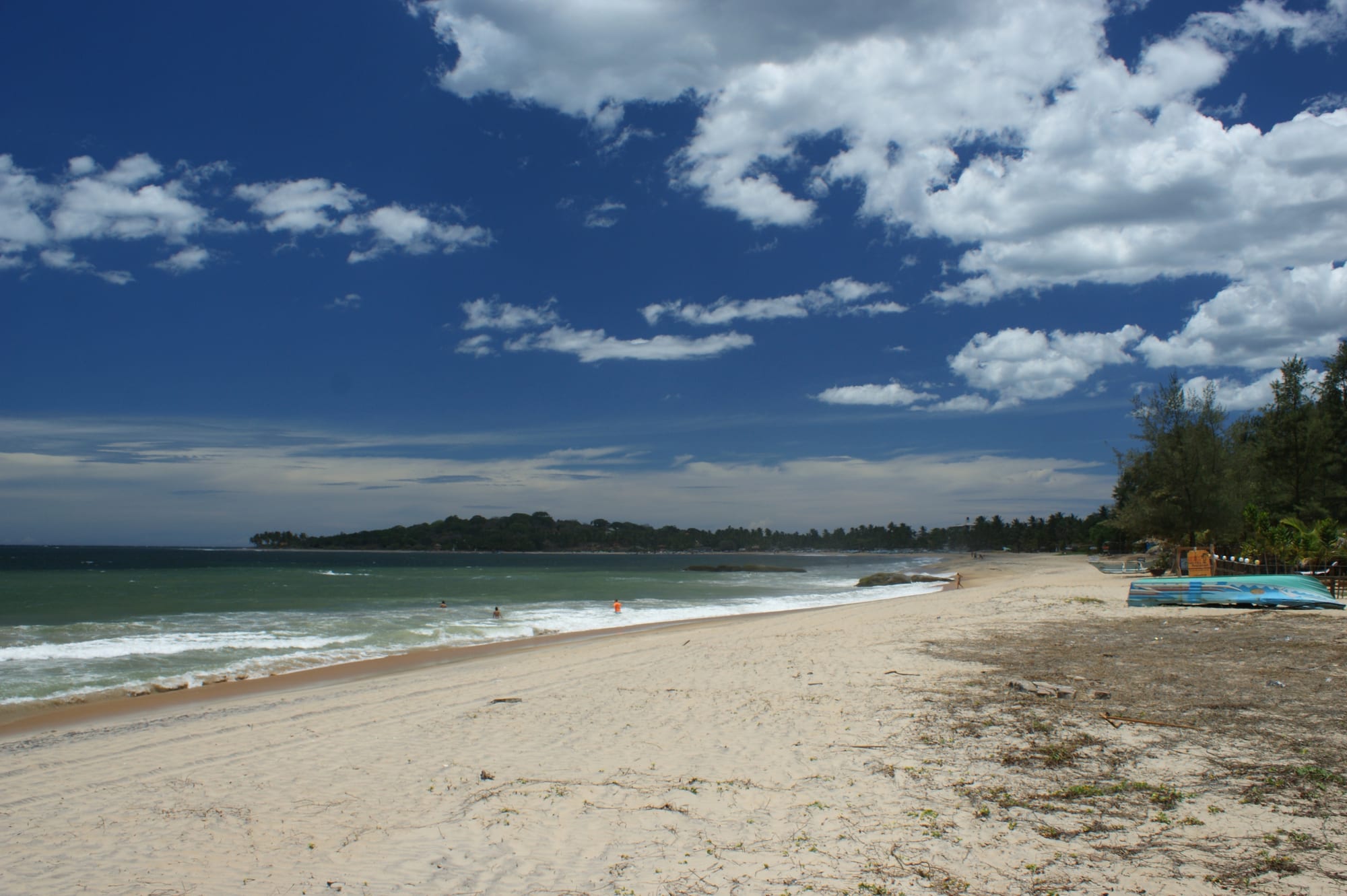
A long sandy beach with small waves under a deep blue sky with white clouds, and a wooded headland in the distance

Sri Lanka

Jaffna, Trincomalee & the North and East

The beach at Arugam Bay, on the east coast in Ampara district, looking south. (Kondephy / Wikimedia Commons · CC BY-SA 4.0)

The Tamil-speaking north and the mixed east of Sri Lanka, from the Jaffna peninsula and its islands down the Indian Ocean coast through Trincomalee and Batticaloa to the surf of Arugam Bay — the heartland of Sri Lankan Tamil culture, the main theatre of the civil war, and the island's quietest beach coast.

Explore Jaffna, Trincomalee & the North and East

History

Tamil-speaking communities have lived in the north and east for more than two thousand years, alongside Sinhalese and Buddhist settlements whose ruins are found across the region. From the 13th century an independent Tamil kingdom ruled the Jaffna peninsula and much of the north under the Aryacakravarti dynasty, with its capital at Nallur. The Portuguese conquered it in 1619 and destroyed many Hindu temples, including the Koneswaram temple at Trincomalee. The Dutch took Jaffna, Batticaloa and Trincomalee in the 17th century and built the forts that still stand, and the British, who took the coast in 1795–96, made Trincomalee's harbour a naval base; Japanese aircraft bombed it in 1942.

After independence, Tamil grievances over language, jobs and education grew, and the north became the centre of the separatist struggle. The burning of the Jaffna Public Library in 1981, with nearly 100,000 books, became a symbol of that conflict. From 1983 the LTTE fought the state for control of the north and east, running a de facto administration from Kilinochchi. In 1990 the LTTE expelled the Muslims of the north. The army retook Jaffna in 1995, and the war ended in May 2009 at Mullivaikkal in Mullaitivu district, amid heavy civilian deaths and allegations of war crimes on both sides.

The east suffered the 2004 tsunami as well, with heavy losses in Ampara, Batticaloa and Trincomalee districts. Since 2009 roads, railways and the airport at Jaffna have been rebuilt, but questions of land, the missing and political devolution remain unresolved.

Culture & Customs

Jaffna is the cultural capital of Sri Lanka's Tamils, and its speech, generally described as preserving older features of Tamil, sets it apart from the Tamil of India. The peninsula is mostly Hindu, following the Saiva tradition, with its temple festivals, chariot processions and carefully kept rituals, and a significant Catholic community lives along the coast and in Mannar, home to the pilgrimage church of Our Lady of Madhu. Education has long been prized, and Jaffna's old schools produced much of the island's professional class. A large diaspora, especially in Canada, the United Kingdom and Europe, maintains close ties.

The east is more mixed. The eastern Tamils have their own dialect and customs, while Tamil-speaking Muslims form the majority in towns such as Kattankudy, and Sinhalese live around Ampara and Trincomalee. Mosques, kovils, churches and Buddhist temples often stand within sight of one another.

The 25-day Nallur festival draws devotees from across the island and the diaspora, some undertaking acts of penance. Carnatic music and bharatanatyam dance are taught widely, and palmyra-leaf weaving is a traditional craft. Remembering the war dead remains a politically sensitive subject, and commemorations are closely watched by the authorities. Hospitality is warm but conservative: modest dress and removing shoes and upper garments for men at some temples are expected.

Daily Life

The eight districts together hold around three million people. Jaffna, with around 90,000 residents, is the largest city of the north; Vavuniya and Kilinochchi are its southern gateways. On the east coast, Trincomalee, Batticaloa, Kalmunai and Ampara are the main towns.

Farming and fishing dominate. The Jaffna peninsula grows red onions, chillies, tobacco, bananas and grapes in its limestone soils, watered from wells, and palmyra palms cover large areas. The Eastern Province grows about a quarter of the country's rice. Fishing is vital along every coast. Trincomalee has its port, naval base and a colonial-era oil tank farm, and tourism has grown quickly on the east coast. Money sent by relatives abroad supports many families.

The region is still recovering from the war. Many families lost members or homes, some land remains under military control, and the families of the disappeared continue to protest. Young people often leave for Colombo or abroad. Yet daily life has normalised: markets are busy, the train runs to Jaffna, and new hotels and cafés have opened.

Food

Jaffna has one of the most distinctive cuisines on the island, spicier and heavier on seafood than the south. Jaffna crab curry, nandu kari, is the famous dish, made with the crab that is plentiful in the peninsula's waters. Odiyal kool is a rich seafood soup thickened with palmyra root flour and loaded with crab, prawns and fish. Mutton curry, fish curries and pittu, steamed cylinders of rice flour and coconut, are staples, alongside idiyappam (string hoppers), thosai and vadai.

The palmyra palm gives the north much of its character: its sap becomes toddy, kallu, and palm jaggery, its fruit is made into sweets and fritters, and its young shoots are dried and eaten. Jaffna mangoes and grapes are prized.

In the east, cooking reflects the Tamil and Muslim mix. The east's lagoons and coast supply much of the country's fish, and Muslim cooks in towns such as Kattankudy make watalappam, a spiced coconut custard. Fresh fish is fried on the beaches, and rice from Ampara's paddy fields fills plates across the region.

Attractions & Natural Wonders

Jaffna's sights begin with the Nallur Kandaswamy Kovil and the Dutch fort, restored after the war, with the rebuilt public library nearby. The peninsula has the Keerimalai springs, Point Pedro at the northern tip and the Casuarina beach. Small ferries cross from the islands to Nainativu, with its Nagapooshani Amman temple and the Buddhist Nagadeepa Vihara, and to Delft, known for its wild horses, coral-stone walls and the ruins of a Dutch fort.

Mannar, joined to the mainland by a causeway, has its Portuguese and Dutch fort, baobab trees, migratory birds, the ancient Thiruketheeswaram temple and the start of Adam's Bridge, the chain of shoals towards India. Inland, Kilinochchi, Elephant Pass and Mullaitivu contain war memorials and sites that are now visited by Sri Lankans from across the country.

Trincomalee has Fort Frederick, the Koneswaram temple on Swami Rock high above the sea, the Commonwealth war cemetery and whale and dolphin trips offshore. North of the town lie the beaches of Uppuveli and Nilaveli, with snorkelling around Pigeon Island National Park, and inland the Kanniya hot wells. Further south, Pasikudah's shallow bay precedes Batticaloa, with its Dutch fort and lagoon. At the southern end, Arugam Bay's point breaks draw surfers, with Kumana National Park, known for its birds, and the elephants of Lahugala nearby.

Cities in Jaffna, Trincomalee & the North and East

Planning basics

Budget

The north and east are among the cheapest parts of Sri Lanka. Jaffna, Batticaloa, Mannar and Vavuniya have simple hotels and guesthouses at low prices, and local food is very cheap. Trincomalee's beaches and Arugam Bay in the surf season cost more, and Pasikudah's resort hotels are expensive. Distances are long, so transport is a bigger share of the budget.

Daily Budget Midrange
USD 65–170 (beach hotel or resort, restaurant meals, a car and driver for long transfers, boat trips)
Daily Budget Shoestring
USD 20–40 (guesthouse, local rice and curry, trains, buses and ferries)

Take the train north to Jaffna, carry cash for the islands and smaller towns, and book Arugam Bay early in July and August.

Safety

The war ended in 2009 and the region is now generally safe to visit, with far fewer checkpoints than in the past. Most landmines have been cleared, but some areas are still marked as hazardous. Military bases remain, and photographing them is prohibited. In 2024 foreign governments warned of a possible threat to tourists around Arugam Bay. The sea is rough in the northeast monsoon, and wild elephants cross roads at night.

Keep to paths and roads in former conflict areas, heed mine-warning signs, dress modestly away from the beaches, and avoid political demonstrations and memorial events. Check current official travel advice before travelling.

Climate

Hot all year and mostly dry zone. Unlike the south and west, the region gets its main rain from the northeast monsoon between about October and January, when storms and occasional cyclones hit the east coast. From May to September the east coast is sunny and calm, while Jaffna and Mannar are very hot and dusty, often around 32–35°C.

Summer
May–September: dry and sunny, calm seas on the east coast, very hot in Jaffna and Mannar
Winter
October–January: the rainy season, with heavy downpours, rough seas and a risk of flooding

Transportation

The Yal Devi and other trains run from Colombo through Vavuniya and Kilinochchi to Jaffna and Kankesanthurai, and separate lines reach Mannar, Trincomalee and Batticaloa. Buses cover the A9 and the coast roads. Small ferries serve Nainativu and Delft from the Jaffna islands, and Jaffna's airport has flights to southern India. Arugam Bay has no railway and is reached by road.

Leave early for the island ferries, which depend on the weather, and allow a full day for the road journeys between the north and the east coast.

Best Time to Visit

April to September is the season for the east coast: calm water at Trincomalee and Pasikudah and the surf season at Arugam Bay. Jaffna is pleasant from January to March and busiest during the annual Nallur festival. The October–January monsoon is the time to avoid, especially on the east coast.