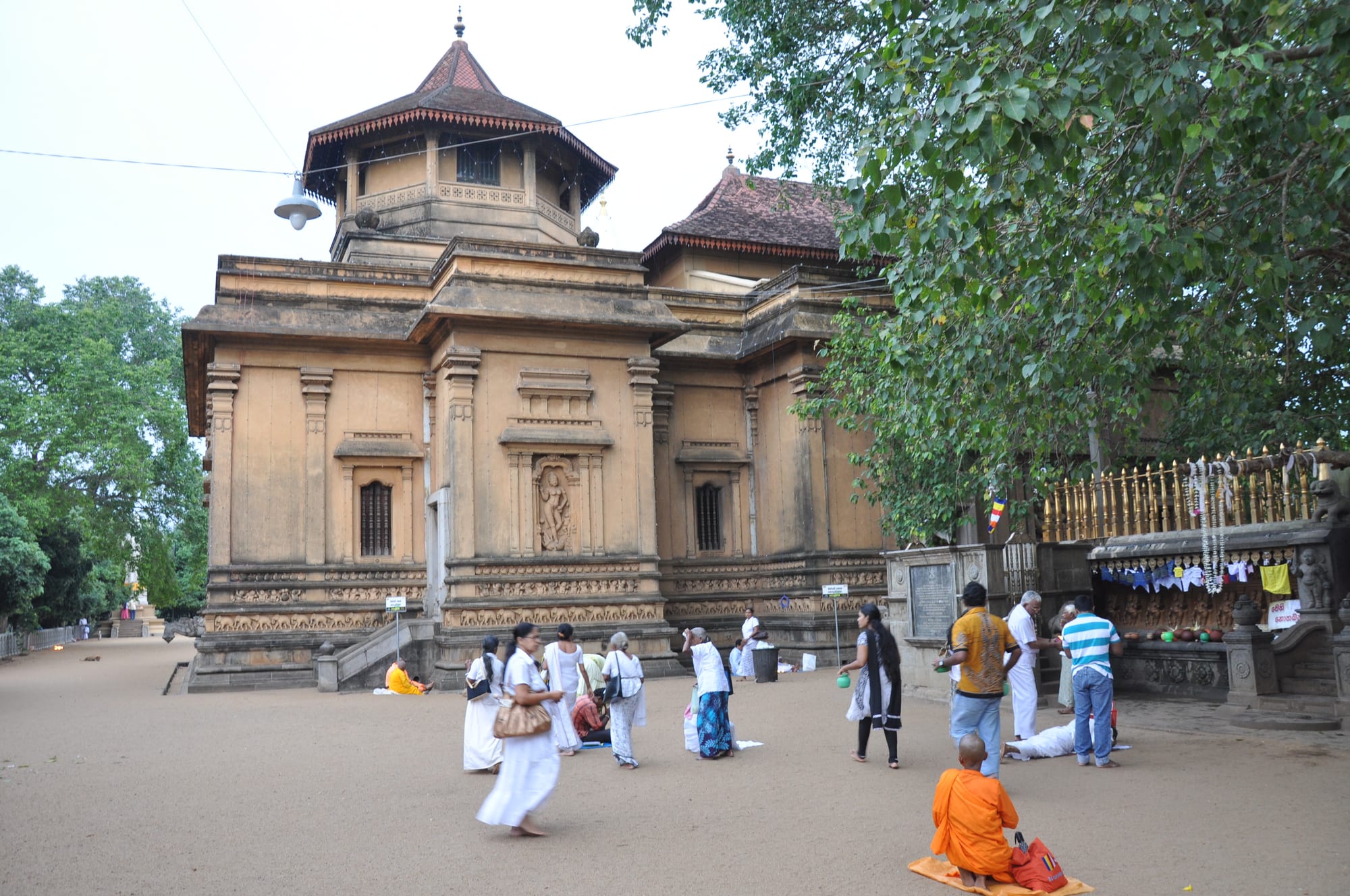
Ochre-coloured shrine with tiled pagoda roofs under a large tree, with white-clad worshippers and a monk in the courtyard

Sri Lanka

Colombo & the West

The image house of the Kelaniya Raja Maha Vihara, the great Buddhist temple on the Kelani River just outside Colombo. (Jorge Láscar / Wikimedia Commons · CC BY 2.0)

Sri Lanka's populous western lowlands and their wet-zone hinterland, from the commercial capital Colombo and the Catholic fishing town of Negombo inland to the gem country of Ratnapura and the rubber hills of Kegalle — the island's economic engine, home to its main port and airport.

Explore Colombo & the West

History

The western lowlands enter the chronicles early: the Mahavamsa tells of the Buddha visiting Kelaniya, and the town was the seat of a small kingdom in legend. Ratnapura has long been the centre of the island's gem trade, and the province around it, Sabaragamuwa, takes its name from the forest peoples who once lived there. The region's political rise came late, as the island's kings moved south-west from the old dry-zone capitals. In the early 15th century Parakramabahu VI ruled from Kotte, just east of Colombo, and briefly united the whole island under a single crown.

The Portuguese arrived off Colombo in 1505 and built a fort there, and the coast became a battleground: the kingdom of Sitawaka, centred near Avissawella, fought them for much of the 16th century under Mayadunne and Rajasinghe I. The Dutch took Negombo in the 1640s and Colombo in 1656, cutting canals, planting cinnamon and building churches, and the British seized the coast in 1796.

Under the British, Colombo grew into the capital of Ceylon, its harbour enlarged and linked by rail to Kandy from 1867, while rubber spread across the hills of Kalutara, Kegalle and Ratnapura. After independence the city remained the centre of everything; in 1982 Parliament moved to a new building at Sri Jayawardenepura Kotte, the official capital. Colombo suffered bombings during the civil war, and on Easter Sunday 2019 attackers struck churches in Colombo and Negombo. In 2022 the protest camp on Galle Face Green became the heart of the Aragalaya movement.

Culture & Customs

This is the heartland of the low-country Sinhalese, whose traditions differ in small ways from those of Kandy — in caste names, wedding dress and the older coastal influence of Portugal and the Netherlands. Portuguese surnames such as Fernando, Perera and de Silva are common, and the coast north of Colombo, from Wattala through Ja-Ela to Negombo, is Sri Lanka's Catholic belt, where Easter passion plays, church feasts and roadside shrines are as prominent as temples.

Colombo itself is the most mixed place on the island. Sinhalese, Tamils, Muslims, Burghers of Dutch and Portuguese descent and a small Malay community live side by side, and English is heard far more than elsewhere. Muslim traders dominate parts of Pettah, and the coastal town of Beruwala, in Kalutara district, is traditionally counted among the earliest Muslim settlements in the country.

The Buddhist calendar is still the city's frame. At Vesak, in May, Colombo fills with paper lanterns, illuminated pandals telling Jataka stories and free food stalls, the dansal, run by neighbourhoods and companies. Gangaramaya's Navam Perahera parades elephants past Beira Lake in February, and Kelaniya's Duruthu Perahera is held each January. Inland, the gem trade shapes Ratnapura's culture, with its dealers, lapidaries and the shrine of the god Saman, patron of the Adam's Peak pilgrimage.

Daily Life

The five districts hold roughly a third of Sri Lanka's people. Colombo city has over half a million residents, and the continuous urban area along the coast and inland to Kotte, Kaduwela and Gampaha holds several million more. Negombo, Kalutara, Panadura, Ratnapura and Kegalle are the main towns beyond it.

The economy is the island's largest. The Port of Colombo is one of the busiest in South Asia, and the reclaimed Port City is being built out on land beside the old Fort. Garment factories cluster in the free trade zones at Katunayake and Biyagama, head offices, banks and IT firms fill the capital, and the airport, brewing and fishing support Gampaha. Inland the work is rubber, low-grown tea, gem mining and trading around Ratnapura, and paddy.

Days start early to beat the traffic: office workers crowd trains from the suburbs and buses along Galle Road, schoolchildren in white uniforms fill the pavements, and lunch is rice and curry from a packet. In the evening Galle Face Green fills with kite-flyers, families and food carts. The pressures of the moment are the cost of living since the 2022 crisis, housing prices and the daily congestion that the new expressways have not solved.

Food

Colombo eats from the whole island, but a few things are its own. On Galle Face Green, evening food vendors sell cooked crabs and prawns and slices of mango with pepper and salt. Burgher cooking survives in lamprais, rice cooked in stock and baked in a banana leaf with meat curry, frikkadels (meatballs) and blachan, a shrimp paste relish, and in Christmas breudher and love cake. Muslim cafés in Pettah and Slave Island serve buriyani and watalappam, a spiced coconut-milk custard sweetened with jaggery.

Negombo is the seafood town: lagoon crabs and prawns and fresh fish sold straight off the boats. Street stalls across the region sell kottu and hoppers in the evening, and bakeries sell short eats — fish buns, Chinese rolls, cutlets — through the day.

Inland, Kalutara is known for its mangosteens and the wet-zone hills for rambutan and kithul treacle, the syrup tapped from the kithul palm and poured over buffalo curd. Coconut toddy is sold in village taverns along the coast, and Lion lager is brewed at Biyagama.

Attractions & Natural Wonders

Colombo rewards a day or two. The Fort district has the restored Dutch Hospital, the old lighthouse clock tower and the Presidential Secretariat, facing Galle Face Green and the sea. Next door, Pettah's crowded bazaars surround the red-and-white Jami Ul-Alfar mosque and the Dutch-era Wolvendaal Church. Further south lie Gangaramaya temple, Geoffrey Bawa's Seema Malaka pavilion on Beira Lake, the National Museum, Independence Memorial Hall and the Lotus Tower, whose observation deck looks over the whole city. Mount Lavinia, on the southern edge, has its colonial seafront hotel and a long beach.

North of the capital, the Kelaniya Raja Maha Vihara stands on the Kelani River, its image house decorated with Solias Mendis's paintings of the Buddha's life and the island's Buddhist history. Negombo, beside its lagoon, has the Dutch canal, the remains of a Dutch fort gate, a busy fish market and a string of beach hotels close to the airport.

Inland, Ratnapura sits in the foothills among gem pits worked with pumps, ladders and woven baskets, and a gem museum or dealer's office shows the washed stones. The Pinnawala Elephant Orphanage, near Kegalle, keeps a large herd whose daily bathe in the Maha Oya is the main spectacle. Kitulgala, also in Kegalle district, is the base for white-water rafting on the Kelani, and the Sinharaja rainforest, a UNESCO World Heritage Site, extends into Ratnapura and Kalutara districts.

Cities in Colombo & the West

Planning basics

Budget

Colombo is the most expensive place in Sri Lanka: city hotels, cafés and restaurants on Galle Road and in Colombo 7 charge well above the rest of the island, though rice and curry in a local canteen stays cheap. Negombo has plenty of good-value guesthouses near the airport, and Ratnapura, Kegalle and the inland towns cost little.

Daily Budget Midrange
USD 75–170 (city or beach hotel, restaurant meals, ride-hailing, a day trip by car to Pinnawala or Ratnapura)
Daily Budget Shoestring
USD 25–45 (guesthouse or hostel, canteen meals, buses, trains and tuk-tuks)

Use ride-hailing apps in Colombo rather than flagging tuk-tuks, and base the first or last night in Negombo to save time and money on the airport run.

Safety

The region is generally safe, but Colombo has the island's usual petty crime concentrated in one place: pickpockets in Pettah and on crowded buses, touts and "gem" or "festival" scams around Galle Face and the Fort, and overcharging tuk-tuks. Traffic is dangerous for pedestrians. Swimming at Mount Lavinia and on the west coast can be risky in monsoon swell, and Ratnapura and Kegalle districts see floods and landslides in heavy rain.

Ignore anyone offering an unsolicited tour or gem deal, check sea conditions before swimming, and avoid demonstrations in central Colombo. Check current official travel advice before travelling.

Climate

The whole region lies in the wet zone, hot and humid all year at around 27–32°C on the coast. The southwest monsoon brings heavy rain from about May to September, and October and November add inter-monsoon thunderstorms. Ratnapura and the Kegalle hills take heavy monsoon rain, and are prone to floods and landslides in bad years.

Summer
the southwest monsoon season, May–September: hot, humid, frequent heavy showers and rough seas
Winter
December–March: drier and sunnier, around 24–31°C, the calmest months on the coast

Transportation

Bandaranaike International Airport is at Katunayake, just south of Negombo, and an expressway links it to Colombo in well under an hour outside rush hour. From Colombo Fort station the coastal line runs south through Kalutara and the main line heads inland past Rambukkana, the nearest station to Pinnawala, towards Kandy. Buses serve Ratnapura and Kegalle; the Southern Expressway speeds traffic south, but city congestion is heavy.

Allow extra time for Colombo traffic before a flight, and take a train or car and driver rather than a bus for the inland day trips.

Best Time to Visit

December to March is the driest and most comfortable time, with calm seas at Negombo and Mount Lavinia. The monsoon months are wetter but rarely stop sightseeing in Colombo. Vesak in May fills the capital with lanterns and decorated pandals, and Kelaniya's Duruthu Perahera falls on the full moon of January.