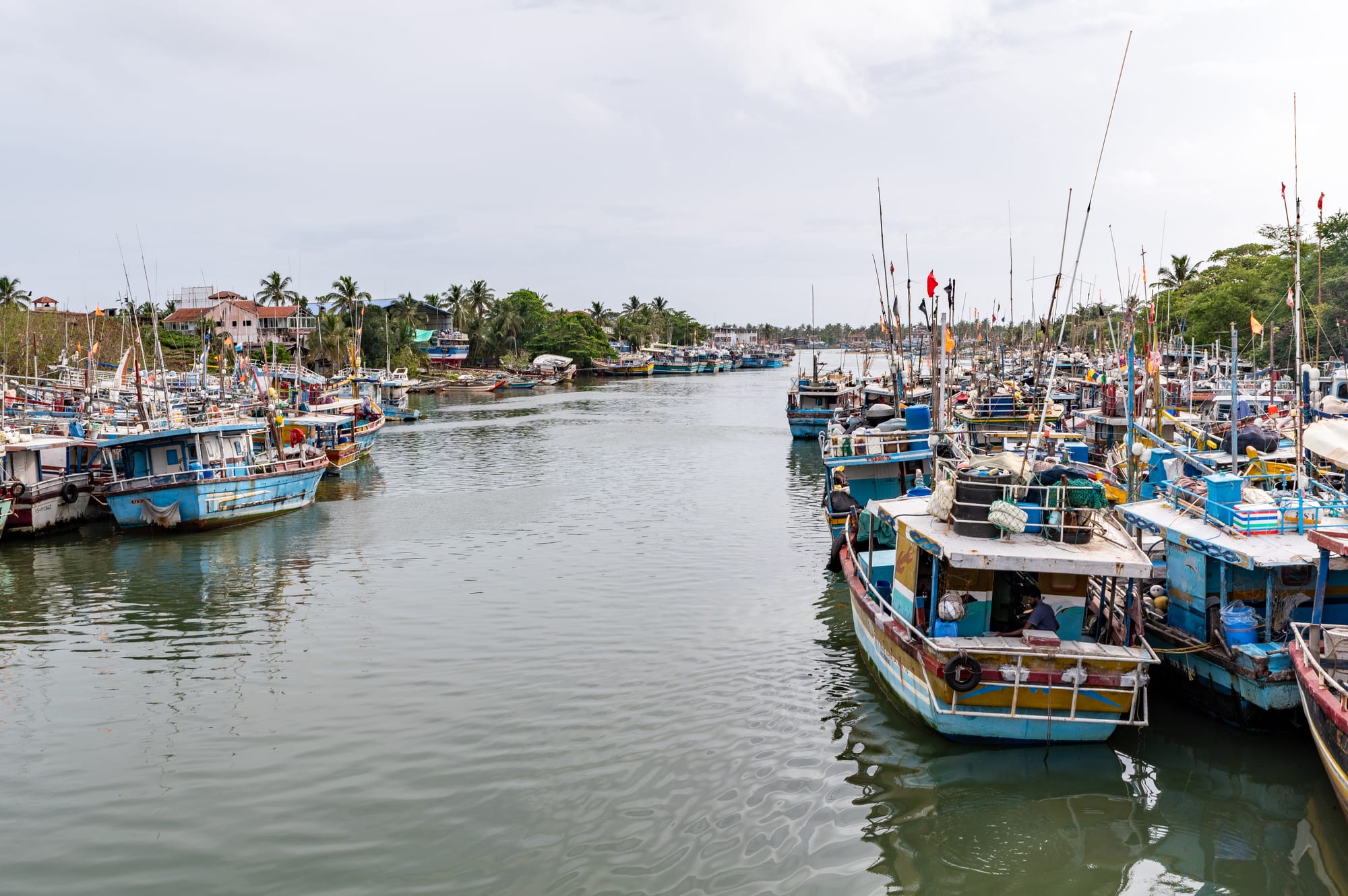
Rows of blue and white wooden fishing boats moored along both banks of a broad lagoon channel under a pale sky

Colombo & the West, Sri Lanka

Negombo

Fishing boats moored in the Negombo Lagoon. (Steffen Schmitz / Wikimedia Commons · CC BY-SA 4.0)

A fishing and beach town on Sri Lanka's west coast, a few kilometres north of the country's main international airport. Dutch cinnamon traders left a fort gate and a canal, and generations of Catholic missions left so many churches that the town is nicknamed Little Rome. Its lagoon, fish markets and hotel strip make it the usual first or last stop on the island.

Neighbourhoods

  • The beach strip
    • First-time visitors
    • Beaches
    • Nightlife

    A few kilometres of sand north of the town centre, along Lewis Place and Porutota Road, backed almost continuously by hotels, guesthouses, restaurants and bars. It is the part of Negombo built for visitors, and the easiest base for an early flight.

    Open in Maps
  • Town centre and the fish market
    • Local life
    • Markets
    • Close to public transport

    The working heart of Negombo around Main Street, the bus stand and the railway station, with the lagoon-side fish market, the fort gate and the main churches. Busy, unpolished and at its liveliest when the boats come in.

    Open in Maps
  • Duwa
    • Local life
    • Quiet and residential

    A low sandy spit reached across the lagoon, home to a close-knit Catholic fishing community known across the island for its Easter passion play. Little happens here beyond boats, nets and church.

    Open in Maps
  • Katunayake
    • Close to the airport
    • Quiet and residential

    The town immediately south, built around Bandaranaike International Airport and the free trade zone that surrounds it. Thousands of garment workers live in its boarding houses, and airport hotels cluster along the approach roads.

    Open in Maps

Things to do

The lagoon and the waterfront

  • Negombo Lagoonattraction

    A shallow estuarine lagoon fringed with mangroves, fished with outrigger canoes and stake nets, and the source of the crab and prawns the town is known for.

    Open in Maps
  • Hamilton Canalattraction

    The canal running south from Negombo towards Colombo, part of the old Dutch waterway system and cut in its present form by the British between 1802 and 1804, still lined with moored boats, coconut palms and small landings.

    Open in Maps
  • Negombo fish marketmarket

    The lelama beside the lagoon mouth, where the night's catch is auctioned in the early morning and fish are split and dried on mats in the sun.

    Open in Maps
  • Negombo Beachbeach

    A long brown-sand beach facing the Indian Ocean, with outrigger boats pulled up between the hotels and heavy surf during the southwest monsoon.

    Open in Maps

Churches, forts and temples

  • Dutch fort gatelandmark

    The surviving gateway and fragments of the fort beside the lagoon in the town centre, first built by the Portuguese and rebuilt by the Dutch in 1672 on a pentagonal plan.

    Open in Maps
  • St Mary's Churchlandmark

    One of the largest Catholic churches in Sri Lanka and the fifth on its site, begun in 1874 and finished in 1922, neoclassical, with a ceiling painted with scenes from the life of Christ.

    Open in Maps

Short trips from the town

  • Bandaranaike International Airporttransit hub

    Sri Lanka's main airport, at Katunayake about nine kilometres south of the town, the reason most visitors pass through Negombo at all.

    Open in Maps
  • Waikkalbeach

    A quieter stretch of coast and river mouth north of Negombo, with a handful of hotels among coconut groves and fishing hamlets.

    Open in Maps
  • Kelaniya Raja Maha Viharalandmark

    A major Buddhist temple on the Kelani River on the way into Colombo, its image house covered with Solias Mendis's paintings of the island's Buddhist history.

    Open in Maps

Seasonal events

  • Duwa passion playGood Friday, in March or April

    A full-day re-enactment of the Passion performed by the fishing community on Duwa, said to go back some four hundred years and among the oldest Catholic pageants still staged anywhere, drawing crowds from across the coast.

  • Sinhala and Tamil New Yearmid-April

    The island's main holiday, marked with games, sweets and family visits, and one of the busiest times on the beach for Sri Lankan holidaymakers.

  • VesakMay, at the full moon

    The Buddhist festival of the Buddha's birth, enlightenment and death, when lanterns and illuminated pandals appear along the main roads.

  • Feast of St Anne at Talawilaaround St Anne's day, 26 July

    A Catholic pilgrimage to the old church at Talawila on the coast north of Negombo, which draws thousands of devotees, with families camping on the sand beside the shrine.

Eat and drink

Long-standing places and food districts in Negombo. Hours, ratings and directions come from your maps app, always current.

Negombo classics

  • Lagoon crab and prawnsrestaurant

    The town's speciality, cooked as a spicy curry with coconut milk or devilled with chilli and onion, served all along the beach strip and at simple places near the lagoon.

    Open in Maps
  • Fish ambul thiyal and seer fishrestaurant

    Tuna or seer fish simmered dry with goraka, a sour fruit, and black pepper, a coastal preparation that keeps without refrigeration, eaten with rice and curry.

    Open in Maps

Food districts and markets

  • The beach strip restaurantsneighborhood

    Porutota Road and Lewis Place hold most of the town's tourist restaurants and bars, from seafood grills to Italian and German kitchens serving long-staying visitors.

    Open in Maps
  • Negombo fish marketmarket

    The morning auction beside the lagoon, with tuna, seer, skipjack and baskets of small fish, and racks of drying fish, or karawala, spread nearby.

    Open in Maps
  • Main Street food stallsneighborhood

    Bakeries and evening carts around the town centre and bus stand selling kottu roti, hoppers, short eats and strong sweet tea.

    Open in Maps

Experience Negombo

History

Negombo was a cinnamon port long before it was a town. The wild cinnamon of the surrounding lowlands was traded through this stretch of coast, at first under the Sri Lankan kings and then through Moor and Indian merchants, and the Portuguese, who arrived on the island in the early 16th century, took control of the trade and brought Franciscan missionaries with them. The mass conversions of coastal fishing families to Catholicism date from that period, and many local surnames — Fernando, Perera, Fonseka — do too.

The Dutch East India Company captured Negombo in 1640, lost it and retook it, and rebuilt the Portuguese fort beside the lagoon mouth in 1672; its gateway still stands. The Dutch treated the town as a cinnamon and supply station and dug a network of canals inland from it; the waterway south towards Colombo was cut in its present form by the British between 1802 and 1804 and named after Gavin Hamilton, the government agent of revenue and commerce. Under British rule the canal carried cinnamon, coconut and fish to the capital until the railway took the traffic away.

The modern town was made by two things: fishing and the airport. The lagoon and the sea supported a large fleet of outrigger canoes and, later, motorised boats, and Negombo became one of Sri Lanka's main fishing centres. When the international airport was completed at Katunayake in 1967, the nearest beach with hotels was this one, and a strip of guesthouses and package hotels grew north of the town. The 2004 tsunami struck the west coast less severely than the south and east. On Easter Sunday 2019 attackers bombed churches in Colombo and Negombo, killing many in the parish of Katuwapitiya, a loss the town still marks.

Culture & Customs

Negombo is the centre of Sri Lanka's Catholic belt, the coastal strip running north from Colombo where Catholics form the majority and churches outnumber temples. Its nickname, Little Rome, comes from the number of parishes packed into a small area, and the calendar is built around them: Sunday mass, feast days for each parish's patron saint, processions with statues carried through the streets, and roadside grottoes lit at night. Catholic and Buddhist neighbours live closely together, and it is common for both to attend the other's festivals.

Holy Week is the high point. On Duwa, the sandy spit across the lagoon, the fishing community stages a passion play that has been performed for generations, with parts handed down within families and a cast drawn from the village. Other coastal parishes hold their own Good Friday processions, and the Feast of St Anne at Talawila, further north, draws pilgrims from across the island.

The other identity here is the fishery. Negombo's fishermen are known by their boats — the oruwa, the traditional outrigger canoe with a single sail, and the small fibreglass craft that have replaced most of them — and by the stake-net and lagoon fishing methods used in the shallow water. The rhythm of the town follows the boats, the auctions and the drying racks. Sri Lankan and European families who come back year after year to the same guesthouses have made the beach strip an unusually settled kind of resort.

Daily Life

About 140,000 people live in Negombo and its immediate suburbs, making it one of the larger towns on the west coast. Roman Catholics are the majority, alongside Buddhist, Muslim and Hindu communities, and Sinhala and Tamil are both widely spoken, with a distinctive coastal dialect.

Three things employ most people: fishing, the airport and the garment industry. The lagoon and offshore fleets support boat owners, crews, auctioneers, ice suppliers, dryers and market traders. The Katunayake free trade zone next door is one of the country's largest concentrations of clothing factories, and its mostly female workforce lives in boarding houses around the airport. Tourism is the third leg, employing hotel and restaurant staff, drivers and guides, and it is far more exposed than the others to events far away.

Mornings start before dawn at the fish market, where the auction is finished by the time most visitors are awake. Schoolchildren fill the buses at seven, factory shifts change through the day, and in the evening families walk on the beach and the bars along Porutota Road fill up. The town's pressures are familiar ones: declining catches and disputes over fishing methods in the lagoon, pollution and encroachment on the mangroves, the cost of living since the 2022 economic crisis, and the seasonal nature of tourist work.

Food

Seafood is the point of Negombo. Lagoon crab, cooked as a rich curry in coconut milk with chilli, pepper and curry leaves, is the dish most associated with the town, followed by prawns of every size and cuttlefish, usually devilled — stir-fried with onion, chilli and tomato until dark and hot. Seer fish, tuna and skipjack come off the boats each morning; ambul thiyal, a dry sour curry made with goraka and black pepper, is the coastal way of preserving them.

The kitchen behind that is standard Sri Lankan and very good: rice with several curries, pol sambol of grated coconut, chilli and lime, mallung of chopped greens, and papadams. Hoppers and string hoppers appear morning and evening, kottu roti is the late-night dish, and the bakeries sell short eats all day — fish buns, cutlets, Chinese rolls. Catholic households keep their own festival table, with breudher at Christmas and love cake made from semolina, cashew and spices.

Dried fish, karawala, is a local trade as much as a food, salted and laid out on racks near the lagoon and sold across the country. Isso wade, crisp lentil patties topped with a whole prawn, are sold on the beach in the evening, and king coconut and faluda, a rose-syrup and ice-cream drink, are the usual cold refreshments. The beach strip adds European and Chinese cooking for long-staying guests, but the seafood is what people come back for.

Planning tools

Budget

Negombo is noticeably cheaper than Colombo and has an unusually wide choice of small guesthouses because of the airport traffic. The beach strip charges tourist prices for food and drink; the town centre, a kilometre or two away, does not. Airport transfers are the other regular cost, and short taxi rides are cheap.

Daily Budget Midrange
USD 70–150 (beach hotel, seafood dinners, airport transfer, a lagoon or marsh boat trip)
Daily Budget Shoestring
USD 20–40 (guesthouse room, rice and curry or street food, buses and tuk-tuks)

Rooms near the beach strip cost more than equally good guesthouses a few streets inland, and most places arrange airport pick-ups for a fixed price.

Best Time to Visit

December to March brings the calmest sea and the driest weather, and is the season for swimming and for the beach hotels. The southwest monsoon from May to September makes the surf rough and the beach narrower, though the town itself carries on much as usual. Holy Week is the most striking time to be here, when the Catholic coast stages its passion plays.

Suggested Number of Days

Most visitors give Negombo a night on the way in or out. A full day covers the lagoon, the churches and the beach without rushing, and a second or third allows the marsh, the canal and the coast to the north.

First Visit
1 day
With Surroundings
2–3 days

Transportation

The town is small enough for tuk-tuks to reach everything, and ride-hailing apps work here. Buses run constantly along the coast road to Colombo and inland to Katunayake, and the coastal railway line has a station in the town centre with slow trains to Colombo Fort. Bicycles are a common way to cover the beach strip and the canal road.

Agree a tuk-tuk fare before setting off, or use an app; drivers along the beach strip quote tourist prices.

Airport & Station Connections

Bandaranaike International Airport is about nine kilometres south at Katunayake, twenty minutes away by taxi outside peak traffic, which is why so many visitors start or end here. Colombo is about 38 kilometres south by the coast road, or twenty to thirty minutes by the airport expressway, opened in 2013, which joins the coast road at the Katunayake interchange. Buses and slow trains also connect the two.

Walkability

The beach strip is flat and easy to walk end to end, and the town centre, fort gate, market and main churches sit within a compact area beside the lagoon. The two are a couple of kilometres apart along a busy road with broken pavements, so most people take a tuk-tuk between them. Heat and humidity make midday walking hard work.

Safety

Negombo is a quiet town and serious crime against visitors is unusual. The everyday annoyances are touts and overcharging along the beach strip, tuk-tuk drivers steering guests to shops, and petty theft from rooms and beaches. Sea currents can be strong, particularly during the monsoon, and the beach is not patrolled. Traffic on the coast road is the main physical risk.

Swim with care and only where others are swimming, decline unsolicited offers of tours or gems, and keep valuables out of sight on the beach. Check current official travel advice before travelling.

Climate

Hot and humid all year, with sea breezes taking the edge off the afternoons. Daytime temperatures sit around 27–32°C in every month, and the seasons are marked by rain rather than heat.

Summer
May to September: the southwest monsoon, around 27–31°C, with heavy showers, thunderstorms and rough seas
Winter
December to March: the driest and sunniest months, around 24–31°C, with calm water in the lagoon and off the beach

Local Customs

This is a strongly Catholic town, and churches are used rather than visited: dress modestly, keep quiet during services and ask before photographing worshippers or funerals. At Buddhist temples shoes and hats come off and shoulders and knees are covered. Fishing families are hospitable but their boats and nets are working equipment, not props.

Alcohol is not sold in shops on poya (full moon) days; beachwear belongs on the beach and not in the town or in churches.

Common Payment Methods

The currency is the Sri Lankan rupee. Hotels and the larger restaurants on the beach strip take cards, but the market, tuk-tuks, buses and small eating houses are cash only. ATMs are easy to find in the town centre and at the airport, where the rate is usually better than at hotel desks.