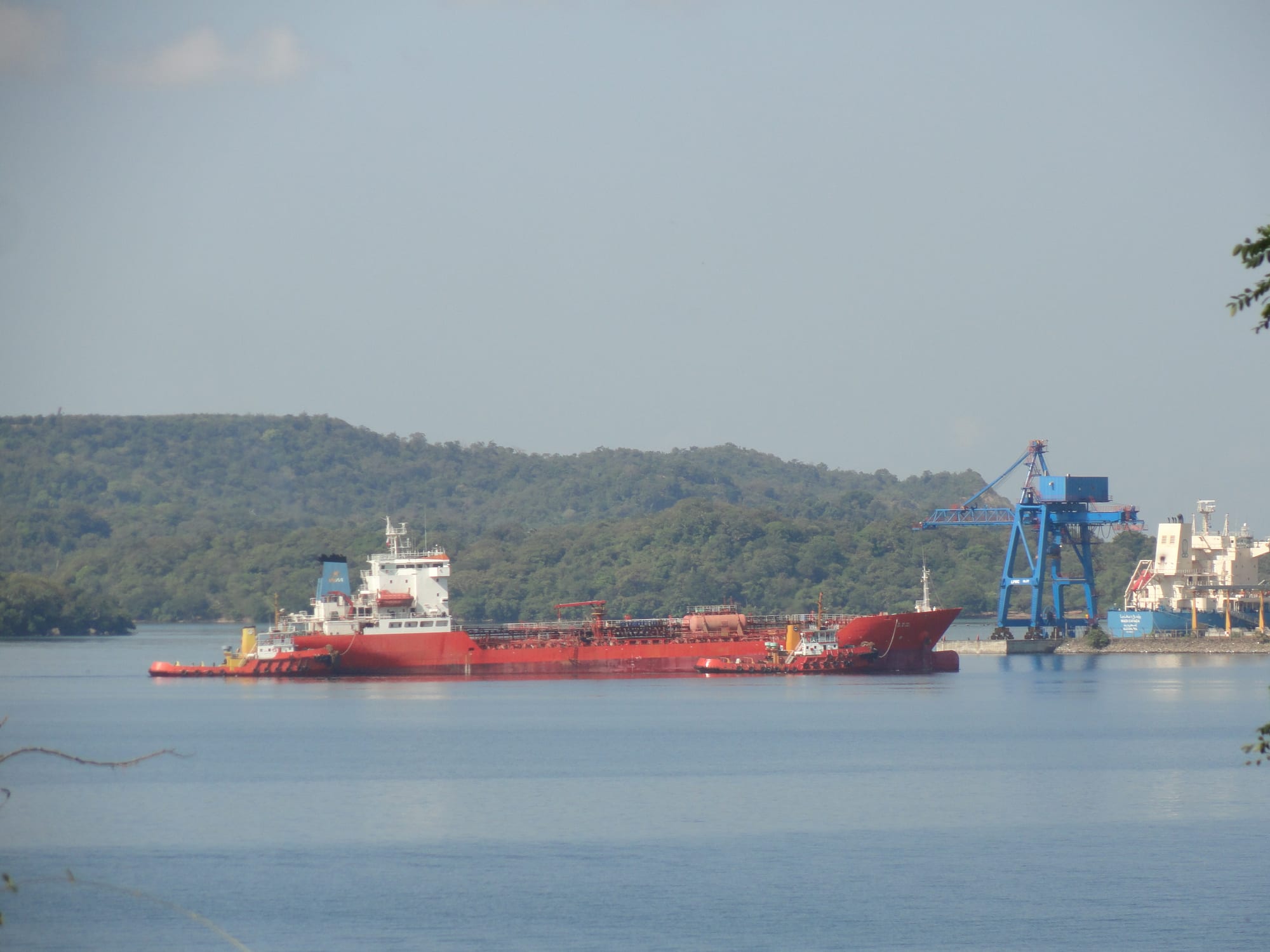
A red tanker moored beside a blue harbour crane on a broad sheltered bay backed by low forested hills

Jaffna, Trincomalee & the North and East, Sri Lanka

Trincomalee

A ship alongside the quay in Trincomalee's natural harbour, on Sri Lanka's north-east coast. (Rehman Abubakr / Wikimedia Commons · CC BY-SA 4.0)

A port city on Sri Lanka's north-east coast, set on one of the largest natural deep-water harbours in the world. Its rocky headland carries the Koneswaram temple inside a Portuguese and Dutch fort, the harbour has drawn navies for four centuries, and pale beaches at Uppuveli and Nilaveli run north towards the reefs of Pigeon Island.

Neighbourhoods

  • The town centre and Dutch Bay
    • First-time visitors
    • Markets
    • Close to public transport

    The commercial heart of the city, a grid of shops, kovils and mosques between the bus stand and the shallow curve of Dutch Bay. It is noisy and busy by day, and the seafront promenade fills with families in the evening.

    Open in Maps
  • Fort Frederick and Swami Rock
    • Historic district
    • Viewpoints

    The headland above the town, entered through the old fort gate and still partly a military area, with deer wandering among colonial buildings. The road climbs to the Koneswaram temple at the cliff edge, high above the sea.

    Open in Maps
  • Uppuveli
    • Beaches
    • Best for food
    • Budget stays

    A beach village a few kilometres north of the city, with guesthouses, small hotels and seafood restaurants along a sandy shore. It is the usual base for visitors who want the sea but still want the town close at hand.

    Open in Maps
  • Nilaveli
    • Beaches
    • Quiet and residential
    • Snorkelling

    A longer, wider and emptier beach further north, lined with resorts set back among the palms. Boats leave from here for Pigeon Island, and the village itself is scattered and quiet.

    Open in Maps
  • China Bay and the inner harbour
    • Local life
    • Industry and history

    The shore of the harbour south-west of the town, where the navy, the airfield and the colonial-era oil tank farm sit among scrub and inlets. It is workaday rather than scenic, but it shows why the city exists.

    Open in Maps
  • Kinniya
    • Local life
    • Quiet and residential

    A mainly Muslim town across the inner harbour, reached by a long bridge over the Koddiyar bay. Mosques, rice land and coconut gardens surround it, and fishing and paddy set the rhythm of the day.

    Open in Maps

Things to do

Temples and forts

  • Koneswaram Templelandmark

    A classical Hindu temple to Shiva on Swami Rock, destroyed by the Portuguese in 1622 and rebuilt in the 20th century, standing above a sheer cliff with the sea on three sides.

    Open in Maps
  • Fort Fredericklandmark

    A fort completed by the Portuguese in 1624, rebuilt by the Dutch in 1665 and renamed by the British in 1795, occupying the whole headland with its gateway, ramparts and colonial barracks.

    Open in Maps
  • Pathirakali Amman Templelandmark

    A large Hindu temple in the town dedicated to the goddess Kali, with a tall painted gopuram tower over the entrance.

    Open in Maps
  • Velgam Veheralandmark

    An ancient Buddhist monastery north-west of the city, with a stupa and inscriptions recording gifts from South Indian rulers, unusual for its Tamil connections.

    Open in Maps

Beaches and the sea

  • Uppuveli beachbeach

    The nearest beach to the city, a few kilometres north, with calm water in the dry season and a line of small hotels and restaurants.

    Open in Maps
  • Nilaveli beachbeach

    A long, wide beach of pale sand about 15 kilometres north of the city, the main resort strip on this coast.

    Open in Maps
  • Pigeon Island National Parkpark

    Two small islands off Nilaveli protected as a national park, with coral reef, reef fish and blacktip reef sharks in the shallows, reached by boat.

    Open in Maps
  • Trincomalee Harbourattraction

    The fifth largest natural harbour in the world, sheltered in all weathers and deep enough for the biggest warships, which has shaped the city's whole history.

    Open in Maps

Museums and memorials

  • Trincomalee War Cemeteryattraction

    A Commonwealth war cemetery near the harbour holding graves of servicemen from the Second World War, including those killed in the Japanese air raid of 1942.

    Open in Maps
  • Kanniya Hot Springsattraction

    Seven walled wells of warm mineral water in a compound about 8 kilometres north-west of the city, long used for bathing and tied to local legend.

    Open in Maps

Short trips from the city

  • Seruwila Mangala Raja Maha Viharalandmark

    An ancient stupa south of the harbour, one of the sixteen great Buddhist pilgrimage sites of Sri Lanka, reached across the Mahaweli delta.

    Open in Maps
  • Girihandu Seyalandmark

    A hilltop stupa at Thiriyai, north of Nilaveli, surrounded by a circular ring of stone pillars and held by tradition to be among the island's earliest.

    Open in Maps
  • Marble Beachbeach

    A sheltered cove of clear water and fine sand south of the city near China Bay, backed by forest.

    Open in Maps

Seasonal events

  • Thai PongalJanuary

    The Tamil harvest festival, when rice is boiled with milk and jaggery in new pots at first light and kovils and homes are decorated.

  • Sinhala and Tamil New YearApril

    The shared new year of both communities, marked with rituals performed at set auspicious times, sweets, games and family visits.

  • Koneswaram temple festivalApril

    The temple's Ther chariot festival, which runs for twenty-two days around the Tamil new year, with processions of the deities, music and crowds of pilgrims climbing the headland.

  • VesakMay, on the full moon

    The Buddhist commemoration of the Buddha's birth, enlightenment and death, marked with lanterns and free food stalls in the Sinhalese neighbourhoods and at the temples nearby.

  • Ramadan and EidVaries with the lunar calendar

    In Kinniya, Muthur and the Muslim quarters of the city, the fasting month changes the rhythm of the day and ends with communal prayers and family feasting.

Eat and drink

Long-standing places and food districts in Trincomalee. Hours, ratings and directions come from your maps app, always current.

Trincomalee classics

  • Seafood at Uppuvelineighborhood

    The beach restaurants north of the city cook the day's catch — seer fish, prawns, squid and crab — grilled, devilled or in a coconut and chilli curry.

    Open in Maps
  • Eastern crab and prawn curryneighborhood

    The lagoons and harbour supply crab and prawns that are cooked in the spicier Tamil style of the east, dark with roasted spices and eaten with rice or pittu.

    Open in Maps

Food streets and markets

  • The town centre eating housesneighborhood

    Around Main Street and Dockyard Road, small Tamil and Muslim eating houses serve rice and curry at midday, and thosai, vadai and string hoppers at the ends of the day.

    Open in Maps
  • Trincomalee marketmarket

    The city's produce and fish market, busiest early in the morning, selling reef and lagoon fish, dried fish, mangoes, coconuts and spices.

    Open in Maps
  • Kinniya and the Muslim kitchensneighborhood

    Across the bridge, Muslim cooking means biryani, mutton and chicken curries, short eats and the spiced coconut custard watalappam at festival times.

    Open in Maps

Experience Trincomalee

History

The great harbour made Trincomalee. Tamil tradition places the Koneswaram temple on Swami Rock in remote antiquity, and the surrounding country holds Buddhist monastic ruins of similar age, so the headland has been a sacred and strategic point for far longer than any European record. Medieval South Indian dynasties and the kings of Polonnaruwa in turn endowed and fortified the site, and the port traded with India and beyond.

The Portuguese arrived in 1622, destroyed the temple and used its stone to build a fort on the headland. The Dutch took the harbour in 1639 and rebuilt the works; for the next two centuries Trincomalee changed hands repeatedly, held at different moments by the Dutch, the French and the British, who renamed the fortress Fort Frederick and turned the anchorage into the principal base of their eastern fleet. In April 1942 Japanese carrier aircraft bombed the harbour and the airfield, sinking ships offshore; the war graves near the harbour date from that campaign. Britain handed the base over after independence, and in the 1950s divers recovered the old temple's lingam and other images from the sea; they were reinstalled when the rebuilt Koneswaram was opened in 1963.

The civil war hit the district hard. Trincomalee's mixed population — Tamil, Muslim and Sinhalese — made it a contested prize, and from the 1980s the city saw killings, displacement and long periods under curfew, while the surrounding countryside changed hands more than once. The 2004 tsunami then destroyed villages along the coast and caused heavy loss of life in the district. Since the war ended in 2009 the port has been expanded and the beaches north of the city have been rebuilt for visitors, though land and resettlement questions remain unsettled.

Culture & Customs

Trincomalee is one of the most mixed cities in Sri Lanka, and its skyline shows it: gopurams, minarets, church spires and the white domes of Buddhist stupas stand within a few streets of each other. Tamil is the main language of the city, with Muslim communities who also speak Tamil, and Sinhalese neighbourhoods and villages nearby; many residents move between two or three languages in a working day.

The Koneswaram temple anchors the religious calendar, with its annual festival and a steady flow of pilgrims from across the island and the diaspora, and the cliff beside it, Lover's Leap, carries its own legends. Hindu practice here is Saiva, with kovil processions, chariot festivals and firewalking at some village temples. The Muslim towns of Kinniya and Muthur keep the fasting month and the Eids, and Buddhist pilgrimage draws visitors to Seruwila and Girihandu Seya. Carnatic music and bharatanatyam are taught in the city, and the east has its own Tamil dialect and folk traditions, distinct from Jaffna's.

Manners are conservative and hospitable. Modest dress is expected in town, shoes come off at shrines, and invitations to eat are pressed warmly. The war remains close to the surface in a city where every community lost people, so commemoration is handled carefully and is a subject on which visitors are better listeners than talkers. Cricket is followed everywhere, and the seafront at Dutch Bay is where the city gathers in the cool of the evening.

Daily Life

About a hundred thousand people live in the city, with a wider district of some four hundred thousand spread around the bays, the paddy land and the coast. The city is the capital of Trincomalee District and a provincial administrative centre, so government offices, schools and the hospital employ a substantial part of the workforce.

The harbour underpins the rest. The port handles cargo, the navy keeps a major base, a colonial-era tank farm above the inner harbour stores fuel, and cement and other industry sits around China Bay. Fishing is the other constant: boats work the deep water outside the harbour and the lagoons behind it, and the morning catch sets prices in the market. Inland, the district grows rice, coconut and vegetables, and tourism along the Uppuveli and Nilaveli strip has become an important employer since the war, though it stops almost entirely in the monsoon.

The day starts early and pauses in the heat of the afternoon, before the seafront and the shops fill again towards evening. Incomes are lower than in the west of the island, many households depend on relatives working in Colombo or the Gulf, and the economic crisis of 2022, with its fuel queues and price rises, was felt sharply here. Water supply, the state of rural roads, and unresolved questions about land taken during the war are recurring local issues.

Food

Trincomalee eats the food of the Tamil and Muslim east, hotter and more heavily spiced than the south-west. Rice and curry is the midday staple, with a fish or crab curry dark with roasted spices, dhal, a fried vegetable and a coconut or onion sambol. Crab curry, nandu kari, and prawn curries are the dishes to look for, made with shellfish from the harbour and the lagoons, and eaten with rice, pittu — steamed cylinders of rice flour and coconut — or string hoppers.

Breakfast and the evening meal lean on the South Indian repertoire: thosai and idli with sambar and coconut chutney, string hoppers with fish curry, and vadai sold by the bagful, including the flat lentil vadai eaten with a fried chilli. Kottu roti, chopped on a steel plate with a rhythm that carries down the street, is the late-night meal everywhere. Muslim kitchens in the city and across the bridge in Kinniya make biryani, mutton curry and short eats, and watalappam, a set custard of jaggery, coconut milk, eggs and spices, at festival times.

The sea supplies the rest. Seer fish, tuna, squid, prawns and reef fish are grilled or devilled at the beach restaurants, and dried fish flavours curries inland. Palmyra and coconut products, buffalo curd with treacle, and mangoes in season round out the local table, and king coconut, thambili, is sold from roadside stalls all day.

Planning tools

Budget

Trincomalee is inexpensive by Sri Lankan standards. Rooms in the town and guesthouses at Uppuveli cost little, and local food is very cheap. The resorts at Nilaveli, boat trips to Pigeon Island, diving and whale watching, and the long road transfers that this part of the island requires are what raise the daily cost.

Daily Budget Midrange
USD 70–160 (beach hotel or resort, restaurant meals, a boat or snorkelling trip, a car and driver)
Daily Budget Shoestring
USD 20–40 (guesthouse, rice and curry, buses, trains and tuk-tuks)

Staying at Uppuveli rather than Nilaveli keeps costs down while leaving the city, the beaches and the boats all within a short tuk-tuk ride.

Best Time to Visit

The east coast season runs roughly from April or May to September, when the sea is calm, the beaches are at their best and boats run to Pigeon Island. The northeast monsoon from about October to January brings heavy rain, rough water and a risk of flooding, and many beach businesses close or go quiet. February and March are hot, dry and in between.

Suggested Number of Days

Two or three days cover the headland, the harbour and a beach. Four or five allow the reefs, the hot wells and the ancient sites scattered through the district, and suit anyone diving or snorkelling. Weather is the main variable, since the monsoon can shut the sea down.

First Visit
2–3 days
With Surroundings
4–5 days

Transportation

Tuk-tuks are the standard way to move between the town, the fort, the harbour front and the beaches at Uppuveli and Nilaveli, a ride of ten to thirty minutes. Buses run along the coast road north and inland to Anuradhapura, Kandy and Colombo, and a branch railway reaches the city. Scooters and cars with drivers are widely hired, and boats to Pigeon Island leave from Nilaveli.

Agree a tuk-tuk fare before setting out, and remember that the naval and air force areas around the harbour are closed to the public and must not be photographed.

Airport & Station Connections

Trincomalee lies about 260 kilometres from Colombo by road, usually six to seven hours by car or bus through Dambulla or Habarana, and around 110 kilometres from Anuradhapura. Trains run from Colombo by way of Maho and Gal Oya, taking most of a day. There is a small domestic airfield at China Bay, and international arrivals come through Colombo's airport.

Walkability

The town centre is compact and walkable, and the climb through Fort Frederick to the temple is a straightforward walk of about half an hour from the middle of town, shaded in places and worth doing early or late. Beyond that the city spreads out along the coast, the roads are hot, dusty and short of pavements, and the beaches are too far to reach on foot.

Safety

Trincomalee is generally safe, with petty theft the main crime risk. Military and naval installations occupy parts of the harbour and the headland, and photographing them is prohibited. The sea is the bigger hazard: currents are strong outside the season and rough water follows the northeast monsoon. Most landmines have been cleared, but some former conflict areas are still marked as hazardous, and wild elephants cross roads inland after dark.

Swim where local people swim, keep to marked paths and roads in former conflict areas, avoid photographing military sites or personnel, dress modestly away from the beaches, and take care on rural roads at night. Check current official travel advice before travelling.

Climate

Hot and dry-zone tropical, with the main rain coming from the northeast monsoon between about October and January, sometimes with cyclonic storms. The rest of the year is hot and largely dry, with sea breezes on the coast and temperatures usually between 26°C and 34°C.

Summer
May–September: dry, sunny and hot, often around 30–34°C, with calm seas and the main beach season
Winter
October–January: the wet season, with heavy downpours, rough seas, flooding in low-lying areas and temperatures around 25–30°C

Local Customs

The city is mixed Tamil, Muslim and Sinhalese, and dress is conservative away from the beach hotels: shoulders and knees covered in town, and swimwear kept to the beach. Shoes are removed at temples and mosques, and at some Hindu shrines men remove their shirts as well. Food is often eaten with the right hand, and the head is not touched. Alcohol is not sold on poya full-moon days, and it is not welcome in the Muslim quarters.

Ask before photographing people, especially at temples and mosques; do not photograph military sites; and treat the war and its commemoration as a sensitive subject rather than a conversation opener.

Common Payment Methods

The currency is the Sri Lankan rupee. Hotels, resorts and larger restaurants take cards, but tuk-tuks, guesthouses, market stalls and boat operators expect cash. ATMs are plentiful in the town centre and scarce at Nilaveli, so it is worth drawing money before heading to the beaches.