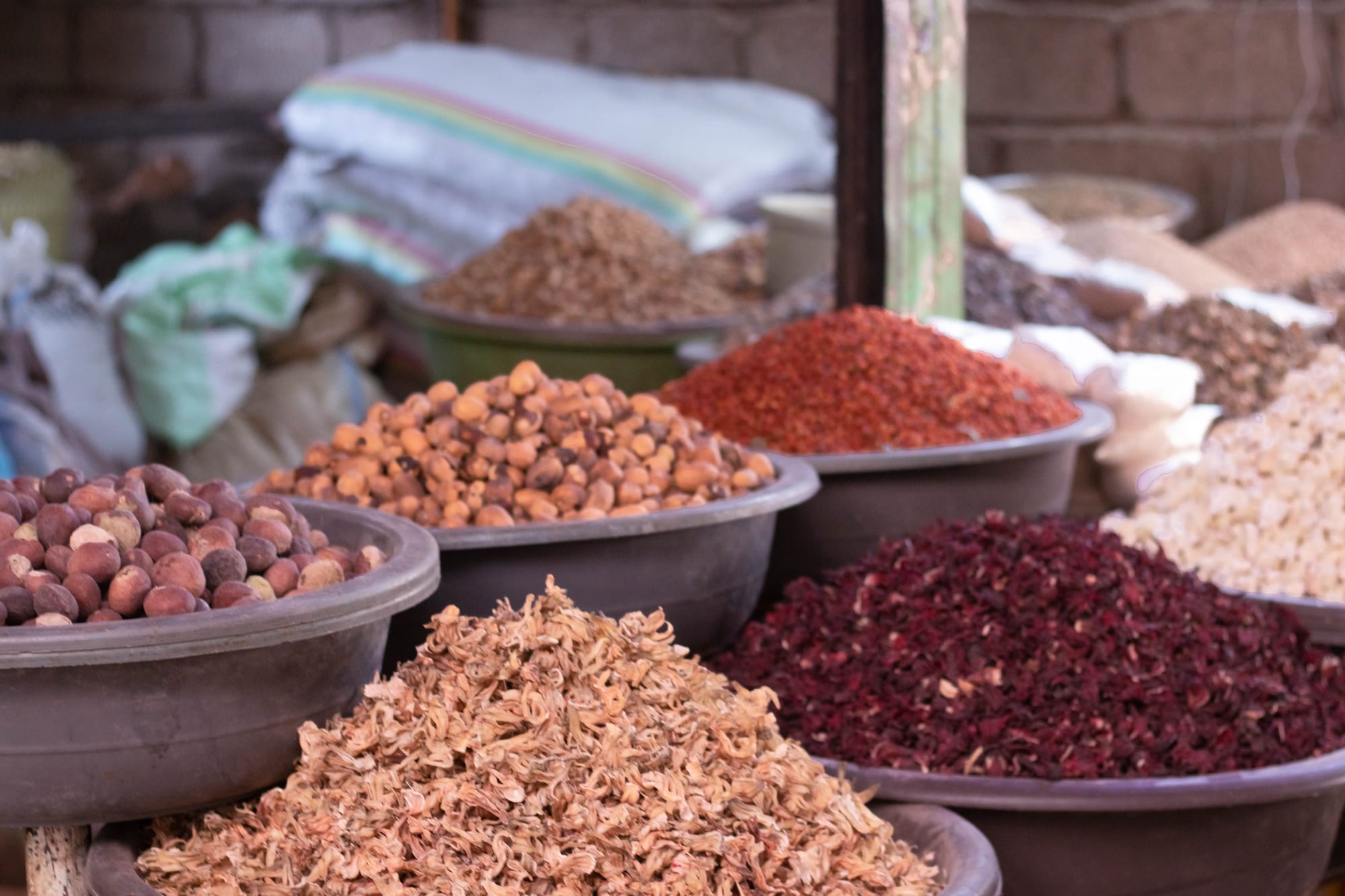
Wide metal bowls heaped with dried hibiscus, nuts, dried okra and chillies at a market stall against a breeze-block wall

Darfur & Kordofan, Sudan

El Obeid

Dried hibiscus, nuts and spices for sale in one of El Obeid's markets. (Wadalyemen / Wikimedia Commons · CC BY-SA 4.0)

The capital of North Kordofan, in the sandy savannah of central Sudan and the commercial hinge between western Sudan and the Nile. Founded by the Egyptians in 1821 on an older caravan stop, it grew on gum arabic, grain and livestock, fell to the Mahdi in 1883, and has been repeatedly besieged since the war began in 2023. This page is written to explain the city, not to encourage travel.

Neighbourhoods

  • The market quarter
    • First-time visitors
    • Markets
    • Shops and transport

    The commercial core, where the crop markets, the livestock trade and the shops that supply the whole of Kordofan are concentrated. Lorries load sacks of gum arabic, sesame and groundnuts here, and the tea stalls and small eating houses around them fill and empty with the traders.

    Open in Maps
  • Around the cathedral
    • Historic district
    • Religious sites

    The quarter containing the red-brick Catholic cathedral of Our Lady Queen of Africa, one of the oldest and largest churches in Sudan, with mission buildings and schools nearby and a small Christian community around them.

    Open in Maps
  • The railway and airport side
    • Understanding the city
    • Transport

    Beyond the centre lie the railway terminus that connected Kordofan to Khartoum and Port Sudan between 1909 and 1912, its yards and sheds, and the road out to El Obeid Airport — the infrastructure that made the city a hinge between west and east.

    Open in Maps
  • The outer residential quarters
    • Local life
    • Quiet and residential

    Low houses of mud brick and concrete with sandy lanes and acacia trees spread outwards from the centre in every direction, thinning into fields of millet and sesame. Many households here have taken in relatives displaced by the war.

    Open in Maps

Things to do

Landmarks

  • Catholic Cathedral of Our Lady Queen of Africalandmark

    A brick cathedral in the centre, considered one of the oldest and largest churches in Sudan and the seat of the Catholic diocese of El Obeid.

    Open in Maps
  • The Grand Mosque and the old centrelandmark

    The main mosque and the surrounding streets of low colonnaded shops, the core of the town rebuilt after the Mahdist period.

    Open in Maps

Markets

  • The crop marketmarket

    The yard where Kordofan's harvests are traded — gum arabic tapped from acacia trees, sesame, groundnuts, millet and dried hibiscus for karkade — long one of Sudan's most important markets for cash crops.

    Open in Maps
  • The livestock marketmarket

    A trading ground on the city's edge where Baggara and other herders bring cattle, camels, sheep and goats from across the region.

    Open in Maps

History and short trips

  • The Sheikan battlefieldlandmark

    The wooded country at Shaykan, near Kashgil outside the city, where the Mahdi's forces destroyed an Egyptian army under Hicks Pasha on 3-5 November 1883, months after El Obeid itself had surrendered.

    Open in Maps
  • The gum-arabic country of North Kordofanattraction

    The sandy savannah of acacia, baobab and millet fields that begins just outside the city and yields the gum arabic the region trades on; about 70% of the world's supply comes from Sudan.

    Open in Maps

Getting around and away

  • El Obeid Airporttransit hub

    The city's airport, a few kilometres from the centre, long the main air link between Kordofan and Khartoum; it also hosts a Sudanese Air Force base.

    Open in Maps

Eat and drink

Long-standing places and food districts in El Obeid. Hours, ratings and directions come from your maps app, always current.

Kordofan classics

  • Market eating housesmarket

    Plain rooms and stalls around the souqs serving ful medames in the morning and asida with mullah, grilled meat and liver later in the day.

    Open in Maps
  • Karkade and tea standscafe

    Hibiscus flowers dried in the surrounding country are brewed into karkade, drunk hot or iced, alongside sweet tea and spiced coffee poured from a clay jebena.

    Open in Maps

Markets and food streets

  • The crop and spice souqmarket

    Sacks and bowls of gum arabic, groundnuts, sesame, dried okra, chillies and hibiscus, with bread and grilled meat sold among the stalls.

    Open in Maps
  • Milk and meat stallsmarket

    Fresh and soured cow's and camel's milk from the herding families of the plains, and mutton and goat butchered and grilled to order.

    Open in Maps

Experience El Obeid

History

El Obeid began as a caravan stop in the sandy country between Darfur and the Nile, prospering under the Musaba'at before Egyptian forces founded the modern town in 1821 as the seat of their government in Kordofan. Its position made it rich: caravans carrying gum arabic, ivory, ostrich feathers and, from the 1840s, enslaved people taken in raids to the south all converged here, and the population rose and fell with the seasons of herding, farming and trade. By the mid-19th century the town held a governor's residence, barracks, a hospital and several mosques.

Its most consequential years were 1883 and 1884. Followers of the Mahdi assaulted the town, were driven off, and then besieged it until it surrendered on 17 January 1883. Later that year, in November, they destroyed an Egyptian army under Hicks Pasha at Shaykan nearby — the defeat that opened the whole country to the Mahdist state. El Obeid was largely destroyed and abandoned during the Mahdiyya, and only rebuilt after Anglo-Egyptian forces took control in 1899.

The 20th century restored it. A railway reached the city between 1909 and 1912, tying Kordofan to Khartoum and to the new harbour at Port Sudan, and El Obeid became the country's great gum-arabic market and an administrative centre. It grew from about 10,000 people in 1905 to about 341,000 in 2008. Since April 2023 it has been repeatedly besieged and attacked in the war between the army and the Rapid Support Forces.

Culture & Customs

El Obeid is a Kordofani city, and the region's mixture is its character: Arabic-speaking traders and townspeople of Arab and Nubian descent, Baggara cattle herders who come in from the plains, and families with roots in Darfur, the Nuba mountains and the Nile valley. Arabic is the common language, but many households speak another at home, and the weekly market is the great social occasion for the country around.

Islam orders the week and the year, with Friday prayers, the two Eids and Sufi orders whose gatherings draw people from the surrounding villages. Alongside this the Catholic cathedral of Our Lady Queen of Africa, one of the oldest and largest churches in the country, has anchored a small Christian community and its schools for generations, and the city is the seat of a Catholic diocese covering an enormous stretch of western Sudan.

Hospitality is close to obligatory. Coffee, roasted and pounded with ginger or cloves and poured from a clay jebena, and glasses of very sweet tea accompany every visit and every negotiation, and business in the crop markets is done face to face. Music, drumming and horse and camel racing mark weddings and the end of the rains in the villages around the city, and wrestling, associated above all with the Nuba further south, has a following here as well. The Mahdist years are part of local memory, and Shaykan is a name every schoolchild in Sudan knows.

Daily Life

About 341,000 people lived in El Obeid in 2008; by July 2026 an estimated 563,000 residents and a further 105,000 displaced people were living in the city, a measure of how far the war has reshaped it. Almost everything here is trade. Gum arabic from the acacia groves of North Kordofan — Sudan supplies about 70% of the world's gum arabic — along with sesame, groundnuts, millet, hibiscus and livestock, is bought, bagged and sent east by road and rail, and manufactured goods come back the other way.

The rhythm of life follows the seasons and the heat: work early, rest through the middle of the day, and the streets busy again in the cool of the evening. Water has always been a constraint in this sandy country, and power cuts are routine.

Since April 2023 the city has been besieged and shelled repeatedly. Supply routes have been cut, markets and hospitals damaged, prices for food, fuel and medicine driven to extremes, and families from across Kordofan and Darfur have crowded into schools, mosques and the homes of relatives. Aid arrives intermittently. Much of the ordinary business of a market city continues between the interruptions, because there is no alternative.

Food

Kordofan's kitchen is built on millet and sorghum. The staple is asida, a stiff porridge shaped in a bowl and eaten with mullah, a thick stew, or kisra, a thin fermented flatbread torn and dipped into the same. The stews are made with dried okra ground into waika, with dried meat called sharmout, or with kawal, a pungent fermented leaf paste that gives western Sudanese cooking its distinctive depth. Groundnuts are ground into sauces and into salatat dakwa, a salad dressed with peanut butter.

Milk and meat come in from the herders: fresh and soured cow's milk among the Baggara, camel's milk from the north, butter made from both, and mutton and goat grilled over charcoal for guests. Ful medames, fava beans stewed with oil and cumin, is the standard breakfast, bought from a stall with bread.

Drinks belong to the region. Karkade, brewed from the dried hibiscus flowers that are one of Kordofan's cash crops, is drunk hot in winter and iced in the heat; tamarind and baobab-fruit drinks are made in the same way; and coffee roasted with ginger and cloves is poured from a jebena at every meeting. Alcohol was prohibited under the Islamic law introduced in 1983, and the ban was lifted for non-Muslims only in 2020.

Planning tools

Budget

El Obeid never had a visitor trade: travellers were mostly traders, aid workers and people passing between Khartoum and Darfur, and costs were low. Since 2023 sieges and fighting have cut supply routes, markets have been damaged and prices for food and fuel are extreme. The figures below are pre-war and are given for reference only.

Daily Budget Midrange
USD 70–150 (pre-war equivalent; guesthouse, hired vehicle and driver — the Sudanese pound is not meaningful during the war)
Daily Budget Shoestring
USD 30–50 (pre-war equivalent; simple lodging, market food, buses — the Sudanese pound is not meaningful during the war)

Do not plan travel here; before the war visitors needed US dollars in cash, as international cards and ATMs did not work, and travel permits for the west.

Best Time to Visit

In peacetime November to February was the only comfortable season, after the rains and before the heat, when the roads were passable and the harvest filled the markets. April to June is fiercely hot and the rains from about June to October cut the dirt roads. Travel is not advisable at any time of year while the war continues.

Suggested Number of Days

The city is a market town rather than a sightseeing destination, and its centre takes a day. Longer stays were made for the country around it and as a stop on the long road west. None of this is possible now.

First Visit
1–2 days
With Surroundings
3–4 days

Transportation

The city is flat and spread out, and rickshaws, pick-ups and minibuses serve it. It is a road hub: highways run north-east to Khartoum, west to Darfur and south into Kordofan, and a railway terminus links it to the Nile and to Port Sudan. Roads outside the city are largely unpaved and flood in the rains.

There is no safe way for visitors to enter or travel in the region; roads, the railway and the airport have all been fought over since 2023.

Airport & Station Connections

El Obeid lies about 500 km south-west of Khartoum on the main road and railway to the west, historically about nine hours by coach or a long overnight train. El Obeid Airport, on the edge of the city, carried domestic flights. Every route into the city has been affected by the fighting since 2023.

Walkability

The centre around the markets and the cathedral is flat and walkable, and distances between the main streets are short. Beyond it the city spreads out in sandy lanes with little shade, and the heat for much of the year keeps walking to the early morning and the evening.

Safety

Do not travel. El Obeid has been repeatedly besieged and attacked by the Rapid Support Forces since the war began in April 2023; the army said it had broken the siege in February 2025, but the respite was short. The fighting has caused civilian casualties, shortages of food, fuel and medicine and large-scale displacement, and the city holds tens of thousands of people driven from elsewhere in Kordofan and Darfur.

Most governments advise against all travel to Sudan, and there is no consular help anywhere in the region. Check current official travel advice before travelling.

Climate

Hot semi-arid savannah with one rainy season. The rains green the acacia country and make the gum and grain harvests possible; the rest of the year is dry and dusty, with harmattan winds in winter.

Summer
very hot before the rains, often around 40°C; rains from about June to October bring thunderstorms and humidity
Winter
dry and warm, around 30°C by day, with cool nights and dust in the air

Local Customs

A conservative, overwhelmingly Muslim trading city with a small long-established Christian community around the cathedral. Modest dress covering shoulders and knees is expected, most women cover their hair, and greetings are lengthy. Hospitality is a strong obligation: tea or coffee is offered to every visitor, and eating and giving are done with the right hand. Business is done slowly and through conversation.

Alcohol was prohibited under the Islamic law introduced in 1983, and the ban was lifted for non-Muslims only in 2020. Do not photograph military positions, checkpoints or airports, and ask people before taking their picture, especially women.

Common Payment Methods

The currency is the Sudanese pound (SDG), which has lost most of its value. International cards and ATMs do not work because of sanctions, and banking has been badly disrupted by the war, so trade runs on cash and on credit between traders who know each other. US dollars are changed informally at rates far from the official one.