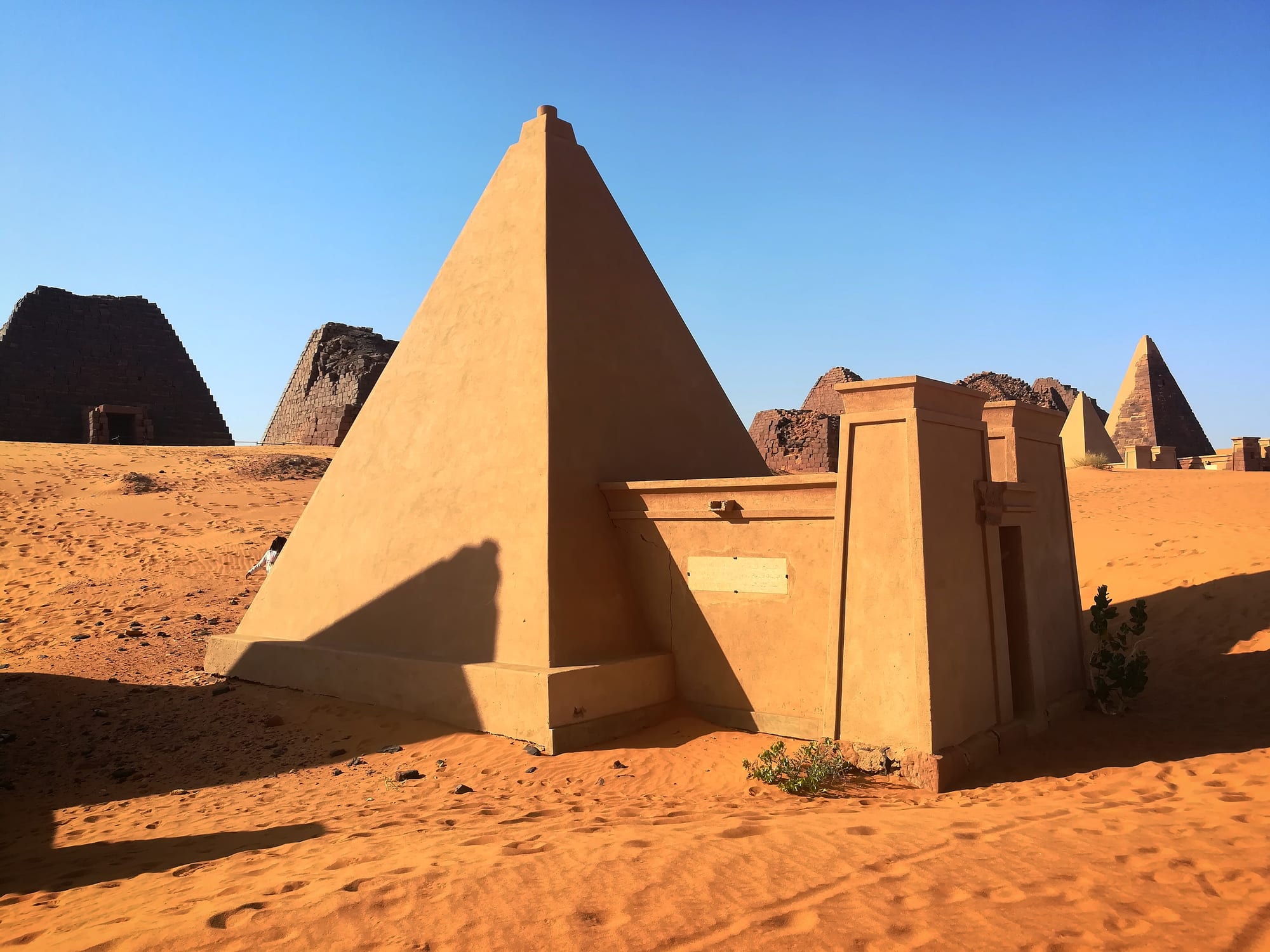
A cluster of steep, narrow sandstone pyramids on a desert ridge, sand drifting around their bases under a clear sky

Sudan

The pyramids of Meroë, royal tombs of the Kingdom of Kush, on the desert east of the Nile — a UNESCO World Heritage Site. (Ahmed Amir / Wikimedia Commons · CC BY-SA 4.0)

A vast country where the Blue and White Niles meet, holding more ancient pyramids than Egypt — long ruled from Khartoum by soldiers, split by the secession of South Sudan in 2011, and since April 2023 torn apart by a war between the army and the paramilitary Rapid Support Forces. Most governments advise against all travel.

Explore Sudan

History

The middle Nile was home to the Kingdom of Kush, whose rulers governed from Napata and later Meroë, built the steep pyramids that still stand, and in the eighth century BC conquered Egypt itself as its 25th "Kushite" dynasty. Meroë later developed its own script and an iron industry before declining around the fourth century AD. Christian Nubian kingdoms followed and held out for centuries against the Islamic expansion, before Arab migration and trade brought Islamisation and Arabic to the north from roughly the fourteenth century.

The Ottoman-Egyptian conquest of the 1820s founded Khartoum. In 1881 a religious leader proclaiming himself the Mahdi led a revolt that overran the country, killed General Gordon at Khartoum in 1885, and built a short-lived Islamic state, crushed by an Anglo-Egyptian army at Omdurman in 1898. Sudan was then ruled as an Anglo-Egyptian "condominium" until independence in 1956.

Independent Sudan has been governed by the military for most of its history, through a series of coups. Civil war between the Arab-Muslim north and the African, partly Christian and traditionalist south ran from 1955 and again from 1983, ending in a 2005 peace deal and the 2011 secession of South Sudan, which took most of the oil. Omar al-Bashir, in power from a 1989 Islamist-backed coup, presided over the Darfur conflict from 2003 — mass killing that led to genocide charges — before a popular uprising and the army removed him in 2019. A civilian-military transition was derailed by a 2021 coup, and on 15 April 2023 the army and the Rapid Support Forces, its former partner, turned on each other, plunging the country into a catastrophic war. The army regained momentum in 2024 and retook Khartoum by March 2025; the RSF, which besieged El Fasher in Darfur from April 2024, took the city on 26 October 2025 amid massacres that some experts have called genocidal. Sudan's military-led government returned from Port Sudan to Khartoum on 11 January 2026, while fighting continued in Darfur and Kordofan.

  • Sudan: The Land of Kush — Home of the kingdoms of Kush and a hundred pyramids — an Anglo-Egyptian condominium, the largest country in Africa until the south seceded, ruled for 30 years by an Islamist general, freed by a revolution in 2019, and then torn apart by a war between two armies

Culture & Customs

Sudan straddles the Arab and African worlds. The riverine north is largely Arabic-speaking and identifies as Arab; the west (Darfur, Kordofan), the east (the Beja), the Nuba Mountains, and the far south are ethnically African, with their own languages and traditions, and this fault line runs through the country's politics and its wars.

Islam, overwhelmingly Sunni, shapes public life, and Sudan is a heartland of Sufi orders — the Friday dhikr of chanting, drumming, and dancing dervishes at the tomb of Hamad al-Nil in Omdurman was, in calmer times, one of the country's great sights. Hospitality to strangers is proverbial, and Sudanese were widely regarded by travellers as exceptionally welcoming.

Extended family and clan ties are strong, weddings are large and prolonged, and customs around coffee-making, henna, and the tobe (the woman's wrapped garment) mark daily and ceremonial life.

  • Sudan: Diyafa, Dhikr and the Jertiq Tray — A deeply Muslim society with strong Sufi roots, where honour and duty bind wide families together, a guest is never sent away without a drink, and life's great moments are marked with henna, song and old protective rites

Daily Life

Before the war, around 48 million people lived in Sudan, roughly one in seven in the Khartoum–Omdurman–Bahri conurbation at the confluence of the Niles. The economy — already battered by the loss of oil, sanctions, hyperinflation, and the removal of fuel and bread subsidies — ran on farming (sorghum, sesame, gum arabic, livestock), gold mining, and remittances.

The war has upended all of it. Millions have fled abroad or been displaced within the country, Khartoum was fought over street by street and largely emptied before the army retook it in March 2025, crops and markets have been destroyed, and much of the population depends on aid that fighting and bureaucracy obstruct. Famine has been confirmed in several regions, and around 25 million people face severe food insecurity.

For those still in the country, daily life means shortages of food, water, cash, fuel, and electricity, closed schools and hospitals, and the constant risk of shelling, air strikes, and armed men.

  • Sudan: Family, Coffee, and a Country at War — A society organised around wide extended-family networks and the daily ritual of jabana coffee, and, since April 2023, the site of what UN agencies have called the world's largest displacement crisis, with millions of households living in camps, with relatives, or across a border rather than at home

Food

Sudanese cooking centres on bread and porridge — the thin fermented sorghum flatbread kisra and the stiff porridge asida — eaten with stews (mullah) of meat, okra, or dried and pounded ingredients. Ful medames — slow-cooked fava beans dressed with oil and often eaten with cheese — is a staple, scooped with bread.

Sheep's offal dishes such as elmaraara and umfitit, and peanut butter used in salads and sauces — salatat dakwa, or the grilled aubergine salata aswad — are common, and Egyptian and wider Levantine dishes appear in the cities. Umm ali and the semolina sweet basbousa are shared with Egypt.

Strong coffee, roasted, ground with spices, and served from a clay pot called a jabana, and cold hibiscus tea (karkadeh) are the social drinks. Alcohol has been banned since 1983, though the ban was formally eased for non-Muslims in 2020.

Attractions & Natural Wonders

Sudan's headline sights, currently unreachable, are the pyramid fields of the Kingdom of Kush: Meroë, with more than two hundred steep royal pyramids rising from the desert; the temples and royal city of Naqa and Musawwarat es-Sufra nearby; and the older sites around Napata and the holy mountain of Jebel Barkal, all UNESCO-listed.

The Nile itself defines the country — the confluence of the Blue Nile (from the Ethiopian highlands) and the White Nile (from the Great Lakes) at Khartoum, the great S-bends of the river in Nubia, and the cataracts. Nubian villages of brightly painted houses line the northern banks.

On the Red Sea coast, Sanganeb atoll and the Sha'ab Rumi reef — where Jacques Cousteau built an underwater habitat in 1963 — offer world-class, near-untouched diving, and Port Sudan and the ruined Ottoman port of Suakin have their own history. Wildlife survives in Dinder National Park on the Ethiopian border. All of it awaits an end to the war.

  • Sudan: Five Attractions and Natural Wonders — More pyramids than Egypt itself, a sacred mountain once believed to be the dwelling place of a god, and the exact point where two great rivers become one — described here for reference amid a devastating ongoing civil war

Planning basics

Budget

Sudan had a small, inexpensive travel scene built around the pyramids and the Nile before 2023; the war has closed it. Khartoum is a conflict zone, airports and banks barely function, and prices for anything available have soared. This section describes conditions before the war, for reference only.

Daily Budget Note
Pre-war, roughly USD 40–90/day; travel now is not feasible for visitors

Do not plan leisure travel to Sudan while the war continues; monitor your government's advice.

Visa Requirements

All visitors need a visa, arranged in advance through a Sudanese embassy, historically with a supporting letter and, for some nationalities, a slow security clearance. A travel permit and a separate photography permit were required to move around and take pictures. Consular services are disrupted by the war.

Typical Validity
About 30 days, single entry, arranged well in advance

Entry is impractical during the conflict; the pre-war process was lengthy and bureaucratic.

Safety

Most governments advise against all travel. Since April 2023 the Sudanese Armed Forces and the paramilitary Rapid Support Forces have fought a war that some estimates put as high as 150,000 dead, has forced over 14 million people from their homes, about 4.5 million of them out of the country — one of the largest displacement crises in recent history — and has brought famine, ethnic massacres in Darfur, and the collapse of health services. Air strikes, shelling, looting, and sexual violence are widespread. By September 2026 the UN's migration agency counted about 8.6 million people still displaced inside Sudan and more than 5 million who had returned home.

Health
Health system has largely collapsed; cholera and other outbreaks; no reliable emergency care or evacuation

Do not travel. Foreign nationals were evacuated in 2023; there is no consular support on the ground.

Climate

Mostly hot desert. The north is arid year-round and extremely hot from April to June, often above 40°C. A short rainy season affects the centre and south roughly July to September, when Khartoum gets dust storms (haboobs) and brief downpours. Winter, November to February, is warm and dry.

Rains
July–September in the centre and south; haboob dust storms
Hottest
April–June, over 40°C in the north

Transportation

Khartoum International Airport was heavily damaged in the fighting and closed for almost two years; it reopened to domestic flights in October 2025 and to international flights in April 2026, though it was hit by a drone attack that May. The army regained full control of Khartoum on 26 March 2025, and the military-led government, based in Port Sudan since 2023, returned to the capital on 11 January 2026. Port Sudan on the Red Sea remains the country's main seaport and a gateway for aid. Overland routes cross active front lines. In peacetime, travel was by long desert highways, a limited rail network, and Nile boats.

There is no safe way to travel within Sudan for visitors at present.

Best Time to Visit

The cooler dry season, November to February, was the only sensible time to visit the pyramids and the Nile. Travel is not advisable at any time of year while the war continues.

Events
Independence Day (1 January); Eid al-Fitr and Eid al-Adha; Sufi dhikr gatherings at Omdurman (held on Fridays in peacetime)

Currency

The Sudanese pound has collapsed in value, with a wide gap between official and street rates that has widened further in the war. It has long been a cash-only economy for visitors, and US dollars in cash were essential.

Symbol
LS
Currency Code
SDG — Sudanese pound

Language

Arabic is the main official language, in a distinctive Sudanese dialect. English is also official and used in higher education and some business. Many other languages are spoken, including Beja in the east and Nubian languages along the northern Nile.

Others
Beja, Nubian languages, Fur, and many more
Official Languages
Arabic and English