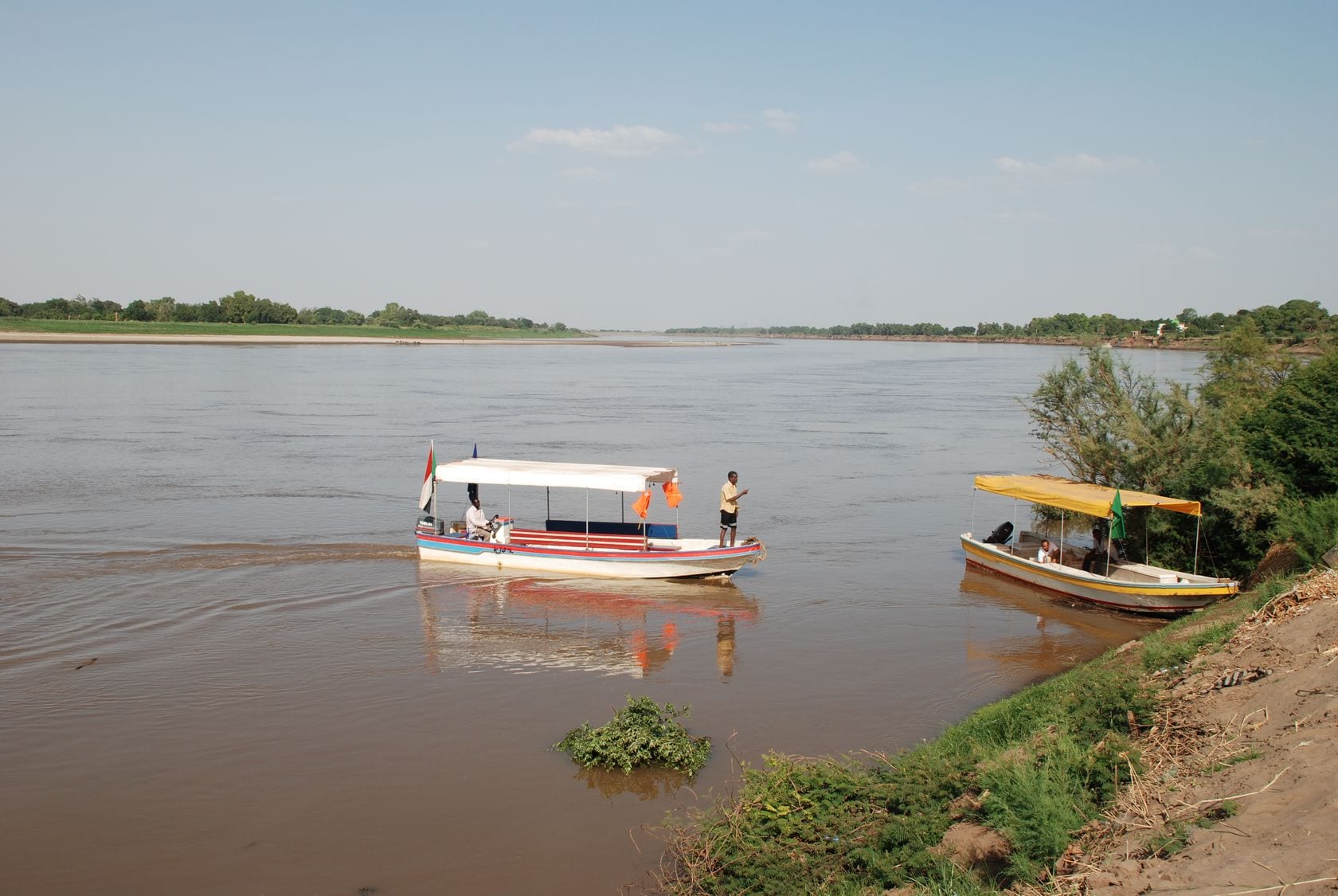
Two small awning-covered passenger boats on the wide brown Blue Nile at Wad Madani, with green banks behind

Khartoum & Central Sudan, Sudan

Wad Madani

Passenger boats on the Blue Nile at Wad Madani. (Bertramz / Wikimedia Commons · CC BY 3.0)

The capital of Gezira state, on the west bank of the Blue Nile about 135 km south-east of Khartoum, at the heart of the irrigated Gezira plain that has been Sudan's cotton belt since the 1920s. A university and market town of low colonial-era buildings and riverside gardens, it changed hands twice in the war. This page is written to explain the city, not to encourage travel.

Neighbourhoods

  • The town centre and the corniche
    • First-time visitors
    • Markets
    • Riverside walks

    The old core between the market and the Blue Nile, with single-storey shops, offices of the cotton scheme and administrative buildings from the condominium period. A tree-lined riverside road runs along the bank, where tea sellers set out stools in the evening.

    Open in Maps
  • Hantoub
    • Quiet and residential
    • Riverside walks

    The settlement on the east bank of the Blue Nile, reached by the road bridge, known above all for its long-established secondary boarding school and for gardens and orchards running down to the water.

    Open in Maps
  • The university quarter
    • Students
    • Quiet and residential

    The area around the University of Gezira's faculties, founded in the 1970s to serve the farming region. Student housing, bookshops, print shops and cheap eating places cluster here, and before the war it gave the town a young population from across Sudan.

    Open in Maps
  • The Gezira villages
    • Local life
    • Farmland

    Beyond the edge of town the irrigated plain begins, a flat grid of canals, cotton and sorghum fields and tenant villages. Many families in Wad Madani keep land or relatives out here, and the two are hard to separate.

    Open in Maps

Things to do

The river and the town

  • The Blue Nile cornicheviewpoint

    The river that gives the town its setting, wide and silt-brown, with small passenger boats, gardens on the banks and the bridge to Hantoub.

    Open in Maps
  • University of Geziralandmark

    Founded in 1975, the first Sudanese university outside Khartoum and now the second biggest public university in the country, with faculties spread across the town.

    Open in Maps

The farmland

  • Gezira Schemeattraction

    One of the largest irrigation schemes in the world, begun in 1925 and administered from Wad Madani, watering the plain between the Blue and White Niles through a grid of canals and ditches.

    Open in Maps

Short trips from the town

  • Sennar Damlandmark

    The dam completed on the Blue Nile in 1925 that made the Gezira Scheme possible, roughly 100 km upstream of the town.

    Open in Maps

Seasonal events

  • Ramadan and Eid al-Fitrvaries with the lunar calendar

    Fasting days end with iftar spread on mats outside houses and in the street, and the month closes with visiting, new clothes and sweets.

  • Eid al-Adhavaries with the lunar calendar

    Sheep are bought at roadside markets, slaughtered at home and shared with neighbours and the poor.

  • The cotton harvestroughly December to March

    The dry-season months when the Gezira's cotton is picked and brought in, long the busiest and most prosperous time in the town's year.

Eat and drink

Long-standing places and food districts in Wad Madani. Hours, ratings and directions come from your maps app, always current.

Gezira classics

  • Ful and kisra kitchensrestaurant

    Simple eating houses around the market serve ful, mashed broad beans with oil, cumin and cheese, and kisra, the thin fermented sorghum bread, with okra or dried-meat mullah stews.

    Open in Maps
  • Nile fish grillsrestaurant

    Fried Nile perch and tilapia served with lime, chilli salt and bread at stands near the riverbank.

    Open in Maps

Markets and street life

  • The central marketmarket

    The town's produce and trade market, with grain, groundnuts, dates, spices, sugar cane and vegetables from the surrounding tenant farms.

    Open in Maps
  • Tea and jebena stallscafe

    Women set out low stools under the trees and brew sweet tea with mint or cinnamon and clay-pot coffee spiced with ginger and cardamom.

    Open in Maps

Experience Wad Madani

History

The Gezira plain belonged in the medieval centuries to the Christian Nubian kingdom of Alodia, and Wad Madani grew on this stretch of the west bank of the Blue Nile as a river crossing and market on the road between the Funj capital at Sennar and the north. It was a modest place of mud-brick houses and riverside landings when the Ottoman-Egyptian administration reached it in the 1820s, and it later fell under Mahdist control before the Anglo-Egyptian reconquest at the end of the 19th century.

Its modern importance dates from irrigation. The condominium government dammed the Blue Nile at Sennar and opened the Gezira Scheme in 1925, laying a grid of canals across the clay plain between the two Niles and settling tens of thousands of tenant farmers on it to grow cotton for British mills. Wad Madani became the administrative capital of the scheme and of Gezira province, with offices, a research station, rail links, ginning mills and a merchant class that grew rich on the cotton trade. Schools followed, among them the Hantoub boarding school across the river, and in 1975 the University of Gezira was founded, the first Sudanese university outside Khartoum.

The cotton economy declined from the 1980s as prices fell, the canals silted and the scheme was repeatedly restructured, but the town remained the market and university centre of the Gezira. When war broke out in the capital in April 2023 it took in very large numbers of people displaced from Khartoum. The Rapid Support Forces attacked the city in December 2023 and held it for more than a year, displacing its population again, until the army retook it on 11 January 2025.

Culture & Customs

Wad Madani belongs to the Arabic-speaking riverine culture of central Sudan, and the surrounding plain is home to communities including the Rufa'a and other groups long settled between the two Niles. Family and clan ties are strong, weddings run for several days with the jirtig ceremony of red silk, gold and perfume and a henna night, and hospitality to strangers is a matter of honour.

Religious life is shaped by Sufism. The domed tombs of sheikhs stand in villages across the Gezira, drawing visitors at their annual commemorations; the Ansar and the Khatmiyya, the two great religious movements of Sudan, both have deep roots in the region. Friday prayer empties the market for an hour and fills the mosques.

The town has a reputation out of proportion to its size for education and the arts. Hantoub school and the University of Gezira educated a large share of the country's civil servants, doctors and agronomists, and the singers Ibrahim Al Kashif, Abdel Aziz El Mubarak and Mohammed al Amin all came from the town, which had cinemas from the early 1950s and a long tradition of literary and sports clubs. Football is followed closely, and the evening custom is to sit outdoors — in a courtyard, at a tea stall or along the river — and talk politics, farming and prices until late.

Daily Life

Wad Madani had a population of about 345,000 at the 2008 census and had grown well beyond that before the war; the numbers now are impossible to state with any confidence after two mass displacements. The town rises early, works before the midday heat, closes for the worst of the afternoon and comes out again in the evening along the corniche.

The economy is the Gezira Scheme and what depends on it: tenant farming of cotton, sorghum, wheat and groundnuts, ginning and oil-pressing mills, traders in seed, fuel and fertiliser, and the offices and research stations that administer the canals. The university and the hospitals are the other large employers, and the town is the market for hundreds of surrounding villages. Many households combine a salary, a market stall and a plot of land.

Life since 2023 has been dominated by the war. The town first absorbed hundreds of thousands of people fleeing Khartoum, then emptied when the Rapid Support Forces attacked in December 2023, with residents and the displaced moving on again to Sennar, Gedaref and the east. Farming across the Gezira collapsed as fighting reached the villages and canals went unmaintained, worsening hunger across the country. Since the army retook the town in January 2025 people have been returning to damaged homes, with power, water and health care all unreliable.

Food

The Gezira eats the Sudanese staples produced on its own fields. Kisra, the thin fermented sorghum flatbread baked on a hot plate, is the everyday bread, torn and dipped into mullah — stews of okra, whether fresh or dried and powdered as waika, of dried meat called sharmout, or of greens thickened with dakwa, the local peanut paste. Asida, a stiff sorghum porridge eaten with the same stews, is the other mainstay.

Breakfast is ful, broad beans stewed overnight and mashed with oil, cumin, white cheese and chopped onion, eaten from a shared bowl with bread, often with ta'amiya, fried chickpea patties. Grilled and fried mutton and beef, agashe skewers rubbed with peanut and chilli spice, and kammouniya, a cumin-scented offal stew, are the market foods, and fish from the Blue Nile is fried whole and eaten by the water. Groundnuts, grown across the scheme, turn up roasted, pressed for oil and ground into sauces and sweets.

Drinks follow the heat. Tea sellers pour sweet tea with mint or cinnamon, jebena coffee is roasted, pounded with ginger and cardamom and strained through grass from a clay pot, and cold karkade, an infusion of dried hibiscus, and aradaib, made from tamarind, are drunk through the afternoon. In Ramadan the fast is broken with hilu-mur, a dark spiced drink made from fermented sorghum flakes. Alcohol has been illegal for Muslims since 1983, when Islamic law was introduced, though a change in 2020 allowed non-Muslims to drink.

Planning tools

Budget

The Gezira towns were always cheaper than Khartoum, and Wad Madani had only a handful of simple hotels. The war has made any budget meaningless: banks and cash machines barely function, prices for food and fuel have soared, and there is no visitor economy. The figures below describe pre-war conditions for reference only.

Daily Budget Midrange
USD 70–150 pre-war equivalent in Sudanese pounds (better hotel, restaurants, a hired car and driver); no meaningful budget during the war
Daily Budget Shoestring
USD 20–40 pre-war equivalent in Sudanese pounds (simple hotel, market food, minibuses); no meaningful budget during the war

Do not plan travel here while the war continues; before it, Sudan was a cash-only economy for visitors, with no international cards.

Best Time to Visit

In peacetime, November to February, when the air is dry, the heat bearable and the cotton fields still green. April to June is fiercely hot, and the rains from July to September turn unpaved roads and field tracks to mud. No season is suitable for travel while the war continues.

Suggested Number of Days

A day or two was enough for the town itself before the war, and a third allowed for the irrigated plain and the Blue Nile towns upstream. Heat, permits and slow roads added time.

First Visit
1–2 days
With Surroundings
3 days

Transportation

The town is compact enough to cross on foot in the cool hours, with rickshaws, minibuses and shared taxis for longer trips and a road bridge to Hantoub on the east bank. Buses and shared vehicles ran along the paved highway to Khartoum and south to Sennar. Fuel shortages and checkpoints now make any journey uncertain.

There is no safe way for visitors to move around the region at present.

Airport & Station Connections

Wad Madani lies on the main paved highway between Khartoum and the south, about 135 km from the capital — a journey of some three hours by bus or shared taxi in normal times. The town's own airport is disused and its runway built over; Khartoum International Airport, the nearest, was closed from April 2023 and reopened to flights in stages from October 2025.

Walkability

The centre is flat, low-rise and easy to walk, with the market, offices and the river within about a kilometre of each other, and the corniche is the pleasant place for an evening stroll. Heat limits walking to early morning and after sunset, pavements are uneven, and the outlying districts and the university faculties are spread out.

Safety

Do not travel. Since April 2023 the Sudanese Armed Forces and the Rapid Support Forces have fought across central Sudan. The Rapid Support Forces attacked Wad Madani in December 2023 and held the city until the army retook it on 11 January 2025; fighting also spread through the Gezira villages, with shelling, air strikes, looting and killings of civilians. Hospitals, power and water have largely failed, and unexploded ordnance is a hazard.

Most governments advise against all travel to Sudan, and there is no consular help on the ground. Check current official travel advice before travelling.

Climate

Hot semi-desert on the edge of the Sahel, a little wetter than Khartoum. The heat builds through spring, the summer rains are more reliable here than further north and green the plain, and the winter months are dry and warm.

Summer
very hot, often 40–43°C in May and June, with rain from July to September
Winter
warm and dry, around 30°C by day with cool nights from December to February

Local Customs

Gezira is a conservative, largely Muslim farming region, more traditional than the capital. Modest dress covering shoulders and knees is expected, and many women wear the tobe, a long wrapped cloth. Greetings are long and unhurried, the right hand is used for eating and giving, and a visitor is offered water and tea before anything else. Alcohol has been illegal for Muslims since 1983, and non-Muslims were permitted to drink from 2020.

Photography of bridges, government buildings, soldiers and checkpoints is prohibited, and a photography permit was required even in peacetime; always ask before photographing people. Tipping is not expected.

Common Payment Methods

The currency is the Sudanese pound (SDG), which has lost most of its value, with a wide gap between official and street exchange rates. International cards and cash machines do not work because of sanctions, so everything runs on cash; mobile money apps spread before the war, and banking is now badly disrupted.