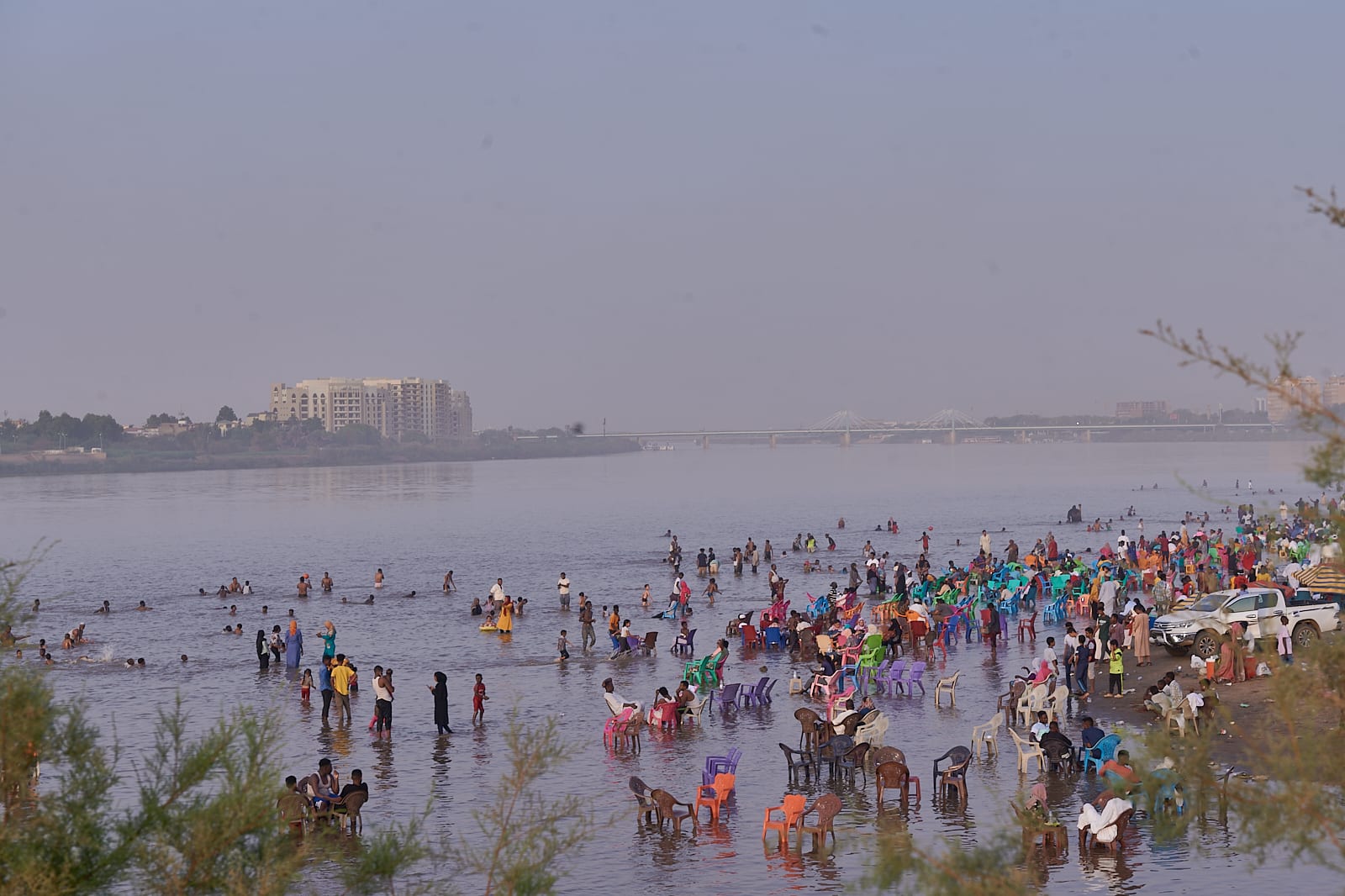
Crowds wading and sitting on plastic chairs in a wide, shallow river, with a long bridge and buildings behind

Sudan

Khartoum & Central Sudan

Families gather on the Nile at Tuti Island, where the Blue and White Niles meet in Khartoum. (Evon2023 / Wikimedia Commons · CC0)

The heart of Sudan, where the Blue and White Niles meet at Khartoum and Omdurman and the irrigated Gezira plain stretches south towards Sennar and the Ethiopian border — the country's old seat of power, its cotton belt, and since 2023 a main theatre of the war. This page is written to explain the region, not to encourage travel.

Explore Khartoum & Central Sudan

History

Long before Khartoum existed, the land between the Blue and White Niles was farmed and grazed, and in the early 16th century the Funj, a people of the upper Blue Nile, founded a sultanate with its capital at Sennar. For about three centuries the Funj ruled much of the central Nile valley, their court became a centre of Islamic learning and Sufi holy men, and trade caravans linked Sennar with Egypt and the Red Sea.

The Ottoman-Egyptian army of Muhammad Ali ended the sultanate in 1821, and Khartoum grew from a military camp at the confluence into the capital of Egyptian Sudan. In 1885 the forces of the Mahdi, Muhammad Ahmad, took Khartoum and killed General Gordon, and the Mahdist state moved its capital across the river to Omdurman. Kitchener's Anglo-Egyptian army destroyed it at the battle of Omdurman in 1898, and under the condominium Khartoum was rebuilt as a colonial capital with Gordon Memorial College, later the University of Khartoum. In 1925 the Sennar Dam began to water the Gezira Scheme, which made the region Sudan's cotton belt.

After independence in 1956 Khartoum was where coups were staged and governments fell, and in 2019 a months-long sit-in outside the army headquarters helped bring down Omar al-Bashir. On 15 April 2023 fighting between the army and the Rapid Support Forces broke out in the capital itself, emptying much of it; the war later spread into the Gezira and the states to the south, and the government's working seat moved to Port Sudan. The army retook Wad Madani in January 2025 and declared Khartoum recaptured in March 2025, and the government returned there in January 2026, but drone strikes on the capital continued, and famine has been confirmed in several parts of the country.

Culture & Customs

Central Sudan is the heartland of the Arabic-speaking riverine culture that long dominated the state, but the capital drew people from every corner of the country, and Omdurman in particular became a meeting place of Nubians, westerners from Darfur and Kordofan, southerners and easterners.

Religious life is shaped by Sufism and by the great religious families. The Ansar, followers of the Mahdi's descendants, and the Khatmiyya order of the Mirghani family each built political parties, and the Friday dhikr at the tomb of Hamed al-Nil in Omdurman, with drums, chanting and whirling dervishes, was a public ritual watched by locals and visitors alike. The Gezira and Sennar are dotted with the domed tombs of holy men.

Omdurman is also the home of modern Sudanese song. The haqiba style of the 1920s and 1930s, sung to clapping and tambourine, shaped the popular music that followed, and the city's radio station spread it across the country. In Blue Nile state the picture changes: the Funj, Berta and many other peoples keep their own languages and customs, and the region looks as much towards Ethiopia as towards Khartoum.

Daily Life

Before the war the three cities of greater Khartoum — Khartoum, Omdurman and Bahri, also called Khartoum North — held several million people and dominated the country's government, commerce, universities and industry. Wad Madani, the Gezira's capital, Kosti on the White Nile, Sennar, Singa and Ed Damazin were the other main towns.

The Gezira Scheme, a grid of canals fed from the Blue Nile, supported tens of thousands of tenant farmers growing cotton, sorghum, wheat and groundnuts. The Roseires Dam at Ed Damazin also produces hydroelectric power. Days ran early, with tea from street sellers under the neem trees, work before the midday heat, and evenings along the Nile banks.

The war has overturned all of this. Millions fled the capital in 2023, factories, markets, banks and the National Museum were looted or damaged, and the Gezira's harvests collapsed as fighting reached its villages. Displaced families crowd into towns that are themselves short of food, water, fuel, medicine and electricity, and neighbourhood emergency rooms run by volunteers have become a lifeline. Where fighting has moved on, people have begun to return to damaged homes.

Food

The central Nile towns eat the Sudanese staples in their fullest form. Breakfast is ful, broad beans stewed overnight and mashed with oil, cumin, cheese and onion, eaten from a shared bowl with bread, often alongside ta'amiya, fried chickpea patties. Kisra, a thin fermented flatbread, and asida, a stiff porridge, are eaten with mullah stews of okra or dried meat.

Omdurman and Khartoum were known for grilled and fried meat and for kammounia, a stew of liver and other offal. Fish from the Nile is fried and eaten by the river. Gurasa, a pancake-like bread, is eaten with stews.

Drinks are central to social life. Street tea-sellers, usually women, brew sweet tea with mint or spices, and jebena coffee is roasted, pounded and poured from a clay pot. Karkade, a hibiscus infusion, and aradaib, made from tamarind, are served cold, and during Ramadan families break the fast with hilu-mur, a spiced drink made from sorghum flakes.

Attractions & Natural Wonders

The confluence of the Niles at Khartoum is the region's defining sight: the muddier Blue Nile and the paler White Nile run side by side for a stretch before mixing, best seen from the bridges or from Tuti Island, a farming island in the angle of the rivers. Khartoum itself had the National Museum, whose gardens held temples moved from Lower Nubia before the Aswan High Dam flooded it, the old colonial buildings along the Nile, and the university.

Across the river, Omdurman held the Mahdi's tomb, rebuilt after British troops destroyed it in 1898, the Khalifa's house, now a museum of the Mahdist period, and the Friday dhikr at Hamed al-Nil. Nearby lies the Karari (Kerreri) battlefield of 1898.

To the south, the Gezira farmland is a flat, green country of canals, cotton fields and villages between the two Niles, centred on Wad Madani. Sennar keeps only ruins of its Funj capital, but the Sennar Dam and the Blue Nile banks give the town its setting. Near the Ethiopian border, Dinder National Park protects savannah, woodland and seasonal pools called mayas, where antelope, buffalo and large flocks of water birds gather in the dry season. All of it is currently out of reach.

Cities in Khartoum & Central Sudan

Planning basics

Budget

Before 2023 Khartoum was the most expensive place in Sudan, though still cheap by international standards, and the Gezira towns cost less again. The war has made any budget meaningless: banks and cash machines barely function, prices for food and fuel have soared, and there is no visitor economy. The figures below describe pre-war conditions for reference only.

Daily Budget Midrange
SDG — not meaningful during the war; pre-war roughly the equivalent of USD 70–150 (Khartoum hotel, restaurants, a hired car and driver)
Daily Budget Shoestring
SDG — not meaningful during the war; pre-war roughly the equivalent of USD 30–50 (simple hotel, street food, minibuses)

Do not plan travel here while the war continues; before it, Sudan was a cash-only economy for visitors, with no international cards.

Safety

Do not travel. Since April 2023 the Sudanese Armed Forces and the Rapid Support Forces have fought across Khartoum, Omdurman and Bahri, and the war spread into the Gezira and neighbouring states, with shelling, air strikes, drone attacks, looting, killings of civilians and sexual violence. Control of towns has changed more than once and front lines move. Blue Nile state has also seen a separate insurgency since 2011. Hospitals, power and water have largely failed.

Most governments advise against all travel to Sudan, and there is no consular help on the ground. Check current official travel advice before travelling.

Climate

Khartoum is among the hottest large cities on earth, with desert heat from April to June that regularly passes 40°C and dust storms (haboobs) at the start of the rains. The summer rains grow heavier southwards: short and patchy in Khartoum, reliable across the Gezira and Sennar, and heaviest in Blue Nile state, where the land turns green from July to September.

Summer
very hot, often 40–45°C in May and June; rains from July to September, heavier towards Ed Damazin
Winter
warm, dry and pleasant, around 30°C by day and cool nights from December to February

Transportation

Khartoum International Airport was damaged in the first days of the war and the capital's bridges, roads and river crossings have been fought over. In peacetime, paved highways ran south from Khartoum to Wad Madani, Sennar, Kosti and Ed Damazin, buses and shared taxis covered them, and a limited railway linked Khartoum with the south and the Red Sea.

There is no safe way for visitors to move around the region at present.

Best Time to Visit

In peacetime, November to February was the season for Khartoum, Omdurman and the Gezira, with dry air and bearable heat, and Dinder was best visited after the rains, when the tracks dried and animals gathered at the remaining pools. No season is suitable for travel while the war continues.