Culture & Customs · Sudan
Sudan: Diyafa, Dhikr and the Jertiq Tray
A deeply Muslim society with strong Sufi roots, where honour and duty bind wide families together, a guest is never sent away without a drink, and life's great moments are marked with henna, song and old protective rites
By Globeway Editorial · 30 September 2026
A visitor steps into a Sudanese home. The host rises to meet them, and the two men tap each other's left shoulder with the right hand before shaking hands, then shake again, and again, as the questions begin: how is the family, how are the children, how is the health, how are the relatives back home. None of it is hurried. Before the guest has properly settled, a glass of water appears, then tea or coffee, and it would be a real discourtesy to refuse. The scene is small, but it holds much of what Sudanese people most value: faith spoken aloud in every other sentence, respect shown through patience, and a generosity so expected that it barely needs saying. This article is written to explain Sudanese culture, not to encourage travel, which most governments currently advise against.
Faith, identity and values
Islam shapes almost every part of life in Sudan. Official estimates put the Muslim share of the population at around 97 per cent, although some international estimates are lower; almost all are Sunni. Small Christian communities, among them Coptic Orthodox, Catholic and Anglican churches, live mainly in the towns and in some southern border areas, and a minority follow Indigenous African religions. Faith is visible in dress, in diet, in the rhythm of daily prayer and, above all, in speech: "inshallah", God willing, is attached to almost any plan for the future, and thanks and good news are rarely mentioned without a word of praise to God.
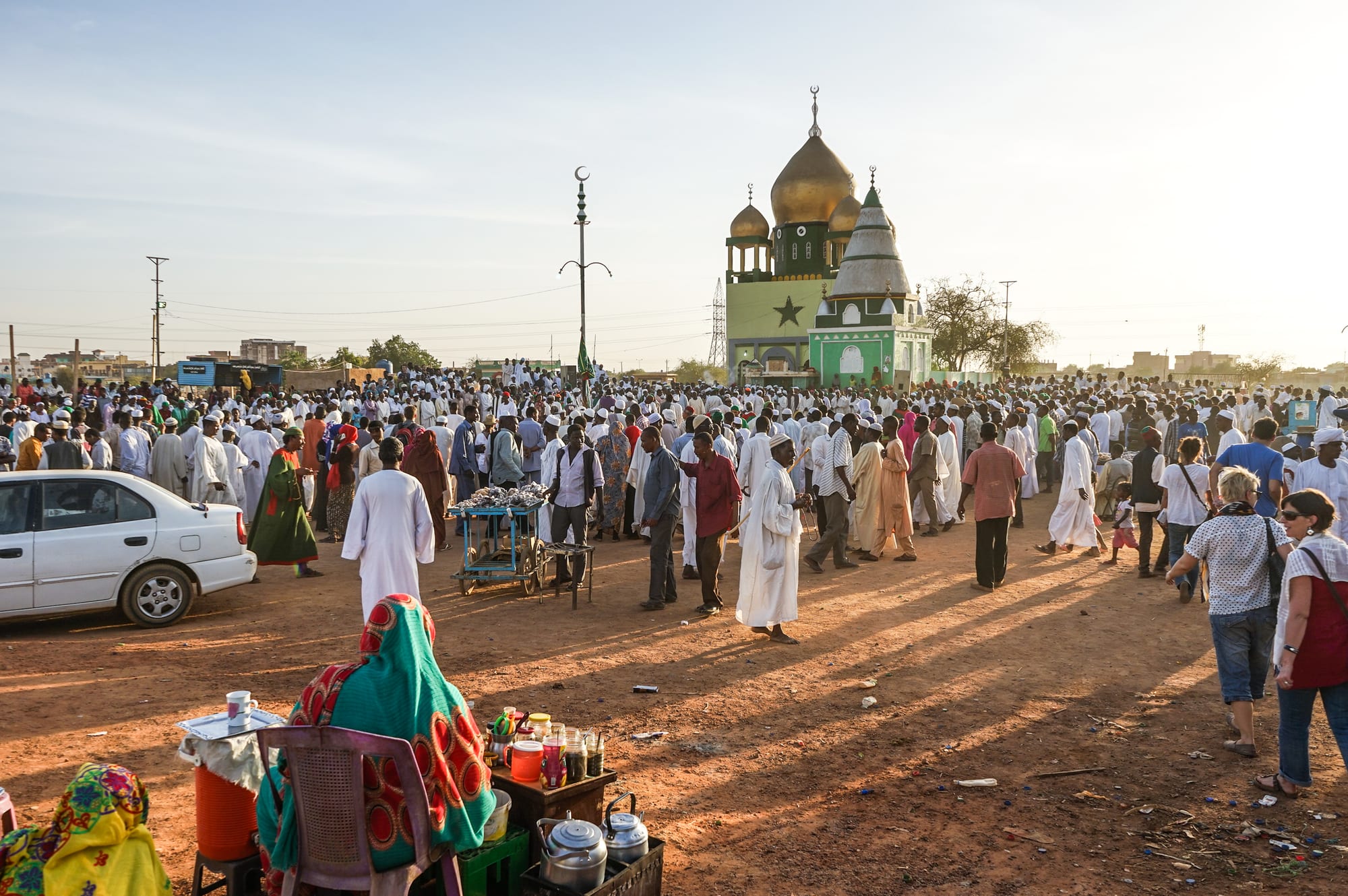
Sufism, the mystical strand of Islam, has a wide traditional following, and its brotherhoods, each with its own sheikhs, shrines and ways of worship, are woven into religious life. Their best-known practice is the dhikr, the rhythmic, repeated remembrance of God's names, performed with chanting, drumming and swaying, whirling movement. Before the war, weekly dhikr gatherings at the shrines of revered Sufi sheikhs drew large crowds of followers and onlookers alike.
Beneath the faith sits a set of values that Sudanese people describe in their own terms. Sharaf, honour, covers personal integrity, family reputation and modesty, and because one person's behaviour reflects on the whole family and clan, the fear of aar, shame, is a powerful force. Al-wajib, duty, expresses the idea that those who have more must help those who have less, often quietly. Karam, generosity, and diyafa, hospitality, are taught from childhood as marks of dignity. Tawadae, humility, means achievements are played down, so that a task is more likely to be described as "we finished it" than "I did". Emotional restraint is admired, and hardship is widely accepted as God's will. Belief in the evil eye, the harm caused by another's envy, remains common.
Sudan also sits where the Arab and African worlds meet. The Nile valley north is largely Arabic-speaking and many there identify as Arab, while the country's west, east and south are home to many other peoples with their own languages and traditions, and questions of identity run deep in national life. Since April 2023, a war between the Sudanese Armed Forces and the paramilitary Rapid Support Forces has driven what the International Organization for Migration describes as the world's largest displacement crisis, and many of the customs described here are now kept up in camps, in crowded relatives' homes, or in exile.
Greetings and meeting people
The spoken greeting is "as-salamu alaykum", peace be upon you, while a simple "salam" serves among friends. Entering a room full of people, a newcomer may raise the right hand and say "salam" to everyone at once. People stand to greet others, especially those older than themselves, since age and status command visible respect.
Between people of the same sex, the greeting is warm and physical: the shoulder tap, a handshake that may be repeated several times, and between close friends or relatives a hug. Between men and women it is more reserved. A man waits for a woman to offer her hand before offering his own; if she does not, a nod and a spoken greeting are enough.
Greetings are long, and that length is part of their meaning. A string of questions about family, health and home is expected before any business, and people may ask about a newcomer's family, clan or background in order to place them, which is a sign of interest rather than intrusion. Titles matter: people are addressed as "Uncle" or "Aunt" as a mark of respect even without any family tie, by professional titles such as "Doctor", or as "Haji" if they have made the pilgrimage to Mecca.
Communication tends to be indirect. People soften disagreement to keep the peace, and "inshallah" can mean a hopeful yes, a polite maybe or a gentle no. Eye contact is kept brief, particularly with elders or those of higher standing, and lowering the gaze is a sign of respect rather than evasion. The right hand is used for greeting, giving and receiving, since the left is associated with hygiene, and pointing with a single finger is considered rude; a whole open hand is used instead. Swearing and crude humour are frowned upon, although quick wit and gentle teasing are much enjoyed.
Hospitality and being a guest
Hospitality is treated as a duty, not an option. A host is expected to offer something to drink to anyone who comes to the door, even if it is only water, and turning down tea or coffee can cause real offence and misunderstanding. At the same time, a first invitation may be a courteous formula rather than a firm plan, and Sudanese people understand the difference; a sincere invitation is usually repeated.
Social visits are traditionally made in the mid-morning or early evening, avoiding mealtimes, and Friday, the Muslim day of rest, is a favoured day for calling on family and friends. Shoes are taken off at the door unless the host says otherwise, since homes are also places of prayer and are kept ritually clean. For the same reason dogs are not brought into homes. In many households, men and women socialise in separate rooms, and guests are shown to the appropriate one.
Gifts are welcome but should be offered with both hands or the right hand alone. The recipient will often decline at first out of modesty, so a gentle second offer is expected. Anything containing alcohol or pork, or made from pigskin, is inappropriate.
Meals are often eaten from a shared dish, with the right hand. Each person takes food from the part of the dish directly in front of them, and reaching across another diner's hand is rude. Guests do not ask for particular dishes; the host decides what to serve and when. Modest dress is part of good manners at any gathering: clothing that covers the shoulders and knees is the expected minimum for visitors of both sexes.
Festivals and life's big moments
The religious calendar sets the rhythm of the year. Ramadan, the month of fasting, ends with Eid al-Fitr, and Eid al-Adha, the feast of sacrifice, follows the pilgrimage season; both are times for prayer, family gatherings and visits between households. On the national calendar, Independence Day falls on 1 January.
The Prophet's birthday, al-Mawlid, is one of Sudan's great public celebrations and is on UNESCO's list of intangible cultural heritage. It begins twelve days before the birthday itself, in the third month of the Islamic calendar, with a procession of thousands: men, women and children, community leaders, officials and music corps. Along the way, participants sing religious songs, perform ritual dances and recite Sufi prayers, and the celebration settles in a large open square decorated with lights, flags and prayer rugs, where people meet, enjoy food from different parts of the country and buy sweets and toys for children. UNESCO notes that the occasion brings together people of different religions as well as different Sufi orders.
Weddings are among the biggest events in Sudanese social life, often lasting several days and drawing hundreds of guests. The path to marriage is long: families negotiate indirectly, sometimes for many months, and the groom is expected to provide the mahr, the marriage payment, and the shila, gifts for the bride. The religious contract is concluded between the groom and the bride's guardian. Henna runs through the celebrations: the bride's hands and feet are decorated with intricate designs, and the groom has a henna night of his own. Henna's rituals and social practices, shared by Sudan and many other Arab countries, are on UNESCO's list too.
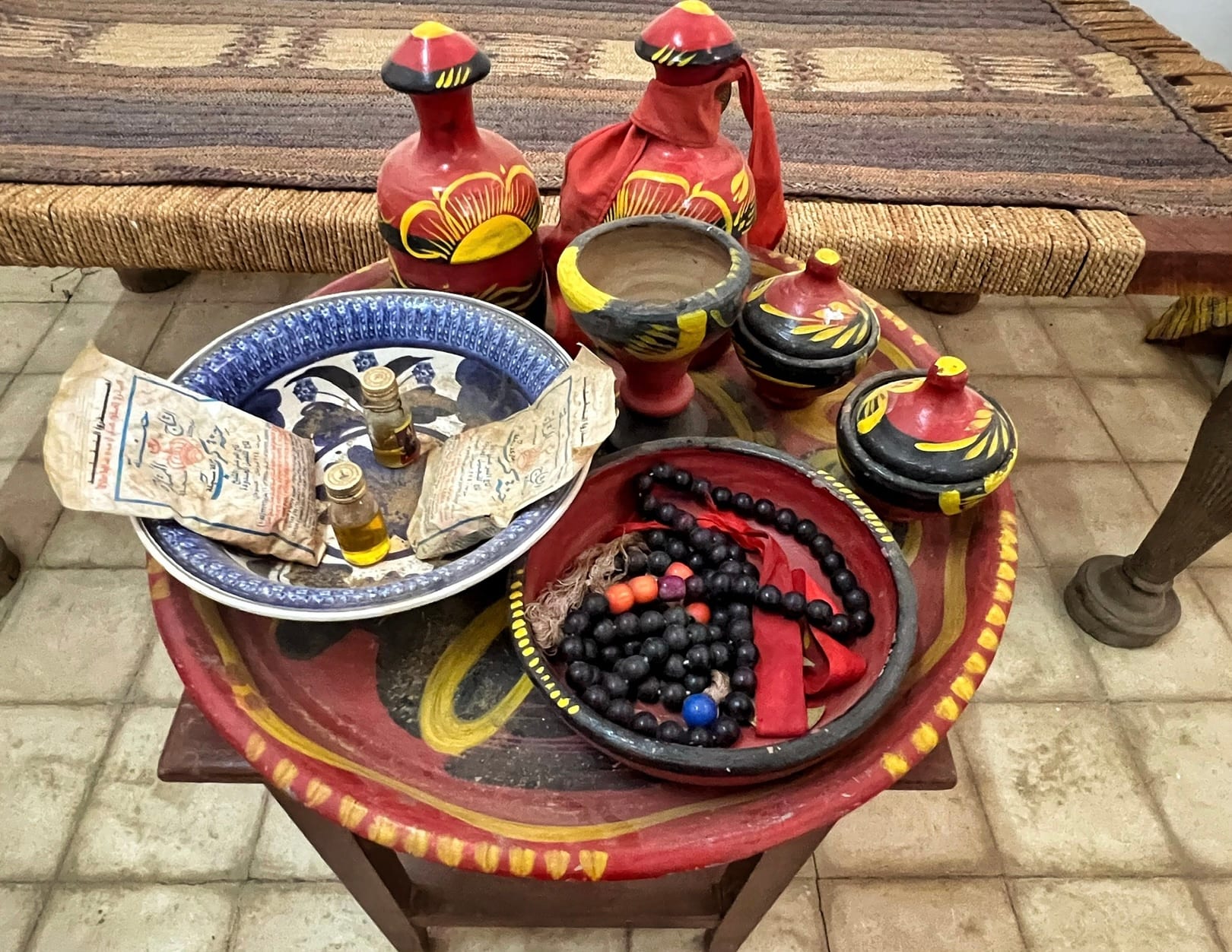
The Jertiq itself is led by older women, who pass on its steps informally to daughters and granddaughters watching at their side. Each of its objects has a purpose, whether to guard against the evil eye, to bring good fortune or to promote fertility. Wedding music has long been part of the celebration too, and live bands and singers remain a fixture of the evening parties.
A birth is greeted with prayer: among Muslim families, God's name is whispered into the newborn's ear. When someone dies, relatives, neighbours and friends come to the family home as soon as they hear the news, with no fixed time for condolences. Men and women mourn in separate spaces, often with the women inside the house and the men on a veranda or under a tent outside, and the family receives visitors over several days, with food prepared to feed the many mourners.
Arts, crafts and music
Music has a special place in Sudanese life. Haqiba, a largely vocal style, took shape in the 1920s and 1930s and laid the ground for what followed. In the decades after independence, Sudanese popular music grew into one of the most vibrant scenes in Africa and the Arab world, its songs heard well beyond Sudan's borders. Its orchestras blended the oud with violins, accordions and other imported instruments, and singers such as Mohammed Wardi, a poet as well as a performer, became national figures. After 1989, musicians faced heavy restrictions and many left the country, and weddings became one of the last places where the older orchestral tradition could still be heard.
Religious arts are equally alive. The chanting and drumming of the Sufi dhikr are heard at shrines and at the Mawlid, where religious songs and ritual dances fill the procession. Arabic calligraphy, the skills of engraving on metal, and the traditions of the date palm, all shared with other Arab countries, are on UNESCO's list with Sudan among the countries named.
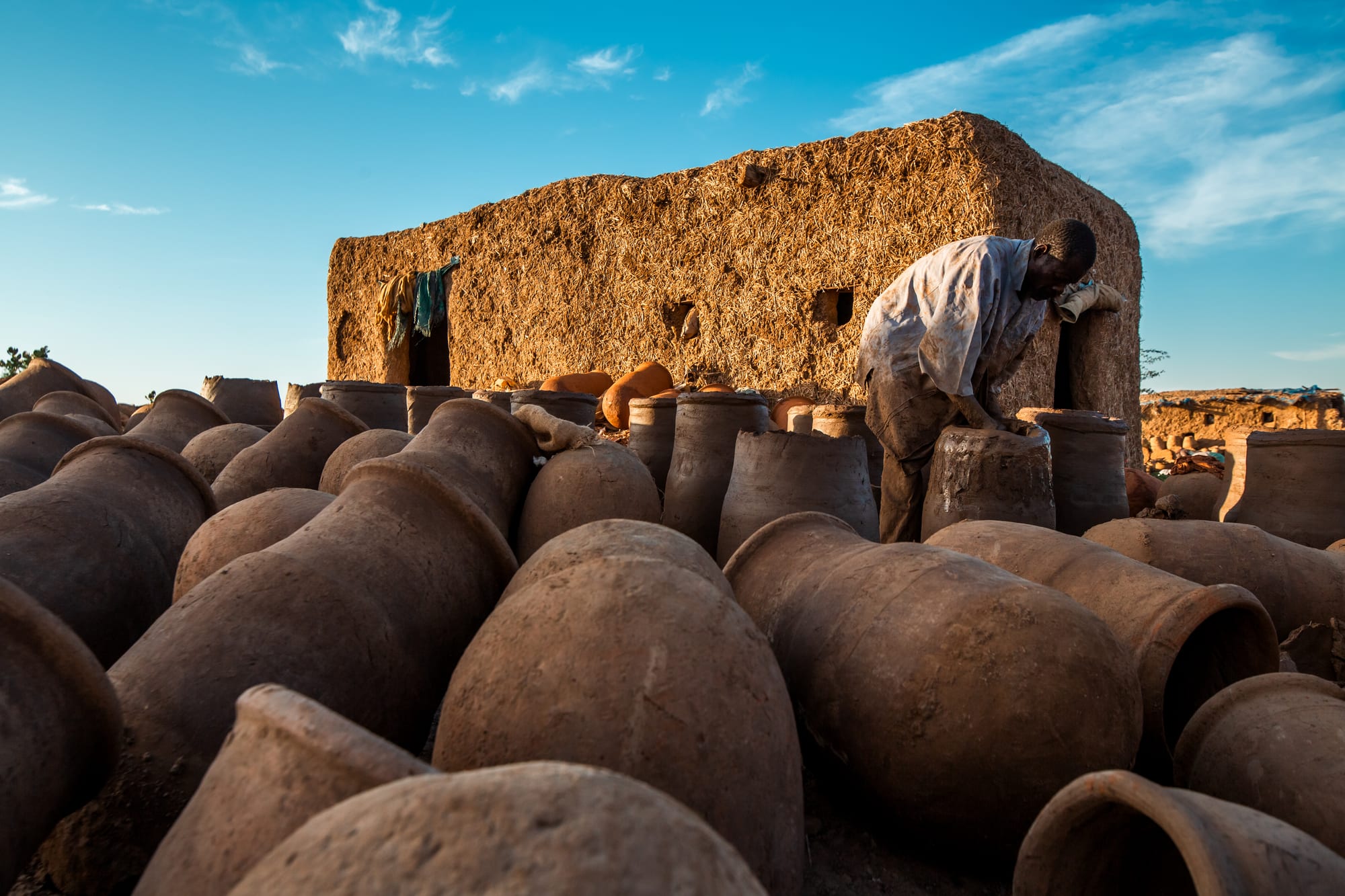
Hand crafts for everyday use have a long history, among them silverwork, leatherwork, pottery and baskets and mats woven from palm fibre, a craft Sudan has put forward for UNESCO recognition. Dress carries tradition too. Men traditionally wear the jalabiya, a long white robe, with a cap or turban, while many women wear the toub, a long length of fine fabric wrapped around the body and over the hair.
Dos and don'ts for visitors
- Do check the latest government travel advice before any trip; the UK and most other governments advise against all travel to Sudan because of the ongoing armed conflict.
- Do take time over greetings, stand up for elders, and address older people as "Uncle" or "Aunt" or by their title.
- Do accept at least a little of the water, tea or coffee offered; refusing hospitality can give real offence.
- Do use the right hand to greet, eat, give and receive, and eat from the part of a shared dish nearest to oneself.
- Do dress modestly, with shoulders and knees covered, and take shoes off when entering a home.
- Don't offer to shake hands with someone of the opposite sex; wait for them to offer theirs.
- Don't bring alcohol or pork products as gifts — alcohol has been illegal for Muslims since 1983 — and don't point at people with a single finger.
- Don't press people about the war; many Sudanese have lost relatives, homes or livelihoods, and the subject calls for care.
What to take away
Sudanese customs rest on a simple conviction, that honour is kept by giving, whether a drink to a stranger, a long greeting to an elder or help to a relative in need, and even in a time of war that conviction remains the surest guide to how people treat one another.