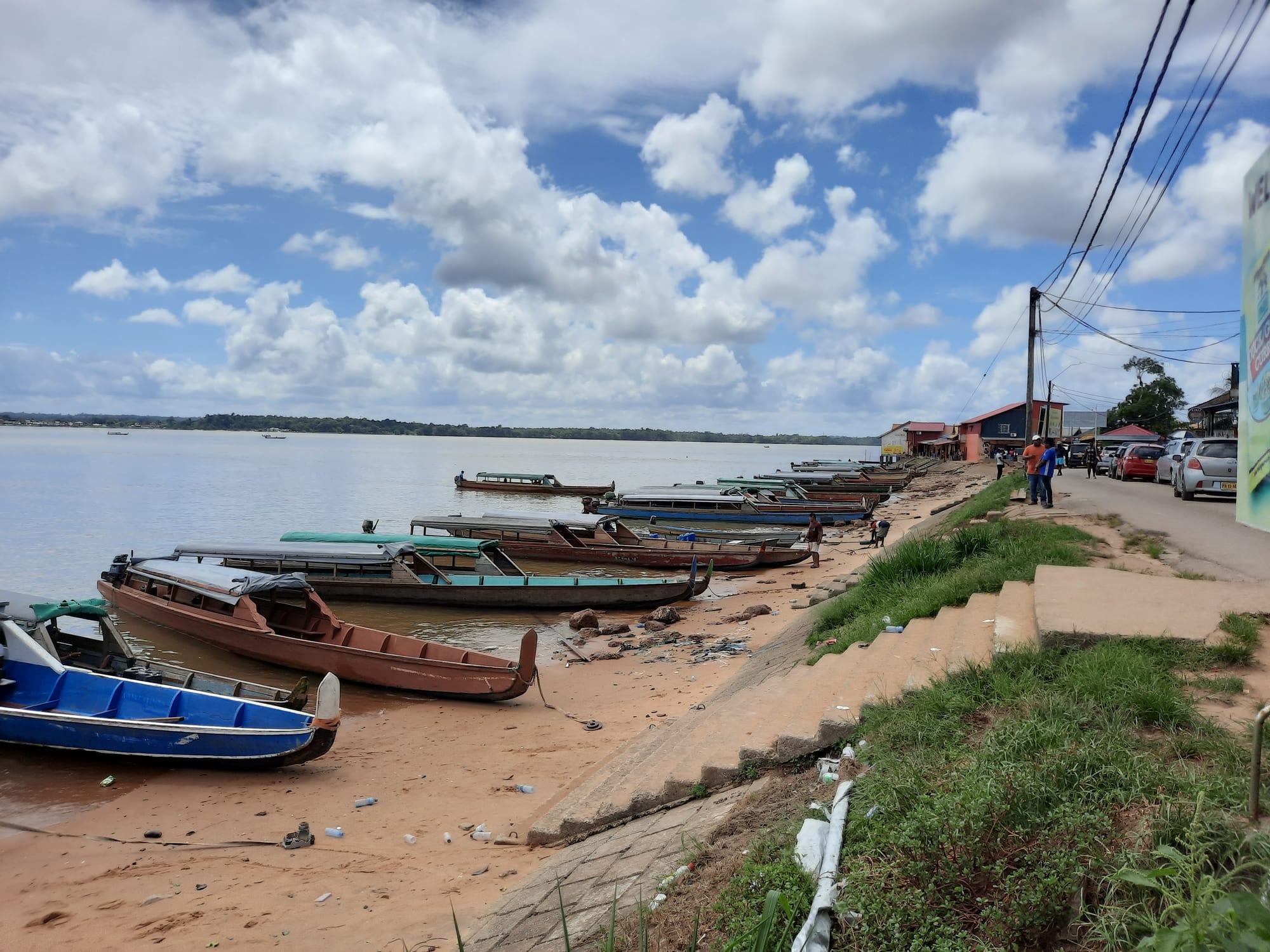
Long wooden river boats pulled up on a sandy bank beside a riverside road at Albina, with the wide Marowijne beyond

Suriname

Albina

Boats on the Marowijne at Albina, used for the crossing to French Guiana. (Ymnes / Wikimedia Commons · CC BY-SA 4.0)

The capital of Suriname's Marowijne District, on the west bank of the Marowijne River directly opposite Saint-Laurent-du-Maroni in French Guiana. Founded in 1846 and later a riverside holiday town, it was largely destroyed during the interior war of 1986–92. Today it is a small border town and the boat base for Indigenous and Maroon villages and the Galibi turtle beaches.

Neighbourhoods

  • Town centre and the Waterkant
    • First-time visitors
    • River views
    • Close to the ferry

    The small grid of streets along the bend of the Marowijne, where the river is about two kilometres wide. Boats for Saint-Laurent-du-Maroni and the river villages leave from the waterfront, and the ferry, the market and the few places to eat are close together.

    Open in Maps
  • Alfonsdorp and Marijkedorp
    • Indigenous communities
    • Quiet and residential

    Two Indigenous Lokono villages within the Albina area, outside the town centre. They are home communities rather than attractions, and visits are best made with a local guide.

    Open in Maps

Things to do

The river and the border

  • Marowijne Riverattraction

    The river that forms the border between Suriname and French Guiana; boats from Albina carry passengers to the villages along it and to Saint-Laurent-du-Maroni.

    Open in Maps
  • Saint-Laurent-du-Maroniattraction

    French Guiana's second city, directly across the river by ferry or pirogue, the site of a penal colony from 1858 to 1946 and home to the Maroon neighbourhood of La Charbonnière.

    Open in Maps

Short trips from the town

  • Galibipark

    A Kalina Indigenous area at the mouth of the Marowijne, about an hour and a half from Albina by korjaal (dugout boat). Its nature reserve's beaches are among the main nesting grounds of the leatherback turtle, and can only be visited under strict supervision between February and June.

    Open in Maps
  • Moiwanalandmark

    A Ndyuka Maroon village where the army killed at least 35 inhabitants, mostly women and children, on 29 November 1986, during the interior war.

    Open in Maps

Eat and drink

Long-standing places and food districts in Albina. Hours, ratings and directions come from your maps app, always current.

Albina basics

  • Albina marketmarket

    The town's small market, where snacks are sold alongside everyday goods.

    Open in Maps
  • Places to eat in the town centreneighborhood

    A handful of basic places to eat near the river and the main streets, serving everyday Surinamese food.

    Open in Maps

Experience Albina

History

Albina was founded on 13 December 1846 by August Kappler, a German former army corporal, on the site of an abandoned Carib village on a bend of the Marowijne, about three metres above the river's highest level. He named it after his fiancée and later wife, Albina Liezenmaier, and settled with the permission of the Indigenous and Maroon people nearby to collect insects, cut timber and trade. At first the place could only be reached by river.

Gold found in the Lawa area in the second half of the 19th century made the settlement grow, and in 1876 it became the seat of the district commissioner. By 1913 it had a medical clinic and was home to 349 men and 266 women. After the First World War Albina became known as a holiday town: Emmastraat along the river was lined with white wooden houses like those of Paramaribo, and people from the capital came for short breaks. A road from Moengo, now part of the East-West Link, was built in the late 1920s, and a ferry to Saint-Laurent-du-Maroni opened in 1969.

The interior war began here on 22 July 1986, when the Jungle Commando attacked the army barracks in Albina. The town was repeatedly plundered by both sides, and in December 1986 the National Army set it on fire; large parts were destroyed, and many people fled across the river to French Guiana. After the war the riverbank was repaired with Dutch aid and rebuilding began. In December 2009 riots broke out in which local Maroon residents attacked Brazilian and other foreign gold prospectors. Plans have been made for a bridge to French Guiana, but as of May 2020 no action had been taken.

Culture & Customs

Albina sits where several of Suriname's peoples meet. Alfonsdorp and Marijkedorp nearby are Indigenous Lokono villages, Bigiston is a group of Ndyuka Maroon and Kalina villages, and further north the Kalina villages of Christiaankondre and Langamankondre at Galibi chose not to be linked by road, to keep their peace and quiet. In the Eastern Maroon Creole spoken by many on the river the town is called Alimina or Alibina, and the river itself is a shared space rather than a barrier: Maroons are the largest group in Saint-Laurent-du-Maroni on the French side.

The town has an Indigenous monument made in 1996 by the sculptor Jozef Klas, whose Kwakoe statue is one of Paramaribo's best-known landmarks. Musicians and politicians born in Albina include the singer Oscar Harris and Henk Chin A Sen, who was president of Suriname in the early 1980s.

The interior war hit the area hard. At Moiwana, a Ndyuka village near Albina, at least 35 people, mostly women and children, were killed by the army on 29 November 1986, and the survivors fled with thousands of others across the river into French Guiana.

Daily Life

About 5,200 people lived in Albina at the 2012 census. It is the capital of the Marowijne District and Suriname's main border crossing to French Guiana — and so to the European Union — and much of the town's activity revolves around the river: the car ferry, the boats that shuttle passengers across, and the boats that carry goods and people to villages upriver.

Small-scale gold mining has grown in the region since the 1980s. During the interior war, Maroon communities were cut off from Paramaribo, and a currency reform in 1986 left cash in the interior worthless, which gave small-scale gold digging a boost; Brazilian garimpeiros were recruited for their experience, and by about 2009 an estimated 14,000 people worked in the small-scale gold sector, most of them Brazilians.

Eastern Suriname has seen little government investment since the war. In the Galibi villages to the north, life rests on fishing, subsistence farming and tourism, and across the river Saint-Laurent-du-Maroni, with about 54,000 people, is a much larger town on the opposite bank.

Food

Albina is a place for simple meals rather than a food destination. A few basic places to eat serve everyday Surinamese food, and snacks can be found at the local market.

The dishes are those of the wider coast: Hindustani roti, a flatbread served with curried chicken, potato and long beans; Javanese bami and nasi goreng from warungs; and Creole dishes such as moksi alesi, rice cooked with salted meat or fish. Street snacks such as telo, fried cassava, and bakabana, plantain fried in batter, are common across Suriname.

Fresh tropical fruit and juices are plentiful, as they are all along the coast, and grilled skewers are a common street snack. Parbo beer, brewed in Paramaribo, and Surinamese rum are the usual drinks, and strong coffee is a daily habit. On the far bank of the river the food is that of French Guiana, and prices there are in euros.

Planning tools

Budget

Albina itself is inexpensive, with few places to stay or eat. The main costs are the boat trips — to Galibi or along the river — which are usually chartered or arranged through tour operators in Paramaribo, and prices depend on bargaining and on how many people share the boat.

Daily Budget Midrange
USD 110–220 (organised trip with transport from Paramaribo, a chartered boat, meals)
Daily Budget Shoestring
USD 40–70 (basic room, market snacks, shared minibus or taxi)

Agree the price of any boat before setting off, and carry euros as well as US dollars and Surinamese dollars for the crossing to French Guiana.

Best Time to Visit

The turtle-nesting season at Galibi, roughly February to June, is the main reason to come, and the nesting beaches can only be visited under supervision in those months. The drier spells of about February to late April and September to November are the easiest for river travel.

Suggested Number of Days

The town itself needs little time, and many travellers simply pass through on the way to or from French Guiana. Allow two or three days to add an overnight trip to the turtle beaches or a longer journey along the river.

First Visit
1 day
With Surroundings
2–3 days

Transportation

The town is small enough to cover on foot. Boats are the main way to go further: large and small boats come and go from the riverbank, and seats can be bought or a whole boat chartered after bargaining. Some parts of the area have no road at all, including the Galibi villages, whose residents chose not to have one.

Expect to wait for a boat to fill if not chartering one, and settle the price first.

Airport & Station Connections

Albina is the eastern end of the East-West Link, about 140–150 km from Paramaribo. Buses take about two and a half to three hours, and shared taxis and private transport also run. From French Guiana, a ferry and smaller boats cross from Saint-Laurent-du-Maroni. The town's airstrip closed permanently in 2025; international flights use Johan Adolf Pengel International Airport, south of Paramaribo.

Walkability

The centre is compact and flat, and the ferry, the boats, the market and the places to eat are a short walk apart. Beyond the town the villages are spread along roads and the river and need transport.

Safety

Suriname is relatively safe, with most crime being opportunistic theft. Albina is a small, quiet town, but tension between local residents and gold miners led to riots in 2009, and the police and army have little influence in eastern Suriname.

Use registered boats and transport, avoid informal gold-mining areas, and travel to Galibi with an organised group or local guide. Check current official travel advice before travelling.

Climate

Tropical, hot and humid all year; across Suriname as a whole temperatures are around 27–32°C, with a long wet season from about late April to August and a short one around December and January.

Summer
Long wet season from about late April to August; hot and humid, at around 27–32°C across Suriname.
Winter
Drier from about September to November and February to April, still around 27–32°C across Suriname; a short wet season comes around December and January.

Local Customs

Albina is a meeting point of Maroon, Indigenous, Creole and other communities on both sides of the river. The surrounding villages are people's homes, with their own leaders and customs. Dutch and Sranan Tongo are spoken in Suriname, and French on the other bank.

Ask before photographing people or homes in the villages, and follow guides' instructions on the turtle beaches.

Common Payment Methods

The currency is the Surinamese dollar, which has been devalued repeatedly. US dollars and euros are widely accepted in Suriname, and euros are the currency across the river in French Guiana. In a small town like Albina it is safest to bring enough cash.