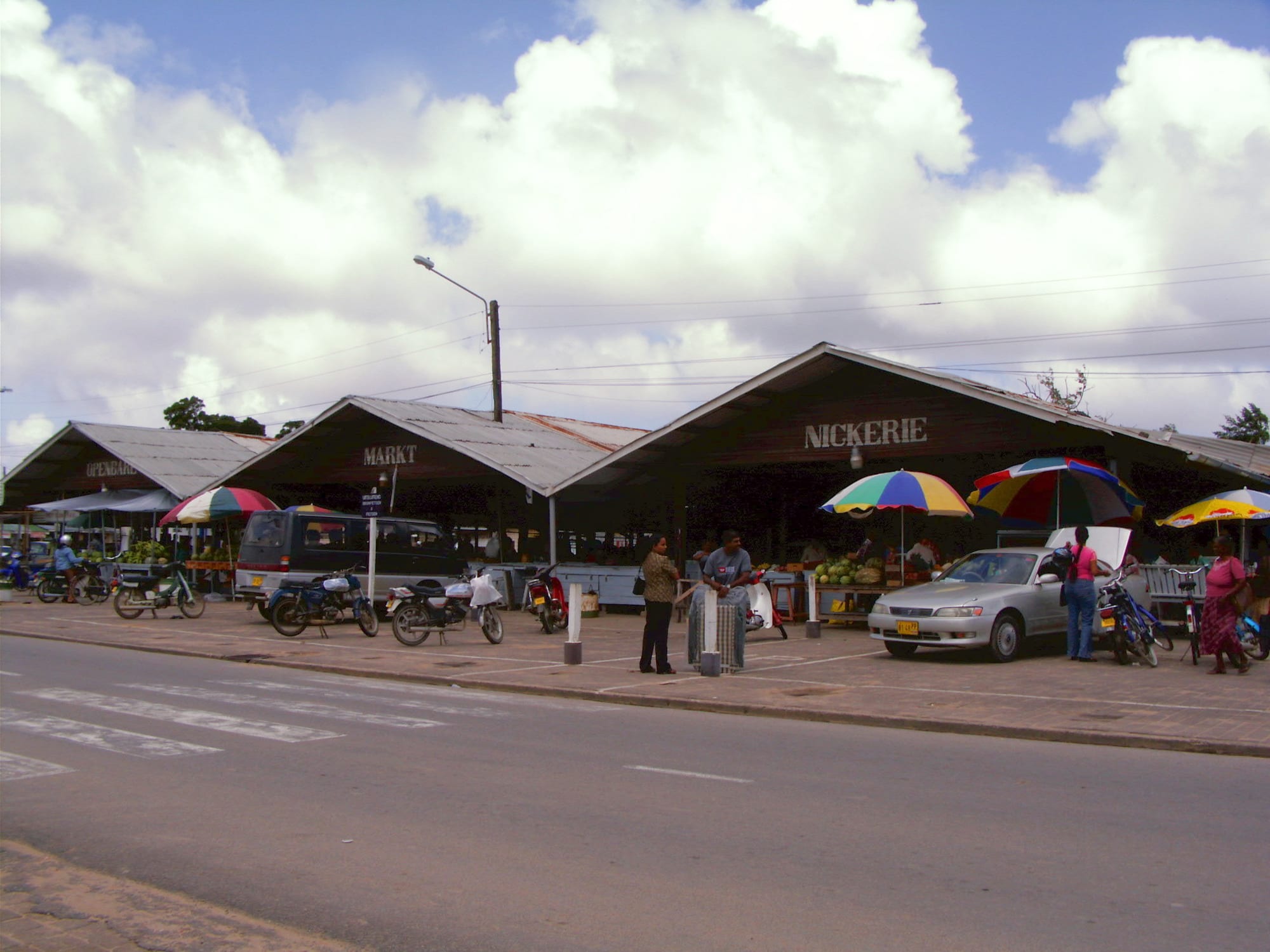
Low market halls signed Markt and Nickerie, with fruit stalls under colourful umbrellas, motorbikes and a parked car

Suriname

Nieuw Nickerie

The market halls in the centre of Nieuw Nickerie. (Brokopondo / Wikimedia Commons · CC BY-SA 3.0)

Suriname's third-largest town and the capital of the Nickerie District, at the mouth of the Nickerie River opposite Guyana, at the western end of the East-West Link. Built in 1879 after floods destroyed the old district centre, it lies among polders behind a sea dike and serves the country's largest rice-growing district. It is the base for the Bigi Pan wetlands.

Neighbourhoods

  • Town centre and the Brasaplein
    • First-time visitors
    • Local life
    • Best for food

    The village-like centre, where a freshwater canal full of water lilies leads to the Brasaplein. The district commissioner's office, the Brasaplein and the Volksplein, with their monuments, a playground and food stalls, and the market halls are all close together.

    Open in Maps
  • The sea dike
    • Sunsets
    • Walks
    • Quiet

    A sea wall about 7.5 km long, reached along the A.K. Doergasawstraat, which protects the polders from the sea and is nicknamed Klein Scheveningen after the Dutch seaside. It has a small beach, a Hindu temple and an open-air cremation ground, and is known for its sunsets.

    Open in Maps

Things to do

In and around the town

  • Brasaplein and Volkspleinlandmark

    The two central squares by the district commissioner's office, with monuments to the abolition of slavery, to Hindustani and Chinese immigration and to the town's centenary, and a bust of Mahatma Gandhi.

    Open in Maps
  • Nieuw Nickerie marketmarket

    The covered market halls in the town centre, with fruit and vegetable stalls.

    Open in Maps
  • The sea dikeviewpoint

    The long sea wall at the end of the A.K. Doergasawstraat, with a Hindu temple, the open-air cremation ground and a small beach, 't Strandje, behind the dike.

    Open in Maps

Rivers and wetlands

  • Nickerie Riverattraction

    The river on whose left bank the town stands; boats leave from its banks for the Bigi Pan wetlands to the east.

    Open in Maps
  • Courantyne Riverattraction

    The wide border river between Suriname and Guyana, with the Guyanese town of Corriverton on the far bank.

    Open in Maps
  • Bigi Panpark

    A wetland reserve of lagoons, mudflats and mangroves east of the town, named after Suriname's largest lagoon, with scarlet ibises for much of the year, flamingos from about November to April, and herons, ospreys and kingfishers; visitors stay overnight on stilt lodges reached by boat.

    Open in Maps

Short trips from the town

  • Wageningenattraction

    A town founded in 1949 as the centre of mechanised rice growing, about 50 km east through rice polders, with Alida, a four-metre statue placed in its central square in 1973 to commemorate the abolition of slavery.

    Open in Maps

Eat and drink

Long-standing places and food districts in Nieuw Nickerie. Hours, ratings and directions come from your maps app, always current.

Nieuw Nickerie basics

  • Brasaplein and Volksplein food stallsneighborhood

    Food stalls on the two central squares, part of the town's evening life.

    Open in Maps
  • Nieuw Nickerie marketmarket

    The central market halls, for fruit, vegetables and the produce of the surrounding farms.

    Open in Maps
  • Restaurants in the town centreneighborhood

    A handful of Chinese restaurants and places serving the mixed Surinamese kitchen, from Hindustani to Javanese dishes.

    Open in Maps

Experience Nieuw Nickerie

History

The name Nickerie probably comes from the Neekeari, an Indigenous people reported in the area in the 1590s; it already appears in the account of Robert Dudley's voyage to the West Indies of 1594–95. The first known settler, Dietzel, arrived in 1718, and the first plantation in Nickerie was approved by Governor Jurriaan de Friderici in 1797. During the British occupation many Scottish and English settlers came to the area and grew mainly cotton and coffee.

The old district centre, Nieuw Rotterdam, stood further downstream and was flooded several times. In 1879 the district centre was moved, and Nieuw Nickerie was built — first planned on a polder created in 1869, then moved further inland. A sea dike was built in the 1940s to protect the area. In 1949 Wageningen, to the east, was founded as a centre of mechanised rice growing.

The town's airport has been in use since 1953, when a small plane named Colibri landed from Paramaribo. In 1995 the management of the harbour, where sea-going ships load paddy rice and bananas and unload farm machinery, passed to the national port authority, and the harbour was upgraded in 2012. The town once had several cinemas, which closed as video and DVD spread. A bridge to Guyana has long been planned but not built, so the crossing is still by ferry.

Culture & Customs

Hindustanis make up just under half of the town's population, and people of mixed descent, Javanese and Creoles form most of the rest, with small Indigenous and Chinese communities. The town's monuments tell the same story: on the Brasaplein and the Volksplein stand memorials to the abolition of slavery from 1913 and 1938, neem trees planted in 1953 for 80 years of Hindustani immigration, a bust of Mahatma Gandhi from 1972 and a monument of 2023 for 170 years of Chinese immigration, while a monument of 1990 in the Liefdespark marks 100 years of Javanese immigration.

Hindu life is visible on the sea dike, where a temple stands and Hindus from all over the country bring their dead to the open-air cremation ground. The dike itself, nicknamed Klein Scheveningen after the Dutch seaside resort, is where people go for the sunset.

Locals pronounce the name roughly "nee-KEE-ree". People born in the town include the singer and musician Clarence Breeveld, the painter and sculptor Hans Lie and the footballer Ken Monkou; the politician Jagernath Lachmon, whose parents ran a dairy farm in the town, has a bust on the Brasaplein.

Daily Life

The resort of Nieuw Nickerie had about 12,800 people at the 2012 census, down from 2004, making it the third-largest town in Suriname and by far the largest place in its district. It is the end of the East-West Link and a service centre for the polders, and several Paramaribo companies have branches here.

Rice is the backbone of the economy: Nickerie is Suriname's largest rice producer, and bananas are the other main industry. Families also fish on the Corantijn and Nickerie rivers and keep cattle, sheep, goats, chickens and ducks. The harbour handles rice and bananas, the Mungra Medical Centre on Annastraat was the first Surinamese hospital outside Paramaribo, and Bigi Pan has begun to bring ecotourism.

In the early afternoon the town looks deserted as everything closes, then it comes back to life until about seven in the evening, when calm returns. The border shapes life too: the ferry from South Drain to Guyana and the informal boats from the sea dike link the town to Corriverton on the far bank.

Food

Rice from the surrounding polders is the staple, and with Hindustanis the largest group, roti — flatbread served with curried chicken, potato and long beans — and dhal are everyday food, alongside Javanese bami and nasi goreng and Creole dishes such as moksi alesi, rice cooked with salted meat or fish. Chinese restaurants are part of the town's eating scene, as they are across Suriname.

The market halls in the centre sell fruit and vegetables from the district's farms, and fishing on the Corantijn and Nickerie rivers and the cattle, goats, sheep, chickens and ducks raised in the district supply local kitchens. Food stalls on the Brasaplein and the Volksplein sell snacks, and street food such as bara fritters and telo, fried cassava, is common across the coast.

The usual drinks are Parbo beer, brewed in Paramaribo, Surinamese rum, strong coffee and fresh tropical juices, as they are all along the Surinamese coast, with sweet Javanese milk drinks as well.

Planning tools

Budget

Nieuw Nickerie is an inexpensive town with simple places to stay and eat. The main cost is a stay at Bigi Pan, usually sold as an overnight package with boat transfers, meals and guided boat trips, either from the town or from Paramaribo.

Daily Budget Midrange
USD 110–250 (better room, restaurant meals, an overnight Bigi Pan package with boat transfers)
Daily Budget Shoestring
USD 40–70 (simple room, market food and food stalls, state bus or minibus)

Bring cash for the Guyana ferry and the journey to it — cards are not taken at the crossing.

Best Time to Visit

September to November is the driest period, and May to July the wettest. For birds, scarlet ibises can be seen at Bigi Pan for much of the year, though they are harder to find in some months, and flamingos are present from about November to April.

Suggested Number of Days

The town itself is small and needs a day or less. Allow two or three days to add an overnight stay in the wetlands, and more if continuing into Guyana, since the ferry runs only a few times a day at most.

First Visit
1–2 days
With Surroundings
2–3 days

Transportation

The centre is small enough to walk, and taxis can be called. A car is the easiest way to explore the polders and reach the sea dike, and some side roads are dirt and need a four-wheel drive. Bigi Pan is reached by boat from the Nickerie River.

Speed bumps, marked drempel, can be very high, and the road just before Nieuw Nickerie has many potholes.

Airport & Station Connections

The town is at the western end of the East-West Link, 237 km from Paramaribo — about four hours by car or by state bus, with shared vans and minibuses as well. Major Henk Fernandes Airport near the town has flights to Zorg en Hoop Airport in Paramaribo. From Guyana, a ferry crosses the Courantyne from Moleson Creek to South Drain, south of the town, in about 30 minutes, often only once a day.

Walkability

The centre is flat and compact, and the squares, the market and the canal are a short walk apart. The sea dike is several kilometres away, and the heat and sun make a bicycle, taxi or car more comfortable for anything beyond the centre.

Safety

Suriname is relatively safe, with most crime being opportunistic theft. Nieuw Nickerie is a quiet town. Pedestrians also cross to Guyana by boat from the sea dike, an illegal route that both governments tolerate; smuggling is not uncommon on it, and locals warn that the boats can be unsafe.

Use the official ferry from South Drain rather than the boats from the sea dike, carry a passport at the security checkpoint on the road from Paramaribo, and use insect repellent and sun protection, especially on the water. Check current official travel advice before travelling.

Climate

A hot, humid tropical climate all year, on the border between rainforest and monsoon types, with temperatures across Suriname as a whole around 27–32°C. A distinctly drier period runs from September to November, and May to July are the wettest months.

Summer
Wettest from about May to July; hot and humid, at around 27–32°C across Suriname.
Winter
Driest from about September to November; still hot and humid, at around 27–32°C across Suriname.

Local Customs

Hindustanis are the largest group in Nieuw Nickerie, alongside Javanese, Creole, mixed, Chinese and Indigenous communities. Life follows the heat: in the early afternoon the centre goes quiet as shops close, and it comes back to life until the evening. The open-air cremation ground on the sea dike is a working sacred place.

Keep a respectful distance from cremations and temples, dress modestly at places of worship, and ask before photographing people.

Common Payment Methods

The currency is the Surinamese dollar, which has been devalued repeatedly. US dollars and euros are widely accepted in Suriname, and the Guyana ferry is paid in cash, with no card payment and no cash machines close to the terminals.