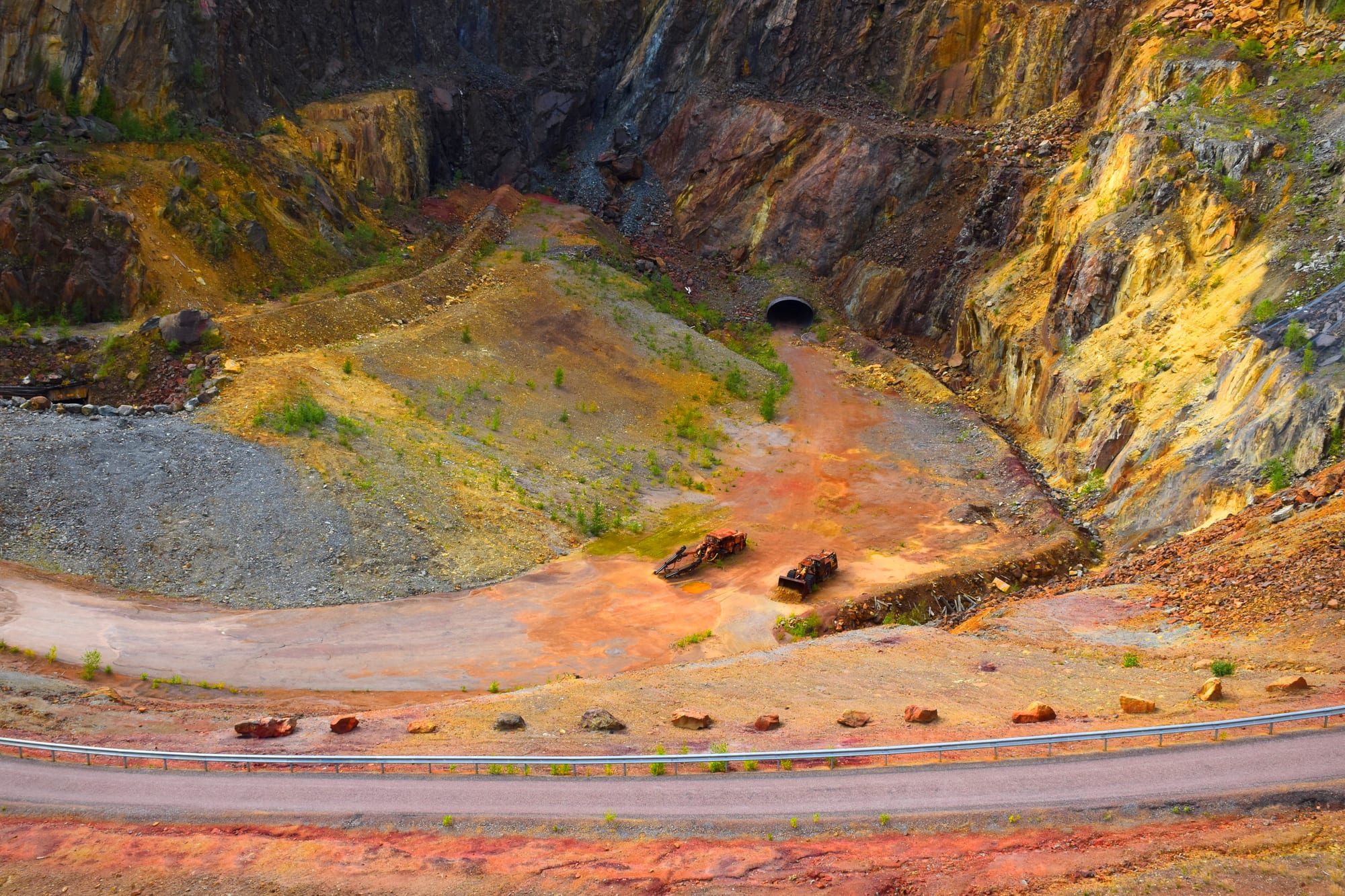
Looking down into the Great Pit at Falun, a deep open crater of yellow, grey and rust-red rock with a tunnel mouth at the bottom

Dalarna, Värmland & Central Sweden, Sweden

Falun

The Great Pit at the Falun copper mine, left by the collapse of 1687. (Helen Simonsson / Wikimedia Commons · CC BY-SA 4.0)

The capital of Dalarna County, built around the Great Copper Mountain, whose mine once supplied as much as two-thirds of Europe's copper and helped pay for Sweden's 17th-century wars. Mining ended in 1992; the mine, the Great Pit and the town are a UNESCO World Heritage Site, and Falun is now a service, university and ski-sport city that gave Sweden its red paint and its favourite sausage.

Neighbourhoods

  • City centre and Stora torget
    • First-time visitors
    • Shopping
    • Historic district

    The cobbled main square, with the 17th-century town hall, Kristine Church and the Art Nouveau Centralpalatset, opens onto pedestrian streets of small shops; the best shopping is along Slaggatan, Holmgatan and Åsgatan. The station is a five-minute walk away.

    Open in Maps
  • The mining side
    • History
    • UNESCO heritage

    West of the Faluån river, the side of town around the copper mine was known as the mining side, where for centuries toxic smoke from the works kept plants from growing. The Great Pit, the mine buildings and the Mining Museum are here.

    Open in Maps
  • The delightful side
    • Quiet and residential
    • Architecture

    Across the river, beyond the reach of the smoke, the mine's wealth built large villas, and the area became known as the delightful side. Today it is a quieter, residential part of the town.

    Open in Maps
  • Lugnet
    • Sport
    • Outdoors
    • Winter

    A large sports complex in the north-east of the town, home to the national ski stadium and its ski jumps, with swimming pools, walking trails and cross-country ski tracks. Dalarna University's campus is close by.

    Open in Maps

Things to do

The copper mine

  • Falun Minelandmark

    The UNESCO-listed copper mine, worked for about a thousand years until 1992, now run as a museum; guided tours take visitors about 65 metres underground, and the copper-rich red mud stains clothes.

    Open in Maps
  • The Great Pitviewpoint

    Stora Stöten, the crater about 95 metres deep and 400 metres across left by the collapse of 1687, which can be seen from the surface for free.

    Open in Maps
  • Mining Museummuseum

    Exhibitions on the history of the mine and of Swedish coins, including some of the largest coins in the world, minerals and scale models of Christopher Polhem's mining inventions.

    Open in Maps

Churches and the old town

  • Kristine Churchlandmark

    The church on the main square, begun in 1642 and ready for use in 1655, whose building was one of the conditions for Falun gaining its town rights.

    Open in Maps
  • Stora Kopparberg Churchlandmark

    The oldest building in Falun, with a nave from the 15th century and parts from the 14th, and more star vaults than any other Swedish church; the miner Fet-Mats is buried in the churchyard.

    Open in Maps
  • Falun Town Halllandmark

    The rådhus on Stora torget, built between 1649 and 1653 as a one-storey building and given a second floor in the 1960s.

    Open in Maps
  • Centralpalatsetlandmark

    An Art Nouveau building on Stora torget, built in 1895–1897, where Selma Lagerlöf lived and wrote The Wonderful Adventures of Nils.

    Open in Maps
  • Dalarnas Museummuseum

    The county museum beside the Faluån river, with exhibitions on the province and its history and a reconstruction of Selma Lagerlöf's 1910 library and study.

    Open in Maps

Lakes, ski jumps and sport

  • Lugnet ski jumpsviewpoint

    The ski jumps at the national ski stadium, Sweden's centre for cross-country skiing and ski jumping, with a café and a view over the town; the stadium has hosted the Nordic World Ski Championships four times, most recently in 2015.

    Open in Maps
  • Lake Runnpark

    The island-studded lake between Falun and Borlänge, popular for boating in summer, canoe and kayak hire, and tour skating on the ice in winter.

    Open in Maps

Short trips from the town

  • Carl Larsson-gårdenmuseum

    Lilla Hyttnäs in Sundborn, the home of the artists Carl and Karin Larsson from 1889 to 1912, whose interiors became famous through his paintings.

    Open in Maps
  • Borlängeattraction

    Falun's close neighbour and friendly rival across Lake Runn, the largest urban centre in Dalarna, with its own airport.

    Open in Maps

Seasonal events

  • Swedish Ski GamesMarch

    A cross-country skiing event at Lugnet, held in Falun since 1959, with World Cup races.

  • Runn Daysmid-February and mid-August

    A winter weekend of tour skating and curling on Lake Runn, and a summer weekend of boat trips and music around it.

  • Falukalasetearly June

    The Falu Party, which turns the town centre into a large market with vendors, carousels and entertainment.

  • Kopparträffenlate July

    The Copper Meet, a gathering of around 500 motorcyclists that includes a procession through town and down into the Great Pit.

  • Sabaton Open Airmid-August

    A metal music festival in the Lugnet area.

  • Falu Autumn Marketlate August or early September

    The höstmarknad, another market that fills the central streets.

Eat and drink

Long-standing places and food districts in Falun. Hours, ratings and directions come from your maps app, always current.

Falun classics

  • Falukorvrestaurant

    Falu sausage, pre-cooked and curved in shape, whose roots go back to the oxen slaughtered for their hides to make the mine's ropes; it has EU Traditional Speciality Guaranteed status and today mixes pork and beef or veal.

    Open in Maps
  • Dagens rätt at lunchtimeneighborhood

    The dish of the day, served on weekdays at lunchtime in most restaurants, is the cheapest way to eat out; one is served in the town hall cellars and moves outdoors in summer.

    Open in Maps
  • Dalarnas Museum restaurantrestaurant

    A restaurant inside the county museum serving local and international food.

    Open in Maps

Experience Falun

History

Copper made Falun. Mining at the Great Copper Mountain, Stora Kopparberget, was a local business by the mid-13th century and possibly as early as the year 1000, and the company that ran it holds a share document dated 1288 and a charter of 1347; it is often called the oldest existing enterprise in the world. A local legend says the copper was found when a goat named Kåre came home with red earth on his horns.

The 17th century was the golden age. The mine produced as much as two-thirds of Europe's copper, Sweden held a near monopoly, and the profits helped to fund the country's wars. Falun received its town privileges in 1641, Kristine Church was built to meet the conditions, and by the middle of the century it was the second-largest town in Sweden, within today's borders, after Stockholm. In 1687, at Midsummer when the miners were off work, the riddled rock collapsed into the Great Pit; nobody was killed. In 1719 miners found the body of Fet-Mats, lost in a cave-in in 1677 and found intact in a water-filled shaft.

Production declined slowly over the following three centuries until the mine closed in 1992. During the Second World War, British and American airmen who landed in Sweden were interned around Falun, staying in hotels and guesthouses with relative freedom. In the 1960s and 1970s the town was modernised and many older buildings were demolished. In 2001 the mine, the town and the mining landscape became a UNESCO World Heritage Site, and the mining company, Stora Kopparberg, is now part of the forest-industry group Stora Enso.

Culture & Customs

The mine's by-products coloured Sweden. Iron and copper residues are still used to make Falu red, the paint used on wooden houses in Sweden, Finland and Norway. Falun also lent its name to falukorv, Falu rågrut crispbread and Falu ättika vinegar.

Dalarna is seen by many Swedes as the essence of the country, and Falun shares in its folk culture: Dala horses, kurbits painting, handicraft shops on Stora torget and Midsummer celebrations. The writer Selma Lagerlöf lived in the Centralpalatset on the main square and wrote The Wonderful Adventures of Nils there; her library and study are reconstructed in Dalarnas Museum. The painter Carl Larsson and the textile artist Karin Larsson made their home at Sundborn nearby.

Winter sport is central to local identity. The ski jumps at Lugnet stand over the town, the stadium has hosted the Nordic World Ski Championships in 1954, 1974, 1993 and 2015, and Falun twice bid unsuccessfully for the Winter Olympics in the 1980s. The bandy club Falu BS has long played in the top division, IBF Falun has had great success in floorball, and the town also hosts a snowboard competition, The Battle.

Daily Life

About 40,000 people lived in the urban area in 2023, out of about 60,000 in the municipality; with Borlänge, its friendly rival, Falun forms a metropolitan area of just over 100,000. It is the county seat of Dalarna and an important service and industrial town, despite the closure of the mine.

Dalarna University, founded in 1977, has a campus in Falun beside the national ski stadium. Stora Enso, the descendant of the old mining company, is still active in the forest industry. Unlike Borlänge, Falun has no dominant out-of-town shopping mall, so the best shopping is in the pedestrian centre; it was named Sweden's city centre of the year in 1998.

The Faluån river divides the town, and the old names for its two halves, the mining side and the delightful side, are still remembered. Daily life follows the seasons: boating on Lake Runn in summer, skating on its ice and skiing at Lugnet in winter, and town festivals from the June market to the autumn fair.

Food

Falun's best-known food is falukorv, the Falu sausage. Its history goes back to the 16th and 17th centuries, when ox hides were used to make ropes for the copper mine and some of the leftover meat was salted and smoked for sausages; a local butcher revived the tradition in the late 19th century. Modern falukorv mixes pork with beef or veal, is pre-cooked so it can be eaten cold, uses only potato flour as a binder, and has EU Traditional Speciality Guaranteed status. It is curved, the result of natural casings.

The town also gave its name to Falu rågrut, a rye crispbread. Everyday eating is Swedish husmanskost, traditional home cooking based on pork, fish, potatoes, root vegetables, cabbage and berries, with pea soup, herring and meatballs with brown cream sauce and lingonberry jam among the classics.

Eating out centres on lunch. Most restaurants serve a dagens rätt, a dish of the day, on weekdays, including one in the town hall cellars that moves outdoors in summer, and there is a restaurant inside Dalarnas Museum. Fika, the coffee break with a pastry, is part of every day, and the café at the ski jumps adds a view over the town.

Planning tools

Budget

Falun is cheaper than the big cities, and parking is free on many streets. Lunch is the best value: most restaurants serve a weekday dish of the day. The Great Pit can be seen for free, while the underground mine tour is the main paid sight. Rooms are scarcer and dearer during big ski events at Lugnet.

Daily Budget Midrange
USD 140–250 (hotel in the centre, restaurant dinners, the mine tour, a hire car for Sundborn)
Daily Budget Shoestring
USD 60–95 (hostel or campsite, self-catering and lunch specials, walking and local buses)

Wear old shoes and trousers for the mine tour, as the red mud stains.

Best Time to Visit

June to August for the mine, the lakes and the summer events, with the warmest days in July. Winter, from mid-November to the end of March, is long but brings skiing at Lugnet, skating on Lake Runn and the Swedish Ski Games in March; March days are often mild.

Suggested Number of Days

One to two days are enough for the mine and the town. Three days leave room for the countryside and lakes around it, and Falun also works as a base for a longer stay in Dalarna.

First Visit
1–2 days
With Surroundings
3 days

Transportation

Falun is small enough to explore on foot, and Dalatrafik runs a local bus network. Cycling works well except in snowy winter. Taxis are pricey and usually have to be phoned for, except at the station rank and in the centre on weekend nights. Parking is free on many streets.

Pay attention to parking signs where a fee applies, as fines are common.

Airport & Station Connections

Falun is about three hours from Stockholm by road or train; many trains from Stockholm need a change at Borlänge. Regional trains run hourly from Gävle, taking about an hour. The station is a five-minute walk from the centre. The nearest airport is at neighbouring Borlänge, about 20 minutes away.

Walkability

The centre, the station and Stora torget are a few minutes apart, and the mine is within walking distance on the west side of town. Lugnet lies on the north-eastern edge. Snow and ice make pavements slippery for much of the winter.

Safety

Sweden is a very safe country for visitors. The practical risks in Falun are icy streets and severe cold in winter, the edges of the Great Pit and old mine workings, and cold water on the lakes.

Keep behind the barriers around the Great Pit, check ice conditions before skating on Lake Runn, and dress in layers in winter. Check current official travel advice before travelling.

Climate

More continental than most of Sweden, being far from large bodies of water. Summers are often warmer than places much further south, with most rain in July and August; winters are cold but variable, as mild spells bring temperatures above freezing.

Summer
warm — July is the warmest month, with an average high of 23°C, and 35.1°C was reached in August 2014
Winter
cold and variable — mild spells above 0°C are common, but the lowest temperature ever recorded is -40°C

Local Customs

Tipping is not customary in Sweden; a bill may be rounded up for good service. In most homes it is customary to remove shoes. Strong alcohol is sold only by the state-owned Systembolaget, which does not serve anyone under 20. The Dala horse, carved since the 17th century and painted with kurbits decoration, is the classic souvenir; the Falu Maiden and the Kåre goat of the mine legend are local alternatives.

Carry identification for bars and Systembolaget, and buy genuine Dala horses at handicraft shops rather than cheap copies.

Common Payment Methods

The currency is the Swedish krona (SEK). Sweden is one of the world's most cashless countries: credit and debit cards are used almost everywhere, as is the Swedish payment app Swish, and businesses that do not take cash at all are common.