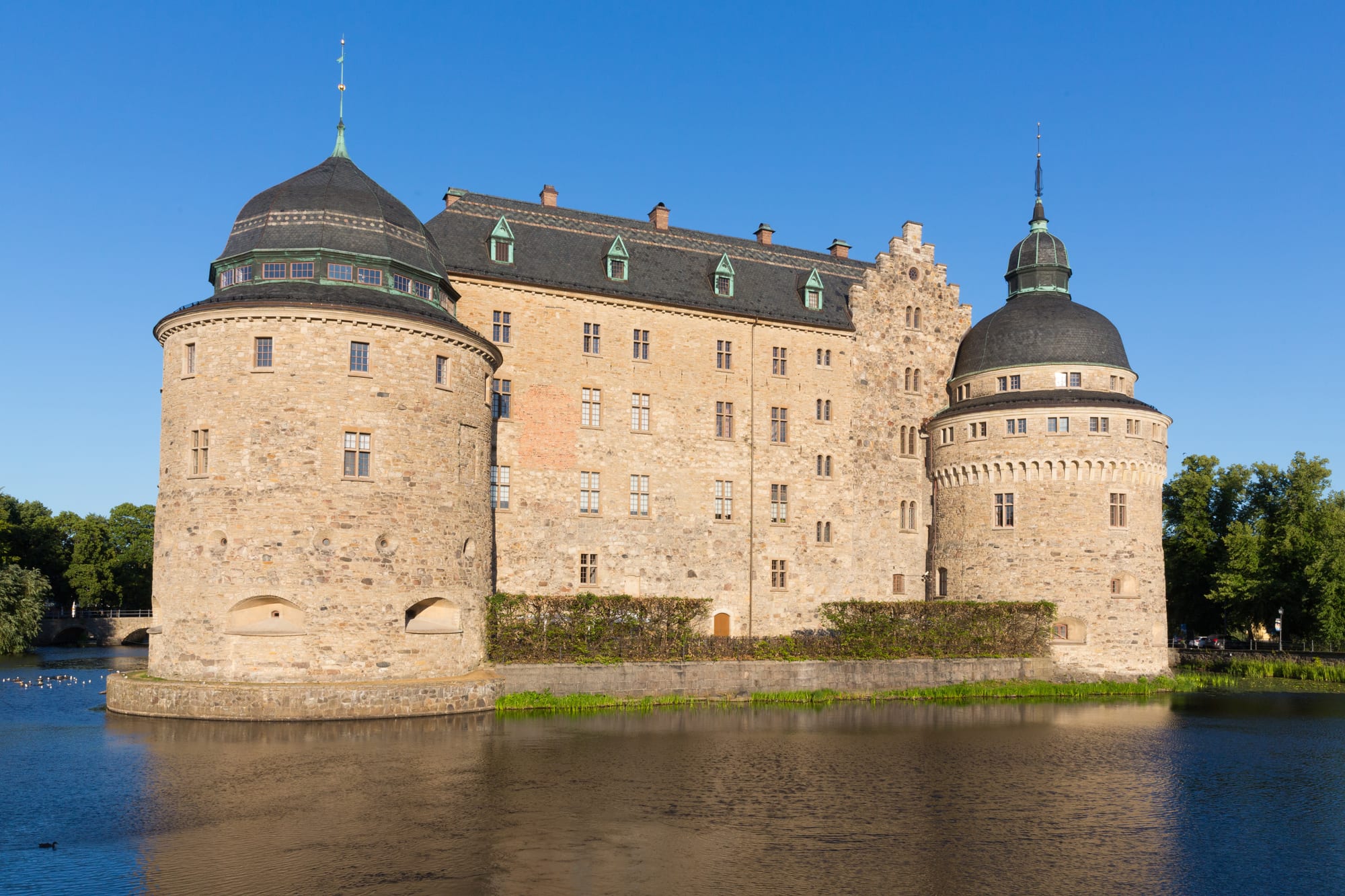
Örebro Castle's stone walls and two domed round towers reflected in calm river water under a clear blue sky

Dalarna, Värmland & Central Sweden, Sweden

Örebro

Örebro Castle on its island in the Svartån, in the evening sun. (Liberaler Humanist / Wikimedia Commons · CC BY-SA 3.0)

An inland city on the Närke plain, built where a bridge crossed the small river Svartån near Lake Hjälmaren. A medieval castle on an island in the river still marks its centre. Once known for shoes and biscuits, Örebro is now a university city and one of Sweden's main logistics hubs, with a wooden-house museum quarter beside its city park.

Neighbourhoods

  • City centre and the castle
    • First-time visitors
    • Shopping
    • Close to public transport

    The compact centre on both banks of the Svartån, with the castle on its island, the medieval St Nicholas Church on Stortorget and the shopping streets Drottninggatan, Köpmangatan and Kungsgatan. Järntorget is a hub for city buses, and the railway station and its bus terminal are a short walk away.

    Open in Maps
  • Wadköping and Stadsparken
    • Historic district
    • Parks
    • Families

    East of the centre along the river, the city park, laid out from the 1860s, adjoins Wadköping, an open-air museum of old wooden houses and workshops, many of them moved here from the old south side of the city. It is the quietest and greenest stretch of the riverbank.

    Open in Maps
  • Eastern riverside and Oset
    • Nature
    • Walking and cycling

    Downstream, where the Svartån enters Lake Hjälmaren, the Oset and Rynningeviken nature reserves lie on either side of the river mouth, with paths through wetlands and meadows on the edge of the city.

    Open in Maps
  • Adolfsberg and the south
    • Quiet and residential
    • Families

    Residential districts south of the centre, with Brunnsparken, the park of Adolfsberg's old spa, and the Gustavsvik water park on the way back towards town.

    Open in Maps

Things to do

Famous landmarks

  • Örebro Castlelandmark

    A castle on an island in the Svartån, grown from a 13th-century defence tower, turned into a Renaissance castle under Charles IX and much rebuilt around 1900; it has been the county governor's residence since 1764.

    Open in Maps
  • St Nicholas Churchlandmark

    The city's medieval church on the main square, begun in the late 13th century largely in limestone, whose Gothic look comes from a long restoration between 1863 and 1900.

    Open in Maps
  • Svampenviewpoint

    A 58-metre mushroom-shaped water tower of 1958 by Sune Lindström, with a lift to a terrace café and exhibition space at the top; a new tower took over its water supply role in 2025.

    Open in Maps

Museums and the arts

  • Wadköpingmuseum

    An open-air museum of old wooden houses and workshops on the bank of the Svartån, opened in 1965 and named after the fictional town in Hjalmar Bergman's stories; its oldest building, the Kungsstugan, dates from the 15th or 16th century.

    Open in Maps
  • Örebro County Museummuseum

    One of Sweden's oldest county museums, begun in 1856, with exhibitions on the history of the county.

    Open in Maps
  • Örebro Konsthallmuseum

    A municipal gallery of contemporary art with free entry and changing exhibitions of sculpture, installation, painting and performance.

    Open in Maps
  • Örebro Concert Hallattraction

    A concert hall built in 1930–32, the home stage of the Swedish Chamber Orchestra, which gives concerts here through the year.

    Open in Maps

Parks and the river

  • Stadsparkenpark

    The city park beside the Svartån, laid out by a local tree-planting society on land bought in 1863, with gardens running into the Wadköping museum quarter.

    Open in Maps
  • Gustavsvikattraction

    A municipal leisure complex just south of the centre, opened as an outdoor pool in 1935, with one of the largest water parks in northern Europe, indoor and outdoor pools and a campsite nearby.

    Open in Maps
  • Karlslund Manorpark

    A manor house owned by the municipality since 1966, set in a protected cultural landscape on the western side of the city, an area much used for outdoor recreation.

    Open in Maps
  • Oset and Rynningevikenpark

    Two nature reserves on either side of the mouth of the Svartån at Lake Hjälmaren, with wetland birdlife and walking paths.

    Open in Maps

Sport

  • Behrn Arenaattraction

    The football stadium of 1923, officially Eyravallen, home of Örebro SK and holding about 12,600 spectators.

    Open in Maps

Short trips from the city

  • Noraattraction

    A small town chartered in 1643, known for its streets of old wooden buildings and summer boat trips on Lake Nora.

    Open in Maps
  • Kilsbergentrail

    A low forested ridge between Närke and Värmland, the southernmost reach of the Scandinavian taiga, with plants and wildlife unusual for the latitude.

    Open in Maps

Eat and drink

Long-standing places and food districts in Örebro. Hours, ratings and directions come from your maps app, always current.

Food halls and the centre

  • Örebro Saluhallmarket

    A modern food hall on Kungsgatan with a range of separate restaurants and counters under one roof.

    Open in Maps
  • Restaurants around Stortorgetneighborhood

    The long main square beside Drottninggatan, close to the castle, with restaurants on and around it.

    Open in Maps

Cafés

  • Café at the top of Svampencafe

    A café on the terrace of the old water tower, with views across the city and the plain.

    Open in Maps

Experience Örebro

History

The name Örebro means the bridge over the gravel bank: a crossing of the small river Svartån, a few kilometres above its mouth in Lake Hjälmaren, on the Närke plain. The place was a natural meeting point for trade in the Middle Ages, is mentioned in writing in the 13th century, and had received its royal charter and town privileges by 1404. A defence tower built on an islet in the river in the latter half of the 13th century grew into a fortress, and under the Vasa kings it became a Renaissance castle; it has been the seat of the county governor since 1764 and was extensively rebuilt around 1900. The castle still divides the town into a northern and a southern half.

Örebro's central position made it a meeting place for the realm. A church synod held here in 1529 took important steps in the Swedish Reformation, and at the national diet of 1810 the French marshal Jean-Baptiste Bernadotte was elected crown prince, founding the present royal dynasty.

The town stayed small until the second half of the 19th century, when it grew quickly as the centre of Sweden's shoe industry; a biscuit factory followed in 1896, and Örebro became known as a city of shoes and biscuits. The closure of both industries in the late 1960s and 1970s brought a serious crisis, but logistics, public services, a university hospital and the university — given full university status in 1999 — rebuilt the economy. On 4 February 2025 a shooting at the Campus Risbergska adult education centre killed ten people, the deadliest mass shooting in Swedish history.

Culture & Customs

Music is a strong part of Örebro's identity. The Swedish Chamber Orchestra, under that name since 1995, plays in the concert hall of 1930–32, and the city has an unusually large rock and metal scene: the punk band Millencolin, who called one album Pennybridge Pioneers after a joking English translation of the city's name, the grindcore band Nasum, and rock groups such as Smash Into Pieces, Truckfighters, Blues Pills and Witchcraft all come from here. The writer Hjalmar Bergman, a banker's son from Örebro, set many stories in a fictional town called Wadköping, whose name now belongs to the open-air museum by the river.

Sport fills the calendar. Örebro SK, the main football club, plays at Behrn Arena, while KIF Örebro play in the top women's league and Örebro HK in the Swedish Hockey League. Bandy, volleyball, American football and the speedway team Vikingarna all have followings, and the Gustavsvik water park draws families from far beyond the city.

Everyday manners follow the Swedish pattern of reserve, punctuality and consensus. A public art trail along the lower Lillån and a scale model of the solar system, stretched over two and a half kilometres from a sun on Olof Palmes torg to Neptune on the Svampen water tower, show the city's taste for art in public space.

Daily Life

About 129,000 people lived in the urban area of Örebro in 2023, making it the seventh-largest city in Sweden. Its position on the main road and rail routes between Stockholm, Oslo and Gothenburg has made it one of the country's largest inland logistics and distribution centres, and many residents work in the public sector, at the university hospital or at Örebro University, which has around 16,000 students.

The centre around the castle and the main square is a shopping district with large malls and pedestrian streets, and most residents live in suburbs of flats and houses spread over the flat plain, connected by city buses and cycle paths. Summer life moves outdoors to the city park, Karlslund and the Gustavsvik pools, while winter brings ice hockey and bandy.

Recent years have brought change and grief. In 2025 the 1958 Svampen water tower handed its role to a new tower, Lyra, on the outskirts, and the school shooting of February 2025 shook the city. Örebro is considered one of the Swedish cities most vulnerable to flooding: summer cloudbursts over its flat centre caused several floods in the record wet summer of 2023.

Food

Örebro's food is everyday Swedish husmanskost — traditional home cooking from local ingredients such as pork, fish, potatoes, root vegetables and berries. Pea soup, pickled and fried herring, and meatballs with a brown cream sauce and tart lingonberry jam are typical, and many restaurants serve a modernised version of these classics. On weekdays the cheapest cooked meal is dagens rätt, the dish of the day served at lunchtime.

The city's own food history is in biscuits: the Örebro biscuit factory, founded in 1896, was one of the industries that defined the town until it closed in the 1970s. Coffee with a sweet bun, cake or biscuit — fika — remains a daily ritual, and Örebro Saluhall on Kungsgatan gathers several small restaurants and counters in one modern food hall.

From elsewhere in Örebro County comes Kopparberg cider, made by a family-owned brewery founded in 1882 in the small mining town of Kopparberg, in Bergslagen. Strong beer, wine and spirits are sold only through the state Systembolaget shops.

Planning tools

Budget

Örebro is cheaper than Stockholm or Gothenburg. Food halls, lunch specials and the many free things — the castle grounds, the city park, Wadköping's lanes and the nature reserves — keep costs down. Restaurant dinners and drinks are the main expense.

Daily Budget Midrange
USD 140–280 (central hotel, restaurant dinners, museum and castle tours, trains)
Daily Budget Shoestring
USD 60–95 (hostel bed, supermarket food and weekday lunch specials, city buses or a hired bike)

Look for 'dagens rätt', the weekday lunch special, for the cheapest cooked meal of the day.

Best Time to Visit

Late spring to early autumn, when the city park, the riverbanks and Karlslund are at their best and outdoor pools open at Gustavsvik. Winters are cold but often without lasting snow in town; there is downhill skiing at Storstenshöjden nearby when there is snow, and the indoor water park works all year.

Suggested Number of Days

One or two days covers the centre, the river and the museums. Three or four allow time for the nearby small towns and the forested hills west of the city, which are easier with a car or careful use of regional buses.

First Visit
1–2 days
With Surroundings
3–4 days

Transportation

The centre is small and walkable, and a network of city buses serves the rest of the city; almost all city and regional buses stop at the Resecenter beside the railway station, and Järntorget is another bus hub. Bicycles can be rented through the municipality. The E20 and E18 motorways and national road 50 meet at Örebro.

Swedish city buses often accept neither cash nor bank cards on board; buy a ticket or the regional electronic travel card before boarding.

Airport & Station Connections

Örebro Central station lies on the Mälaren Line and the Western Main Line, and nearby Hallsberg is one of the country's main rail junctions, so trains connect the city with most of Sweden. Stockholm is about 200 km away. Long-distance buses run to the major cities. Örebro Airport, 10 km south-west of the city, is a small airport with few passenger flights, many of them seasonal charters.

Walkability

The city centre is easily explored on foot: the castle, the main square, the shopping streets, the city park and Wadköping all lie along a short stretch of the Svartån. A riverside path continues east towards the nature reserves at Lake Hjälmaren. Pavements can be icy in winter.

Safety

Sweden is a very safe country for visitors. Örebro is not a dangerous city, and ordinary care with belongings in the centre and at night is enough. The practical hazards are seasonal: ice on pavements in winter and flooding in low-lying streets after heavy summer storms.

Dress for winter conditions and keep 112 in mind as the emergency number. Check current official travel advice before travelling.

Climate

A humid continental climate, made milder by nearby water and the Gulf Stream. Summers are warm, and summer downpours can flood low-lying streets in the flat centre; winters are cold, with hard frosts most years, though the town is often without snow cover for long periods.

Summer
warm — July highs average around 23–24°C and occasionally pass 30°C; nights around 12°C
Winter
cold — January highs average just above 0°C and lows around -5°C, with frosts near -20°C almost every winter

Local Customs

Tipping is not customary in Sweden; rounding up the bill is usual for good service, and 5–10 per cent only for exceptional service. Taxi drivers do not expect tips. Fika, the coffee break with a pastry, is a daily habit, and the weekday lunch special is when many people eat out. Swedes value punctuality and personal space.

Drinks stronger than 3.5 per cent are sold only at the state Systembolaget shops, which do not serve anyone under 20 and ask young-looking customers for identification.

Common Payment Methods

The currency is the Swedish krona (SEK). Sweden is one of the world's most cashless countries: most stores, restaurants and bars accept all major credit cards, contactless phone payments work where the reader shows the icon, and businesses that do not accept cash are common. The Swish app needs a Swedish bank account, and a few small vendors take only Swish or cash, so a small amount from an ATM can be useful.