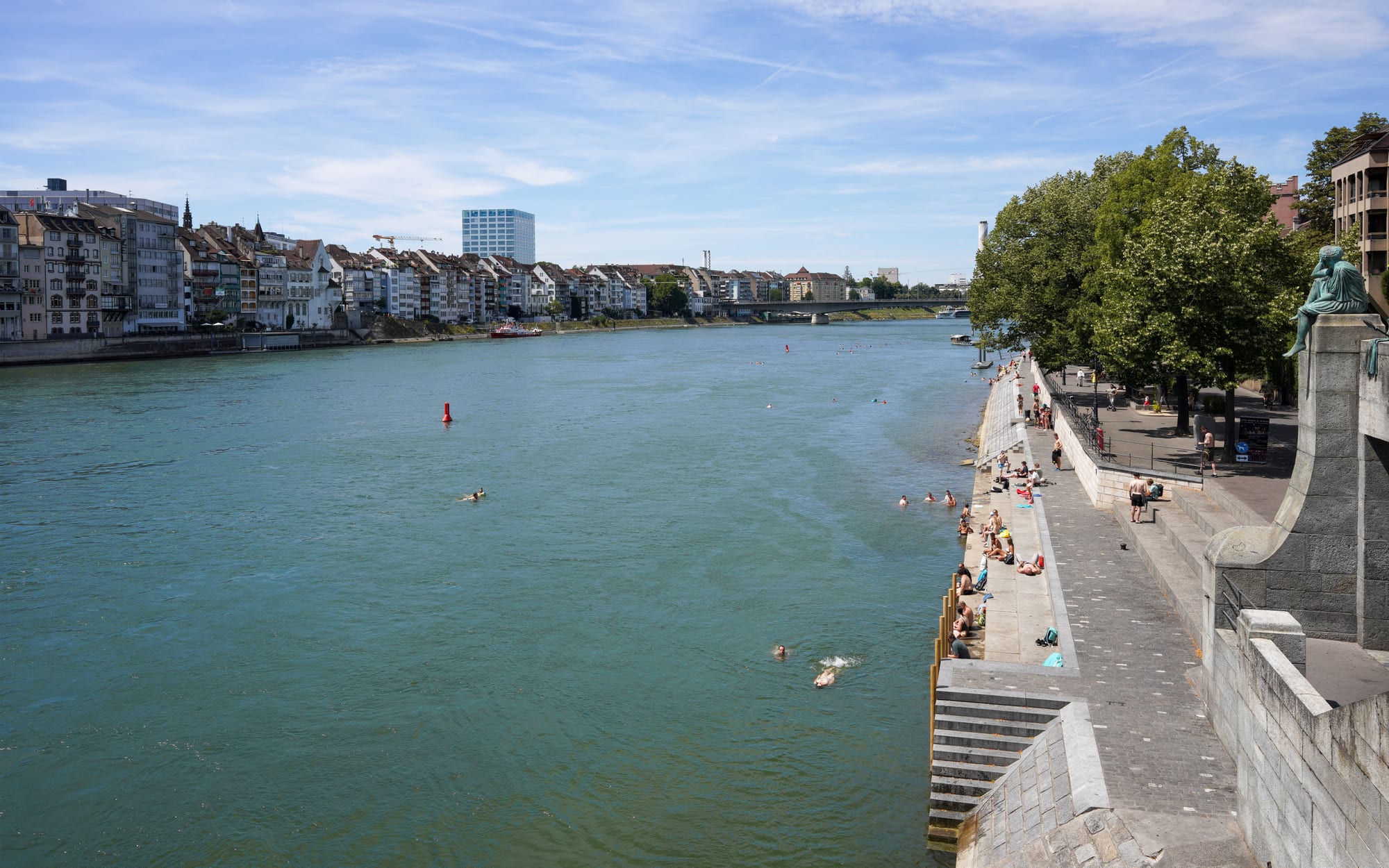
Swimmers in the green Rhine below stone steps where people sunbathe, with rows of old houses along the far bank

Zurich, Basel & Northern Switzerland, Switzerland

Basel

Swimmers and sunbathers on the Rhine in Basel, seen from beside the Middle Bridge. (WikiEuropian / Wikimedia Commons · CC BY-SA 4.0)

Switzerland's third-largest city, on the Rhine where the Swiss, French and German borders meet. A prince-bishop's city that founded the country's oldest university and gave refuge to Erasmus and Holbein, it grew rich on trade, printing and chemistry and is now the home of Novartis and Roche, Art Basel and a carnival listed by UNESCO.

Neighbourhoods

  • Grossbasel Old Town
    • First-time visitors
    • Historic district
    • Museums

    The larger part of the city, on the left bank of the Rhine, with the red sandstone Minster on its terrace above the river, the Marktplatz and its painted town hall, and steep lanes such as the Spalenberg leading up to old gates. Most of the museums and shopping streets are here.

    Open in Maps
  • Kleinbasel
    • Nightlife
    • Riverside life
    • Trade fairs

    The smaller part of the city on the right bank, which grew up around the bridgehead of the first Rhine bridge. Its riverside promenade fills with swimmers and sunbathers in summer, it holds much of the city's nightlife, and the Messe Basel exhibition centre and the German railway station are here.

    Open in Maps
  • St. Johann
    • Local life
    • Riverside life

    A quarter in the industrial north of the city on the left bank, bordered by France and the Rhine, once home to the St. Johann Rhine port.

    Open in Maps
  • Gundeldingen
    • Close to public transport
    • Local life

    A quarter in the south of the city behind the main SBB station, set apart from the rest of Basel by the railway tracks and laid out on an almost chessboard grid of parallel streets.

    Open in Maps

Things to do

Famous landmarks

  • Basel Minsterlandmark

    The red sandstone cathedral with two slim towers and a coloured tile roof, rebuilt after the earthquake of 1356, standing on a terrace high above the Rhine.

    Open in Maps
  • Basel Town Halllandmark

    The 500-year-old town hall with its red sandstone facade, dominating the Marktplatz at the heart of the old town.

    Open in Maps
  • Middle Bridgelandmark

    The bridge on the oldest bridge site across the Rhine between Lake Constance and the North Sea, first recorded in 1223 and linking Grossbasel with Kleinbasel.

    Open in Maps
  • Spalentorlandmark

    One of three surviving gates of the outer city walls, on the west side of the old town, regarded as one of the most beautiful gates in Switzerland.

    Open in Maps

Museums

  • Kunstmuseum Baselmuseum

    Generally considered the most important art museum in Switzerland, with the oldest public art collection in the world, which goes back to the Amerbach Cabinet bought by the city in 1661, and the largest collection of works by the Holbein family.

    Open in Maps
  • Museum Tinguelymuseum

    A museum beside the Rhine, designed by Mario Botta, with the world's largest collection of the work of Jean Tinguely, including his large kinetic sculptures.

    Open in Maps
  • Fondation Beyelermuseum

    In neighbouring Riehen, the collection of the art dealer Ernst Beyeler in a museum designed by Renzo Piano.

    Open in Maps
  • Vitra Design Museummuseum

    Just over the German border in Weil am Rhein, a design museum on a campus with buildings by Zaha Hadid, Tadao Ando and other architects.

    Open in Maps

The Rhine and parks

  • Rhine ferriesattraction

    Small ferry boats hung from a steel rope and pushed across the river by the current alone, one of them below the Minster.

    Open in Maps
  • Swimming in the Rhineattraction

    In summer people float downstream through the city with their belongings in waterproof bags, and the annual Basel Rhine Swim draws thousands.

    Open in Maps
  • Zoo Baselpark

    Switzerland's first zoo, opened in 1874 on the southern edge of the city near Binningen.

    Open in Maps

Short trips from the city

  • Augusta Rauricaattraction

    The ruins of a Roman colony east of the city, with a theatre and a museum.

    Open in Maps

Seasonal events

  • Basel Carnival (Fasnacht)February or March, from the Monday after Ash Wednesday

    Switzerland's biggest carnival, listed by UNESCO since 2017, which starts at exactly 4 a.m. with the Morgestraich and lasts 72 hours.

  • Art Basellate June

    The art fair founded in the city in 1970, held over a week at the Messe Basel and around the city.

  • Basel Rhine Swimsummer, the first Tuesday after the school holidays

    A mass swim held every year since 1980, when participants swim or float down the Rhine from the banks by the Minster; numbers range from a few hundred to several thousand.

  • Herbstmesseautumn

    The autumn fair, with rides, booths and food on several squares including the Messeplatz, the Barfüsserplatz and the Münsterplatz.

Eat and drink

Long-standing places and food districts in Basel. Hours, ratings and directions come from your maps app, always current.

Basel classics

  • Basler Läckerlicafe

    The city's hard spice biscuit of honey, hazelnuts, almonds, candied peel and kirsch, glazed with sugar and cut into rectangles, sold all year.

    Open in Maps
  • Mehlsuppe and Zibelewaierestaurant

    The carnival foods served in the early hours of Morgestraich: a flour soup and an onion tart.

    Open in Maps

Food districts and markets

  • Marktplatz marketmarket

    The morning market on the square in front of the town hall, selling mostly local organic produce from Monday to Saturday.

    Open in Maps
  • Kleinbaselneighborhood

    The right bank of the river, with bars, restaurants and riverside spots that are busiest on summer evenings.

    Open in Maps
  • Spalenberg and the old town lanesneighborhood

    The hilly Spalenberg and the little lanes off it such as Heuberg and Nadelberg, with small original shops.

    Open in Maps

Experience Basel

History

Basel grew on a hill above a bend of the Rhine, and its bishops ruled it as a prince-bishopric from the 11th century. In 1225 the first bridge was built across the river, on the site of today's Middle Bridge, and the settlement of Kleinbasel formed around its far end. The city suffered badly in the 14th century: in 1349 dozens of its Jews were burned in the Basel massacre, and the earthquake of 1356 destroyed much of the city and the castles around it.

In the 15th century Basel became the focus of western Christendom during the Council of Basel of 1431–1449. Pope Pius II endowed its university in 1459, and it opened in 1460 as the oldest university in Switzerland, where Erasmus and Paracelsus later taught; printers such as Johann Froben made the city a centre of humanist publishing. On 9 June 1501 Basel joined the Swiss Confederation as its eleventh canton, and its reputation for tolerance made it a refuge for the Holbein family and, later, for figures such as Friedrich Nietzsche.

A commercial hub since the Renaissance, the city became a centre of the chemical and pharmaceutical industries in the 20th century, and they still dominate it. In 1967 the citizens voted to buy Picasso paintings at risk of leaving the Kunstmuseum, making Basel the first city where a popular vote decided to acquire art for a public collection. The Roche towers, the first designed by Herzog & de Meuron and the second opened in 2022 as the tallest building in Switzerland, now mark the skyline.

Culture & Customs

Basel is a city of museums — some forty across the canton, an unusual number for its size — led by the Kunstmuseum, the Fondation Beyeler and the Museum Tinguely. Art Basel, founded here in 1970, brings the international art world to the Messe every June and has added fairs in Miami Beach, Hong Kong, Paris and Qatar.

The great event of the year is Fasnacht, the biggest carnival in Switzerland and on UNESCO's list of intangible cultural heritage since 2017. It begins on the Monday after Ash Wednesday at precisely four in the morning with the Morgestraich, when masked cliques march through the darkened old town with piccolos, drums and lanterns, and it ends exactly 72 hours later. Its brass bands, the Guggemusige, are especially at home in the working-class streets of Kleinbasel.

The city's speech is Baseldytsch, and its identity is that of a border town and humanist city facing France and Germany as much as the rest of Switzerland. In summer the Rhine becomes a public space: people swim and float through the city, and the riverbanks and the small cable ferries are part of daily life. FC Basel carries the city's colours in football.

Daily Life

About 178,000 people live within the city limits, making Basel the third most populous city in Switzerland, and the canton of Basel-Stadt had about 202,000 residents in 2021, more than a third of them foreign nationals. The wider urban area spreads across three countries and holds around 900,000 people, and many workers commute in from France and Germany.

Basel is Switzerland's main centre for the pharmaceutical industry, home to Novartis and Roche, and the life sciences dominate its economy, alongside the university, the Messe and logistics. The Basel Committee on Banking Supervision also sits here. Most people work in services, and about half of the working population travels to work by public transport.

The city is divided by the Rhine into Grossbasel on the left bank and Kleinbasel on the right. Daily rhythm follows the river in summer, when people head to the banks after work, and the calendar is set by Fasnacht, the autumn fair and the trade fairs that fill the hotels.

Food

Basel's best-known speciality is the Basler Läckerli, a hard spice biscuit made of honey, hazelnuts, almonds, candied peel and kirsch, baked in a thin layer, glazed with sugar while still hot and cut into rectangles. The recipe goes back to the city's spice merchants several centuries ago, and it is sold all year round.

Fasnacht has its own food. During the Morgestraich, restaurants stay open in the early hours and serve Mehlsuppe, a flour soup, and Zibelewaie, an onion tart, to warm the crowds. Every morning except Sunday the market on the Marktplatz sells mostly local organic produce in front of the town hall.

Eating out tends to follow the geography of the city: traditional guild-house restaurants and cafés in the old town around the Marktplatz and the Spalenberg, and much of the nightlife in Kleinbasel across the river. Because the city sits on two borders, euro notes are taken in some places as well as francs.

Planning tools

Budget

Basel is among the most expensive cities in the world, and hotel rooms become scarce and much dearer during big trade fairs, above all Art Basel in late June. Supermarket food, the free riverbank and the city's many inexpensive sights bring costs down.

Daily Budget Midrange
USD 300–550 (city hotel, restaurant dinners, museum tickets, a ferry ride across the Rhine)
Daily Budget Shoestring
USD 120–190 (hostel bed, supermarket meals and snacks, trams)

Hotels in Basel often include a local transport card; check trade-fair dates before booking, when prices rise sharply.

Best Time to Visit

June to September, when the Rhine bank becomes the city's beach and people swim and float through the centre; late June brings Art Basel and crowds. Fasnacht in February or March is the city's great event, the autumn fair fills the squares later in the year, and December has a Christmas market.

Suggested Number of Days

Two days are enough for the old town, the river and a couple of museums. Three or four allow time for the museums on the edges of the city and across the borders, and for the Roman ruins nearby.

First Visit
2 days
With Surroundings
3–4 days

Transportation

Trams and buses cover the city. Basel SBB is the main station, with trains across Switzerland and to France, and Basel Badischer Bahnhof in Kleinbasel serves German trains. Four small reaction ferries cross the Rhine, and a car is not needed.

Carry a passport or identity card for trips to the French or German side, which are only minutes away.

Airport & Station Connections

EuroAirport Basel–Mulhouse–Freiburg lies 3.5 kilometres north-west of the city, entirely on French soil but with a Swiss customs sector and a customs-free road into Switzerland. Direct trains connect Basel SBB with Zurich, Bern and other Swiss cities, and with France and Germany.

Walkability

The old town is compact and walkable, though its lanes climb steeply from the river to the Minster and the Spalenberg. Several bridges and the ferries make crossing between Grossbasel and Kleinbasel easy, and the riverside promenades on both banks are the pleasant way to cover ground.

Safety

Switzerland is very safe, with low crime. Pickpocketing occurs at the main station and in the crowds of Fasnacht and the big fairs. The Rhine is the main hazard: its current is strong, and boats use the river through the city.

Swim in the Rhine only at marked spots and never after drinking, keep away from moored boats and bridge piers, and keep bags close at Fasnacht. Check current official travel advice before travelling.

Climate

Mild and sunny for Switzerland, as the city sits in the Rhine valley open to air from the Burgundian Gate, with less autumn fog than the plateau. The annual mean temperature is about 11°C.

Summer
warm — July averages about 20°C over day and night, with around 59 days a year reaching 25°C and about 14 reaching 30°C
Winter
cool — January is the coldest month, averaging about 2°C over day and night

Local Customs

By law a service charge is included in the bill, so tips are modest and never required. The local dialect is Baseldytsch, and the city is proud of its humanist, border-town identity. Fasnacht is the great event of the year, and the cliques march through the old town with piccolos and drums.

During the Morgestraich the city lights are switched off; keep clear of the marching cliques and their lanterns.

Common Payment Methods

The currency is the Swiss franc. Switzerland is more cash-oriented than many European countries, but credit and debit card payments are common and it is easy to go for days without needing cash. Some supermarkets, restaurants and ticket counters accept euro notes (but not coins). ATMs accept foreign cards, and money can be exchanged at all train stations.