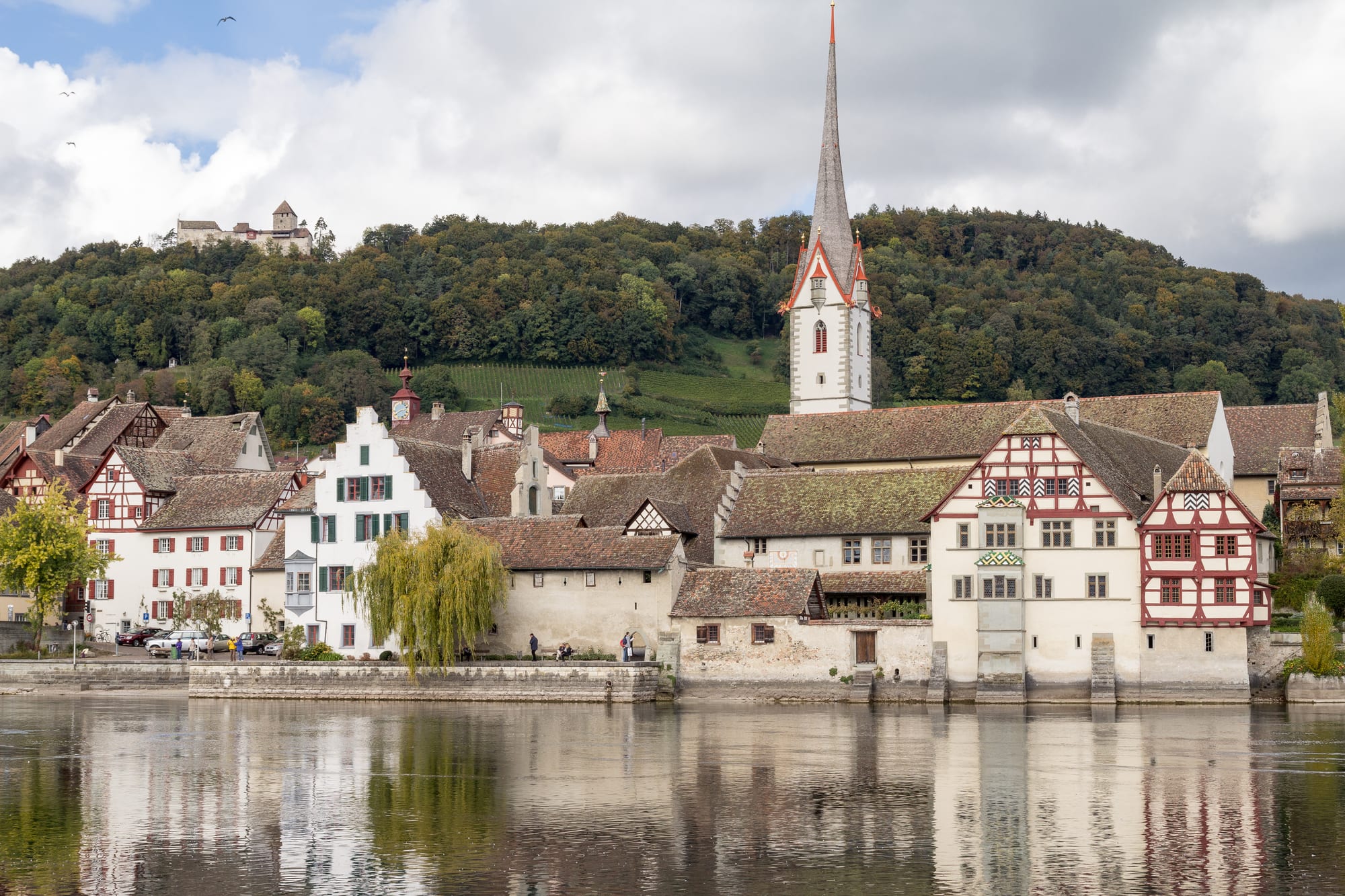
Half-timbered and whitewashed houses and a tall church spire along a calm river, with vineyards, wooded hills and a hilltop castle behind

Switzerland

Zurich, Basel & Northern Switzerland

Stein am Rhein on the Rhine, with St. Georgen Monastery by the water and Hohenklingen Castle on the hill above. (JoachimKohler-HB / Wikimedia Commons · CC BY-SA 4.0)

The German-speaking north and north-east of Switzerland, from Basel on the Rhine and the folded Jura ridges to Zurich, Lake Constance and the green hills of Appenzell — the country's economic engine, home to its largest city, its pharmaceutical industry and its oldest university, with the French-speaking canton of Jura at its western edge.

Explore Zurich, Basel & Northern Switzerland

History

The Rhine was Rome's frontier here. The colony of Augusta Raurica, east of modern Basel, and the legionary camp of Vindonissa at Windisch in Aargau guarded the crossing, and after the empire the Alemanni settled the land and gave it the German speech it still has. The Irish monk Gallus founded a hermitage in the 7th century that became the Abbey of St. Gall, one of the great scriptoria of early medieval Europe, while Basel grew into a bishop's city on the river.

The towns joined the Confederation one by one: Zurich in 1351, Glarus and Zug in 1352, Basel and Schaffhausen in 1501, and Appenzell in 1513. Aargau, the home of the Habsburg castle that gave the dynasty its name, was seized from the Habsburgs by the Confederates in 1415. In 1460 Basel founded Switzerland's first university, where Erasmus later worked, and from 1519 Huldrych Zwingli preached reform from Zurich's Grossmünster, turning the city into a Protestant power. Appenzell split along religious lines in 1597 into Catholic Innerrhoden and Protestant Ausserrhoden.

Industry arrived early. St. Gallen's embroidery, woven and later stitched by machine, was once among Switzerland's largest exports; Winterthur built locomotives and engines; Basel's dye works grew into the chemical and pharmaceutical giants. Basel canton split into city and countryside in 1833 after armed conflict, and in 1979 the French-speaking, largely Catholic north of the canton of Bern became the new canton of Jura after a long separatist campaign.

Culture & Customs

This is German-speaking Switzerland at its most varied. Züritüütsch, Baseldytsch and the dialects of St. Gallen and Appenzell differ enough to be recognised in a sentence, and the canton of Jura, with Delémont as its capital, speaks French. The old rivalry between Zurich and Basel — banking against chemistry, the Protestant merchant city against the humanist border town — is kept alive in football and good-natured insult.

Custom runs deep. Basel's Fasnacht, listed as UNESCO intangible heritage, begins at four in the morning with the Morgestraich, when the city lights go out and masked cliques march with piccolos, drums and painted lanterns for three days. Zurich's Sechseläuten in April ends with the guilds riding round a burning snowman, the Böögg, whose exploding head is said to forecast the summer. In Appenzell Innerrhoden and Glarus, citizens still vote by show of hands at the open-air Landsgemeinde; Innerrhoden was the last canton to give women the cantonal vote, and did so only after a federal court ruling.

Appenzell also keeps its folk culture close: string music, yodelling, the ornate costumes of the cattle descent, and naïve paintings of the Alpfahrt on wood. On New Year's Eve in the old calendar, masked Silvesterchläuse wear bells and headdresses through the villages of Ausserrhoden.

Daily Life

Zurich has about 430,000 people and a metropolitan area several times that; Basel has about 175,000 and Winterthur about 120,000, while St. Gallen is the main city of the east. Most of the rest of the region is a patchwork of small towns, commuter villages and orchards, running up to the dairy farms of Appenzell and the forests and pastures of the Jura.

Zurich is the country's financial centre, home to the big banks, the stock exchange, insurers and ETH Zurich, one of Europe's leading technical universities. Basel's economy rests on Novartis and Roche and on logistics along the Rhine, where the Swiss river port ships goods to the North Sea. Zug has turned low taxes into a base for commodity traders and cryptocurrency firms, and the Jura still makes watch parts and precision tools in small workshops.

The day starts early and trains carry hundreds of thousands of commuters into Zurich. After work, summer life moves to the water: swimming in the Limmat, floating down the Rhine through Basel with belongings in a waterproof bag, and lake baths on the Zürichsee. Housing shortages and rising rents are the constant political subject in Zurich, Zug and Basel.

Food

The north eats hearty German-Swiss food with strong local signatures. St. Gallen's white veal Bratwurst is grilled and eaten with a bürli roll, and locals insist it needs no mustard. Appenzeller cheese is washed in a secret herbal brine, and the canton's Alpenbitter is a herbal liqueur; the local Biberli is a gingerbread speciality. Glarus makes Schabziger, a hard, pale-green cheese flavoured with blue fenugreek and grated over pasta or bread.

Basel's Läckerli are hard, spiced honey biscuits with candied peel, and during Fasnacht the city eats Mehlsuppe, a brown flour soup. Zug gives its name to the Zuger Kirschtorte, a layered cake soaked in kirsch, the cherry spirit from the orchards around the lake; Solothurn has its hazelnut meringue Solothurner Torte. Thurgau is nicknamed "Mostindien" for its orchards and cider, called Most.

In the canton of Jura, Tête de Moine cheese is shaved into rosettes with a rotating blade, and Damassine is a plum brandy. Wine comes from the vineyards of the Zurich lake shore, Schaffhausen's Klettgau and the Rhine valley of St. Gallen, mostly Pinot Noir, known here as Blauburgunder, and Müller-Thurgau, a white grape named after its Thurgau-born breeder.

Attractions & Natural Wonders

Zurich's Old Town lines both banks of the Limmat, with the Grossmünster, the Fraumünster and its Chagall windows, the Kunsthaus art museum, the Swiss National Museum and the Bahnhofstrasse leading to the lake; the Uetliberg gives the view over city and Alps. Winterthur has fine art collections, and Zug a small lakeside old town. Basel has the red sandstone Münster above the Rhine, the Kunstmuseum, the Fondation Beyeler at Riehen and the Tinguely museum; the ruins and theatre of Augusta Raurica lie a short ride east.

The Rhine Falls at Neuhausen near Schaffhausen, about 150 metres wide and 23 metres high, can be seen from boats that land on the rock in mid-stream. Schaffhausen itself has painted oriel windows and the round Munot fortress, and Stein am Rhein a square of frescoed houses. Lake Constance, shared with Germany and Austria, is lined by Thurgau and St. Gallen towns such as Kreuzlingen, Romanshorn and Rorschach.

St. Gallen's Abbey precinct and library are a UNESCO World Heritage Site. Beyond it, Appenzell's painted main street leads to the Alpstein, with the Säntis cable car from Schwägalp, the Ebenalp and the cliff-hung Äscher inn, and the Seealpsee. Glarus has the Klöntalersee under steep limestone walls.

To the west, Solothurn's Baroque St. Ursus cathedral and old town sit on the Aare below the Weissenstein ridge of the Jura mountains. The canton of Jura offers the medieval town of Saint-Ursanne on the Doubs and the high pastures of the Franches-Montagnes, known for the Freiberger horse.

Cities in Zurich, Basel & Northern Switzerland

Planning basics

Budget

Zurich, Zug and Basel are among the most expensive cities in the world, with city-centre hotel prices to match, especially during trade fairs such as Art Basel in June. Winterthur, St. Gallen, Solothurn and the small towns of Thurgau and the Jura cost somewhat less, and farm stays and simple inns in Appenzell and the Franches-Montagnes are good value by Swiss standards.

Daily Budget Midrange
USD 300–550 (city hotel, restaurant dinners, museum tickets, a cable car or lake boat)
Daily Budget Shoestring
USD 120–190 (hostel, supermarket meals, regional trains and trams)

Hotels in Basel and Zurich often include a local transport card; check trade-fair dates before booking, when prices rise sharply.

Safety

The region is very safe. Pickpocketing occurs at Zurich and Basel main stations and in crowds during Fasnacht and street festivals, and the Rhine and Limmat have strong currents that catch out summer swimmers. The Alpstein has steep, exposed paths where walkers are injured every year.

Swim in the Rhine only at marked spots and never after drinking; keep to marked routes on the Alpstein. Check current official travel advice before travelling.

Climate

Mostly the climate of the Swiss plateau: warm summers, cold grey winters and frequent low fog over the lakes and the Rhine valley in autumn and winter. The Jura heights and the Alpstein are colder and snowier, and the Säntis is one of the windiest and snowiest summits in the country.

Summer
warm, 22–30°C in Zurich and Basel, with thunderstorms; cooler in Appenzell and the Jura
Winter
cold and often foggy, around -2 to 5°C in the lowlands; snow in the Jura and on the Alpstein

Transportation

This is the densest part of the Swiss rail network. Zurich's main station links to Basel, Winterthur, St. Gallen, Schaffhausen, Zug and Solothurn in roughly half an hour to an hour and a quarter, with S-Bahn trains round Zurich and trams in the cities. Appenzell is reached by narrow-gauge train from St. Gallen or Gossau, Lake Constance by train to Romanshorn or Kreuzlingen and by lake boats, and the Jura by regional trains and postbuses.

Zurich airport has its own station with direct trains across the region; a car is unnecessary except for the remoter Jura.

Best Time to Visit

May to September for the lakes, the Rhine and walking in the Alpstein and the Jura, with Zurich's lake baths busiest in July and August. Basel's Fasnacht starts on the Monday after Ash Wednesday, usually in February or March, and Zurich's Sechseläuten falls in April. Autumn brings the apple harvest in Thurgau and cattle descents in Appenzell; December has the Christmas markets of Basel and Zurich.