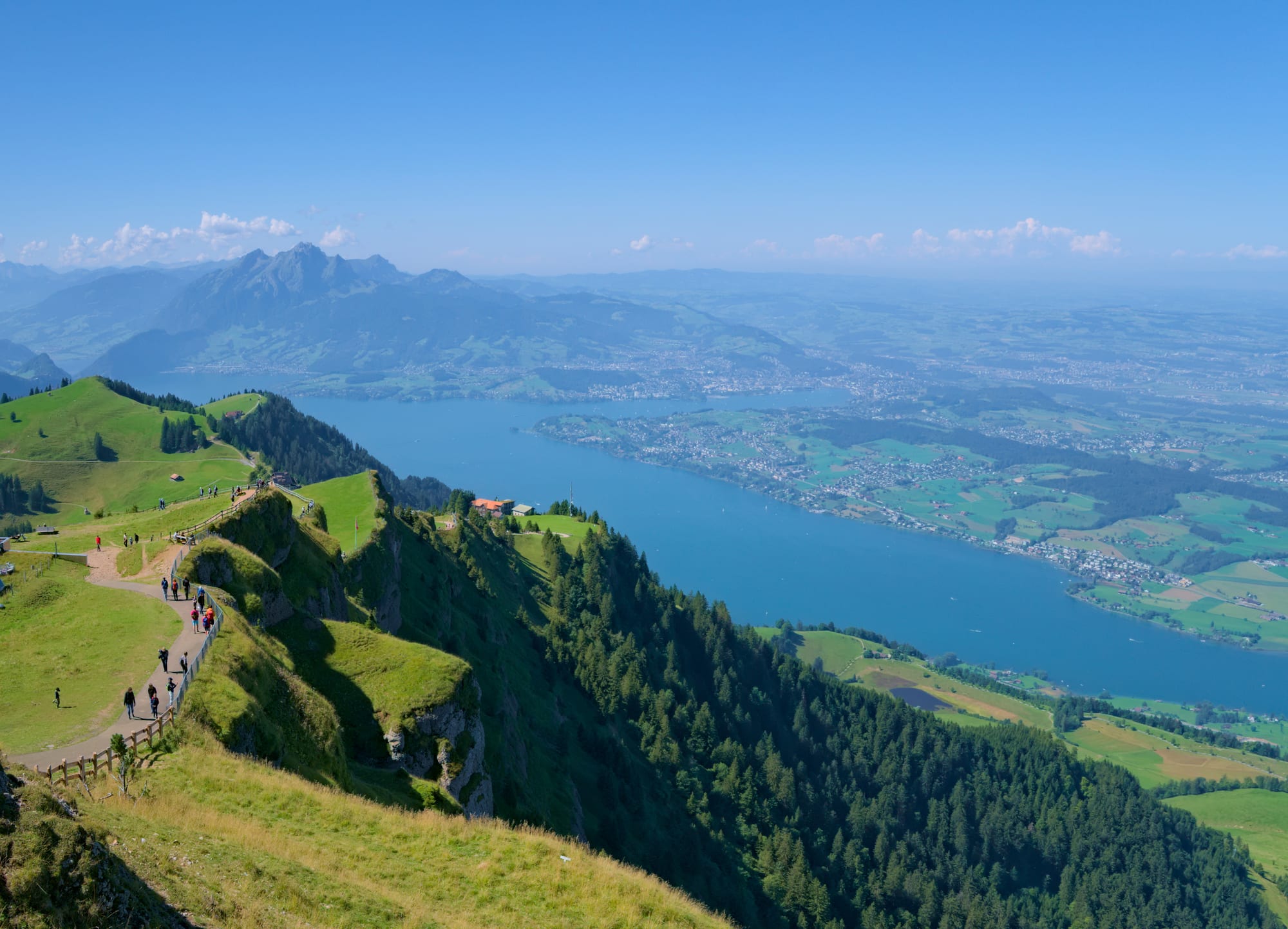
View from a grassy ridge with a walking path down to a long blue lake, a town on the far shore and a jagged mountain behind

Switzerland

Bern, Lucerne & Central Switzerland

Lake Lucerne seen from Rigi Kulm, with the city of Lucerne and Mount Pilatus beyond. (Daniel Kraft / Wikimedia Commons · CC BY-SA 3.0)

The historic core of Switzerland, from the federal capital Bern and the farmland of the Emmental to the Bernese Oberland and the lake cantons around Lucerne where the Confederation was born in 1291 — a region of arcaded old towns, lake steamers and the Eiger, Mönch and Jungfrau.

Explore Bern, Lucerne & Central Switzerland

History

The Confederation began on the shores of Lake Lucerne. The valley communities of Uri, Schwyz and Unterwalden, which controlled the approach to the Gotthard pass, sealed an alliance in 1291; tradition places the oath on the Rütli meadow above the lake, and the legend of William Tell, the crossbowman of Altdorf, grew around the same struggle against Habsburg officials. The peasants beat Habsburg armies at Morgarten in 1315 and at Sempach in 1386, and Schwyz eventually gave its name to the whole country.

Lucerne joined the alliance in 1332 and Bern in 1353. Bern, founded in 1191 by the Zähringen dukes on a loop of the Aare, became the largest city-state north of the Alps, conquering Aargau, and in 1536 Vaud. It turned Protestant in 1528, while Lucerne and the forest cantons remained the Catholic heartland, and the central cantons fought on the losing Catholic side in the Sonderbund War of 1847.

In 1848 Bern was chosen as the federal city, the seat of government. The 19th century also brought the tourists: the English climbers and walkers of the Oberland, grand hotels in Interlaken and Lucerne, and railways up the mountains, culminating in the Jungfraujoch line, opened in 1912. Uri was transformed by the Gotthard rail tunnel of 1882 and by the Gotthard Base Tunnel, opened in 2016. The French-speaking Jura broke away from Bern in 1979, but Bern remains a bilingual canton through Biel/Bienne and the Bernese Jura.

Culture & Customs

Central Switzerland sees itself as the country's original core, and the federal symbols are everywhere: the Rütli, the Tell monument in Altdorf, and the 1291 charter displayed in Schwyz. Bernese are teased for their slow speech and unhurried manner, a reputation they wear comfortably; the Bernese dialect is one of the most distinct in German-speaking Switzerland.

Rural traditions stay strong in the Emmental and the Oberland. Schwingen, Swiss wrestling in sawdust rings, yodelling choirs, alphorns and flag-throwing fill the summer festivals, and the Unspunnen festival near Interlaken is famous for the throwing of a heavy boulder. Hornussen, a team game of striking a puck across a field, is at home in the Emmental. Woodcarving is the craft of Brienz.

Lucerne's Fasnacht is the great Catholic carnival of German-speaking Switzerland, opening before dawn on the Thursday before Ash Wednesday and filling the old town with brass bands playing deliberately off-key Guggenmusik. Catholic pilgrimage is alive at the monastery of Einsiedeln, and Bern's Zibelemärit in November covers the old town in onion garlands.

Daily Life

Bern has about 145,000 people and Lucerne about 85,000; Biel/Bienne, with about 55,000, is the watch town, and Thun is the gateway to the Oberland. The rest of the region is small towns, farming valleys and mountain villages, with Interlaken's few thousand residents hosting far larger numbers of visitors.

Bern is a city of civil servants, federal offices, the parliament and embassies; Biel is home to watchmakers including Swatch, Omega and Rolex, and the Emmental makes cheese. Tourism dominates the Oberland and Lucerne, and the lake cantons have used low taxes to attract companies and wealthy residents. Victorinox makes Swiss army knives in Ibach near Schwyz.

Life is unhurried. In summer the people of Bern float down the Aare past the Federal Palace at lunchtime and after work. Mountain villages follow the farming year, with cows driven up to the alp in June and down in September. Overtourism in Lucerne and Lauterbrunnen, and the future of mountain resorts under climate change, are local talking points.

Food

The Bernese table is famously generous. The Berner Platte is a platter of smoked pork, sausages, tongue and bacon served over sauerkraut, green beans and potatoes. Emmentaler, the large, holed cheese, comes from the Emmental valley, and central Switzerland makes Sbrinz, a very hard, long-aged cheese for grating and shaving.

Lucerne's signature is the Chügelipastete, a large puff-pastry shell filled with veal and mushrooms in cream sauce. In Uri and the high valleys, Älplermagronen and cheese dishes sustain walkers. Fish from Lake Lucerne and Lake Thun, especially perch and whitefish, are served in lakeside restaurants.

Meiringen, in the Haslital, claims to be the birthplace of the meringue, served here with whipped cream. Berner Lebkuchen is a local gingerbread, and the Zibelemärit sells onion tart and onion soup. The region's beer, cider and small-scale wine from Lake Biel and Lake Thun round out the drink.

Attractions & Natural Wonders

Bern's Old Town, a UNESCO World Heritage Site, has long arcades, the Gothic Münster, the Zytglogge clock tower, painted fountains, the Federal Palace, the house on Kramgasse where Einstein lived from 1903 to 1905, and the bear park by the river; the Zentrum Paul Klee holds the painter's work.

Lucerne and its lake form the second centre: the Chapel Bridge, rebuilt after a fire in 1993, the Lion Monument carved into a cliff, the Swiss Museum of Transport, and paddle steamers sailing to Weggis, Vitznau, Brunnen and Flüelen. Mount Pilatus is reached from Alpnachstad by a cogwheel railway with gradients close to 48 percent, and Rigi faces it across the water. Engelberg, with its 12th-century Benedictine abbey, is the base for the Titlis and its revolving cable car.

Interlaken lies between Lake Thun and Lake Brienz. Beyond it, the Jungfrau region has Grindelwald beneath the Eiger north face, Lauterbrunnen's valley of waterfalls including the Trümmelbach Falls inside the rock, car-free Wengen and Mürren, the Schilthorn, and the rack railway to the Jungfraujoch at 3,454 metres, looking down on the Aletsch Glacier. Further east, the Aare Gorge near Meiringen and the Reichenbach Falls, where Conan Doyle sent Sherlock Holmes over the edge, complete the Oberland.

Cities in Bern, Lucerne & Central Switzerland

Planning basics

Budget

The Jungfrau region is the costly part: mountain railway tickets are a major expense, and hotels in Grindelwald, Wengen and Interlaken fill and rise in price in summer and at Christmas. Bern is cheaper than Zurich or Geneva, and the Emmental and the small lake villages of Uri, Schwyz and the two Unterwalden cantons have simpler guesthouses and farm stays.

Daily Budget Midrange
USD 340–610 (hotel, restaurant dinners, a mountain railway or cable car most days)
Daily Budget Shoestring
USD 130–210 (hostel in Interlaken or Lucerne, supermarket meals, half-fare card on trains)

The half-fare card or a regional pass cuts the cost of the Jungfrau, Pilatus and lake-boat excursions; weather-check webcams before paying for a summit trip.

Safety

The region is very safe. The risks are alpine: sudden storms, rockfall and steep paths in the Oberland, glaciers that should never be crossed without a guide, and altitude at the Jungfraujoch. Lakes are cold and the Aare in Bern is fast. Pickpockets work the crowds in Lucerne and Interlaken in summer.

Swim in the Aare only at the known entry and exit points, carry warm layers to the summits, and stay on marked trails. Check current official travel advice before travelling.

Climate

Bern and Lucerne have plateau weather — warm summers, cold and often foggy winters — with Lucerne wetter because it lies against the Alps. The Föhn, a warm, dry wind down the valleys of Uri and the Oberland, can raise temperatures suddenly. The high Bernese Oberland is alpine: snow for much of the year on the summits and year-round ice at the Jungfraujoch.

Summer
warm in the lowlands, 20–28°C; cool in the mountain villages; near or below freezing at the Jungfraujoch
Winter
cold and grey in Bern and Lucerne, around 0°C; reliable snow in Grindelwald, Wengen, Mürren and Engelberg

Transportation

Bern and Lucerne are main rail hubs about an hour apart. Interlaken is reached by train from Bern via Thun, and from there the Bernese Oberland railways climb to Lauterbrunnen and Grindelwald, with rack railways and cable cars above. Lucerne connects by train to Engelberg, by boat and cogwheel railway to Pilatus and Rigi, and by train through Uri to the Gotthard. Wengen and Mürren are car-free.

Lake Lucerne boats and the Brünig line to Interlaken make the Lucerne–Oberland journey part of the trip; leave the car at the valley stations.

Best Time to Visit

June to September for high walking, lake steamers and the mountain railways at full service, with July and August the busiest months at the Jungfraujoch and in Lucerne. December to March is ski season in the Oberland and Engelberg. Lucerne's Fasnacht fills the city before Lent, and Bern's Zibelemärit onion market is held on the fourth Monday of November.