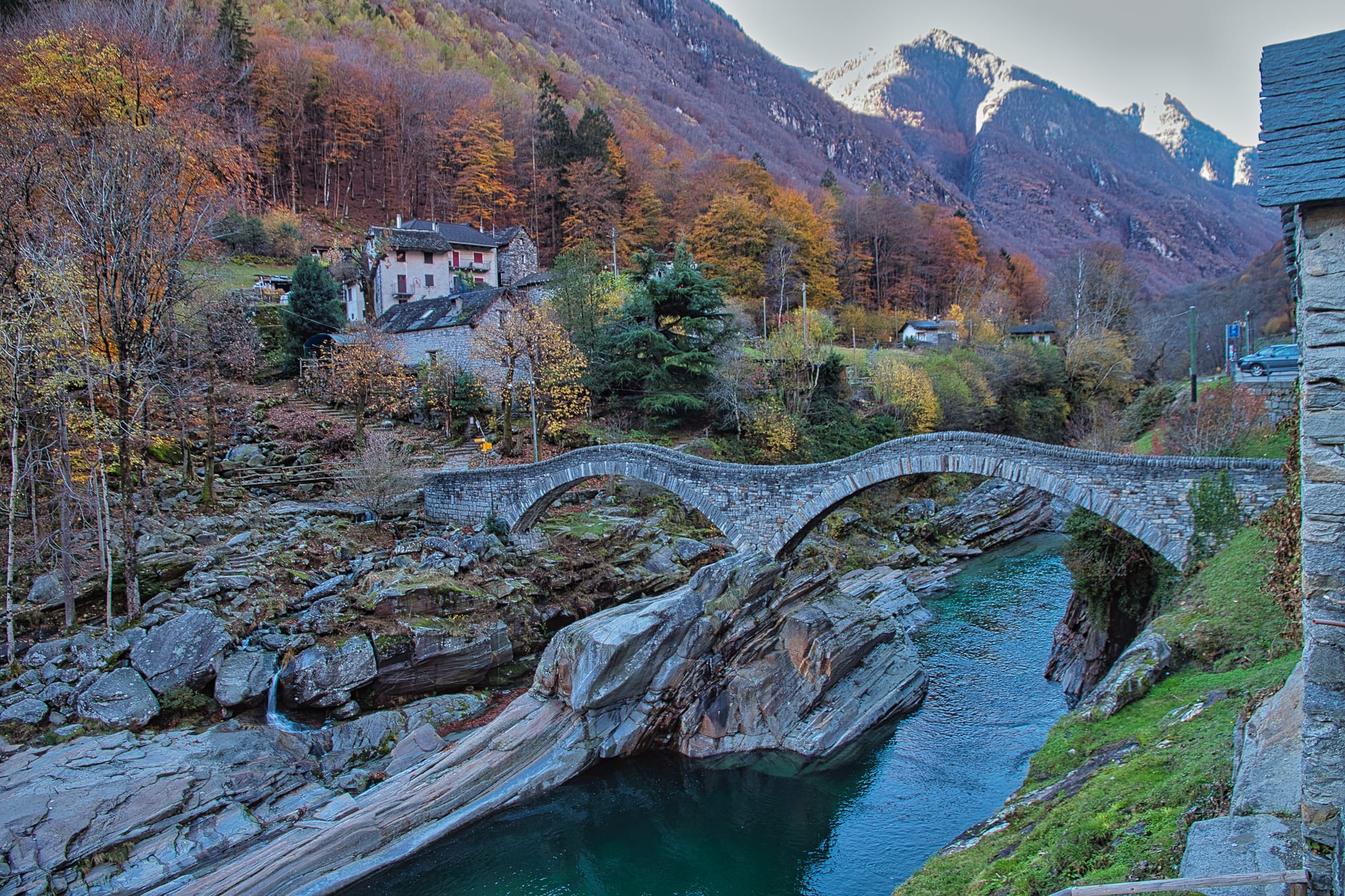
A double-arched stone bridge over a clear green river between smooth grey rocks, with autumn woods and stone houses behind

Switzerland

Ticino

The Ponte dei Salti over the Verzasca river at Lavertezzo. (Martin Thurnherr / Wikimedia Commons · CC BY-SA 4.0)

Switzerland's Italian-speaking canton, south of the Gotthard, running from high granite valleys down to the lakes of Lugano and Maggiore — once a subject land of the Swiss cantons, now a place of lakeside towns, stone villages and grotto taverns where the country turns Mediterranean in climate, language and food.

Explore Ticino

History

The Lepontii, a Celtic people, lived in these valleys before Roman rule, and the region later belonged to Lombard kings, the bishops of Como and the Duchy of Milan. Bellinzona, controlling the roads from the Gotthard, San Bernardino and Lukmanier passes, was fortified by the Dukes of Milan into the chain of three castles that still stand.

The Swiss came from the north. Uri took the Leventina valley in the 15th century and defeated a Milanese army at Giornico in 1478, and around 1500 the central cantons seized Bellinzona and then Lugano, Locarno and the Mendrisiotto. For three centuries Ticino was ruled as a set of subject bailiwicks by bailiffs sent from the German-speaking cantons, a period remembered without much fondness.

Napoleon's intervention ended that rule, and in 1803 Ticino became a full canton. Poverty drove emigration for generations: chimney sweeps across Europe, chestnut roasters to Paris, and families to California and Australia. Architects and builders from the lakes, among them Carlo Maderno, Francesco Borromini and Domenico Fontana, shaped Baroque Rome. The Gotthard railway of 1882 linked the canton to the north, and in 1925 the Locarno treaties were negotiated in the town.

Culture & Customs

Ticino is Italian in language and outlook yet firmly Swiss in its politics and institutions. Standard Italian is official, and many older people and villagers speak Ticinese, a Lombard dialect close to that of Como and Varese. The canton is largely Catholic, with Baroque churches, chapels and processions in almost every village, and Holy Week processions in Mendrisio are listed as UNESCO intangible heritage.

Carnival is a major event, above all Rabadan in Bellinzona, when the town is taken over by masks and bands, and risotto is served in its squares. The Locarno Film Festival fills the Piazza Grande with an open-air screen each August, and Ascona has long attracted artists and dreamers, from the utopian colony of Monte Verità in the early 1900s onward.

The grotto, a rustic tavern built against cool rock where wine and cheese were once stored, is a Ticinese institution, with granite tables under chestnut trees and wine poured from a ceramic boccalino. Architecture is a point of pride too: the Ticino school of Mario Botta and others made the canton known for modern buildings.

Daily Life

About 350,000 people live in Ticino. Lugano has around 63,000, Bellinzona, the capital, about 45,000 after merging with surrounding villages, and Locarno, Mendrisio and Chiasso are the other main towns. The upper valleys have lost much of their population, and many stone villages are now partly holiday homes.

Lugano is Switzerland's third financial centre, and the canton also lives from tourism, trade, fashion and logistics companies near the Italian border, and the Università della Svizzera italiana. Tens of thousands of cross-border workers, the frontalieri, commute daily from Italy, a source of political tension over wages and jobs.

Life follows an Italian rhythm: coffee standing at the bar, long lunches, the evening passeggiata by the lake, and weekends in the grotti of the valleys. The new base tunnels have brought Zurich closer, raising hopes of growth and fears of rising rents.

Food

Ticino's cooking belongs to the Lombard tradition. Polenta, made from maize and stirred for hours in a copper pot, is served with brasato, beef braised in red wine, or with rabbit; risotto, often with saffron, comes with luganighe, fresh pork sausages. Minestrone and the country soups of the valleys use beans and vegetables, and chestnuts, once the staple food of the poor, are roasted in autumn and made into flour, bread and sweets.

Cheeses include formaggio d'alpe from the summer pastures and zincarlin, a fresh cheese seasoned with pepper from the Valle di Muggio. Salumi such as salami, coppa and mortadella di fegato, a liver sausage, are the cured meats. Torta di pane is a dense cake of stale bread soaked in milk with raisins and pine nuts.

Merlot, planted after phylloxera destroyed the old vineyards, now makes most of Ticino's wine, both red and a white vinified from the same grape. Grappa is the spirit, nocino a walnut liqueur, and gazosa a fizzy lemonade.

Attractions & Natural Wonders

Lugano sits on its lake beneath Monte Brè and Monte San Salvatore, both reached by funicular, with the arcades of Via Nassa, the Parco Ciani, the frescoes of Santa Maria degli Angioli and the LAC arts centre. Along the shore lie Gandria, a village stepped down to the water, and Morcote. Monte San Giorgio, a UNESCO World Heritage Site for its fossils, rises above the southern arm of the lake.

The castles of Bellinzona, Castelgrande, Montebello and the outlying Sasso Corbaro, and the walls across the valley together form a UNESCO World Heritage Site.

On Lake Maggiore, the Swiss shore holds Locarno, with its Piazza Grande and the sanctuary of Madonna del Sasso above the town, and Ascona, with its lakefront and Monte Verità. The Brissago Islands have a botanical garden of subtropical plants. The Verzasca valley runs north from the lake past the Verzasca dam and the double-arched Ponte dei Salti at Lavertezzo to the stone village of Sonogno. The Valle Maggia has Mario Botta's church at Mogno and the waterfall at Foroglio, and the Leventina leads up to the Gotthard.

Cities in Ticino

Planning basics

Budget

Ticino is a little cheaper than German-speaking Switzerland, though Lugano, Ascona and Locarno are expensive in summer and during the Locarno Film Festival in August. Grotti serve simple, reasonably priced meals, and the valleys have modest guesthouses and hostels.

Daily Budget Midrange
USD 280–510 (lakeside hotel, restaurant dinners with local Merlot, boat trips and funiculars)
Daily Budget Shoestring
USD 110–180 (hostel, grotto lunches, picnics, regional trains and buses)

Eating in the grotti rather than at lakefront restaurants keeps costs down.

Safety

Ticino is safe. The main danger is the rivers: the clear water of the Verzasca and Maggia is cold, and currents and sudden rises in water level, including releases from dams, drown swimmers most summers. Summer storms can cause flash floods and landslides in the valleys.

Swim only in calm pools, never jump from rocks or bridges, and heed the warning signs about dam releases. Check current official travel advice before travelling.

Climate

Ticino has one of the mildest climates in Switzerland, sheltered from the north by the Alps. The lake shores around Lugano, Locarno and Ascona have warm summers and mild winters, with palms, camellias and magnolias, and are among the sunniest places in the country. Rain comes in heavy downpours rather than long drizzle, and the northern valleys are fully alpine.

Summer
warm to hot, 25–32°C by the lakes, with thunderstorms; fresher in the Leventina and upper valleys
Winter
mild and sunny on the lakes, around 2–10°C; snow in the high valleys

Transportation

The Gotthard Base Tunnel and Ceneri Base Tunnel have cut about an hour from the train journey from Zurich to Bellinzona and Lugano, with direct trains onward to Milan. Regional trains link Bellinzona, Locarno and Lugano, and postbuses climb the Verzasca and Maggia valleys. Boats cross Lake Lugano and Lake Maggiore, calling at Italian ports too.

Take the postbus into the Verzasca on summer weekends rather than driving, since parking near Lavertezzo fills early.

Best Time to Visit

April to June and September to October are ideal, with camellias in spring, warm lake water in early autumn and the grape and chestnut harvests in October. July and August are hot and busy, with the Locarno Film Festival in August and bathing in the Verzasca and Maggia rivers. Winter is quiet and many valley grotti close, but the lakes stay mild.