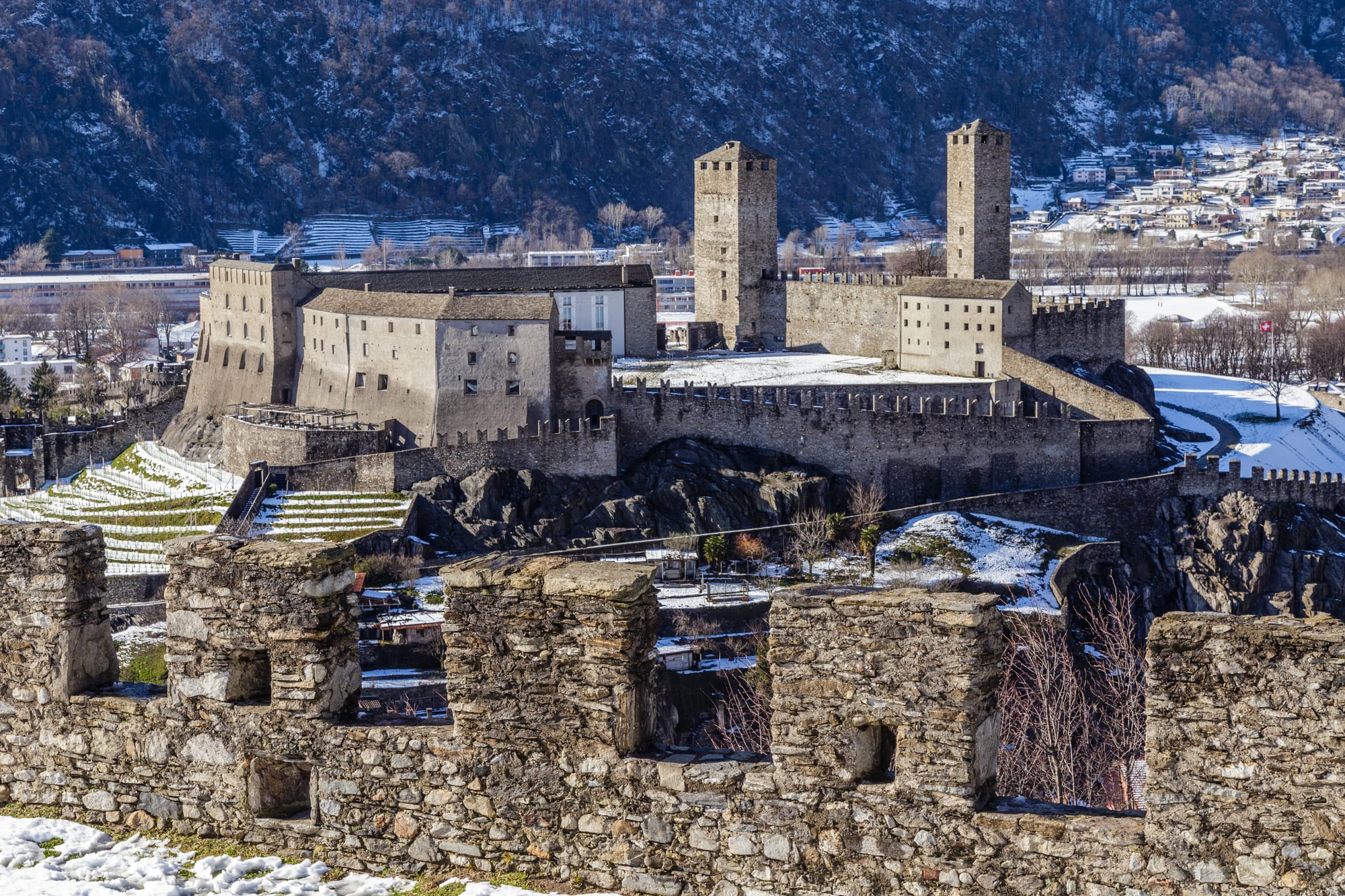
Battlemented stone walls in the foreground and a hilltop castle with two square towers beyond, with snow on the ground

Ticino, Switzerland

Bellinzona

Castelgrande seen from the walls of Montebello Castle in Bellinzona in winter. (JoachimKohler-HB / Wikimedia Commons · CC BY-SA 4.0)

The capital of Ticino, in the Ticino valley where the roads from the Gotthard, Lukmanier and San Bernardino passes meet. Fortified since Roman times and turned by the Dukes of Milan into a barrier of castles and walls across the valley, it joined the Swiss in 1500; its three castles have been a UNESCO World Heritage Site since 2000.

Neighbourhoods

  • Centro storico (Old Town)
    • First-time visitors
    • Historic district
    • Best for food

    The walled town between Castelgrande and Montebello, around the Piazza Collegiata and its great church. The neoclassical Teatro Sociale and the old houses of the centre stand within a few minutes' walk of both castles.

    Open in Maps
  • The castle hills
    • History
    • Views

    The rock of Castelgrande above the town, and the slope climbing south-east to Montebello and the isolated promontory of Sasso Corbaro, the highest of the three castles. Walls link the castles to the old town.

    Open in Maps
  • Station district
    • Close to public transport

    The area around the railway station, rebuilt and opened in 2016, the first stop south of the Alps for long-distance trains from the north. Montebello is a few hundred metres away through the old town.

    Open in Maps
  • Giubiasco and the merged villages
    • Quiet and residential
    • Local life

    The former municipalities of Giubiasco, Sementina, Monte Carasso, Claro and others that merged into Bellinzona in 2017, spreading the city along both sides of the Ticino valley.

    Open in Maps

Things to do

The castles and walls

  • Castelgrandelandmark

    The oldest castle, on a rock of gneiss fortified since the Romans, with the 13th-century White Tower and the Black Tower; a lift through the rock rises from the Piazza Mario della Valle.

    Open in Maps
  • Montebello Castlemuseum

    The castle built by the Rusca family around the end of the 13th century, with a civic and archaeological museum inside.

    Open in Maps
  • Sasso Corbarolandmark

    The highest of the three castles, built on its own rocky promontory after the battle of Giornico in 1478 and now used for temporary exhibitions.

    Open in Maps
  • Muratalandmark

    The long wall built across the Ticino valley in the second half of the 14th century so that Milan could protect and tax the trade route over the Gotthard.

    Open in Maps

Churches and the town

  • Collegiata dei Santi Pietro e Stefanolandmark

    The largest and most important church of the area, on the Piazza Collegiata, with an organ of 1588 that is the second oldest in Switzerland.

    Open in Maps
  • Santa Maria delle Grazielandmark

    A church near the Villa dei Cedri, one of the town's listed heritage buildings.

    Open in Maps
  • Villa dei Cedrimuseum

    A villa and park that house the city's art gallery.

    Open in Maps
  • Teatro Socialeattraction

    A neoclassical theatre, unique of its kind in Switzerland, restored after 150 years of history.

    Open in Maps

Short trips from the town

  • Giornicoattraction

    A village up the Leventina valley, where a small Swiss force defeated a much larger Milanese army in 1478.

    Open in Maps
  • Verzasca Damlandmark

    The arch dam at the mouth of the Val Verzasca, holding back the Lago di Vogorno above Lake Maggiore.

    Open in Maps

Seasonal events

  • RabadanFebruary or March, the six days before Lent

    The largest carnival in Italian-speaking Switzerland, held for over 150 years, when the mayor hands the keys of the city to King Rabadan for six days of festivities in the streets of the centre.

Eat and drink

Long-standing places and food districts in Bellinzona. Hours, ratings and directions come from your maps app, always current.

Bellinzona classics

  • Old town restaurantsneighborhood

    The old centre holds restaurants and pizzerias serving Italian cooking.

    Open in Maps
  • Castelgrande restaurantrestaurant

    A restaurant with a wine cellar in the grounds of Castelgrande.

    Open in Maps
  • Grotti in the valleyrestaurant

    Ticino's rustic eateries, often old wine caves turned into restaurants, serving traditional food such as polenta.

    Open in Maps

Experience Bellinzona

History

Bellinzona guards the point where the roads from the Gotthard, Lukmanier and San Bernardino passes come together, and it has been occupied since the early Neolithic. A Roman fort was built on the rock of Castelgrande in the late 1st century BC and rebuilt and enlarged in the 4th century. Ostrogoths, Byzantines and Lombards all held it in turn, and in the Middle Ages emperors, the bishops of Como and the city of Milan fought over it; Castelgrande was besieged in 1284, 1292 and 1303.

Milan took the town in 1340 after a long siege, and under the Visconti and then the Sforza it flourished on the trade over the Gotthard. In the second half of the 14th century the Murata wall was built right across the valley, and the Rusca family's castle of Montebello, which they kept after the siege, stood within them. The Swiss of Uri pressed south: Milan routed them at Arbedo in 1422, but after a small Swiss force defeated a far larger Milanese army at Giornico in 1478, Milan built Sasso Corbaro and strengthened the other castles and the wall. Much of what stands today dates from that late 15th-century work.

When the French seized Milan in 1499 the citizens drove out their garrison, and on 14 April 1500 Bellinzona joined the Swiss Confederation as a subject town of Uri, Schwyz and Nidwalden. It became part of the canton of Ticino in 1803, shared the role of capital with Lugano and Locarno until 1878, and has been the sole capital since. Railway workshops opened in 1874, the castles were listed by UNESCO in 2000, and in 2017 twelve neighbouring municipalities merged into the city.

Culture & Customs

The castles shape Bellinzona's identity. Castelgrande, Montebello and Sasso Corbaro, with the walls and ramparts of the old market town, form a UNESCO World Heritage Site, and Castelgrande was restored in a project completed in 1992 by the architect Aurelio Galfetti, with a lift cut through the rock and a spiral ramp from the Piazza Mario della Valle. Montebello holds a civic and archaeological museum, and Castelgrande a historical museum.

Carnival is the city's great festival. Rabadan, held for over 150 years, is the largest carnival in Italian-speaking Switzerland and one of the most important in the country. On the Thursday before Lent the mayor hands the keys of the city to King Rabadan, and for six days, until Shrove Tuesday, the streets of the centre are given over to festivities.

The town is largely Catholic and Italian-speaking, with German and Serbo-Croatian the next most common languages at the 2000 census. The Collegiata of Saints Peter and Stephen, the largest church in the area, keeps an organ of 1588 by Graziadio Antegnati of Brescia, the second oldest in Switzerland. The neoclassical Teatro Sociale and the art gallery in the Villa dei Cedri carry the town's cultural life.

Daily Life

Bellinzona had about 43,000 residents at the end of 2020. Before the 2017 merger the city had about 18,000; joining with Giubiasco, Sementina, Monte Carasso, Claro and eight other municipalities made it much larger in both people and area, and the old city of Bellinzona is now one district among many. In 2008 nearly 30 per cent of residents were foreign nationals.

As cantonal capital, Bellinzona is the seat of the cantonal government, the cantonal parliament and many cantonal offices. Its industrial symbol was the Officine, the railway workshops for wagons and locomotives, opened in 1874, and the railway remains central to the town. The new station of 2016, built as part of the AlpTransit project, made Bellinzona the first stop south of the Alps for long-distance trains from the north.

Life moves between the old town and its squares and the residential districts that spread across the valley floor. Many people commute in: in 2000 more than 16,000 workers travelled into the municipality for work.

Food

Bellinzona eats the food of Ticino. Polenta and risotto are the popular dishes, often served with luganighe and luganighetta, artisan sausages. For centuries polenta was regarded as a meal for the poor: maize reached the south of Ticino at the start of the 17th century, but it was another 200 years before polenta, first of mixed flour and later of pure cornmeal, became the staple dish of the area.

Chestnuts are a historical staple food of southern Switzerland, and the chestnut tree, introduced around 2,000 years ago, was called the bread tree. Bruscitti, finely chopped beef cooked for a long time, are a Lombard dish popular in southern Ticino, served with polenta, risotto alla milanese or purée.

The grotto is the place to find these dishes: a rustic eatery, often an old wine cave turned into a restaurant, popular with locals and visitors in the hot summer months. Merlot is the leading red grape of Italian-speaking Switzerland. In town, restaurants and pizzerias around the old centre serve Italian cooking, and Castelgrande has a restaurant and wine cellar in its grounds.

Planning tools

Budget

Bellinzona is a practical base in Ticino, with the canton's main railway station. The castles, walls and old town can be seen largely on foot, and grotti and picnics keep meals affordable; regional trains reach Lugano and Locarno quickly.

Daily Budget Midrange
USD 250–450 (town hotel, restaurant dinners with local Merlot, castle museums and trains around the canton)
Daily Budget Shoestring
USD 110–170 (hostel, grotto lunches, picnics, regional trains and buses)

Staying in Bellinzona and taking trains to the lakes is cheaper than staying in Lugano or Locarno in summer.

Best Time to Visit

Spring and early autumn are the most comfortable times to walk the walls and castles. Summer is warm and busy, and winter is cold but quiet, with Rabadan bringing the town to life before Lent.

Suggested Number of Days

One or two days are enough for the town itself. Three to five days leave time for the valleys and lakes nearby, which are easy to reach by train and bus from the station.

First Visit
1–2 days
With Surroundings
3–5 days

Transportation

The old town and the castles are best seen on foot, with local buses serving the merged districts across the valley. Bellinzona is the rail hub of the canton: regional trains run to Lugano, Locarno and the Leventina, and long-distance trains arrive through the Gotthard Base Tunnel from the north.

Use the lift inside the rock of Castelgrande from the Piazza Mario della Valle to save the climb.

Airport & Station Connections

The station, opened in its new form in 2016, is the first stop south of the Alps for long-distance trains from Zurich and the north, and lies on the line to Lugano and Milan. Milan's airports are the nearest large ones for international flights.

Walkability

Good. Montebello is a few hundred metres from the station through the old town, and Castelgrande is reached by a path from the Piazza Collegiata or by the lift. Sasso Corbaro stands higher up the hill and can also be reached by road.

Safety

Switzerland is very safe, with low crime. In Bellinzona the main risks are steep paths and walls at the castles, and in the valleys nearby the cold, fast rivers and summer storms.

Swim only in calm pools in the rivers, never jump from rocks or bridges, and heed warnings about dam releases. Check current official travel advice before travelling.

Climate

A mild, humid climate at the southern foot of the Alps, warmer than the north of Switzerland but less so than the lake towns. May is the wettest month.

Summer
warm — July is the warmest month, averaging about 21°C over day and night
Winter
cool — January is the coldest month, averaging about 2.5°C

Local Customs

Italian is the language of daily life. A service charge is included in restaurant bills by law, so tipping is a personal choice. Sundays are quiet, and Carnival is taken seriously: during Rabadan the city is officially in the hands of its carnival king.

Dress modestly in the Collegiata and other churches.

Common Payment Methods

The currency is the Swiss franc. Switzerland is more cash-oriented than many European countries, but card payments are common, ATMs accept foreign cards, and money can be changed at train stations and most banks. Euros are widely accepted.