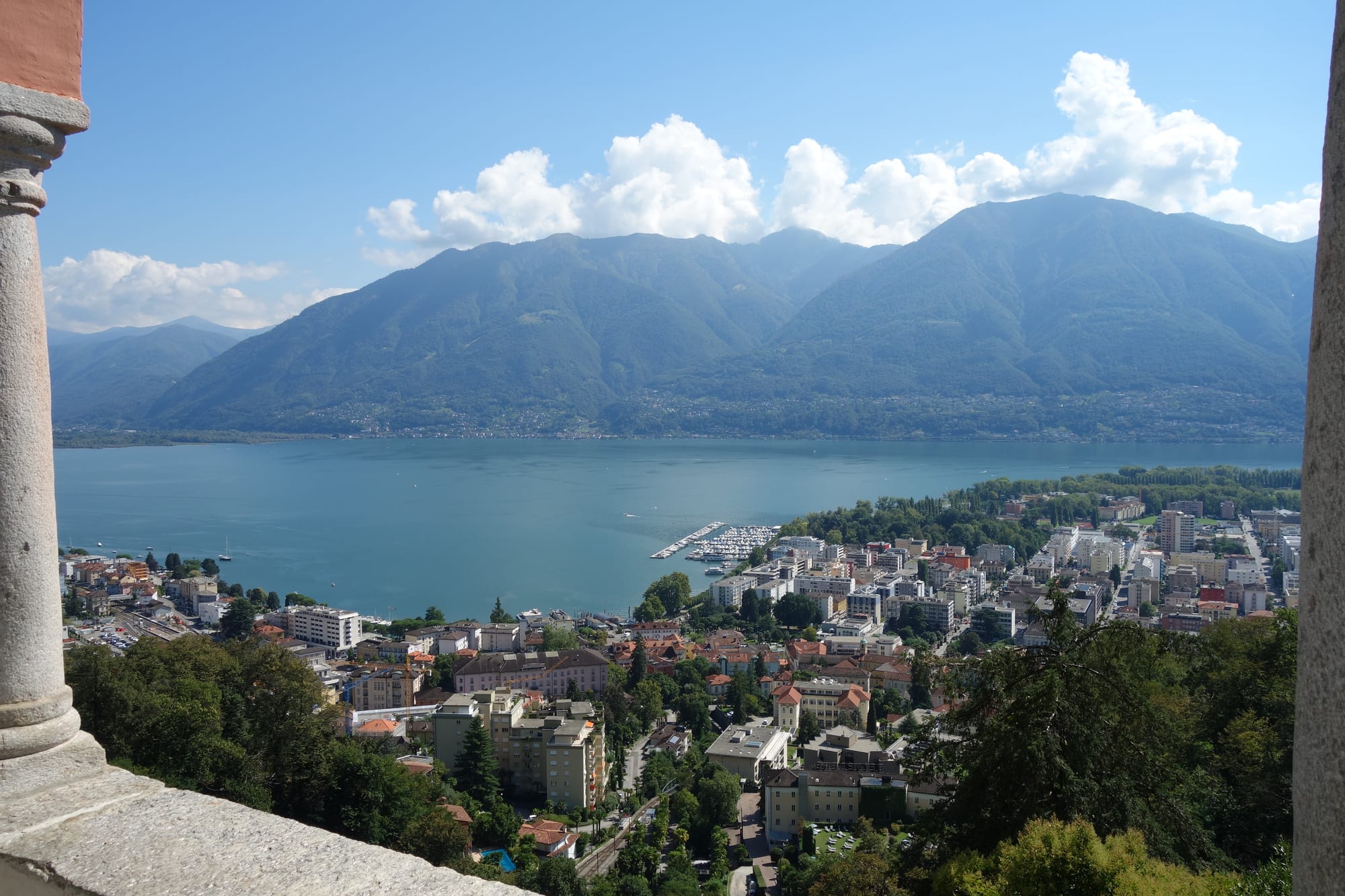
Rooftops of a lakeside town below a stone column, with a wide blue lake, a marina and forested mountains beyond

Ticino, Switzerland

Locarno

Locarno and Lake Maggiore seen from the sanctuary of Madonna del Sasso. (Pimlico27 / Wikimedia Commons · CC BY-SA 4.0)

A lakeside town at the northern end of Lake Maggiore, on the delta of the Maggia facing Ascona. A medieval market town ruled by local nobles, Milan and then the Swiss, it grew into a tourist town from the 1870s, gave its name to the treaties of 1925, and now fills its Piazza Grande each August for one of Europe's major film festivals.

Neighbourhoods

  • Città Vecchia (Old Town)
    • First-time visitors
    • Historic district
    • Best for food

    The historic centre rising up the slope behind the Piazza Grande, with the Visconti castle on its edge, the Casa Rusca art gallery on the Piazza Sant'Antonio and houses of the 16th to 18th centuries built on older foundations. Many of the town's small restaurants and shops are in its lanes.

    Open in Maps
  • Piazza Grande and the Nuovo Quartiere
    • Shopping
    • Close to public transport
    • Festivals

    The large main square and the newer quarter between the old town and the lake. Shops line the arcades of the Piazza Grande, which becomes an open-air cinema during the film festival, and the lakeside promenade starts close by.

    Open in Maps
  • Muralto and Minusio
    • Lakefront walks
    • Close to public transport

    Neighbouring municipalities to the east, part of Locarno's wider urban area. Muralto holds the main railway station and the old mother church of San Vittore, beside the Roman vicus.

    Open in Maps
  • Orselina and the hillside
    • Views
    • Quiet and residential

    The slope above the town, reached by funicular, where the sanctuary of Madonna del Sasso looks over the lake and the cable car to Cardada begins.

    Open in Maps

Things to do

Churches and the old town

  • Madonna del Sassolandmark

    The pilgrimage sanctuary in Orselina above the town, founded after a Franciscan friar reported a vision of the Virgin in 1480, with an ornate interior and a terrace over the lake.

    Open in Maps
  • Castello Visconteomuseum

    The castle on the edge of the old town, built in the 12th century, enlarged by the Visconti and partly demolished by the Swiss in 1531, now the municipal and archaeological museum.

    Open in Maps
  • Piazza Grandelandmark

    The town's main square and shopping arcade, which holds the open-air screenings of the film festival every August.

    Open in Maps
  • Pinacoteca Casa Ruscamuseum

    An 18th-century palazzo on the Piazza Sant'Antonio, used for changing art exhibitions; the town's art collection is in the neighbouring Casorella.

    Open in Maps
  • San Francescolandmark

    A church and former convent built in the early 13th century, where the town's nobles and citizens once held their meetings.

    Open in Maps

Mountains and the lake

  • Locarno–Madonna del Sasso funiculartransit hub

    The funicular from the town centre up to the sanctuary and Orselina.

    Open in Maps
  • Cimetta and Cardadaviewpoint

    From Orselina a cable car climbs to Cardada and a chairlift on to the summit of Cimetta, above the town and Lake Maggiore.

    Open in Maps
  • Lake Maggiore promenadetrail

    The lakeside walk along the town's waterfront, from where Swiss and Italian boats leave for ports around the lake.

    Open in Maps
  • Falconeria Locarnoattraction

    A falconry centre with flying displays of falcons, eagles, owls and vultures.

    Open in Maps

Short trips from the town

  • Asconaattraction

    The town across the Maggia delta on Lake Maggiore, a popular resort that holds a yearly jazz festival.

    Open in Maps
  • Monte Veritàattraction

    A 321-metre hill in Ascona that forms a cultural-historical ensemble, on the edge of the town.

    Open in Maps
  • Brissago Islandspark

    Two islands in the Swiss part of Lake Maggiore near Brissago, the larger of them, San Pancrazio, known for its botanical garden.

    Open in Maps
  • Verzasca Damlandmark

    The arch dam at the mouth of the Val Verzasca, also called the Locarno Dam, holding back the Lago di Vogorno just upstream of Lake Maggiore.

    Open in Maps
  • Centovalli railwaytransit hub

    The metre-gauge Centovallina, which leaves Locarno for Domodossola in Italy through steep mountain country.

    Open in Maps

Seasonal events

  • Moon & StarsJuly

    A series of concerts by international acts on the Piazza Grande.

  • Locarno Film FestivalAugust

    A major international film festival founded in 1946, with nightly open-air screenings on the Piazza Grande.

Eat and drink

Long-standing places and food districts in Locarno. Hours, ratings and directions come from your maps app, always current.

Locarno classics

  • Old town restaurantsneighborhood

    The lanes of the old town hold small restaurants, from osterie to pizzerias and places serving fish.

    Open in Maps
  • Grottirestaurant

    Ticino's rustic eateries, often old wine caves turned into restaurants, serving traditional food such as polenta and most popular in the hot summer months.

    Open in Maps

Squares and bars

  • Piazza Grandeneighborhood

    The main square, whose arcades hold many of the town's shops, and the setting of the film festival's open-air screenings.

    Open in Maps

Experience Locarno

History

Romans settled at Muralto, beside today's town, and Locarno grew into a medieval market town on the north shore of Lake Maggiore. The emperor Frederick Barbarossa granted it a monthly market in 1164 and in 1186 placed it directly under imperial rule. It was governed by local noble families of capitanei, among them the Orelli and the Muralto; the Orelli castle, first recorded in 1210, was taken by the Visconti of Milan in 1342 and enlarged, and the Rusca counts later held the town as a fief.

The Swiss Confederates occupied Locarno in 1503 but could not take the castle until the French king handed it over after the battle of Novara in 1513, and in 1516 all of Locarno passed to them. They demolished much of the castle in 1531. During the Reformation in the 16th century Protestant families, including branches of the Muralto and Orelli, left for Zurich and Bern, and with the plague of 1576–77 the town's population fell.

After 1803 Locarno joined the new canton of Ticino, and under the constitution of 1814 it shared the role of capital with Lugano and Bellinzona. Emigration to California thinned the population between 1860 and 1880, and the town grew more slowly than places directly on the Gotthard railway, but from the 1870s, as connections improved, hotels and tourism developed. In October 1925 the Locarno Treaties were negotiated here, and in 1946 the first film festival was held.

Culture & Customs

Film defines Locarno's place in the world. The Locarno International Film Festival, founded in 1946, screens features, documentaries, shorts and retrospectives each August, and its evening shows on the Piazza Grande turn the town's main square into an open-air cinema. In July the same square hosts Moon & Stars, a series of concerts by international acts.

The town is largely Catholic and Italian-speaking, with German the second language of its residents. Madonna del Sasso, the sanctuary above the town founded after a friar's vision of the Virgin in 1480, remains the principal place of pilgrimage, and the church of San Francesco recalls the meetings of nobles and citizens held there for centuries. The town's art collection, with works by Jean Arp and the Locarno painter Filippo Franzoni, is kept in the Casorella beside the Casa Rusca.

Locarno shares a wider area with Ascona, its partner town across the Maggia delta, with the hill of Monte Verità, a cultural-historical site, and a jazz festival held every year. The 1925 treaties gave the town's name a lasting place in European diplomacy.

Daily Life

Locarno had about 15,700 residents at the end of 2020, and about 56,000 people live in its wider agglomeration, which includes Ascona, Muralto, Minusio and other neighbouring municipalities. It is the third largest town in Ticino, after Lugano and Bellinzona. In 2008 about a third of its residents were foreign nationals.

The town is divided into the old town, the new quarter toward the lake and the Campagna district toward Solduno, and its territory climbs from the lake at 209 metres to mountain land above Cardada. Tourism, helped by the mild climate, is the backbone of its economy, and visitors arrive in the greatest numbers for the film festival in August.

Daily life centres on the Piazza Grande and its arcades, where much of the town's shopping is done, and on the lake promenade. Buses connect Locarno with the valleys behind it, and the Centovallina carries passengers to Domodossola in Italy. In 2011 Locarno voted to merge with Muralto, Minusio, Orselina and other neighbours, but most of them rejected the plan and the canton did not pursue it.

Food

Locarno eats the food of Ticino. Polenta and risotto are the popular dishes, often served with luganighe and luganighetta, artisan sausages. Polenta was regarded for centuries as food for the poor: maize arrived in the south of Ticino at the start of the 17th century, but it took another 200 years before polenta, made at first from mixed flour and later from pure cornmeal, became the staple dish of the area.

The chestnut is a historical staple of southern Switzerland, and the chestnut tree, introduced around 2,000 years ago, was known as the bread tree. Bruscitti, finely chopped beef cooked for a long time, are popular in southern Ticino and come with polenta or risotto. The typical place to eat them all is the grotto, a rustic eatery often set in an old wine cave, popular with locals and visitors in the hot summer months.

Merlot is the leading red grape of Italian-speaking Switzerland. In town, the lanes of the old town hold osterie, pizzerias and restaurants serving fish, and the town's bars serve aperitifs.

Planning tools

Budget

Locarno is cheaper than the big Swiss cities, but hotel prices climb steeply in summer and above all during the film festival in August. Grotti, picnics on the promenade and regional trains keep costs down; lake cruises and the cable car to Cardada are the main extras.

Daily Budget Midrange
USD 280–510 (lakeside hotel, restaurant dinners with local Merlot, boat trips and funiculars)
Daily Budget Shoestring
USD 110–180 (hostel, grotto lunches, picnics, regional trains and buses)

Book a room well ahead for the film festival, or stay elsewhere in the canton and travel in for the evening screenings.

Best Time to Visit

Spring and early autumn are the most comfortable seasons on the lake. July brings the Moon & Stars concerts and August the film festival, when the town is at its busiest and most expensive. Winter is quiet and mild by Swiss standards.

Suggested Number of Days

Two or three days are enough for the town itself. Four to six days leave time for the lake and the valleys around it, and a festival visit usually needs several nights on its own.

First Visit
2–3 days
With Surroundings
4–6 days

Transportation

The centre is compact. Regional buses run along the lake to Ascona and Brissago and up the Maggia valley, the funicular climbs to Orselina, and boats link the town with Swiss and Italian ports on Lake Maggiore. The Centovallina leaves from Locarno for Domodossola.

Check boat timetables before planning a lake trip; services to the Italian shore are run separately from the Swiss ones.

Airport & Station Connections

Locarno station, in neighbouring Muralto, is at the end of the Giubiasco–Locarno branch of the Gotthard railway, with connections via Bellinzona to Zurich and Lugano. Milan's airports are the nearest large ones for international flights.

Walkability

The lakefront, the Piazza Grande and the old town are close together and easy on foot, and the promenade continues along the shore. The old town climbs the slope behind the square, and the funicular carries visitors up to Madonna del Sasso.

Safety

Switzerland is very safe, with low crime. Locarno's main dangers are natural: the cold, fast rivers of the Verzasca and Maggia valleys nearby, and summer storms that bring heavy downpours.

Swim only in calm pools in the rivers, never jump from rocks or bridges, and heed warnings about dam releases. Check current official travel advice before travelling.

Climate

Among the warmest places in Switzerland, with a humid subtropical climate. It is also among the sunniest, with about 2,170 hours of sunshine a year, yet rain is plentiful because it falls in short, intense downpours.

Summer
warm to hot — at the Locarno-Monti weather station July averages about 22°C over day and night, with 15 to 16 days a year reaching 30°C
Winter
mild for Switzerland — at the Locarno-Monti weather station January averages about 4°C

Local Customs

Italian is the main language, with German the second most spoken. A service charge is included in restaurant bills by law, so tipping is a personal choice. Sundays are quiet.

Dress modestly and keep quiet in Madonna del Sasso, which is still an active place of pilgrimage.

Common Payment Methods

The currency is the Swiss franc. Switzerland is more cash-oriented than many European countries, but card payments are common, ATMs accept foreign cards, and money can be changed at train stations and most banks. Euros are widely accepted.