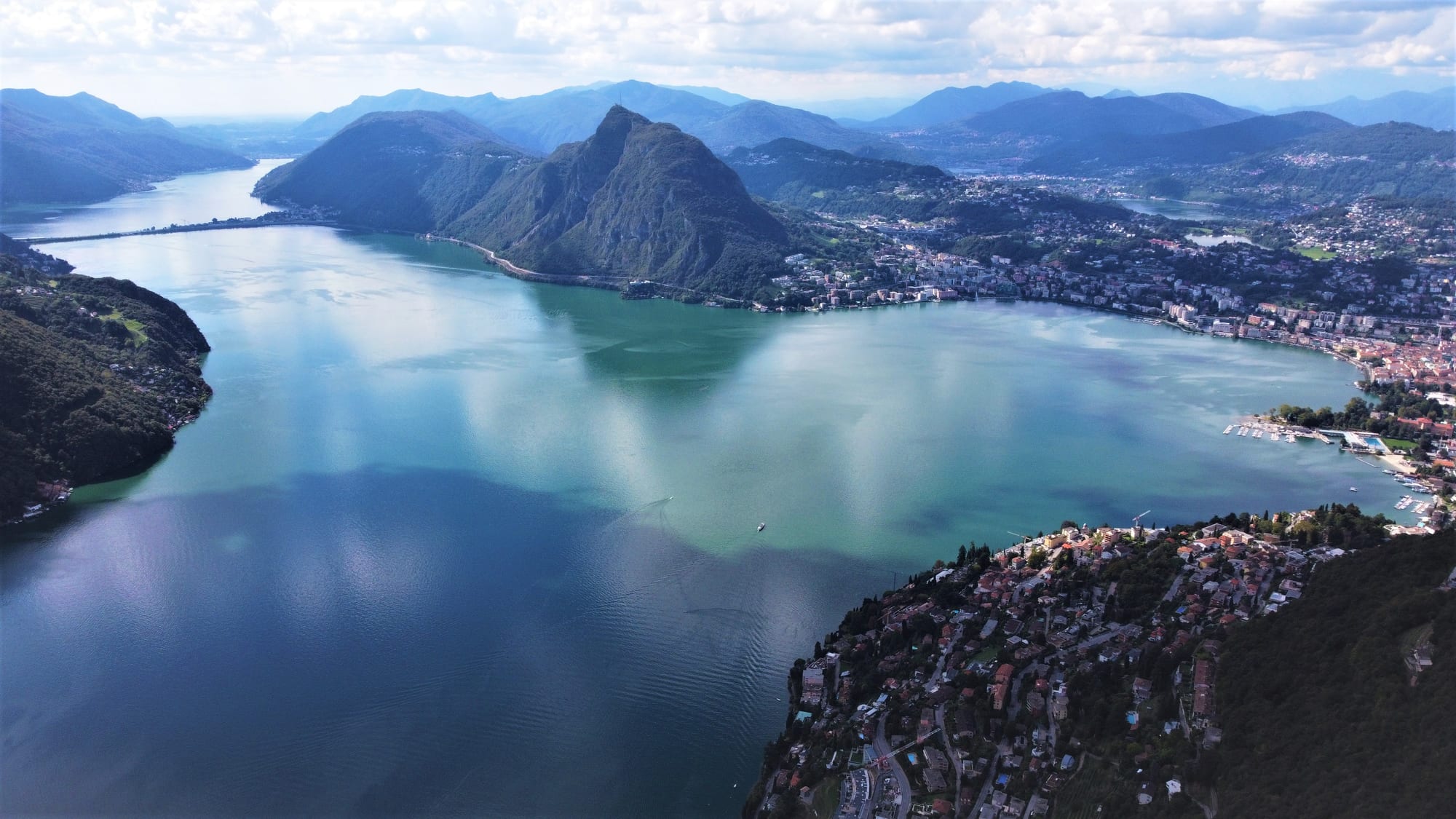
A wide turquoise lake bay seen from high above, with a steep green peak in the middle and the city spreading along the shore

Ticino, Switzerland

Lugano

Lake Lugano, Monte San Salvatore and the city of Lugano seen from Monte Brè. (Mchernyavska / Wikimedia Commons · CC BY-SA 4.0)

The largest city of Italian-speaking Switzerland, curved around a bay of Lake Lugano between Monte Brè and Monte San Salvatore. A market town fought over by Como and Milan, then a Swiss subject land, it grew on the Gotthard railway and postwar banking into the country's third financial centre, with a lakefront promenade, arcaded old streets and a modern arts centre.

Neighbourhoods

  • Centro Storico (Old Town)
    • First-time visitors
    • Historic district
    • Shopping

    The old centre on the lakeshore just west of the mouth of the Cassarate, around the Piazza della Riforma and the town hall. Via Nassa, an old arcaded merchant street, is the main shopping street, and many streets are pedestrian-only. A funicular climbs from here to the railway station on the hill above.

    Open in Maps
  • Cassarate and Castagnola
    • Lakefront walks
    • Quiet and residential

    The districts east of the river Cassarate, joined to Lugano in 1972. The lakeside promenade continues this way past the Parco Ciani, and the Monte Brè funicular starts above Cassarate; Castagnola has the 17th-century Villa Favorita.

    Open in Maps
  • Paradiso
    • Close to the lake
    • Mountain access

    A separate small municipality on the bay, almost entirely surrounded by Lugano and the lake, where the funicular to Monte San Salvatore begins. It runs along the shore south of the centre.

    Open in Maps
  • Brè
    • Views
    • Quiet villages

    The old village of Brè on the slopes of Monte Brè, reached by funicular or road, one of the city districts listed as a Swiss heritage site.

    Open in Maps
  • Gandria
    • Historic district
    • Lakefront walks

    A lakeside village on the northern shore at the foot of Monte Brè, part of Lugano since 2004, with narrow streets closed to cars. It is reached by boat, by bus or along the Gandria trail from the end of the city promenade.

    Open in Maps

Things to do

Churches and the old town

  • Lugano Cathedrallandmark

    The Cathedral of San Lorenzo, seat of the Bishop of Lugano, founded in the Middle Ages and rebuilt in the late 15th century, with its façade completed in 1517.

    Open in Maps
  • Santa Maria degli Angiolilandmark

    A 16th-century church near the lakefront with a full-wall fresco of Christ's Passion by Bernardino Luini.

    Open in Maps
  • Piazza della Riformalandmark

    The main square of the old town, overlooked by the Palazzo Civico, the town hall built in 1843–44 on the site of the bishop's palace.

    Open in Maps
  • Parco Cianipark

    The lakeside park beside the centre, planted with a wide variety of flowers and trees around the Villa Ciani, on the site of a 17th-century palace of the von Beroldingen family.

    Open in Maps

Museums and the arts

  • LAC Lugano Arte e Culturamuseum

    The city's arts centre for music, visual and performing arts, home of the Orchestra della Svizzera Italiana and of one of the two sites of the MASI art museum.

    Open in Maps
  • MASI Luganomuseum

    The art museum of Italian-speaking Switzerland, mainly 20th-century and contemporary art, split since 2019 between the LAC and the Palazzo Reali.

    Open in Maps
  • Hermann Hesse Museummuseum

    A museum devoted to the writer Hermann Hesse at Montagnola, in the hills just outside the city, with an audio-guided walk in his footsteps.

    Open in Maps

Funiculars and viewpoints

  • Monte Brè funicularviewpoint

    The funicular from Cassarate to an upper station at 883 metres near the summit of Monte Brè, considered one of the sunniest points in Switzerland.

    Open in Maps
  • Monte San Salvatore funicularviewpoint

    The funicular from Paradiso to the summit of Monte San Salvatore, 912 metres high, which has a 360-degree view over the city and the lake.

    Open in Maps
  • Lugano Città–Stazione funiculartransit hub

    The short funicular known as the Sassellina, linking the old town with the main railway station on the hill above.

    Open in Maps

The lake and its villages

  • Gandria trailtrail

    A lakeside path from the end of the Lugano promenade to Gandria, marked with panels on the history of the olive trees in the region.

    Open in Maps
  • Swiss Customs Museummuseum

    The Swiss customs museum, across the lake from Gandria and reached by boat.

    Open in Maps
  • Morcoteattraction

    A village on the southern shore of Lake Lugano, about 10 kilometres from the city, part of the Lugano district.

    Open in Maps

Short trips from the city

  • Campione d'Italiaattraction

    An Italian town on the opposite shore of Lake Lugano, an enclave entirely surrounded by Swiss territory.

    Open in Maps
  • Monte Generosoviewpoint

    A mountain on the Italian border reached by rack railway from Capolago, whose summit looks over the lakes of Lugano, Como, Varese and Maggiore, with a restaurant by Mario Botta opened in 2017.

    Open in Maps
  • Melideattraction

    A lakeside village below Monte San Salvatore, joined to Bissone by the causeway of 1844–47 that carries road and railway across the lake.

    Open in Maps

Seasonal events

  • LongLake Festivalsummer

    A city festival of concerts, theatre and street arts held in public spaces and neighbourhoods across Lugano.

  • Blues to Boplate August

    A free open-air music festival with stages throughout the heart of the city.

  • Festa d'Autunnoautumn

    The city's autumn festival, one of its main traditional events.

  • Natale in PiazzaDecember

    Christmas events in the city's squares.

Eat and drink

Long-standing places and food districts in Lugano. Hours, ratings and directions come from your maps app, always current.

Lugano classics

  • Grotti around the lakerestaurant

    The grotto is Ticino's own kind of restaurant, where the canton's typical food is served; one stands near the customs museum across the lake from Gandria.

    Open in Maps
  • Old town restaurants and caffèneighborhood

    Small restaurants and caffè in the city serve Italian-style food with a Swiss twist, including piadine, grilled Italian flatbread wraps.

    Open in Maps

Markets and shopping

  • Mercato di Luganomarket

    The city market in the old town, which promotes local and organic produce.

    Open in Maps
  • Via Nassaneighborhood

    The main shopping street of the old town, a historic arcaded merchant street.

    Open in Maps

Experience Lugano

History

Within today's city limits, in Breganzona, Castagnola, Davesco and Gandria, prehistoric grinding stones have been found, and Etruscan monuments stand at Davesco-Soragno, Pregassona and Viganello. Documents of 804 and 844 name the lake, and an act of 984 describes Lugano as a market town. For centuries it was fought over by Como and Milan — by the Rusca of Como and the Visconti of Milan — and in 1416 Duke Filippo Maria Visconti took it as a fief. Shortly before the French invasion of 1499 Ludovico Sforza built a castle on the plain of the Cassarate.

The Swiss Confederates besieged that castle and took Lugano in 1513, beginning its demolition in 1517. For almost three centuries the town was governed as a subject land by bailiffs from the Swiss cantons, with the von Beroldingen family of Uri as chancellors. In 1746 the Agnelli brothers opened a printing press whose Gazzetta di Lugano was the first Italian-language newspaper to print part of the American Declaration of Independence; it was sacked in anti-French riots in 1799.

After the Helvetic Republic, Lugano joined the new canton of Ticino in 1803 and took turns as its capital until the 1860s. The Melide causeway of 1844–47 and the Gotthard railway of 1882 made it a main link between northern Italy and northern Europe, and tourism followed. From the 1960s capital from Italy made it Switzerland's third financial centre, and mergers with the surrounding villages between 2004 and 2013 doubled the city's area.

Culture & Customs

Lugano is the main city of Italian-speaking Switzerland. Italian is the language of the street, and the city looks south to Milan and Como as much as north across the Alps. The LAC, opened as a centre for music, visual and performing arts, is home to the Orchestra della Svizzera Italiana and to the MASI art museum, and hosts the LuganoInScena and LuganoMusica seasons.

Music fills the summer. The LongLake Festival brings concerts, theatre and street arts into the squares and neighbourhoods, Blues to Bop is a free open-air festival on stages across the centre in late August, and Estival Jazz is another of the city's main music events. The calendar also includes the Festa d'Autunno, the Lugano Buskers Festival and Christmas in the squares, and the city hosts the Settimana della Lingua Italiana nel Mondo.

Writers and artists have long settled in the hills. Hermann Hesse lived at Montagnola, where a museum keeps his memory, and the Villa Favorita in Castagnola and the Villa Ciani in its lakeside park recall the city's patrons. The Università della Svizzera italiana, with five of its six faculties in Lugano, keeps the city young. Its Catholic heritage shows in the cathedral of San Lorenzo and the Luini frescoes of Santa Maria degli Angioli.

Daily Life

About 68,500 people lived in Lugano at the end of 2024, and over 150,000 in its urban area — the largest city in Italian-speaking Switzerland. The city's territory runs from the lakefront up the Val Colla, taking in former villages such as Gandria, Brè, Pregassona and Viganello, while Paradiso stays a separate municipality on the bay.

Tourism and finance are central to the economy, which provides an estimated 38,000 jobs, over a third of them held by cross-border commuters. Lugano is Switzerland's third largest banking centre after Zurich and Geneva, but with the end of banking secrecy the city has worked to diversify into technology, digital services and sustainability. The university, its applied sciences school SUPSI and the Dalle Molle artificial intelligence institute are all based in the city.

Shoppers head for Via Nassa and the old town, walkers for the promenade and the Gandria trail, and visitors ride the funiculars to Brè and San Salvatore.

Food

Lugano eats the food of Ticino. Polenta and risotto are the popular dishes, often served with luganighe and luganighetta, artisan sausages; luganega itself is a fresh pork sausage also used in the Monza-style risotto across the border. For centuries polenta was regarded as food for the poor, and maize became a staple in Ticino after it spread south of the Alps.

The typical food of the canton is found in the grotto, Ticino's own kind of restaurant, and grotti are scattered around the lake shores and the hills above the city. Olive oil is another product of Ticino: olive growing was revived in the late 20th century, and the Gandria trail along the lake explains the history of the olive trees that grow beside it.

In town, small restaurants and caffè serve Italian-style food with a Swiss twist, and piadine, grilled flatbread wraps filled with cold cuts, cheese and vegetables, are the local fast food. The Mercato di Lugano in the old town sells local and organic produce, and Ticino is one of Switzerland's wine regions, known above all for red Merlot.

Planning tools

Budget

Lugano is cheaper than Zurich or Geneva for meals, but lakeside hotels and restaurant dinners are expensive, above all in summer. Grotti, supermarket picnics and the lakefront parks keep costs down; boat trips and funicular rides add up quickly.

Daily Budget Midrange
USD 280–510 (lakeside hotel, restaurant dinners with local Merlot, boat trips and funiculars)
Daily Budget Shoestring
USD 110–180 (hostel, grotto lunches, picnics, city buses and regional trains)

A supermarket picnic on the promenade or in the Parco Ciani is the cheapest lunch in town.

Best Time to Visit

April to June and September to October are the most comfortable months, warm without the summer heat. July and August bring the music festivals and the busiest lakefront; winter is mild by Swiss standards but some lake services and mountain lifts run less often.

Suggested Number of Days

Two to three days cover the city, its lakefront and its two mountains. Allow four to six days to add the villages around the lake, the Mendrisiotto and the Italian side of the border.

First Visit
2–3 days
With Surroundings
4–6 days

Transportation

The centre is small enough to walk, and the city buses of TPL serve the districts and hills. Funiculars link the old town to the station and climb Monte Brè and Monte San Salvatore, and lake boats run to Gandria and across to the customs museum.

Take the Sassellina funicular between the station and the old town rather than walking up the steep streets.

Airport & Station Connections

Lugano is a stop on the Gotthard railway, with direct trains from Zurich through the base tunnels and from Milan. Lugano Airport at Agno had no regular scheduled flights as of March 2025, so most air travellers use Milan Malpensa, about 80 km away by road, which has a direct hourly train to Lugano taking about one hour 45 minutes.

Walkability

The lakefront and old town are flat and largely pedestrian, and the promenade continues east to Cassarate and on to Gandria. The hills above, including the walk up to the station, are very steep, which is why the funicular and buses are worth using.

Safety

Switzerland is very safe, with low crime. Lugano itself has few problems; the main risks are on the water and in the hills, where summer storms can bring heavy downpours.

Take care on steep lakeside paths in wet weather and swim only at recognised bathing places. Check current official travel advice before travelling.

Climate

One of the warmest and sunniest places in Switzerland, with a humid subtropical climate. Rainfall is high, about 1,560 mm a year, and May is the wettest month.

Summer
warm and often humid — days above 30°C come on about eight days a year
Winter
cold at night — most January nights fall below 0°C, though severe cold is rare, and some snow usually falls each winter

Local Customs

Italian is the language of daily life. A service charge is included in restaurant bills by law, so tipping is a personal choice. Sundays are quiet, with most shops closed.

Dress modestly in the cathedral and churches.

Common Payment Methods

The currency is the Swiss franc. Switzerland is more cash-oriented than many European countries, but card payments are common, ATMs accept foreign cards, and money can be changed at train stations and most banks. Euros are widely accepted, and many price lists show both currencies.