A red train curving across a tall stone arched viaduct over a rocky gorge, with a snow-streaked mountain behind

Switzerland

Graubünden

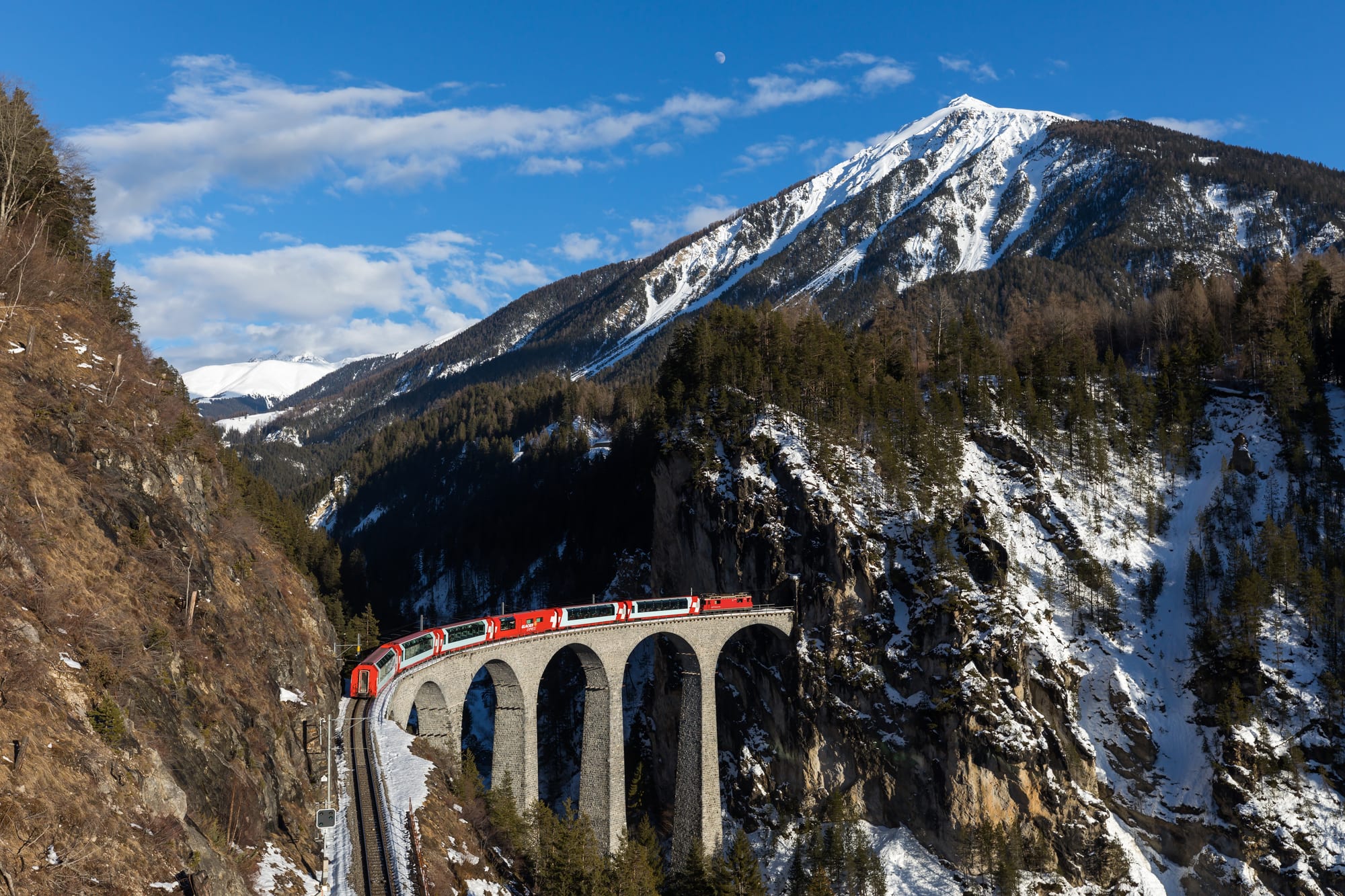
A Glacier Express crossing the Landwasser Viaduct near Filisur on the Albula line in winter. (Kabelleger / David Gubler / Wikimedia Commons · CC BY-SA 4.0)

Switzerland's largest and most thinly populated canton, a knot of some 150 valleys in the south-east where German, Romansh and Italian are all official — home of the old Free State of the Three Leagues, the ski resorts of St. Moritz and Davos, the high valley of the Engadin and the Rhaetian Railway's famous mountain lines.

Explore Graubünden

History

The Raetians inhabited these valleys when Rome conquered them in 15 BC, creating the province of Raetia, and the Latin spoken here evolved into Romansh. Chur became the seat of a bishop by the 5th century, and the bishops controlled the Alpine passes — the Splügen, San Bernardino, Julier and Septimer — that made the region valuable to emperors travelling to Italy.

To resist the bishops and local lords, the valleys formed three alliances: the League of God's House in 1367, the Grey League in 1395 and the League of the Ten Jurisdictions in 1436. Together they became the Free State of the Three Leagues, an ally of the Swiss Confederation, and from the 16th century they ruled the Valtellina, Chiavenna and Bormio in what is now Italy. The Reformation divided the valleys, and during the Thirty Years' War the Leagues were fought over by France, Spain and Austria in the years of turmoil known as the Bündner Wirren.

The Valtellina broke away to the French-backed Cisalpine Republic in 1797, and in 1803 the Three Leagues joined Switzerland as the canton of Graubünden. Poverty drove many to emigrate as pastry cooks and café owners across Europe. Tourism transformed the canton: St. Moritz opened for winter guests in the 1860s and hosted the Winter Olympics in 1928 and 1948, Davos became a tuberculosis cure resort, and the Rhaetian Railway reached the Engadin in 1903.

Culture & Customs

Graubünden is Switzerland's only trilingual canton. German dominates in Chur and the north, Italian is spoken in the southern valleys of Bregaglia, Poschiavo and Mesolcina, and Romansh survives in the Engadin, the Surselva and the Val Müstair in five written idioms, unified for official use as Rumantsch Grischun. Romansh is spoken by only a small minority and its survival depends on schools, radio and local pride.

The Engadin villages are known for their stone houses with deep-set windows and sgraffito, patterns scratched into the plaster. On 1 March, children celebrate Chalandamarz, ringing cowbells through the villages to drive out winter, and in January young people ride decorated sleighs in the Schlitteda. Religion is mixed, with Catholic and Protestant valleys side by side.

The canton's literature and art are rooted in its landscape: Giovanni Segantini painted the Engadin light, the Giacometti family came from Stampa in the Bregaglia, and Friedrich Nietzsche spent summers at Sils Maria. Thomas Mann set The Magic Mountain in a Davos sanatorium.

Daily Life

About 200,000 people live across the canton's large area, making it the most thinly populated in Switzerland. Chur has about 38,000 people; Davos has around 10,000, and St. Moritz about 5,000, although both swell many times over in season. Many side valleys have lost population as young people move to the cities.

Tourism is the main business, from the luxury hotels of St. Moritz to the family resorts of Lenzerheide, Flims and Laax. Hydroelectric power, construction, forestry, farming and the Rhaetian Railway are other large employers, and Davos lives also from research institutes and the World Economic Forum, held each January since 1971.

Daily life turns on the seasons and on the trains and postbuses that link the valleys. Second homes, which stand empty for much of the year, and the pressure they put on housing for locals are a long-running debate, as is the future of lower ski slopes as winters warm.

Food

Graubünden's cooking is hearty mountain food. Capuns are parcels of spätzle-type dough mixed with dried meat or salsiz sausage, wrapped in chard leaves and cooked in a milky broth. Pizokel are thick, short noodles, sometimes made with buckwheat, and maluns are grated potatoes slowly roasted in butter into crumbly nuggets, eaten with apple sauce. Bündner Gerstensuppe is a barley soup with vegetables and cured meat.

Bündnerfleisch, air-dried beef, and salsiz, small dried sausages, are the cured meats of the canton. The Engadiner Nusstorte, a shortcrust tart filled with caramelised walnuts, was spread across Europe by emigrant pastry cooks, and Birnbrot is a loaf packed with dried pears and fruit. In the south, the Val Poschiavo and Bregaglia eat polenta, chestnuts and pizzoccheri, buckwheat pasta with cabbage and cheese.

The Bündner Herrschaft, around Maienfeld, Malans and Jenins, makes some of Switzerland's most respected Pinot Noir. Calanda is the Chur brewery, and Röteli is a cherry liqueur drunk at New Year.

Attractions & Natural Wonders

The Engadin is the heart of the canton. In the Upper Engadin, St. Moritz, its lake and the Corviglia ski area are joined by the lakes of Silvaplana and Sils, with Nietzsche's house at Sils Maria, Muottas Muragl's viewpoint and Pontresina below the Morteratsch Glacier. In the Lower Engadin, sgraffito villages such as Guarda and Ardez, the spa town of Scuol and Tarasp Castle line the valley, and the Swiss National Park, founded in 1914, spreads around Zernez and the Ofen Pass.

The Bernina and Albula lines of the Rhaetian Railway, a UNESCO World Heritage Site, are travelled end to end by the Bernina Express, over the Bernina Pass and down the spiral viaduct at Brusio, and by the Glacier Express from Zermatt, which crosses the 65-metre Landwasser Viaduct near Filisur on its way to St. Moritz.

Davos and Klosters form one large ski and walking area, with the Kirchner Museum of Expressionist art in Davos. Chur has its cathedral and old town; Maienfeld is the setting of the Heidi stories; and the Rhine Gorge, the Ruinaulta, cuts below Flims. Vals has Peter Zumthor's stone thermal baths, the Val Müstair holds the Carolingian frescoes of the UNESCO-listed Convent of St John, and Soglio looks across the Bregaglia to granite peaks.

Cities in Graubünden

Planning basics

Budget

St. Moritz is one of the most expensive resorts in the Alps, and Davos, Klosters, Arosa and Laax are costly in the ski season and during the World Economic Forum in January, when Davos prices soar. Chur, the Lower Engadin, the Val Müstair and the southern valleys are cheaper, and scenic train tickets are a real expense unless covered by a pass.

Daily Budget Midrange
USD 340–670 (resort hotel, mountain restaurants, ski pass or a scenic train seat reservation)
Daily Budget Shoestring
USD 120–190 (hostel or simple guesthouse, supermarket meals, regional trains and postbuses)

The Bernina and Albula lines can be ridden on regular regional trains with the same views as the express, and without the supplement.

Safety

The canton is safe. Hazards are alpine: avalanches off-piste and on ski tours, sudden weather on the passes, cold in winter, and steep trails. Rules in the Swiss National Park are strict — no leaving the paths, no dogs and no camping — and are enforced by rangers.

Check avalanche bulletins before going off-piste and keep to marked paths in the national park. Check current official travel advice before travelling.

Climate

A canton of extremes shaped by altitude. The Upper Engadin, around 1,800 metres, has cold, dry, sunny winters, with some of the lowest temperatures in inhabited Switzerland, and short, fresh summers. Chur and the Rhine valley are milder, and the Föhn wind keeps the Bündner Herrschaft warm enough for vines. The southern valleys of Bregaglia, Poschiavo and Mesolcina are noticeably Mediterranean.

Summer
fresh in the Engadin and Davos, 15–22°C by day with cold nights; warmer in Chur and the southern valleys
Winter
cold and bright in the high valleys, often -10°C or lower at night in the Engadin; snowy in the resorts

Transportation

Chur is reached by direct fast train from Zurich, and the narrow-gauge Rhaetian Railway runs from there to Davos, Arosa, St. Moritz and the Lower Engadin, with the Vereina tunnel linking Klosters to the Engadin. The Bernina line continues over the pass to Poschiavo and Tirano in Italy, and postbuses cross the Julier, Maloja and Flüela passes.

Reserve seats on the Glacier Express and Bernina Express in summer; the regional trains need no booking.

Best Time to Visit

December to March for skiing and the winter events of St. Moritz, with the Engadin Skimarathon in March. Late June to September for walking in the Swiss National Park, the high passes and the lakes, and October for the golden larch forests of the Engadin. Many hotels close in the off-seasons of April–May and November.