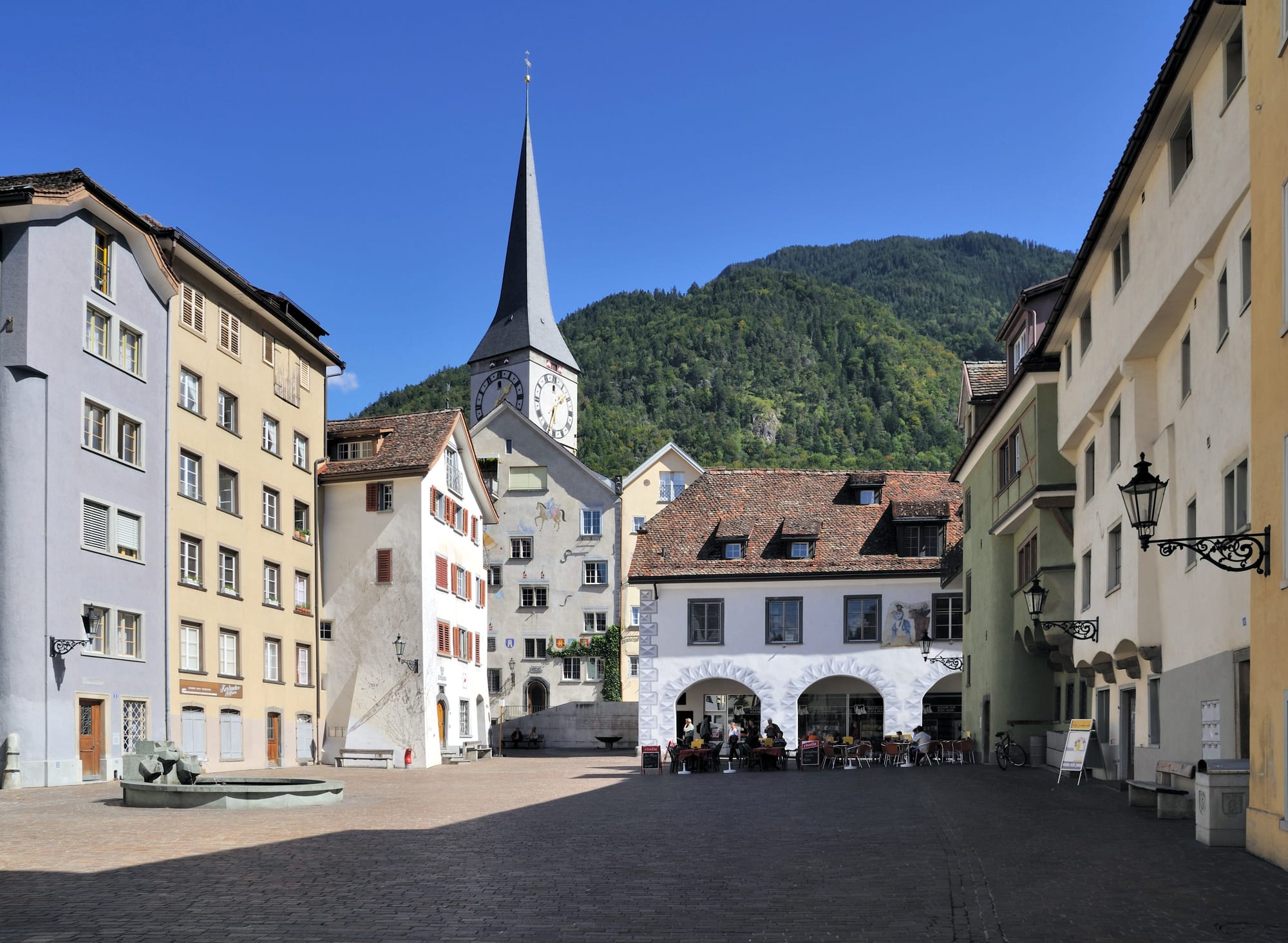
A cobbled square ringed by pale old town houses, with a pointed church spire and clock tower before a wooded mountain

Graubünden, Switzerland

Chur

The Arcas square in Chur's old town, with the tower of St Martin's Church behind. (Wladyslaw / Wikimedia Commons · CC BY-SA 3.0 de)

The capital of Graubünden, in the Rhine valley, and reputedly the oldest town in Switzerland. A Roman provincial capital and a bishop's seat since late antiquity, it grew on the Alpine pass roads; today it is the canton's administrative and railway hub, with a compact old town below the cathedral.

Neighbourhoods

  • Altstadt (Old Town)
    • First-time visitors
    • Historic district
    • Best for food

    The medieval town between the Plessur river and the old line of walls along today's Grabenstrasse. Squares such as the Arcas, Kornplatz and Pfisterplatz are lined with guild and burgher houses of the 16th to 18th centuries, and the Obertor gate dates from the 13th century. It is car-light and has most of the town's restaurants.

    Open in Maps
  • The Hof
    • Historic district
    • Quiet and residential

    The raised cathedral quarter on the eastern edge of the old town, around the bishop's palace and Chur Cathedral. During the Reformation the Catholic population was confined to this enclosure beside the cathedral; St. Luzi, a former abbey church, stands on the slope above.

    Open in Maps
  • Bahnhofstrasse and the station district
    • Close to public transport
    • Shopping

    The newer town between the old town and the railway station, where most of Chur's shops and its department stores line the Bahnhofstrasse. The station, with the postbus terminal built above it, is the meeting point of the standard-gauge line from Zurich and the Rhaetian Railway's mountain lines.

    Open in Maps
  • Welschdörfli
    • History
    • Local life

    The district south of the Plessur where a prehistoric settlement and the Roman vicus of Curia were excavated, one of the town's two archaeological sites. It lies just across the river from the old town.

    Open in Maps

Things to do

Churches and the old town

  • Chur Cathedrallandmark

    The Catholic Cathedral of the Assumption, built between 1154 and 1270 on a site used for churches since the 5th century, which claims the relics of St Lucius and is a Swiss heritage site of national significance.

    Open in Maps
  • St. Luzilandmark

    A church and former Premonstratensian abbey above the cathedral quarter, where around the year 800 a community of regulars appears to have run a school for clerics.

    Open in Maps
  • St Martin's Churchlandmark

    The late Gothic Protestant church on the Martinsplatz, where Johannes Comander began preaching the Reformation in 1523.

    Open in Maps
  • Arcasneighborhood

    One of the old town's squares lined with guild and burgher houses of the 16th to 18th centuries.

    Open in Maps
  • Obertorlandmark

    A gate of the medieval town fortifications, dating from the first half of the 13th century.

    Open in Maps

Museums

  • Bündner Kunstmuseummuseum

    The Graubünden art museum, founded in 1919 in the Villa Planta and a modern extension, with works by Angelica Kauffmann, the Giacometti family and Ernst Ludwig Kirchner.

    Open in Maps
  • Rätisches Museummuseum

    One of the three cantonal museums in Chur, housed in the Haus Buol.

    Open in Maps
  • Bündner Naturmuseummuseum

    The Graubünden natural history museum, another of the three cantonal museums in the town.

    Open in Maps
  • Giger Barattraction

    The first of the two Swiss bars designed by the Chur-born artist H. R. Giger, opened in the Kalchbühl district in 1992 and with walls, roof and chairs all modelled by the artist.

    Open in Maps

Parks and mountains

  • Fontana Parkpark

    One of the town's most popular parks, with flowers and a fountain.

    Open in Maps
  • Quaderwiesepark

    Chur's largest park, used for sunbathing and football in summer.

    Open in Maps
  • Brambrüeschviewpoint

    The town's own mountain, reached by cable car straight from Chur, with winter sports, a bike park for mountain bikers and walks towards the Calanda huts.

    Open in Maps
  • Calandaviewpoint

    The limestone massif rising across the Rhine from the town, whose highest peak, at 2,805 metres, is now the highest point within Chur's boundaries.

    Open in Maps

Short trips from the town

  • Chur–Arosa railwaytransit hub

    The metre-gauge line built in 1914 that runs through the streets of Chur before climbing the Schanfigg valley to the resort of Arosa.

    Open in Maps
  • Ruinaultapark

    The Rhine Gorge, a canyon about 14 kilometres long with white cliffs, carved by the Anterior Rhine through the debris of the prehistoric Flims rockslide.

    Open in Maps
  • Maienfeldattraction

    A wine village down the Rhine valley, known for its vineyards and as the setting of Johanna Spyri's Heidi.

    Open in Maps

Seasonal events

  • Churer MaiensässfahrtMay or June

    A traditional town event named after the maiensässe, the spring and autumn pastures close to the town.

  • Freilichtspiele Chursummer

    An open-air theatre production staged every summer since 1981.

  • Churer Festlate August

    The town festival, held at the end of summer.

Eat and drink

Long-standing places and food districts in Chur. Hours, ratings and directions come from your maps app, always current.

Chur classics

  • Old town restaurantsneighborhood

    The guild houses and inns around the Pfisterplatz, Goldgasse and Postplatz are where several restaurants serving Graubünden specialities stand.

    Open in Maps
  • Arcas squareneighborhood

    An old town square of 16th- to 18th-century guild and burgher houses, in the restaurant-filled old town.

    Open in Maps

Shops and markets

  • Bahnhofstrasseneighborhood

    The town's main shopping street, between the station and the old town, with its two big department stores.

    Open in Maps

Experience Chur

History

Chur lies where the Plessur joins the Rhine, and people lived here in prehistoric times; the remains of an early settlement and of a Roman vicus have been dug up in the Welschdörfli district. Rome conquered the area in 15 BC, and under the emperor Diocletian at the end of the 3rd century Curia Raetorum became the capital of the new province of Raetia prima. In the 4th century it became the seat of the first Christian bishopric north of the Alps; its first recorded bishop, Asinio, appears in 451.

The bishops became the town's lords. Magyar raiders destroyed the cathedral in 925–926 and Saracens attacked in the 940s and 950s, but Chur prospered where several Alpine transit routes met and continued down the Rhine. Otto I granted it the right to collect tolls in 952, and in 1170 the bishop became a prince-bishop. To resist him and the Habsburgs, the League of God's House was founded in Chur in 1367. After a fire destroyed most of the town in 1464, the emperor Frederick III granted the citizens rights that freed them from the bishop's rule.

The Reformation came with Johannes Comander, parish priest of St Martin's from 1523; by 1527 all of Chur except the bishop's estates had turned Protestant, and German slowly displaced Romansh as the town's language. Another fire in 1574 destroyed about half the town. When Graubünden joined Switzerland as a canton in 1803, Chur became its capital. The railway arrived in 1858, the Arosa line in 1914, and the town has grown by merging with Maladers in 2020, Haldenstein in 2021 and Tschiertschen-Praden in 2025.

Culture & Customs

The bishop's quarter and the Protestant town below it still shape Chur's character. The cathedral, built between 1154 and 1270, remains the seat of the Catholic diocese, while St Martin's on the Martinsplatz is the old Reformed parish church. Today the town is mixed: at the end of 2025 about 31 per cent of residents were Catholic, about 24 per cent Reformed, and the rest belonged to other faiths or none.

German is the everyday language, and Chur speaks the Swiss German dialect of the Rhine valley, but many residents grow up bilingual with Romansh or Italian, the canton's other official languages. The town's cultural life runs through the Theater Chur, the Klibühni and the Postremise, the open-air theatre staged every summer since 1981, and the town festival at the end of August.

Chur's best-known modern artist is H. R. Giger, who was born here in 1940 and shared an Academy Award for the visual design of the 1979 film Alien; the bar he designed in the Kalchbühl district opened in 1992. The Bündner Kunstmuseum gathers the art of the canton, from Angelica Kauffmann to the Giacometti family. In sport, the Calanda Broncos, an American football team, won the Eurobowl in 2012.

Daily Life

Chur had about 36,000 residents at the end of 2020, before Tschiertschen-Praden merged into it in 2025; in 2014 roughly a fifth of residents were foreign nationals. As the canton's capital it is above all a town of offices and services: the cantonal government and parliament, the diocese, the Fachhochschule Graubünden and the headquarters of the Rhaetian Railway are all here, and the town counted more than 32,000 jobs in 2014.

Life is lived between the old town, with its restaurants and squares, and the residential districts that spread across the flat ground of the Plessur's alluvial fan. The Bahnhofstrasse is where the town shops, and in summer the Quaderwiese and Fontana Park fill with people sunbathing, reading and playing football.

The mountains begin at the edge of town. A cable car climbs from Chur to the ski and walking area of Brambrüesch, whose bike park draws mountain bikers from far away, and because most of the Arosa ski area lies on land owned by Chur's citizens' community, Chur residents are treated as locals when they buy season passes there.

Food

Chur eats the food of Graubünden. Capuns are made from spätzle dough with pieces of dried meat such as Bündnerfleisch or salsiz sausage, rolled in a chard leaf, boiled in a broth of bouillon, milk and water and served covered in grated cheese. Maluns are boiled potatoes, grated and mixed with a little flour, then fried slowly in butter and stirred until they form small golden crumbs; they are usually served with apple compote.

Bündnerfleisch, also called Bindenfleisch or viande des Grisons, is the air-dried meat produced in the canton, and one of the dried meats that go into capuns. The Bündner Nusstorte, a caramelised walnut-filled pastry also known as the Engadiner Nusstorte, was invented in the 1920s and became widely available in the 1960s.

Restaurants serving Graubünden specialities include a guild house and old inns around the Pfisterplatz, the Goldgasse and the Postplatz. Down the Rhine valley, Maienfeld is known for its wine as well as for Heidi.

Planning tools

Budget

Chur is one of the cheaper bases in Graubünden, well below the resorts in hotel prices, but it is still Switzerland and meals out are costly. Scenic train tickets into the mountains are the biggest extra unless a pass covers them.

Daily Budget Midrange
USD 300–550 (town hotel, restaurant dinners, museum tickets and a mountain train or cable car)
Daily Budget Shoestring
USD 120–180 (hostel or simple guesthouse, supermarket meals, regional trains and buses)

Chur's old town, churches and parks cost nothing, and staying here rather than in a resort keeps the costs of mountain day trips down.

Best Time to Visit

May to October for walking in the old town, the parks and on Brambrüesch, with the Churer Fest at the end of August. Winter is cold but the town makes a cheaper base for the ski areas of Brambrüesch and Arosa.

Suggested Number of Days

The town itself is small and one or two days cover it. Most visitors use it as a base for the mountain railways and nearby resorts, which can stretch a stay to three to five days.

First Visit
1–2 days
With Surroundings
3–5 days

Transportation

The old town is walkable and local buses cover the rest of the town. The railway station joins the Swiss Federal Railways line from Zurich to the Rhaetian Railway network, and the main postbus terminal for the canton sits above it. The Arosa line runs along the street through the centre to Chur Altstadt station.

Watch for the Arosa trains, which share the streets through the centre with traffic and pedestrians.

Airport & Station Connections

Zurich Airport, about 130 km to the north-west, is the nearest airport, and most visitors arrive by direct train from Zurich. Chur is also served by Deutsche Bahn InterCity Express trains from Germany and by the Glacier Express from Zermatt.

Walkability

Very good. The old town, the cathedral quarter, the museums and the station are all within a short walk of one another, and the old town's lanes are largely free of cars.

Safety

Switzerland is very safe, with low crime. Chur's own hazards lie in the mountains above it — sudden weather, steep paths and, in winter, snow and ice on Brambrüesch and around Arosa.

Check mountain forecasts before heading up and carry proper footwear and layers. Check current official travel advice before travelling.

Climate

A mild climate for the Alps, classed as oceanic despite the inland position. Summers are warm and sometimes hot; winters hover around freezing. August is the wettest month and February the driest.

Summer
warm — daytime highs average around 25°C, and July is the warmest month, averaging about 19°C over day and night
Winter
cold — daytime temperatures are about 5°C and January averages around 1°C

Local Customs

German is the main language, though many residents grow up with Romansh or Italian at home as well. A service charge is included in restaurant bills by law, so tipping is a personal choice rather than an obligation. Sundays are quiet, with most shops closed.

Dress modestly in the cathedral and churches, and keep noise down on Sundays.

Common Payment Methods

The currency is the Swiss franc. Switzerland is more cash-oriented than many European countries, but card payments are common, ATMs accept foreign cards, and money can be changed at train stations and most banks. Euros are widely accepted.