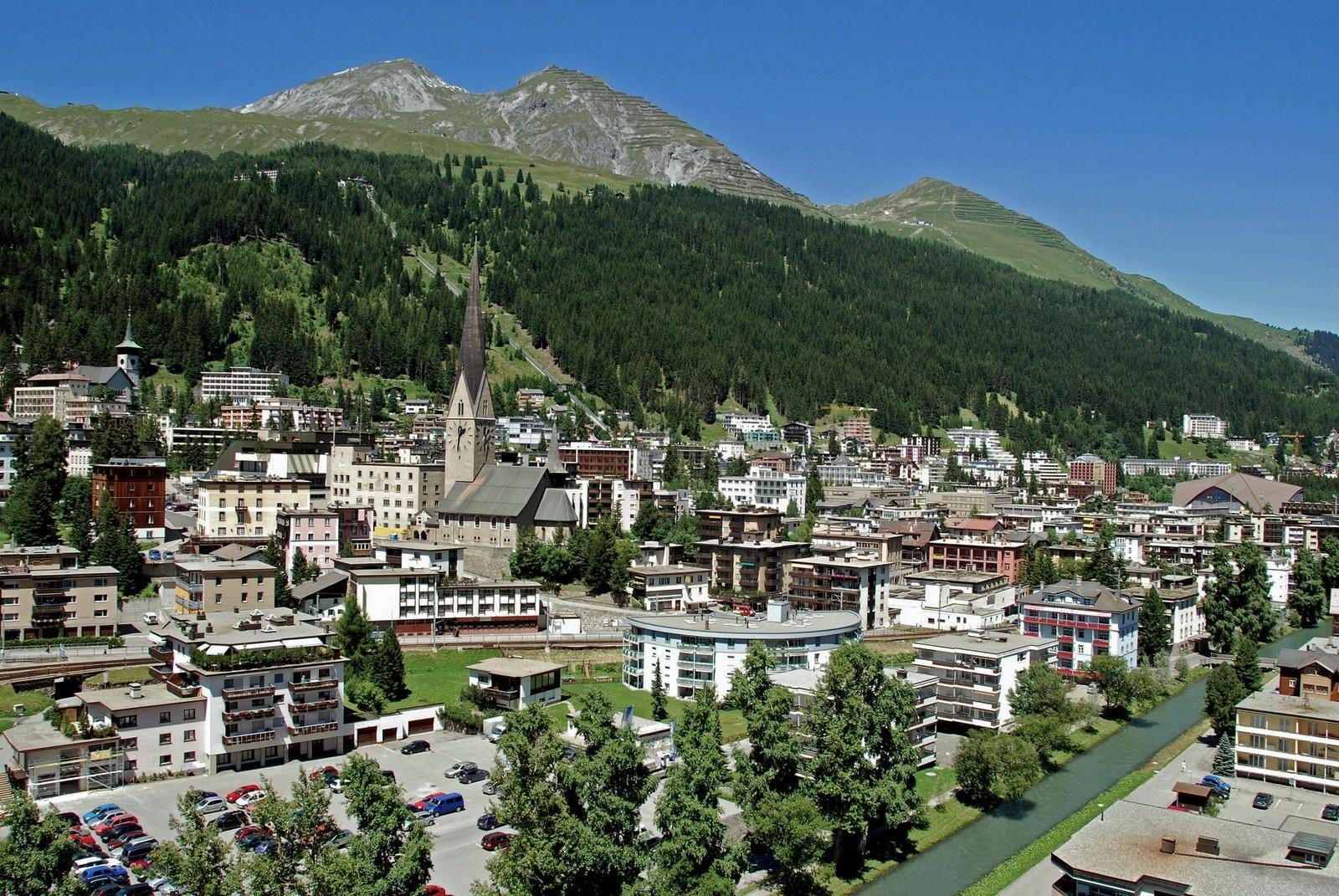
Davos Platz in summer, a town of flat-roofed blocks and a tall church spire below forested slopes and a bare mountain ridge

Graubünden, Switzerland

Davos

Davos Platz on a summer day, with the spire of the church of St. Johann. (MadGeographer / Wikimedia Commons · CC BY-SA 3.0)

A high Alpine town of about 11,000 people at 1,560 metres in the Landwasser valley of Graubünden. Settled by German-speaking Walsers in the Middle Ages, it became a world-famous tuberculosis cure resort in the 19th century, and is now a large ski area, a research centre and, each January since 1971, the meeting place of the World Economic Forum.

Neighbourhoods

  • Davos Platz
    • First-time visitors
    • Shopping
    • Close to public transport

    The south-western half of the town and its administrative centre, with the town hall, the church of St. Johann, the Kirchner Museum and the cable car to the Jakobshorn beside the railway station. The Promenade, the main shopping street, runs through it.

    Open in Maps
  • Davos Dorf
    • Close to the lifts
    • Lake walks

    The north-eastern half, joined to Platz along the Promenade, with its own station, the funicular up to Parsenn and Weissfluhjoch, and Lake Davos just beyond its edge. The two halves are about half an hour apart on foot.

    Open in Maps
  • Frauenkirch and Glaris
    • Quiet and residential
    • Village atmosphere

    Villages down the Landwasser valley south-west of the town, each with its own railway station; the Rinerhorn lift starts beside the station at Glaris.

    Open in Maps
  • Monstein and Wiesen
    • Hiking
    • Rural life

    Small villages in the lower valley towards Filisur, reached by the railway; a geology trail links them, and Monstein has a brewery claimed to be the highest in Europe.

    Open in Maps

Things to do

Museums and landmarks

  • Kirchner Museum Davosmuseum

    A museum opened in 1992 in a building by Annette Gigon and Mike Guyer, holding the world's largest collection of work by the Expressionist Ernst Ludwig Kirchner, who lived in Davos from 1918 to 1938.

    Open in Maps
  • Winter Sport Museummuseum

    A collection of old sleds, bobsleds, skis, skates and curling equipment that documents the history of winter sports.

    Open in Maps
  • Waldfriedhoflandmark

    The forest cemetery, listed as a Swiss heritage site of national significance.

    Open in Maps
  • Eisstadion Davosattraction

    The ice hockey arena of HC Davos, holding just over 7,000 people, and home every December to the Spengler Cup.

    Open in Maps

Mountains and the lake

  • Parsenn and Weissfluhjochviewpoint

    The funicular from Davos Dorf, running since 1932, climbs to Weissfluhjoch at 2,693 metres and the Parsenn ski area, which links over to Klosters.

    Open in Maps
  • Jakobshornviewpoint

    A 2,590-metre peak reached by a two-stage cable car from Davos Platz, known for snowboarding and hang-gliding, with summer walks from July to October.

    Open in Maps
  • Lake Davospark

    A small natural lake just north-east of Davos Dorf, 54 metres deep and used as a hydropower reservoir, with a swimming area and a sailing and surfing centre.

    Open in Maps
  • Sertig Valleytrail

    A side valley south of the town, ending at the small village of Sertig Dörfli at 1,861 metres, reached by road.

    Open in Maps

Short trips from the town

  • Klostersattraction

    The village 10 km north over the Wolfgang Pass, sharing its ski area with Davos and reached by the Rhaetian Railway.

    Open in Maps
  • Zügenschluchttrail

    The deep gorge at the lower end of the Davos valley, with a dramatic railway line and a mining museum at Schmelzboden.

    Open in Maps
  • Landwasser Viaductlandmark

    The curved six-arched limestone railway viaduct of 1901–02 between Schmitten and Filisur, a signature of the Rhaetian Railway's World Heritage line.

    Open in Maps

Seasonal events

  • Spengler Cup26–31 December

    An invitational ice hockey tournament first held in 1923, often called the oldest of its kind, hosted by HC Davos with European clubs and Team Canada.

  • World Economic Forum Annual MeetingJanuary

    The annual meeting of global political and business leaders, held in Davos since 1971, when the town is filled with delegates and security.

  • Davos FestivalJuly and August

    Young Artists in Concert, a festival in which young musicians from around the world play as soloists or in chamber groups at the congress centre, the Kirchner Museum and churches.

  • Davos sounds goodJuly and August

    A summer jazz festival, held alongside the davos@promenade street festival.

Eat and drink

Long-standing places and food districts in Davos. Hours, ratings and directions come from your maps app, always current.

Davos classics

  • Capunsrestaurant

    Spätzle dough with pieces of dried meat rolled in chard leaves, simmered in bouillon and milk and served under grated cheese.

    Open in Maps
  • Bündner Nusstortecafe

    The Graubünden nut tart, a shortcrust pastry filled with caramelised walnuts, sold in the town's pastry shops.

    Open in Maps
  • Monstein breweryrestaurant

    A small brewery in Monstein claimed to be the highest in Europe, offering tours and tastings.

    Open in Maps

Food districts

  • The Promenadeneighborhood

    The main shopping street running the length of the town, where most of Davos's restaurants, cafés and bars are found.

    Open in Maps

Experience Davos

History

Davos was first mentioned in 1213 as Tavaus, a name probably meaning the people of, or the land below, the ravines that overlook the town. Rhaeto-Romans settled the valley in the High Middle Ages, and from about 1280 the barons of Vaz let German-speaking Walser colonists settle with broad rights of self-government. In 1289 the people of Davos won freedom from personal taxes, and the valley became the largest Walser settlement in eastern Switzerland. In 1436 the League of the Ten Jurisdictions was founded here, one of the three leagues that later formed Graubünden.

From the mid-19th century, encouraged by the doctor Alexander Spengler, Davos became a health resort for tuberculosis patients, who came for a high-valley climate that doctors recommended for lung disease. Robert Louis Stevenson wintered here in 1880, Arthur Conan Doyle wrote about skiing in Davos in 1899, and a Davos sanatorium inspired the Berghof of Thomas Mann's The Magic Mountain. The painter Ernst Ludwig Kirchner arrived as a patient in 1917 and spent the rest of his life here. The town's natural ice also made it a centre of speed skating and figure skating.

During the Second World War, in which Switzerland stayed neutral, Davos was a centre of Nazi activity in Switzerland, with Nazi salutes and flags common in its German-led sanatoria and schools; the assassination of the Swiss Nazi leader Wilhelm Gustloff here in 1936 strained relations with Germany. In 2022 the town commissioned a study of this past. After the sanatorium era Davos became a ski resort, and since 1971 it has hosted the World Economic Forum.

Culture & Customs

Davos is a German-speaking town with deep Walser roots: long-established families still speak a dialect atypical of Graubünden and closer to that of Raron in the Valais. The municipality keeps its old institutions, with a Landammann at its head and a Grand Country Council of 17 members.

Its cultural life still reflects the cure years. The Kirchner Museum, opened in 1992 in a building by Annette Gigon and Mike Guyer, holds the world's largest collection of the painter's work, and the museum, the forest cemetery, the Grosses Jenatschhaus and the town archives are among its seven heritage sites of national significance. Writers and artists associated with the town include Stevenson, Mann and Klabund, and the artist Sophie Taeuber-Arp was born here. Each summer young musicians from around the world perform in the Davos Festival, and in July and August the Davos sounds good jazz festival and the davos@promenade street festival are held.

Sport runs through local life. HC Davos plays in the top Swiss ice hockey league, and its Spengler Cup, first played in 1923, is a fixture of the Christmas holidays. Davos has one of Europe's largest natural ice rinks, staged the only European Bandy Championship in 1913, and its research institutes, from trauma surgery to allergy, radiation and avalanche research, make it a scientific town as well.

Daily Life

About 10,800 people lived in Davos in 2020, mostly in the twin settlements of Davos Dorf and Davos Platz, with the rest spread through the villages and hamlets of a municipality covering most of the Landwasser valley. Households averaged about two people in 2014.

Davos is a regional centre as well as a resort. In 2014 about 8,900 people worked in the municipality, more than 7,600 of them in services: hotels, shops, the ski areas, clinics and research institutes such as the AO Foundation, the Swiss Institute of Allergy and Asthma Research, the World Radiation Center and the Institute for Snow and Avalanche Research.

The year has fixed peaks: the Spengler Cup at the end of December, the World Economic Forum in January, when the town fills with delegates, and the ski weeks of February and March. Summer brings walkers, cyclists and musicians, and the quieter seasons belong to residents. Buses along the Promenade and the Rhaetian Railway carry everyday traffic.

Food

Davos eats the food of Graubünden. Capuns are pieces of Spätzle dough mixed with dried meat such as Bündnerfleisch or salsiz sausage, rolled in chard leaves, boiled in a mixture of bouillon, milk and water and served under grated cheese. Capuns are made above all in the eastern part of the canton. Bündnerfleisch, also known as Bindenfleisch, Grisons meat or viande des Grisons, is meat air-dried in Graubünden, and salsiz are the canton's small dried sausages.

The Bündner Nusstorte, also called the Engadiner Nusstorte, is a shortcrust tart filled with caramelised nuts, usually walnuts; the modern filled version was invented in the 1920s and became widely available in the 1960s. It is a traditional sweet of the whole canton.

Restaurants and cafés line the Promenade, and the ski areas have mountain restaurants on their slopes. In the village of Monstein, down the valley, a small brewery describes itself as the highest in Europe and offers guided tours, tastings and classes in brewing, with beer sold direct from the brewery once a week.

Planning tools

Budget

Davos is costly in the ski season and extremely so during the World Economic Forum in January, when prices soar and rooms are scarce. The visitor card (Gästekarte) given to guests makes almost all local buses, local trains and lifts free.

Daily Budget Midrange
USD 340–650 (resort hotel, mountain restaurants, ski pass or a scenic train seat reservation)
Daily Budget Shoestring
USD 130–200 (hostel or simple guesthouse, supermarket meals, local buses and trains on the visitor card)

Avoid the Forum week unless attending it; ask for the visitor card (Gästekarte) on arrival.

Best Time to Visit

December to April for skiing on six areas and the Spengler Cup over Christmas week; the World Economic Forum fills the town in January. Summer, when the mountain lifts run, is the season for walking, mountain biking and the summer music festivals of July and August.

Suggested Number of Days

A short stay covers the town, its museums and one mountain; skiers and walkers usually stay a week, which also leaves time for the neighbouring villages, the side valleys and the scenic railways. Forum week and Christmas change the picture because rooms are hard to find.

First Visit
2–3 days
With Surroundings
5–7 days

Transportation

The town is only 3–4 km long and about 1 km wide, so local buses along the Promenade and short walks reach almost everything. The Rhaetian Railway has two main stations, Davos Dorf and Davos Platz, and several smaller ones down the valley and towards Klosters. Funiculars and cable cars start in both halves of the town.

Traffic in the centre runs one way — south-west along the Promenade and north-east along the lower Talstrasse — except for buses.

Airport & Station Connections

Zurich is the nearest airport with scheduled flights. Trains from Zurich take nearly three hours, changing at Landquart, and run hourly; by car the 160 km take about two hours. A line down the valley to Filisur joins the Albula line towards the Engadin.

Walkability

Good along the valley floor: Davos Dorf and Davos Platz are about half an hour apart on foot, mostly along the flat Promenade, and buses fill the gaps. Side streets climb steeply, and pavements are icy in winter.

Safety

Switzerland is very safe, with low crime. In Davos the risks are those of the mountains — avalanches off-piste and on ski tours, cold, and sudden weather on the passes — and the town is home to the Institute for Snow and Avalanche Research.

Check the avalanche bulletin before leaving marked pistes and keep to marked trails in bad weather. Check current official travel advice before travelling.

Climate

A subalpine climate with cool summers and long, snowy winters. About 1,050 mm of rain and snow falls in a year; August is the wettest month, and February is the driest, though it still brings plenty of snow.

Summer
cool — July averages about 12.8°C, with rain on many days
Winter
cold and snowy — January averages about −4.7°C

Local Customs

Davos is German-speaking, and long-established families still speak a Walser dialect unusual for Graubünden, closer to the German of the Upper Valais. By law a service charge is included in Swiss restaurant bills, so tipping is a personal choice. Ice hockey is followed with passion.

Greet shopkeepers on entering, keep to marked trails in the alpine meadows, and respect the quiet of the forest cemetery.

Common Payment Methods

The currency is the Swiss franc. Card payments are common and all ATMs accept foreign cards, although Switzerland is more cash-oriented than many European countries. Some places accept euro notes, but not coins, and give change in francs.