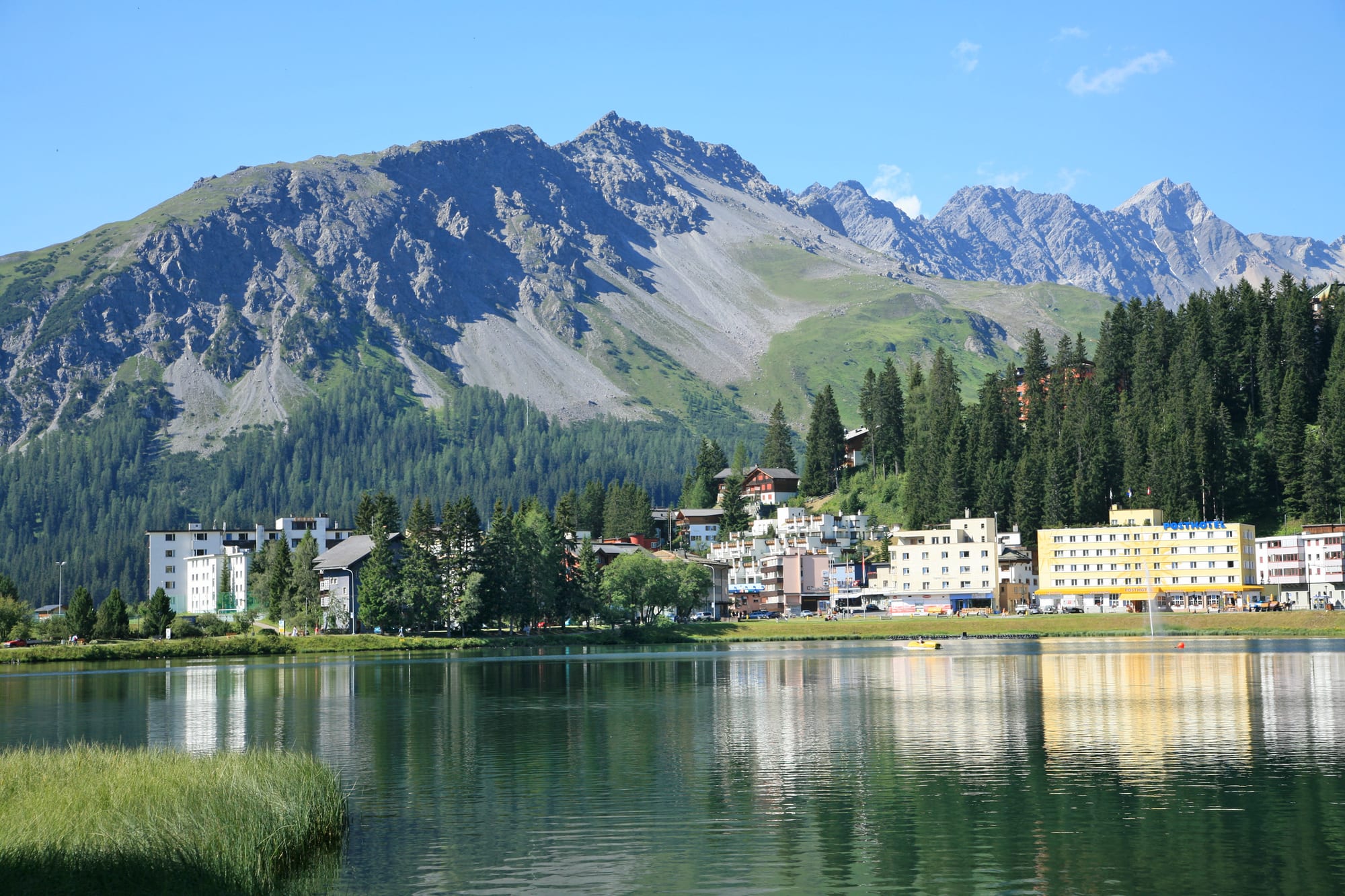
A calm green lake reflecting a row of white resort buildings, with pine forest and a grey rocky mountain ridge behind

Graubünden, Switzerland

Arosa

Arosa seen across the Obersee in summer. (W. Bulach / Wikimedia Commons · CC BY-SA 4.0)

A mountain resort at the head of the Schanfigg valley, at the end of the railway from Chur, spread around two small lakes below the Aroser Weisshorn. A Walser farming settlement turned health resort in the 1880s, it became a ski town in the 20th century and is now half of the large Arosa Lenzerheide ski area.

Neighbourhoods

  • Dorf and the Obersee
    • First-time visitors
    • Close to public transport

    The lower end of the resort around the railway station and the Obersee, the upper of Arosa's two lakes, at about 1,730 metres. The base station of the Weisshorn cable car is close to the station.

    Open in Maps
  • Innerarosa
    • Historic district
    • Ski access
    • Quiet and residential

    The upper, older part of Arosa at the end of the road from Chur, where the Bergkirchli of 1492 and the Schanfigg local history museum stand near the Carmenna chairlift. Paths lead from here onto the Tschuggen.

    Open in Maps
  • Untersee
    • Walks
    • Quiet and residential

    The district around the Untersee, the lower of the two lakes in the centre of Arosa, one of the resort's adjoining areas between about 1,690 and 1,950 metres.

    Open in Maps
  • Maran and Prätschli
    • Quiet and residential
    • Walks

    Districts on the edge of the resort. Maran was a farm of the monastery of Churwalden in 1222 and became part of Arosa in 1911.

    Open in Maps

Things to do

Mountains and the slopes

  • Arosa Lenzerheideattraction

    The ski area created in 2013–14 by linking Arosa with Lenzerheide by cable car, with about 225 kilometres of slopes and 43 lifts, the largest connected ski area in Graubünden.

    Open in Maps
  • Aroser Weisshornviewpoint

    The 2,653-metre mountain above the resort, reached by a two-stage cable car from near the railway station.

    Open in Maps
  • Hörnliviewpoint

    A summit on the resort's western boundary, served by a gondola since 1963 and once by the longest ski lift in Switzerland, opened in 1945.

    Open in Maps
  • Tschuggen squirrel pathtrail

    A walking path on the Tschuggen, Arosa's own mountain, where squirrels used to years of (forbidden) feeding by visitors will climb onto walkers.

    Open in Maps

Lakes, churches and animals

  • Oberseepark

    The upper of Arosa's two lakes, at 1,734 metres in the middle of the resort, where the first horse races on ice were held in the early 1900s.

    Open in Maps
  • Bergkirchlilandmark

    Arosa's oldest church and oldest surviving building, built in 1492 in Innerarosa.

    Open in Maps
  • Arosa Bärenlandattraction

    A bear sanctuary at about 2,000 metres, opened in 2018 by the animal welfare group Four Paws with the resort and its lift company, giving a home to bears rescued from poor conditions, watched from a viewing platform.

    Open in Maps
  • Schanfigger Heimatmuseummuseum

    The local history museum of Arosa and the Schanfigg valley, in Innerarosa.

    Open in Maps

Short trips from the resort

  • Langwieser Viaductlandmark

    The reinforced concrete railway bridge over the Plessur near Langwies, built between 1912 and 1914 for the Chur–Arosa line.

    Open in Maps
  • Chur–Arosa railwaytransit hub

    The metre-gauge line opened in 1914 that climbs the Schanfigg from the streets of Chur to Arosa's station.

    Open in Maps

Seasonal events

  • Arosa Humorfestivalearly to mid December

    An eleven-day gathering of mainly German-speaking comedians founded in 1992, the largest annual cultural event in Graubünden.

  • Arosa ClassicCarSeptember

    A race for classic racing cars on the mountain road between Langwies and the Obersee, which draws thousands of spectators.

Eat and drink

Long-standing places and food districts in Arosa. Hours, ratings and directions come from your maps app, always current.

Arosa classics

  • Poststrasseneighborhood

    A street in the resort with a wine bar and a kebab shop.

    Open in Maps
  • Rösti restaurantsrestaurant

    Rösti, potatoes sautéed or shallow-fried in a pan, is eaten all over Switzerland, often alongside fried eggs and spinach or a sausage.

    Open in Maps

On the mountain

  • Mountain restaurantsrestaurant

    Huts and restaurants in the Arosa Lenzerheide ski area, on the slopes above the resort.

    Open in Maps

Experience Arosa

History

Arosa began as high summer pasture. A farm at Maran belonging to the monastery of Churwalden is recorded in 1222, and after 1300 German-speaking Walser settlers came over from Davos and replaced the Romansh-speaking inhabitants. The Bergkirchli, the small church in Innerarosa, was built in 1492. Arosa belonged to Davos politically until it became a municipality of its own in 1851; by 1850 its population had fallen to just 56.

Then came the cure. A German doctor established Arosa as a health resort in 1883, the first sanatorium opened in 1888, and after the road from Langwies was extended to Arosa in 1890 sanatoria and hotels multiplied. Arthur Conan Doyle, wintering in Davos, crossed the mountains to Arosa on skis ordered from Norway and wrote about it in The Strand in 1894, drawing British skiers to Switzerland. From 1900 winter sport grew steadily: the road served as a bobsleigh run and the first horse races were held on the frozen Obersee. The railway from Chur opened in 1914. Erwin Schrödinger was on holiday here at Christmas 1925 when he made his breakthrough on wave mechanics, and Thomas Mann spent the first week of his Swiss exile here in 1933.

The first ski lifts were built in 1938, the Hörnli lift of 1945 was then the longest in Switzerland, and the Weisshorn cable car and the Hörnli gondola followed in 1956 and 1963. In 2013 Arosa merged with neighbouring villages of the Schanfigg, and at the end of that year a cable car linked its slopes with Lenzerheide.

Culture & Customs

Arosa's culture is a resort culture, built around the seasons. Its best-known event is the Arosa Humorfestival, founded in 1992 — eleven days of mainly German-speaking comedy in December and the largest annual cultural event in Graubünden. In September the old mountain road between Langwies and the Obersee hosts the Arosa ClassicCar race, which draws thousands of spectators.

Ice hockey has deep roots. EHC Arosa, founded in 1924, won seven Swiss championships in a row from 1951 to 1957 and two more in 1980 and 1982, and plays at the Obersee stadium. Local people born here include the 1960 Olympic ski champion Roger Staub and the ice hockey players Werner and Heini Lohrer, bronze medallists in 1948.

At the 2000 census Arosa was Protestant and Catholic in almost equal numbers, and the Bergkirchli of 1492 still stands in Innerarosa. Newer traditions centre on animals: since 2018 the Arosa Bärenland has given rescued bears a home above the resort, and on the Tschuggen squirrels tamed by years of illegal feeding climb onto walkers' shoulders.

Daily Life

Arosa had about 3,200 year-round residents at the end of 2020, counting the villages of the Schanfigg that merged into it in 2013. The resort's population swings with the seasons, rising to its peak in January and falling to its lowest in May, and a large share of residents are foreign nationals. German is the main language, with Portuguese and Italian the next most common.

Tourism is the economy: the ski area, its lifts and mountain restaurants, the hotels, shops and holiday flats. Most of the ski area lies on land owned by the citizens' community of Chur, and Chur residents are treated as locals when buying season passes, so the town and the resort are closely bound together.

The year turns on two seasons. Winter brings skiers, ice hockey and the comedy festival; summer brings walkers on the Schanfigg high trail and the Mittelbünden panoramic trail towards Lenzerheide and Davos. Between them, in spring and late autumn, the resort becomes quiet as many businesses close.

Food

Arosa eats the mountain food of Graubünden. Capuns are spätzle dough mixed with pieces of dried meat such as Bündnerfleisch or salsiz, rolled in a chard leaf, boiled in a broth of bouillon, milk and water and covered in grated cheese. Maluns, boiled and grated potatoes mixed with flour and fried slowly in butter into golden crumbs, come with apple compote.

Rösti, potatoes sautéed or shallow-fried in a pan, began as a farmers' breakfast in the canton of Bern but is now eaten all over Switzerland, often alongside fried eggs and spinach or a sausage such as cervelas. Bündnerfleisch, the air-dried meat of the canton, is the local cured meat.

For something sweet, the Bündner Nusstorte, a caramelised walnut-filled pastry invented in the 1920s, is the canton's speciality. Eating out is spread between the restaurants in the resort and the huts and restaurants of the ski area on the slopes above.

Planning tools

Budget

Arosa is a costly resort in the ski season, when lift passes and hotel rooms are the main expense, and cheaper in the quiet weeks between seasons. Supermarket food and the regional train from Chur keep a stay down; the lakes and the walking paths are free.

Daily Budget Midrange
USD 340–670 (resort hotel, mountain restaurants and a ski pass or cable car tickets)
Daily Budget Shoestring
USD 140–200 (hostel or simple guesthouse, supermarket meals, walking and the train from Chur)

Staying in Chur and taking the train up is a cheaper way to visit for a day.

Best Time to Visit

December to March for skiing on Arosa Lenzerheide and for the Humorfestival in December. Late June to September for walking, the bear sanctuary and swimming and boating on the lakes. The population falls sharply in spring, when many businesses close between seasons.

Suggested Number of Days

Two or three days give time for the lakes, the bear sanctuary and a ride up the mountains. Skiers and walkers usually stay a week, and a longer stay leaves time to explore the Lenzerheide side of the ski area.

First Visit
2–3 days
With Surroundings
4–7 days

Transportation

The resort is spread out between the station and Innerarosa, where the road from Chur ends. A two-stage cable car climbs from near the station to the Weisshorn, a chairlift starts beside the Bergkirchli in Innerarosa, and the cable car to Lenzerheide joins the two ski areas.

The road from Chur is long and winding; the train is the easier way up.

Airport & Station Connections

Arosa is at the end of the Chur–Arosa railway, which the Rhaetian Railway runs frequently from Chur station, where trains from Zurich arrive. Zurich Airport is the nearest large airport. By road, the Schanfiggerstrasse climbs from Chur to the resort.

Walkability

The centre is walkable, with paths around the lakes and through the forest, but the resort climbs steeply from the station to Innerarosa. In winter, paths and pavements can be snowy and icy.

Safety

Switzerland is very safe, with low crime. In Arosa the hazards are alpine: avalanches off-piste and on ski tours, sudden weather on the mountains, cold in winter and steep trails.

Check avalanche bulletins before going off-piste and carry proper footwear and layers. Check current official travel advice before travelling.

Climate

A mountain climate, cool all year at an altitude of around 1,700 to 1,950 metres. Winters are long and snowy, summers short and fresh, and precipitation is high.

Summer
fresh — August is the warmest month, averaging about 12°C over day and night
Winter
cold and snowy — February is the coldest month, averaging about -4°C

Local Customs

German is the main language, with Portuguese and Italian also spoken. A service charge is included in restaurant bills by law, so tipping is a personal choice rather than an obligation. Feeding the squirrels on the Tschuggen is forbidden.

Keep to the marked paths on the mountains and around the bear sanctuary, and keep noise down on Sundays.

Common Payment Methods

The currency is the Swiss franc. Switzerland is more cash-oriented than many European countries, but card payments are common, ATMs accept foreign cards, and money can be changed at train stations and most banks. Euros are widely accepted.