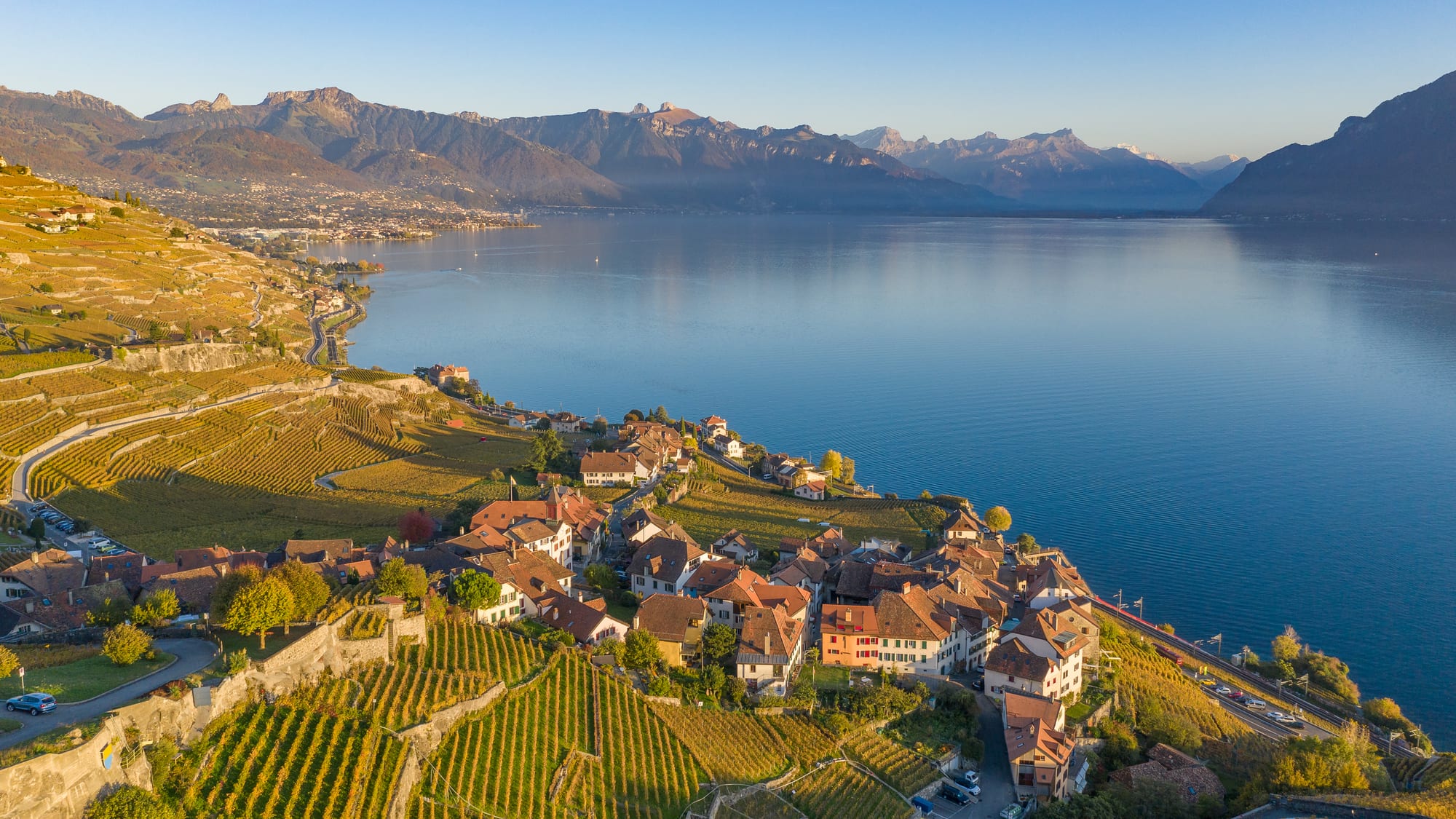
Aerial view of terraced vineyards and a lakeside village of red-roofed houses on Lake Geneva, with mountains beyond

Switzerland

Geneva, Lake Geneva & Romandy

The Lavaux vineyard terraces above Lake Geneva in the canton of Vaud, in autumn light. (Lorenz Poffet / Wikimedia Commons · CC BY-SA 4.0)

The French-speaking west of Switzerland, from international Geneva and the vineyard shores of Lake Geneva through Lausanne and Montreux to the watchmaking valleys of Neuchâtel and the pastures of Fribourg — the Suisse romande, with its own history of Calvin, the Red Cross and Bernese rule.

Explore Geneva, Lake Geneva & Romandy

History

The Helvetii were the Celtic people of this plateau, and after Julius Caesar turned them back in 58 BC the Romans made Aventicum, today's Avenches, their capital, with an amphitheatre that still stands. Burgundians settled the region in the 5th century, and the Latin speech they adopted became the French of the Suisse romande. The Dukes of Savoy held Vaud through the Middle Ages and built Chillon into their lakeside stronghold, while Geneva was ruled by its bishops.

In 1536 Bern conquered Vaud and imposed the Reformation, and Geneva, having thrown off Savoy, adopted Protestantism the same year. Under John Calvin, from 1541, Geneva became the "Protestant Rome", sheltering Huguenot refugees from France who helped build its printing and, later, watchmaking trades. A Savoyard night assault on the walls in 1602 was beaten off, the victory still celebrated as the Escalade. Fribourg, founded in 1157 by the Zähringen dukes, remained Catholic and joined the Confederation in 1481, after the defeat of Charles the Bold at nearby Murten.

Vaud became a canton in 1803, freed from Bern by the French Revolution's reach. Geneva and Neuchâtel joined in 1815, although Neuchâtel was also a principality of the King of Prussia until a republican revolution in 1848. Geneva's modern role began in 1863 with Henri Dunant's founding of the Red Cross, followed by the Geneva Conventions, the League of Nations and today's United Nations offices.

Culture & Customs

The Suisse romande speaks French with a few local words — septante and nonante for seventy and ninety, and huitante in Vaud — and a slower accent often teased by the French. Here the old Franco-Provençal dialects survive mainly in the Gruyère. Geneva, Vaud and Neuchâtel are historically Protestant; Fribourg and its Gruyère district are Catholic, and the city of Fribourg is officially bilingual, straddling the language border on the Sarine river.

Geneva's Escalade in December brings costumed processions through the old town and children smashing chocolate cauldrons filled with marzipan vegetables. Vevey's Fête des Vignerons, a winegrowers' pageant held only a few times a century, is listed as UNESCO intangible heritage. In Fribourg, the autumn Bénichon is a harvest feast of many courses, and the Désalpe brings decorated cows down from the pastures.

Lausanne is the seat of the International Olympic Committee, and its cathedral still keeps a night watchman who calls out the hours from the tower. Montreux has drawn artists since Byron and Rousseau, and hosted Freddie Mercury, whose statue stands on the quay; its Jazz Festival has run since 1967.

Daily Life

Geneva has about 205,000 people, Lausanne about 140,000, and Neuchâtel, Fribourg, La Chaux-de-Fonds and Montreux are all far smaller. Tens of thousands of commuters cross from France into Geneva every day, and around 40 percent of the canton's residents are foreign nationals.

The economy is unusually international: UN agencies and non-governmental organisations, private banks and commodity traders in Geneva; Nestlé at Vevey; Logitech near Lausanne; the universities and EPFL at Lausanne; and the CERN laboratory at Meyrin, straddling the French border. The Neuchâtel Jura and the Vallée de Joux in Vaud make much of the world's luxury watchmaking, and the Gruyère district lives from dairy farming and cheese.

Life follows a French rhythm, with long lunches and evening apéritifs by the lake, swimming at Geneva's Bains des Pâquis and sailing on the Léman in summer. The lack of affordable housing in Geneva and around Lausanne pushes many families into France or the countryside.

Food

The dairy country of Fribourg gives the region its most famous food. Gruyère, a firm cheese aged for months, and the softer Vacherin Fribourgeois combine in fondue moitié-moitié, "half-and-half". In Gruyères, meringues come with thick double cream, and the Bénichon menu includes cuchaule, a saffron brioche spread with a sweet, spiced mustard.

Vaud eats papet vaudois, a stew of leeks and potatoes with saucisson vaudois, a smoked pork sausage, and malakoffs, deep-fried cheese fritters from the villages near Nyon. Perch fillets from the lake, served with butter and chips, are the classic lakeside meal. Geneva has longeole, a pork sausage flavoured with fennel seed, and the cardon, a thistle-like vegetable baked in cream at Christmas. Neuchâtel's taillaule is a sweet brioche.

Wine is central. Chasselas, a delicate white, dominates the terraces of Lavaux, La Côte and the Neuchâtel lake shore, and Geneva is one of the country's largest wine cantons. The Val-de-Travers in Neuchâtel is the historic home of absinthe, banned in Switzerland from 1910 to 2005 and now distilled there openly again.

Attractions & Natural Wonders

Geneva spreads round the end of the lake: the Jet d'Eau fountain, the old town with St Pierre Cathedral, the Reformation Wall in the Parc des Bastions, the Palais des Nations, the International Red Cross and Red Crescent Museum, and CERN's visitor centre at Meyrin.

Along the Vaud shore, Lausanne rises from the port of Ouchy to its Gothic cathedral, with the Olympic Museum by the lake. The Lavaux vineyards, a UNESCO World Heritage Site, climb in terraces between Lausanne and Vevey through villages such as Cully, Epesses and Saint-Saphorin. Above Vevey, Corsier-sur-Vevey has Chaplin's World, the museum in Charlie Chaplin's last home, and Montreux has its lakeside promenade, with the Château de Chillon on its rock at Veytaux just beyond and the Rochers de Naye above. Nyon and Morges have castles on the western shore, and Avenches keeps its Roman amphitheatre.

Inland, Gruyères is a single cobbled street leading to its castle, with the Moléson above. Fribourg has a Gothic cathedral and a medieval old town, and Murten keeps walkable ramparts on its lake. Neuchâtel has its castle and collegiate church above Lake Neuchâtel, the largest lake entirely in Switzerland. In the Jura behind it, La Chaux-de-Fonds and Le Locle are a UNESCO site for their watchmaking town planning, and the Creux du Van is a vast semicircular cliff.

Cities in Geneva, Lake Geneva & Romandy

Planning basics

Budget

Geneva is among the costliest cities in the world, and hotels fill during big international conferences. Lausanne and Montreux are slightly cheaper, while Fribourg, Neuchâtel and the country inns of the Gruyère and Jura regions offer better value. Many hotels in Geneva, Lausanne and Montreux give guests a free local transport card.

Daily Budget Midrange
USD 320–580 (hotel, lake-fish and fondue dinners, museum tickets, a lake steamer)
Daily Budget Shoestring
USD 120–190 (hostel, bakery lunches, supermarket picnics, regional trains)

A wine-tasting walk in Lavaux or a picnic by the lake keeps costs down; Geneva's hotels are cheapest at weekends, when the business travellers leave.

Safety

The region is safe. Geneva has more petty crime than other Swiss cities, with pickpocketing and bag-snatching around Cornavin station and the Pâquis district. The lake can turn rough quickly in storms, and the Jura and Vaud Alps have the usual mountain risks of weather and steep ground.

Watch bags on Geneva's station and tram routes, and follow storm warning lights on the lake. Check current official travel advice before travelling.

Climate

Lake Geneva softens the climate: the shore between Lausanne and Montreux is one of the mildest in northern Switzerland, sheltered enough for palms and vines. Geneva is exposed to the bise, a cold, dry north-east wind that can blow for days in winter. The Neuchâtel Jura is markedly colder, with snowy winters, and La Brévine is known as the coldest inhabited place in the country.

Summer
warm, 24–30°C on the lake shore, with occasional heatwaves; cooler in the Jura and the Gruyère
Winter
cool and grey on the lake, around 0–6°C, with the bise; snow and hard frosts in the Jura

Transportation

The main line along the lake links Geneva, its airport, Lausanne, Vevey and Montreux, with frequent fast trains between Geneva and Lausanne. Lausanne has a metro, and lake steamers cross to France and call along the Vaud shore. Fribourg lies on the Lausanne–Bern line; Gruyères is reached by regional train via Bulle, and Neuchâtel by train from Lausanne, Bern or Biel, with a line climbing to La Chaux-de-Fonds.

The regional trains through Lavaux stop at the wine villages, making the terraces easy to walk one way and ride back.

Best Time to Visit

May to October for the lake, walking in Lavaux and steamer trips, with the grape harvest in late September and October and the Montreux Jazz Festival in July. Geneva's Escalade festival falls in December; winter suits the ski slopes of the Vaud Alps and cross-country skiing in the Jura.